The Arsenal Fit: Vinicius Junior
This was an enjoyable analysis to make because of the hype surrounding the link. I have calmed down since last night, but I still believe this is a signing we should pursue after last season’s achievements.
I hope you enjoy reading this as much as I enjoyed writing it!
In simple terms; Vinicius Junior optimises the whole Arsenal team and creates a real problem for opponents.
His generational talent and elite individual ability would completely change the dynamics of our frontline. Opponents would have to double up on both him and Saka, allowing the rest of the pitch and the players operating centrally to have a lot more space. It would allow us to pin teams in even more because they would be forced to defend so negatively against two World Class wingers.
For years, opposing defensive lines have favoured defending Saka's side because Arsenal have not had a player on the left who reaches his level or demands the same attention. This has become even tougher as Odegaard now drops deeper and Saka has become more of a ball-to-feet player. That can continue, but he would have so much more space because of Vini. There would finally be another elite technical beast on the opposite flank.
How Vini improves the rest of the team
If opponents double up on Vini, Saka can receive with far more freedom and vice versa. Further, if the opp protects both sides, more space opens up centrally for Bruno G, Odegaard and Gyok. There isn’t really a clean solution for opponents.
The left half space (LHS) combinations with Calafiori and Bruno G could be excellent. Vini’s elite separation and body manipulation mean he can beat almost every defender over a yard. Calafiori occupying the LHS forces the RB, RCB and opposition midfielder into difficult decisions.
A brief explanation:
- If the RB stays attached to Vini, Calafiori underlaps
- If the RB follows Calafiori, Vini is isolated
- If the RCB moves across, Gyokeres receives more room centrally.
That could be especially valuable because VG’s separation inside crowded areas is not his best quality. He normally has both CBs occupied, but Vini would stop them from focusing completely on him.
This would give Viktor more room to shoot and attack cutbacks and low crosses. Vini is exceptional at this as he can beat the RB outside and play left-footed deliveries across the box, while Gyokeres is a brilliant one-touch finisher.
The transitional threat alongside Gyokeres and Saka would also give Arsenal a completely different approach after turnovers.
Why Arteta’s system suits him
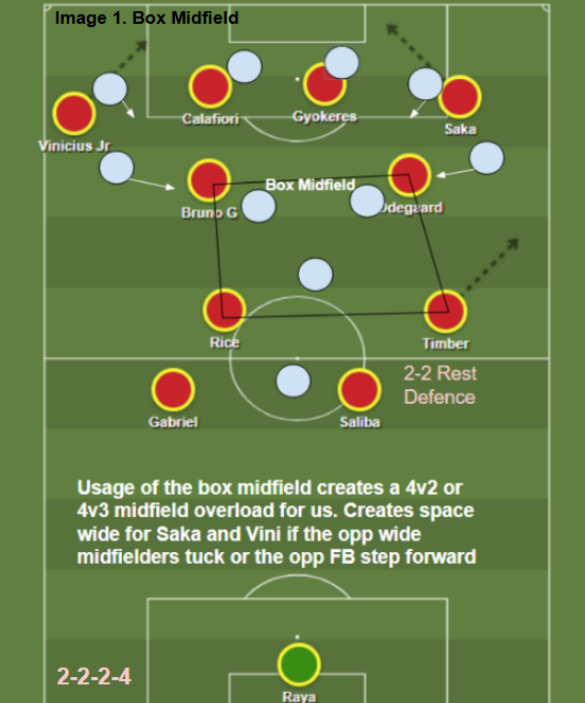
Arsenal's box midfield creates a huge problem when you add Vini. Rice and Timber form the bottom of the box, with Bruno G and Odegaard higher in the half space channels. Against an opposing two or three man midfield, Arsenal create a clear central overload that allows one of Bruno or Odegaard to receive vertical progressive passes.
Refer to Image 1
It gives Vini freedom to either remain wide, attack the channel, move into the LHS or wait before making an explosive run. With Odegaard's circulation and Bruno's progressive passing, Arsenal can attract pressure to one side before switching quickly.
Bruno G’s importance to the left hand combo, he ranks in the:
- 89th percentile for progressive passes
- 93rd percentile for forward passes
- 91st percentile for passes into the final third
Imagine this with Vini as the receiver. We saw this on occasion for Brazil this World Cup. Bruno can find him early before the block is organised, play vertically into the LHS or release him in behind with Vini's elite channel running.
Another important note:
Rice’s role would turn more conservative and would see him and Timber provide the rest defence behind Ode and Bruno G. With Saliba and Gabi, they create a structured and secure 2-2 base. Timber and Rice may have to sacrifice some attacking freedom and intent but the trade-off is worth it IMO.
Refer to Image 1
Vini’s individual dribbling and carrying profile
Vini is an elite take-on and separation dribbler who uses his low centre of gravity, agility and balance to attack defenders on their unbalanced side. His acceleration and deceleration force defenders to open their hips and break their momentum.
He can operate from the touchline or as an inside forward in the LHS. When he starts wide, he pins the RB and uses the touchline as his launch pad. He can take a player on while receiving statically or with momentum. His acceleration is insane. He can go from 0 to 100 in two or three steps, and barely any RB has the body dynamism to cope repeatedly.
Maybe Timber, but luckily we already have him.
If the opp RB covers inside, Vini can accelerate outside and play a dangerous left footed cutback. If the RB covers wide and protects the byline, Vini can shift onto his right foot and attack the LHS. When he moves inside (either off-the-ball or whilst dribbling) he becomes a direct goal and creative threat, using his balance and body manipulation to create separation before shooting or combining with killer through balls
Further, The numbers support the eye test. He ranked in the 100th percentile among La Liga left wingers for creating his own shots and progressive carries, as well as the 88th percentile for successful dribbles and 77th percentile for carries into the final third (per-90 streamlit app).
His 44.6% domestic dribble success rate needs context. Vini is a high rep dribbler who does not protect his percentage through safe attempts. He will lose possession, but he will continue attacking the RB. It is tunnel vision in all the right ways. His dispossessions increased from 1.40 per 90 in La Liga to 1.77 in the UCL, showing the retention cost attached to his style.
As mentioned in my prior post, his physical data also surprised me. In La Liga, he won 6.28 duels per 90 with a 48.9% success rate, ranking in the 71st and 88th percentiles. He clearly does not shy away from contact, while his balance allows him to absorb challenges. He also won 2.58 fouls per 90, ranking in the 93rd percentile. Crucial for our abilities from set-pieces and winning penalties.
His UCL numbers dropped against stronger opposition: 2.08 dribbles and 4.69 duels won per 90. That may suggest a minor adjustment to Premier League physicality, although he still ranked in the 93rd percentile for dribbles and 83rd for fouls won (2.08 per 90).
Shooting and Big Chance Data
Across La Liga and the UCL, Vini scored 21 goals from 21.74 xG, including 5 penalties. His overall and non-penalty output were almost exactly in line with expectation, with 16 non-penalty goals from approximately 16.21 npxG.
He attempted 157 shots, averaging 3.54 per 90. 66 hit the target, giving him a 42% SOT rate, while his overall goal conversion rate was 13.4%. Nearly 74% of his shots came from inside the box where scored 19/116 attempts. Despite being capable of spectacular goals, he is mainly a repetitive box focused shooter.
There was a clear contrast between the domestic and continental numbers. In La Liga, he scored 16 goals from 13.65 xG, had a 46% SOT rate and a 16% goal conversion rate. In the UCL, he scored 5 from 8.09 xG, a massive -3.09xG goal underperformance. His SOT rate dropped to 36% and his goal conversion rate to 9%, despite his shot volume increasing from 3.22 per 90 (La Liga) to 4.31 in the UCL.
The biggest concern I found in my research was his big chance conversion. Vini scored just 9 of 28 big chances across both competitions, including only 4 of 21 non-penalty opportunities worth 8.47 xG. Really poor IMO, especially for a player of his ability. However, his xGOT data adds context: when he hit the target, his placement was generally strong and several high-quality efforts were saved. The issue is therefore consistency rather than a lack of elite finishing ability. His accuracy was excellent in La Liga, where 16 of 17 big chances hit the target, but dropped significantly in the UCL (4/11).
Creativity and Transitions
Vini is not only an elite dribbler and goalscorer. In La Liga, he recorded 5 assists from 5.6 xA (97th percentile) and averaged 2.23 key passes per 90 (96th percentile). His crossing numbers are not amazing at 0.29 successful crosses per 90 with 14.8% accuracy, but he is not a traditional touchline/inverted crosser.
What we could see: His creativity comes from separation followed by a decisive action: a cutback, combination with a CF or pass into FB’s under/over lap. Vini's individual ability creates the opportunity.
He was even more creative in the UCL, recording 5 assists from 3.39 xA and 8 big chances created in only 1,170 minutes, compared with 7 in 2,825 La Liga minutes. He was more of a creator continentally and more of a direct goal threat domestically. A trend we could see at the Emirates
He recorded a top speed of 34.4 km/h in the UCL, ranking in the 96th percentile, alongside 17 sprints per 90 in the 87th percentile. However, he covered only 9.6 km per 90, ranking in the 6th percentile, whilst his walking distance ranked in the 98th percentile.
In basic terms, he walks a lot and conserves energy before exploding. Some people may view that as laziness (which is understandable), but it is what makes him so dangerous. Keeping him high and wide gives Arsenal a key outlet and prevents the opposition rest defence from fully committing. Long switches and diagonals in behind become a lethal direct opportunity too.
The OOP trade-off
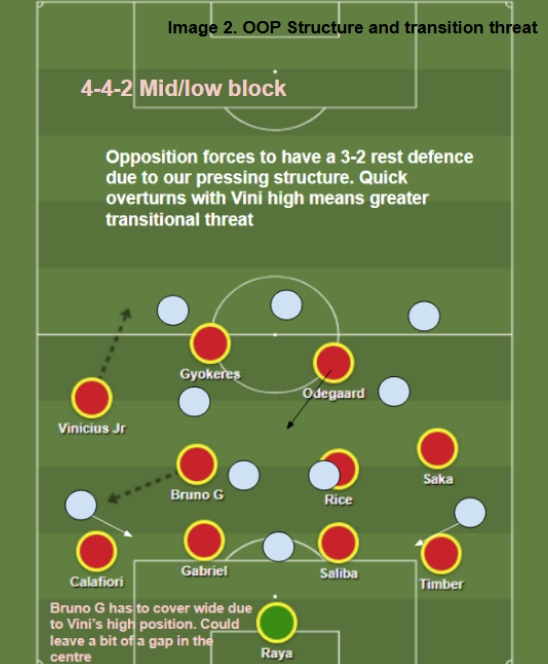
The pressing structure would be slightly different to what we see now. Arteta normally prefers Ode to lead the press alongside the striker, which would leave Vini as the LM in a 4-4-2 mid or low block. He is a strong counter-presser when he wants to be, but he is not tactically disciplined and often does what he wants defensively. Understandable IMO, it sometimes comes with the ego of such a talented player.
Refer to Image 2.
His 1.02 defensive contributions per 90 in La Liga ranked in the 10th percentile, before dropping to 0.46 per 90 (4th percentile) in the UCL. His mindset is to attack. However, he is capable when he engages, averaging 0.92 tackles per 90 with respectable recovery and final-third ball-winning numbers (0.71). The issue is volume and willingness rather than ability. His walking data I mentioned earlier contributes to this issue.
There is also some impatience and aggression. He committed 1.21 fouls per 90, collected 8 La Liga yellows and another 2 in the UCL. Odegaard may have to relax slightly with his pressing triggers, while Rice, Timber, Saliba and Gabriel provide the defensive profiles required to cover the spaces Vini leaves. Bruno G would also have a big role in low/mid block defending.
The minimal defensive effort is made up for by his unbelievable attacking quality.
Final Verdict:
Vini is my ideal winger because of his classic inverted-winger archetype. He can hold the touchline, operate inside the LHS, attack in behind, create his own shot and combine with Calafiori or Gyokeres. Most importantly, his presence improves everyone around him and gives Arsenal a genuine symmetrical threat alongside Saka.
His big chance conversion, UCL finishing and defensive involvement are concerns, but none change my overall view. Arsenal have needed a powerful 1v1 dribbler on the left for years. Vini is not simply another player who fits that profile; he is the best version of it.
This would not only solve the LW problem. It would change how opponents are forced to defend Arsenal.
I think we can get him and I really hope we do.
Do you think Vinicius is the final attacking piece Arsenal need, or are the defensive and financial trade-offs too significant?
How would you structure the left side around Vini, Calafiori, Bruno G and Gyokeres?
#COYG #ViniciusJunior #Arsenal #RealMadrid
Ps. This is not considering the financial package and is just discussing his stylistic fit. I do not think affordability would be the main issue. The bigger question is whether the hierarchy is willing to break Arsenal’s wage structure and transfer record. Also conditional analysis if we sign Bruno G but I think we will definitely get that done
Thank you for reading!
Just my 2 cents of what I’ve been thinking about lately…
I could one day see companies eventually sponsoring Tesla Robotaxi rides, which could quietly create an entirely new business for Tesla.
Imagine opening the Tesla app and seeing a sponsored ride from a company like McDonald’s, Nike, Apple, Coca-Cola, or Netflix. A brand could cover part, or even all, of your fare in exchange for getting its name/products in front of riders.
Everyone wins in this situation.
Riders pay less, brands get customers through the door, and Tesla creates another high-margin revenue stream on top of the ride itself.
Companies could also sponsor themed Cybercabs with custom wraps, offer exclusive discounts during the ride, or reward loyalty members with ride credits. For example, a restaurant could offer a free ride home after dinner. A retailer could sponsor rides to a shopping center during the holidays. Events, concerts, and sports teams could cover transportation for fans.
And since Tesla controls the vehicles, the software, and the app, it can tie the entire experience together in a way traditional ride-hailing companies simply can’t.
The awesome thing is that this will not require Tesla to reinvent anything… once the Robotaxi network reaches meaningful scale, adding sponsorships would mostly be a software and business development opportunity. It could help lower ride prices, increase demand, keep vehicles busier, and generate additional high-margin revenue with relatively little added $ cost.
Tesla hasn’t announced anything like this, so it’s just an idea today.
But it feels like one of those obvious opportunities that becomes much more valuable as the Robotaxi network grows into the millions. The autonomous transportation business alone is super exciting, but if Tesla can layer advertising and brand partnerships on top, it could unlock another meaningful revenue stream that many investors are probably not thinking about today.
Everyone is piling on to @garyseconomics - his wealth tax documentary has bombed. Even the Guardian has given it a 2-star review and watched in horror as experts and onlookers alike call his ideas a car wreck.
It’s disappointing that he stuck to the same scripted lines that he said to me over a year ago. I raised the core issues with him back then and he did nothing to evolve his thinking.
Now with all of that said, I want to urge that we don’t throw the baby out with the bathwater. Wealth Taxes won’t work but that doesn’t mean we can’t look for ways to improve things for people who are struggling.
Gary’s popularity stems from a real issue. Millions of people see no way of keeping up with the costs of living. For millions of people in the UK their living standards are getting worse year on year and it needs to be addressed.
Here’s my thinking:
THE CAUSE:
- technology is devaluing jobs by making them easy to automate, outsource or simplify.
- we’ve had an un-targeted immigration policy that has flooded the UK labour market with millions of additional low skilled workers who compete with local entry-level workers.
- we have a UK government that has exploded debt and spending. Government spending that doesn’t result in productivity gains creates inflation.
- We have massive global businesses who do business in the UK but don’t contribute anything in tax revenue. They put local retailers, code shops and publishers out of business and move their profits to low tax zones.
SOLUTIONS TO EXPLORE:
- Special economic zones that offer lower taxes for small businesses that set up in parts of the country that need economic activity.
- Broadcast licenses for social media giants.
- IP licensing taxes for companies that take the piss with profit shifting.
- Lower taxes for startups. Reinstate the Entrepreneurs Relief. Expand SEIS/EIS.
- Allow home based businesses to claim childcare, cleaners, company car etc so they can run a better business.
- Allow tax deductions for home renovations (other countries have seen massive stimulus from this).
- Set up a British Sovereign wealth fund using oil and gas reserves.
- Reduce regulations and get builders building homes.
- Full support for the British farmers who create jobs and provide domestic food security.
- Entrepreneurial apprenticeships.
- Financial literacy and business skills taught in schools.
What would you add to the list?
A Model Y driver started experiencing a medical emergency with chest pain mid-drive & called his son.
His son then remotely rerouted the car – which had FSD Supervised enabled – to the nearest hospital & let them know the vehicle was en route. ER staff were standing by on arrival.
Doctors later confirmed the quick reroute likely saved his life.
Arsenal: PL Report 25/26
I worked on a team report alongside that Garner report.
Since this has taken a lot out of me, my brain needs a reset. I can't be touching anything data related for a while (except for my job🙁)
PDF here in case you prefer it:
https://t.co/FT2RQ5JwSO