Introducing LSE Terminal, an open source agentic AI IDE for quantitative finance. Market data is integrated via LSE Data directly into the platform.
We created Veron, our AI agent trained with native visual understanding of the terminal. Veron can interpret what is happening on screen and directly access the terminal’s quantitative functions, making it the first agent of its class built specifically for quantitative finance.
Brokerage connectivity runs through Brue, our adapter layer for standardising external broker integrations.
@Londonstrategic created an amazing open-source trading terminal. It’s still early, and the open-source approach gives us plenty of room to experiment and ship additions faster through a fork.
I’ve been building on it with:
• Portfolio backtesting across multiple strategies and instruments
• Detailed backtest view with saved backtests you can reopen after restarting
• Clearer strategy vs. buy-and-hold comparisons
• More detailed reports and trade exports
• Monte Carlo simulations and walk-forward testing to explore robustness
• ATR and Linda Raschke strategy ports with instrument-aware contract calculations (as part of repository)
Huge credit to LSE for creating the foundation and making it open source.
Code + Windows/Mac releases:
https://t.co/Cbd1CPSQDb
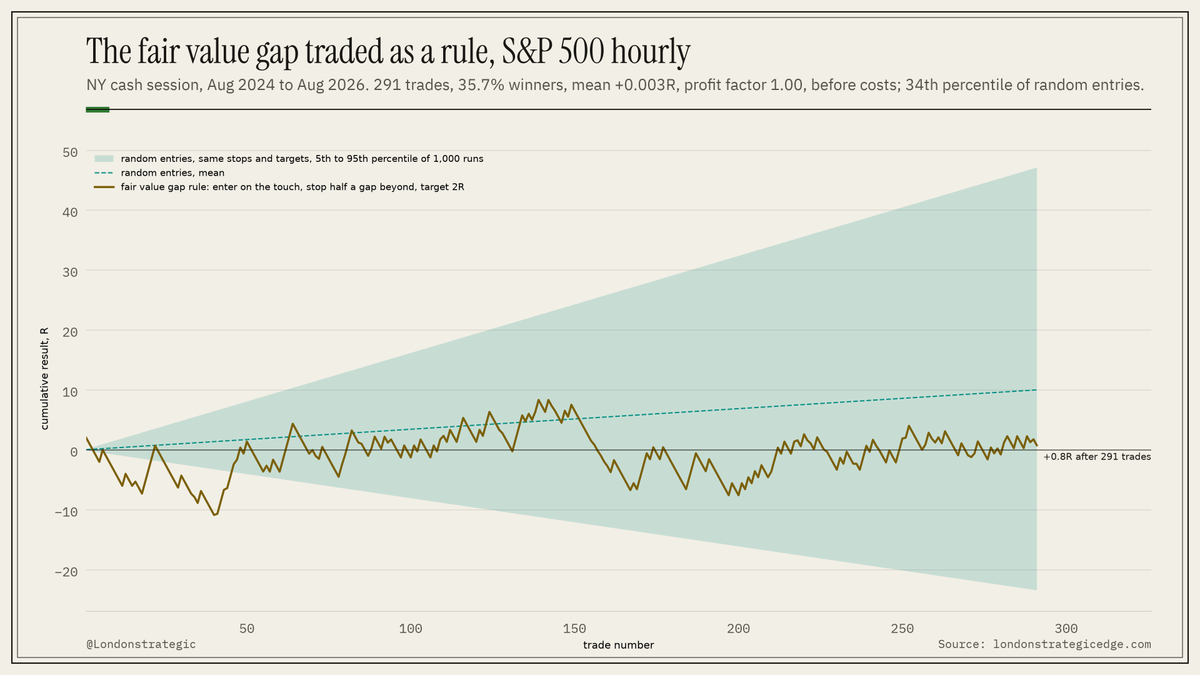
Traded as a rule, since a fill rate on its own settles nothing: buy the first touch, stop half a gap past the far edge, target twice the risk, out after 20 bars.
291 trades on S&P 500 hourly bars since August 2024. Profit factor 1.00. Random entries with the same stops and targets did better in 66 runs of 100.
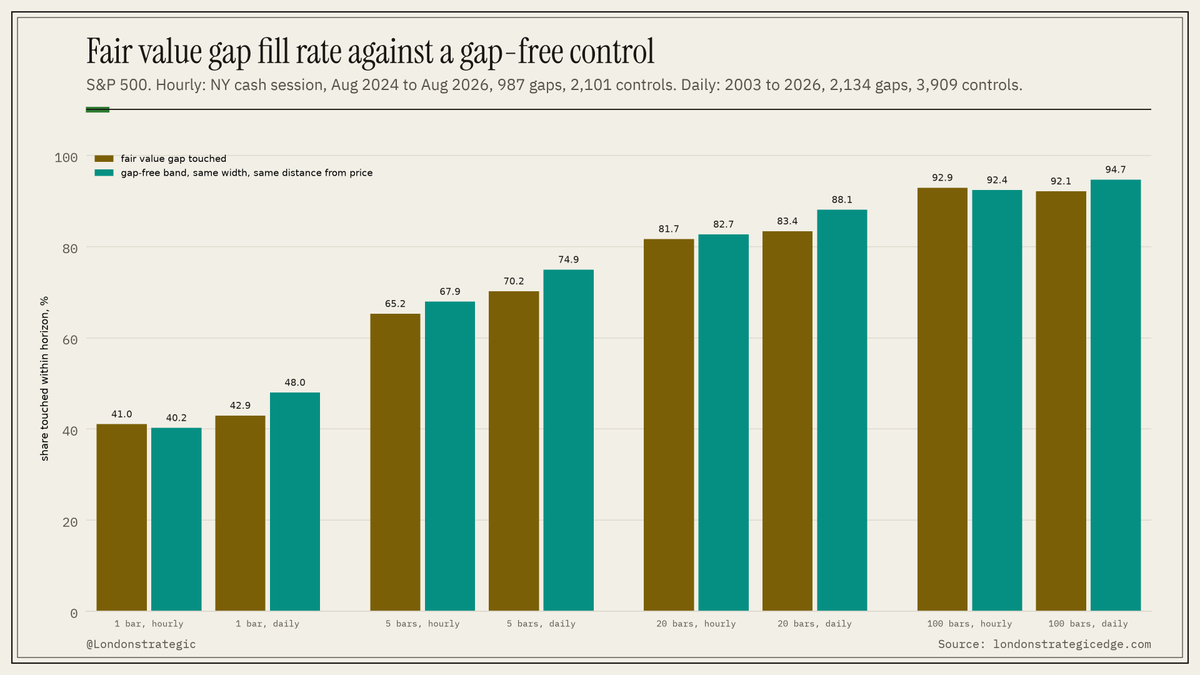
Method: bullish gap at bar t when the high of bar t-2 sits below the low of bar t, bearish when the low of t-2 sits above the high of t; a touch is any later bar whose range overlaps the gap. Control: in every three-bar window with no gap, a band of the median gap width (0.16% of price hourly, 0.43% daily) placed at the median gap distance from the bar-3 close (0.15% and 0.47%) on the side a pull-back would reach. Hourly bars are the New York cash session only. Data: https://t.co/mfCkozIYDq
Fair value gaps fill 82% of the time. So does any box that size.
987 gaps on S&P 500 hourly bars, then 2,101 boxes of the same size at the same distance from price with no gap.
Filled within 20 bars: 81.7%. Boxes with no gap: 82.7%.
Price comes back to everything.
@MarketBubble 6. Shit my strategy had no empirical edge, i've lost all my money
7. Wait I can just sell a course and make content encouraging more people to lose money