Have:
25 $ETH (today's cost: $45k) or
2 $BTC (today's cost: $130k )
You can be a millionaire by 2030 (Source from Stand Charterd Research )
In 4 years time
"making everything work on top of 'slow oracles' (ie., the type that prediction markets use)"
Vitalik wants "slow oracles" to build DeFi rather than regulated Oracles and liquidations.
Now you know where $TRUE will go
@MikeIppolito_ Vitalik does, in fact, say stuff like that.
His vision just includes a synthetic asset model that tracks the underlying so it doesn’t require centralized issuers!
Ya estaba bastante bullish con $DRV de @DeriveXYZ, pero atentos al anuncio de hoy sobre las opciones de $Nvidia. 👀
Os voy intentar explicar por qué me parece tan interesante.
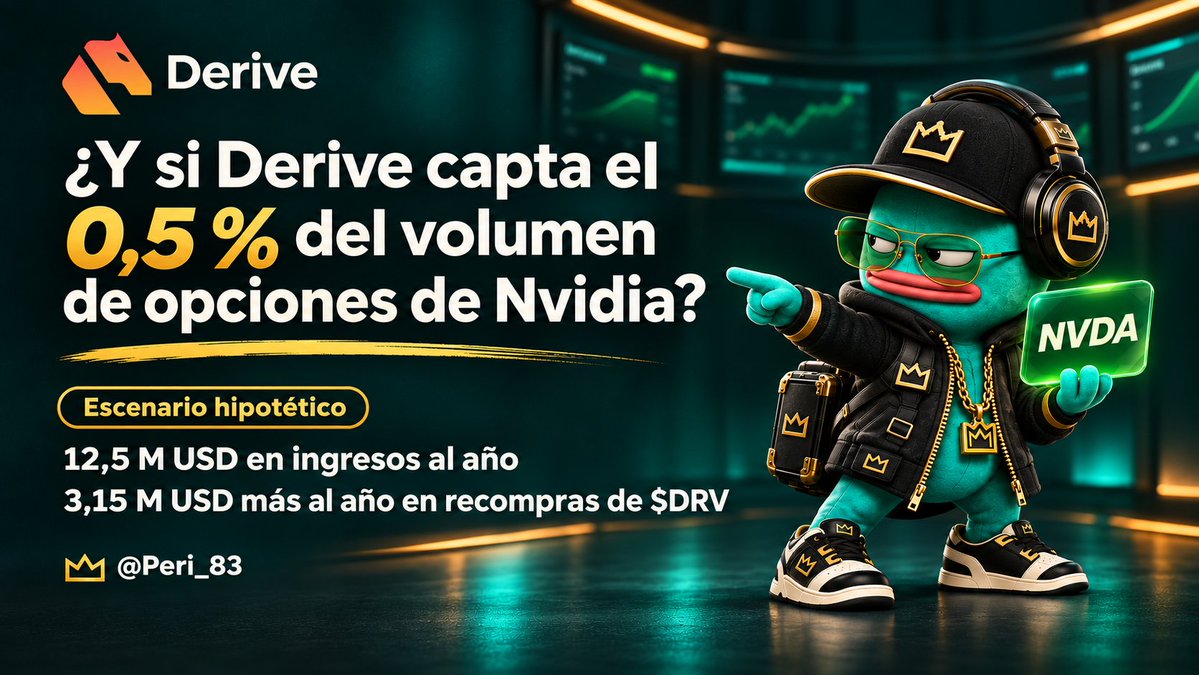
¿Qué pasaría si Derive consiguiese captar solamente el 0,5 % del volumen de las opciones de Nvidia?
Para que os hagáis una idea, en 2025 se negociaron unos 6,3 billones de dólares en opciones de Nvidia entre Nasdaq y Cboe, 2 de los principales mercados de opciones de EEUU.
Este mundo de las opciones es jodido de explicar pero digamos que las opciones son contratos que permiten apostar por las subidas o bajadas de un activo sin tener que comprar directamente sus acciones.
Pues bien, captar solo el 0,5 % de ese mercado supondría unos 31,500 millones de dólares de volumen al año. Y estamos hablando únicamente de Nvidia.
Ahora vamos con los números de Derive. Según su panel del 16 de noviembre, el protocolo acumula:
$46,370 Millones de volumen negociado.
$11,47 Millones en comisiones generadas.
5,64 millones de operaciones.
27k de traders únicos.
$151 Millones de volumen en las últimas 24 horas.
3,570 Millones en posiciones abiertas.
Es decir, Derive ya tiene actividad real. No estamos hablando de un proyecto que todavía tenga que demostrar que alguien utiliza su plataforma. ¿Y cuánto dinero podría generar Nvidia?
Haciendo números y suponiendo que Derive consigue ese 0,5 % del mercado:
El negocio actual podría generar unos 6,2 M$ anuales si mantiene el ritmo de los últimos 30 días. Nvidia podría aportar otros $6,3 Millones anuales de ingresos, aplicando la misma tasa de comisiones a la que ha mantenido Derive hasta ahora. Estaríamos hablando de unos $12,5 Millones al año entre el negocio actual y Nvidia. Ojo, son pajas mentales como dice mi mujer pero con una cierta posibilidad, no ingresos garantizados.
Y aquí viene lo que más me interesa como holder de $DRV: las recompras. La DAO de Derive utiliza el 50 % de las comisiones que entran en su programa de recompras. Si los ingresos adicionales de Nvidia entrasen íntegramente en ese programa, podríamos estar hablando de unos $3,15 Millones adicionales al año en recompras.
Para ponerlo en contexto, desde que comenzó el programa ya se han destinado aproximadamente $1,9 Millones a recomprar 29,09 millones de $DRV. Imaginad lo que supondría aumentar esas compras de forma recurrente. Pero mi tesis no se queda solamente en Nvidia.
Hay otra cosa que me parece muy importante y de la que se habla bastante menos. Derive ya cuenta con una integración con Porto, la wallet institucional de Anchorage Digital.
¿Y esto qué significa?
Que fondos de inversión y empresas que gestionan grandes cantidades de capital tienen una vía para operar opciones en Derive utilizando herramientas de seguridad y autocustodia pensadas para instituciones.
Esto no significa que mañana vayan a entrar millones de dólares, pero sí facilita que ese tipo de clientes puedan utilizar el protocolo. Y aquí es donde veo el verdadero potencial. Si Derive consigue atraer volumen de Nvidia, mantener una buena liquidez y después ampliar su oferta a otras acciones e índices, el mercado al que podría dirigirse sería muchísimo mayor.
Más volumen puede significar más comisiones y, si esas comisiones entran en el programa, más recompras de $DRV.
Esa es mi tesis. No estoy diciendo que Derive vaya a captar ese 0,5 % ni que el precio de $DRV tenga que subir. Lo que quiero ver es si consiguen atraer traders, mantenerlos y convertir ese volumen en ingresos recurrentes. Porque si lo consiguen con Nvidia y después lo repiten con otros activos, creo que podríamos estar ante algo bastante interesante.
Yo voy a seguir muy de cerca sus métricas y las recompras semanales.
NFA / DYOR.
P.D- Perdonar si veis alguna errata en las métricas pero creo que las apunte bien 🫶
My guess is the admin realizes the China hawks went too far and there are now discussions of bringing him back, cowed and equipped with a new China policy
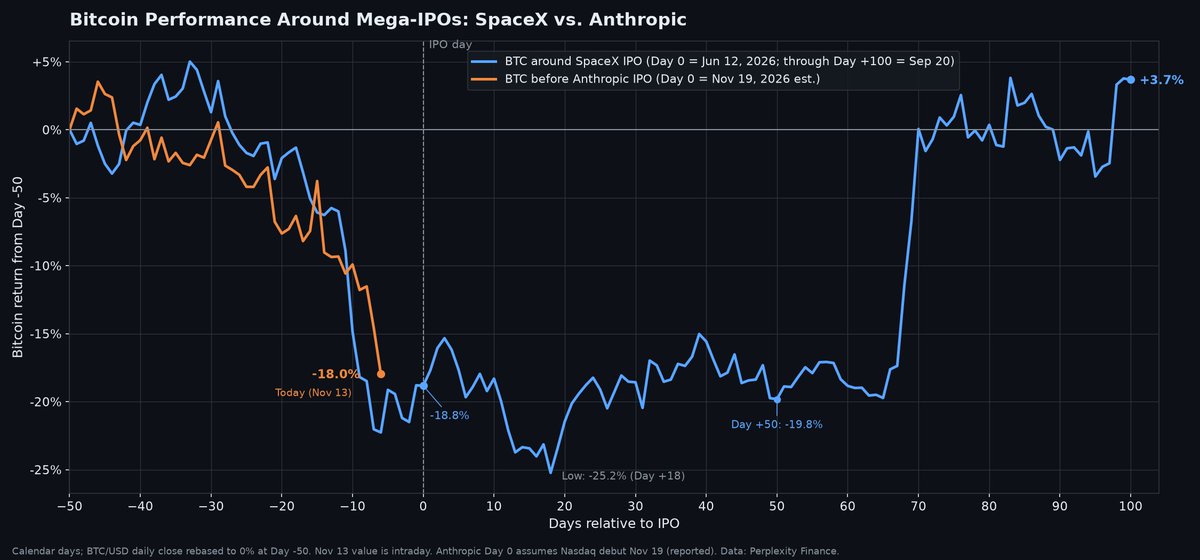
Bitcoin fell 19% into the biggest IPO ever. Now it's down 18% heading into the second biggest.
SpaceX raised $75B when it went public on June 12. In the 50 days before it listed, Bitcoin dropped 19%. Anthropic plans to raise up to $64B when it lists next week, and Bitcoin is down 18% over the same stretch. Overlay the two and they look almost the same.
What happened after the SpaceX IPO is the notable part. Bitcoin bottomed 18 days after the listing, then recovered all the way. By Day 100, it was above where it started.
Bitcoin around the SpaceX IPO:
Day -50 to IPO day: -19%
Low (Day +18): -25%
Day +50: still -20%
Around Day +70: a sharp rally
Day +100: +3.7%
From the IPO-day close to Day +100, Bitcoin gained 28%. From the low, it gained 39%.
The takeaway is that the selling came in the run-up to the listing. The bottom had effectively happened by the IPO, and the recovery came relatively shortly after, and it came all at once.
If Anthropic follows the same pattern, most of the drawdown is behind us, and it could reverse quickly over the next couple of months. And Bitcoin is sitting right at its 200-week moving average.
Map the SpaceX path onto today's price and you get roughly $90k by late February. Markets rarely follow a comparison like this exactly. But we remain very constructive on both the technicals and the fundamentals heading into 2027, and it's not hard to imagine what the narrative would be if anything close to this plays out.
@TheNotoriousSKi Kalshi and Polymarket US were the product of highly a partisan admin with vested interests in those companies. An unnatural arrangement.
The natural state is offshore prediction markets. And the end state is highly decentralized prediction markets.
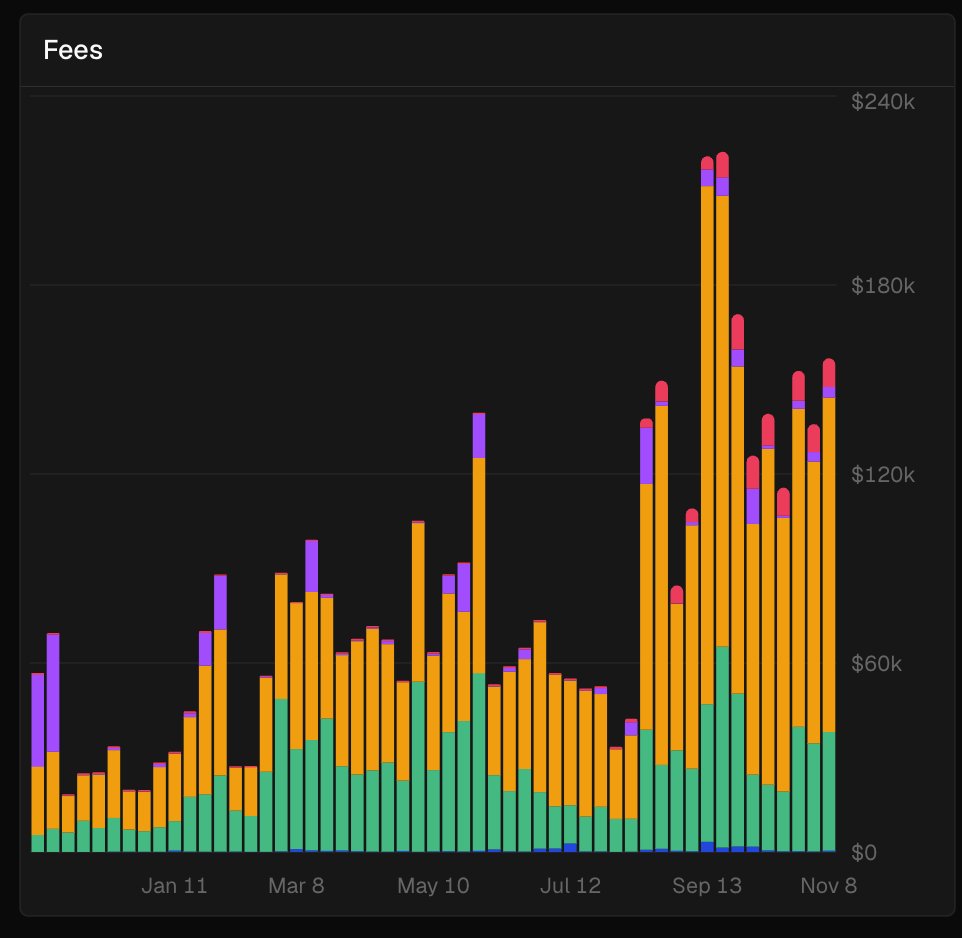
Derive is tracking for our 3rd biggest week of fees in the last year - crazy that a year ago we were putting up $20k in fees a week and now we are regularly hitting 30-40k per day.
Taker base has diversified significantly in the last two months, both in terms of assets traded (BTC, ETH, HYPE, ZEC, SOL) and unique users. Retention numbers have also been very encouraging.
Derive's maker base has also expanded dramatically post v3 with the dramatically simpler onboarding flow and upswing in taker activity.
Further, we are now closing in on a few critical integrations going live that have been months/years in the making, and the quality and breadth of assets you can trade on Derive are about to see another step change.
We continue to welcome all the feedback you can give us. Have a great weekend everybody.