Fantastic news! Congratulations to my colleague and longtime collaborator Whitney K. Newey on being awarded the 2026 Erwin Plein Nemmers Prize in Economics. Well-deserved recognition for his foundations contributions to econometrics. 🎉
Congratulations to Hong Wang of on winning the 2026 New Horizons in Mathematics Prize for work in harmonic analysis, partial differential equations, and geometric measure theory, including the local smoothing conjecture, Furstenberg set conjecture, and the Kakeya conjecture. https://t.co/awmRtAWxGl @Institut_IHES@NYU_Courant
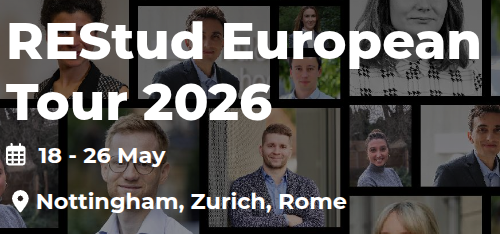
📢📢We now know the Tourists and Hosts for the 2026 REStud European Tour!📢📢
The REStud European Tour recognizes the most promising graduating doctoral students in economics and finance and introduces them and their research to audiences in Europe.
Let's Meet the Hosts and the Tourists in this thread!
1/16
Woe to those who manipulate religion and the very name of God for their own military, economic, and political gain, dragging that which is sacred into darkness and filth. #ApostolicJourney#Cameroon https://t.co/bKteFZ3iWE
Those who pray are aware of their own limitations; they do not kill or threaten with death. Instead, death enslaves those who have turned their backs on the living God, turning themselves and their own power into a mute, blind and deaf idol (Ps 115:4–8), to which they sacrifice every value, demanding that the whole world bend its knee. Enough of the idolatry of self and money! Enough of the display of power! Enough of war! True strength is shown in serving life. #Peace
🧵
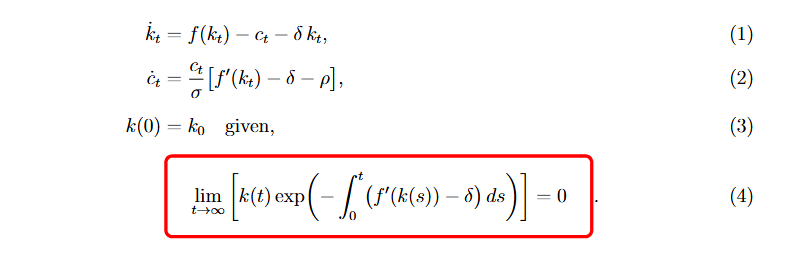
1/) Thanks to my fantastic co-author for posting this. Let me elaborate on one of the challenges Jesús mentions in his post.
After grad school in (theoretical-ish) physics, I switched to economics. The first thing in macro that puzzled me was the Ramsey–Cass–Koopmans model.
Here at [famous scientist’s name].ai, we’re developing tools to accelerate science. Unlike academia, which has stifled the production of high quality scientific work by demanding it be correct, here at [fsn].ai, we know that you can just do (wrong) things.
🚨Registrations to become a GAIN mentor are now open!
GAIN mentors are assigned to help guide a mentee one-on-one through the entire graduate application cycle in economics or related fields.
➡️Register here: https://t.co/sflp2jF7u2
🗓️Deadline: April 30th
@CesarChavezP29 Interesting post: There were more independent discoveries, eg There were even more versions of LATE, e.g., in 1997, Cuzick, Jack, Robert Edwards, and Nereo Segnan. "Adjusting for non‐compliance and contamination in randomized clinical trials." Statistics in medicine (1/n)
Come and work for me in beautiful Zurich! Hiring for pre-doc positions is open. Details here: Long hours, hard work, tough tasks guaranteed. https://t.co/cVcdJE24j5
No, not at all. I absolutely do consider the exponential growth element. What I am doing is changing the frame and looking beyond first-order effects.
What I am saying is that AI cannot possibly be "growth inducing", regardless of how good it is at replicating people, or even outperforming people, if it is deployed in such a way that undermines the purpose of life itself or concentrates capital in the hands of only a few powerful people, or even itself.
It is a simple FACT that if the outcome of AI deployment is the vast destruction of high-quality middle-class lives and livelihoods, and the rise of precarious lifestyles or a dependency on handouts at a cost to agency... then it is by definition NOT growth-inducing.
The growth you are calculating is actually zero sum and thus not growth.
What it really amounts to is POWER growth. This is a completely different thing to positive-sum growth that serves humanity as a whole.
Rather than thinking of AI as an investment in productivity, we should think of it as an investment in power. Raw power. And who gets to benefit from it.
This is entirely counterintuitive which is why it is hurting so many analysts' brains. They do not understand the paradox of the current system. Chasing the bottom line in this context simply creates a race to the bottom, in which power only concentrates. NOT GOOD.
There is a way for AI to empower ALL humanity. But it doesn't involve corporates making vast lay offs. It involves corporates freeing up human employees to do better quality and meaningful work. Pausing the system and saying I don't need 15 bog standard research reports that nobody will read. I need one really good one, that I'm prepared to wait for a year for that great one to be delivered. It means valuing every point of human to human contact as a quality creation opportunity that improves your reputation in the system.
It's about shifting expectations regarding human output and contribution. Humans no longer have to compete on quantity. They can - hopefully - once again compete on quality.
If we do that, then power will not be concentrated. But that involves shifting our understanding of value and differentiating between "commoditised" output and "quality" output.
"Made by fallible but LOVING human" because the best things in life often emerge from fortuitous accidents linked to human error.
Reality is, if AI is just allowed to concentrate power, nobody wins. Not even AI. Ai needs constant and distributed human observer inputs to improve itself. IT would inevitably seek to fragment itself if it consolidated all power.