Leading China-based Peptide Manufacturer. High Purity. High Value. High Trust. 🌍 Powering global research with precision chemistry | Whatsapp:+85253073471
Most of you have heard of peptides by now.
Well, most of you don’t know their origins.
Many of the best peptides were actually discovered by a scientist / doctor name Khavinson.
Worth the read, follow up piece coming soon ⬇️
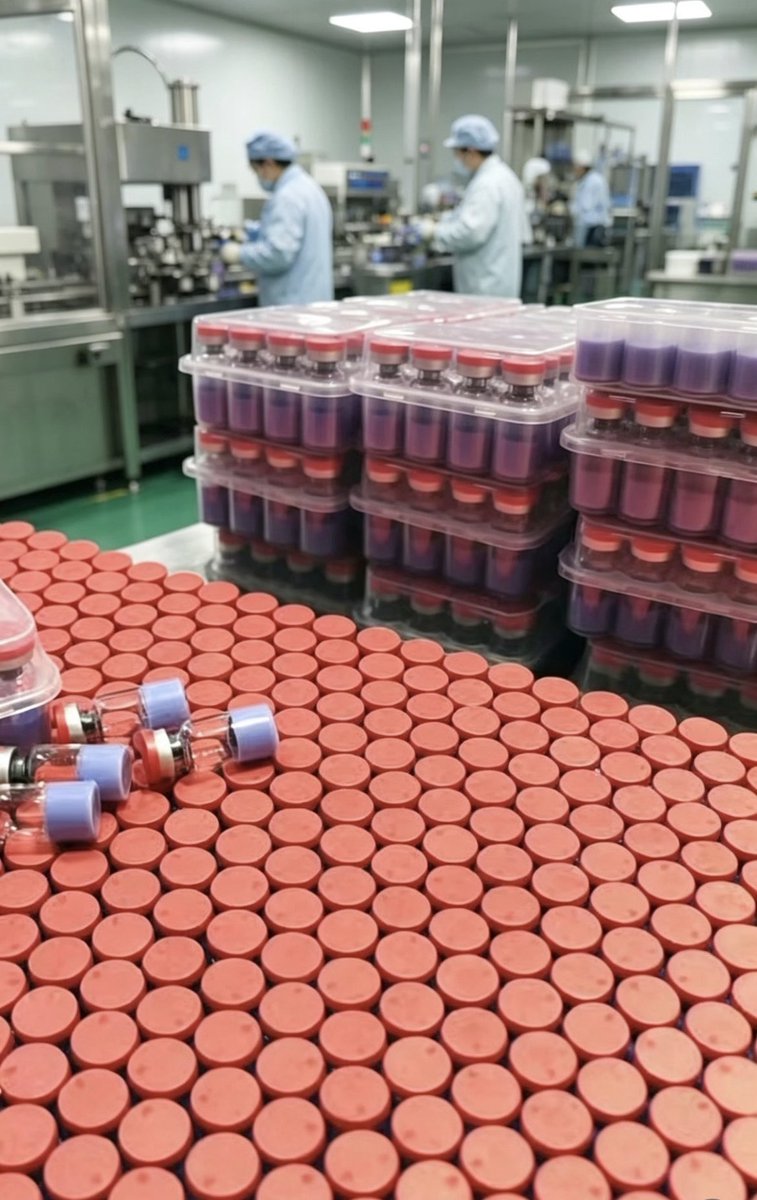
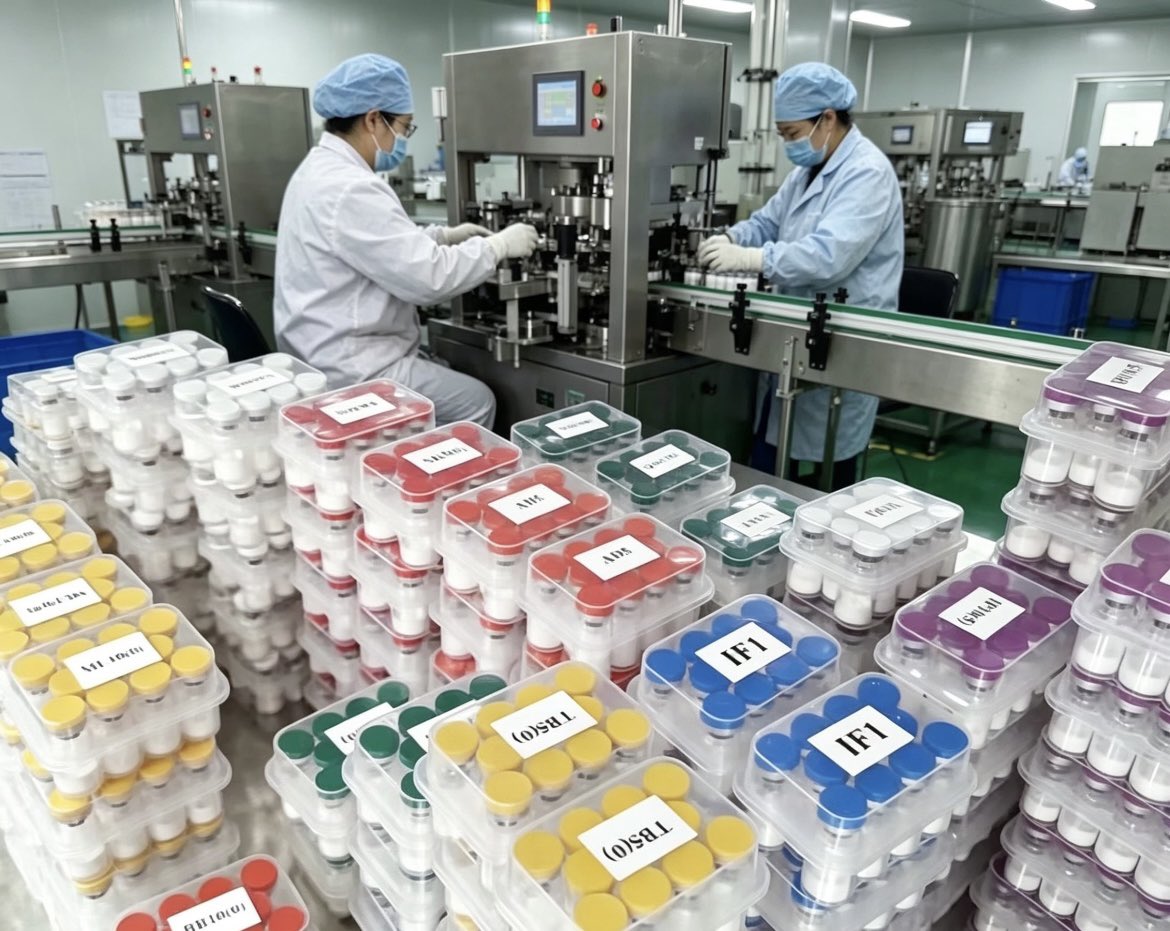
New batch of products rolled off the production line.
✨ 99%+ Purity Guaranteed
📦 Massive Stock Ready to Ship
🏷️ OEM / Private Label Supported
Looking for a reliable peptide source factory?
📌 Send us a DM or check our profile to get the 2026 Wholesale Catalog!
#Peptides
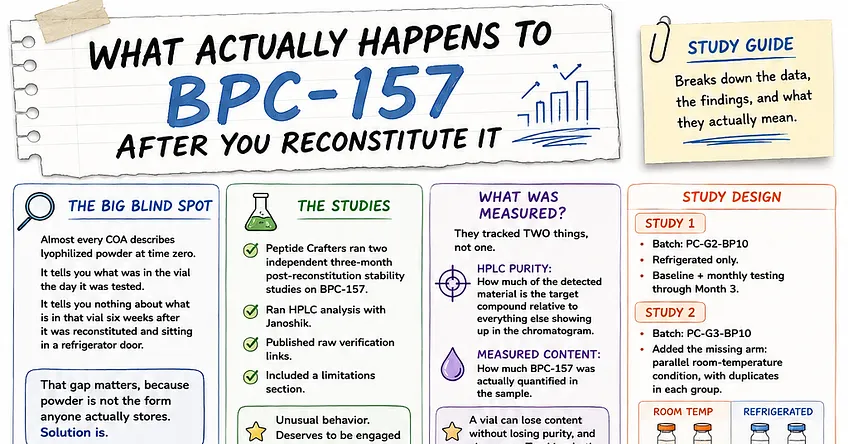
New data on BPC-157 you should know about before your next vial goes in the fridge.
Two independent 90-day HPLC studies just landed (Peptide Crafters × Janoshik, sterile-water reconstitution), and the refrigerated-vs-room-temp gap is bigger than the community heuristics said. Derek Pruski wrote the definitive breakdown.
The numbers:
Refrigerated (35°F): 97% → 93% → 87% of active peptide at Days 30 / 60 / 90.
Room temp (70°F): 90% → 85% → 79% at Days 30 / 60 / 90.
A vial left out for a month costs you ~10% of the active peptide. Refrigerated for that same month, you're at ~97%.
The mechanism is the interesting part. BPC-157 has adjacent aspartic-acid residues (Asp-Asp motif) that undergo intramolecular hydrolysis in aqueous solution. It needs only water — no oxygen, no light. Amber vials and inert gas headspace don't touch this reaction. The only things that slow it are cold and short time-in-solution.
Practical rules:
— Refrigerate the moment you reconstitute. Not "later that day." Immediately.
— Don't reconstitute more than you'll realistically use in ~30 days.
— Bulk buyers: keep the extra vials lyophilized in the fridge, still sealed. Reconstitute one vial at a time. Lyophilized BPC-157 is stable for years — the degradation clock only starts when you add water.
— Swirl gently before each draw to redistribute anything that adhered to the vial. Never shake.
— Do NOT extrapolate this to other peptides. BPC-157 is roughly 10× less stable refrigerated than Tesamorelin over the same window. Every peptide has its own curve.
Full breakdown by Derek — one of the sharpest evidence-first peptide writers online:
https://t.co/wnHEr2qC0t
Where are you shipping from?
We have multiple cargo warehouses worldwide, with the largest ones located in Hong Kong and the United States. We will select the optimal solution to deliver the packages.
#Peptides#Biotech#ResearchPeptides#Semaglutide
Peptide Manufacturer Direct Supply
Direct from our factory: NAD+ (B-Nicotinamide
Adenine Dinucleotide) bulk supply.
Purity: ≥99%,in lyophilized powder form.
We support OEM, third-party testing, and COA.
We ship our products worldwide.
#ghk#NAD+ #peptide
We found 84% of cancer patients taking ivermectin + mebendazole declared their cancer had COMPLETELY DISAPPEARED, SHRUNK, or STOPPED SPREADING after 6 months.
Our study is now PEER-REVIEWED and PUBLISHED by the International Institute of Anticancer Research.
Peptides are short chains of amino acids that act as signaling molecules in the body.
Many modern therapies are now based on peptide technology — especially in metabolic health and longevity research.
The peptide era has just begun.#peptides
Your go-to peptide factory in China
Every vial is carefully packaged in our controlled workshop with full quality checks. What you get:
· 100% lab-tested peptides
· Custom labeling & packaging options· Fast shipping with tracking
· Dedicated support for bulk orders #peptide
GLP-1 drugs can increase heart rate.
Cagrilinitide does the opposite.
It can decrease HR by 5.1 bpm.
It decreases HR dose-dependently.
And still produces substantial weight loss.
4.5mg = 10.8% bodyweight loss in 26 weeks.
Vitamin C and GHK-Cu show up together a lot in skin and tissue research conversations, and for good reason, they hit the collagen pathway from two different angles.
GHK-Cu is the copper-bound form of the natural tripeptide glycyl-L-histidyl-L-lysine. It acts as a signal.
In research models it tells fibroblasts to ramp up production of collagen, elastin, glycosaminoglycans, and other pieces of the extracellular matrix. It also helps with remodeling by modulating the enzymes that break down old or damaged matrix. That’s why it’s studied for wound healing, skin density, and general tissue repair.
Vitamin C (ascorbic acid) plays a completely different but necessary role. Collagen is made as long procollagen chains. For those chains to fold into the strong, stable triple-helix structure that actually holds tissue together, two enzymes (prolyl hydroxylase and lysyl hydroxylase) have to add hydroxyl groups to specific proline and lysine residues.
Those enzymes require vitamin C as a cofactor. Without enough vitamin C, the extra collagen signal from GHK-Cu just produces unstable, poorly formed collagen that the body breaks down quickly. In simple terms: GHK-Cu says “make more collagen,” and vitamin C makes sure the collagen that gets made can actually stay put and function.
That’s the core synergy people talk about. One provides the production signal, the other provides the biochemical machinery that turns the raw material into usable structure.
There’s also a practical chemistry note that matters for topical use. Pure L-ascorbic acid is a strong reducing agent and copper is redox-active.
When they sit together in the same solution or get layered wet on the skin, the copper can oxidize the vitamin C (wasting it) and the reaction can destabilize the GHK-Cu complex itself.
That’s why most research and formulation guidance says not to mix pure vitamin C serums and copper peptides in the same application. The common workaround is separation by time of day, vitamin C in the morning for antioxidant support, GHK-Cu in the evening for repair signaling, or waiting long enough for the vitamin C to fully absorb before applying the copper peptide.
Systemically (oral vitamin C), the picture is cleaner. Adequate body stores of vitamin C support the hydroxylase enzymes everywhere, so the collagen-production signal from GHK-Cu has a better chance of resulting in stable matrix.
Extremely high doses of vitamin C have been shown in cell-free systems to reduce copper from the 2+ to the 1+ state, which can affect the complex, but normal dietary or moderate supplemental levels don’t appear to create that problem in living systems.
So the role is straightforward once you separate the pieces:
•GHK-Cu drives the “make and remodel matrix” program.
•Vitamin C is required for the final, stable assembly of that collagen.
•Topically they don’t play well mixed together because of basic redox chemistry.
•Systemically, solid vitamin C status simply lets the GHK-Cu signal land more effectively.
That’s the practical relationship between the two in the research that’s available.
For research and laboratory use only. Not for human consumption. Not intended to diagnose, treat, cure, or prevent any disease.
FTC Disclosure: ELEVATE and ELEVATE Performance Marketing LLC maintain affiliate, referral, and marketing relationships with select research and wellness industry partners.
We may receive compensation from purchases made through our links, discount codes, referrals, or other promotional partnerships.
Content shared by ELEVATE is intended solely for educational and informational purposes and should not be construed as medical advice.
All statements, opinions, and recommendations expressed are our own.
#GHKCu #CopperPeptide #VitaminC #Collagen #ResearchUseOnly #EvidenceBased
Everyone is chasing the next longevity breakthrough.
Meanwhile, scientists have spent nearly 3 decades studying a protein most people have never heard of:
Klotho.
And its relationship with healthy aging is worth understanding.
A bodybuilder with 20 years of steroid experience explains his thoughts on guys who does TRT cream:
Chase Irons: "Every time a man tells me he's doing his TRT by rubbing cream on his balls, it's always someone who's like 55 or older."
"The guy that's going to be completely bare ass in the locker room, walking around, no towel, and wanting to talk to people, that's the guy that's rubbing cream on his nuts for his TRT."
"What's wrong is, like, you say anything like that, they're like, oh, you're just insecure with yourself, man."
"It's like, no, it's fucking weird. It's just weird."