I'm excited to share our latest work: AeroTransformer — a step toward bringing the foundation model paradigm to real-world aerodynamic design.
Code & models: https://t.co/mZ0SaIhD7W Paper: https://t.co/97Gt64q2m8
Mathematician Frank Merle won a $3M Breakthrough Prize for his work on nonlinear equations.
By studying how solutions "blow up," he's decoding the physics of fluid dynamics and lasers.
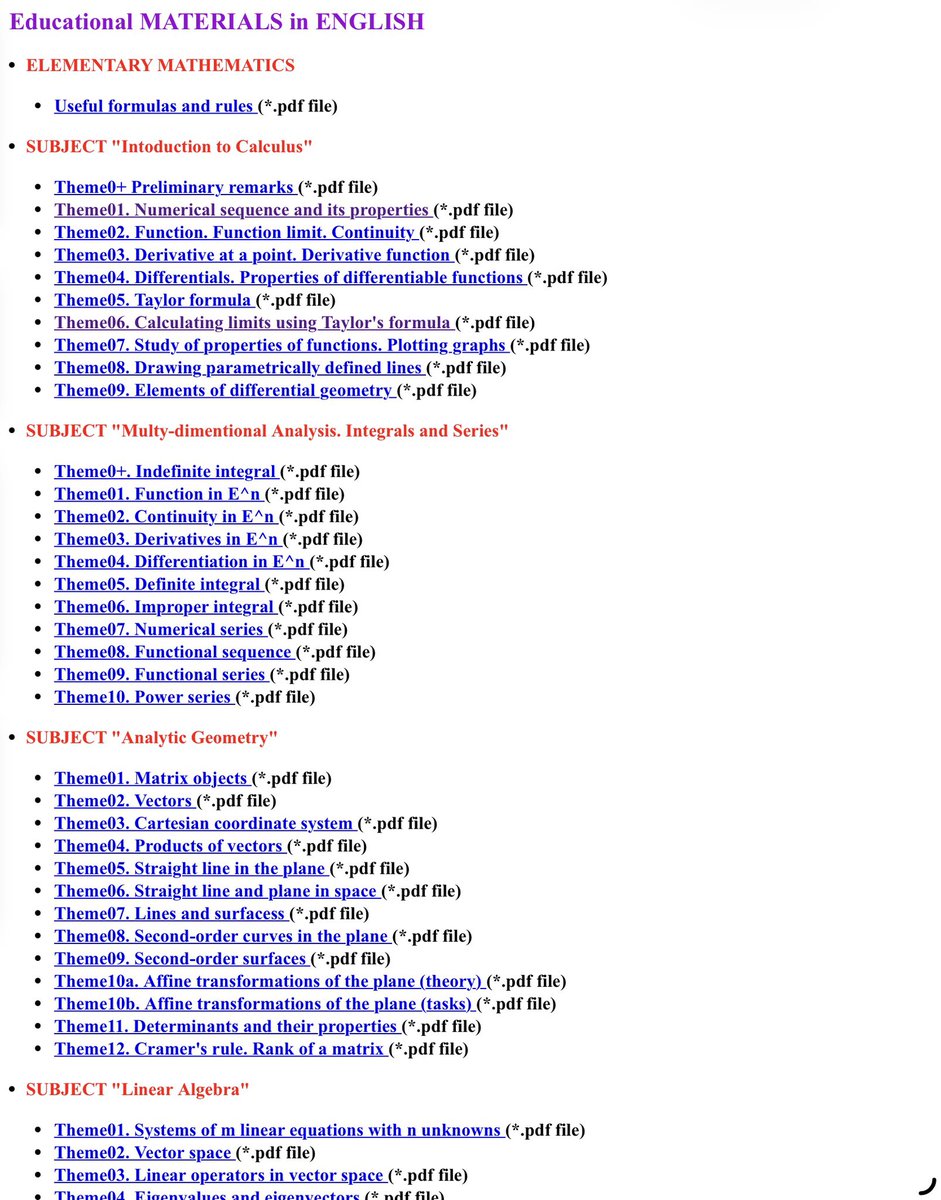
Prof. Alexander Umnov from MIPT has some excellent English-language materials on mathematics.
His son, Egor Umnov, now also teaches in the MIPT math department — clearly, the talent for math runs in the family.
#math
Do any of the genius AI prompt engineers have the prompts for Claude or ChatGPT for writing an FEM solver in C++ for multiphase flows using the phase field approach?
Our first TENO paper published in JCP, i.e., [A family of high-order targeted ENO schemes for compressible-fluid simulations, Volume 305, 15 January 2016, Pages 333-359], is now listed by Web of Science as Highly Cited Papers !
The total lift force (L) generated by a complete, finite three-dimensional wing:
L = Total lift force
ρ = Air density
V = Freestream velocity
S = Planform area
CL = Lift Coefficient
✨Excited to share that our work “MSPT: Multi-Scale Patch Transformer for Efficient Large-Scale Physical Modeling” was selected as a #CVPR2026 Highlight!
📰 Paper: https://t.co/w6kNvncQM6
🤗 Project page: https://t.co/brIdh55bpt
💻 Code: https://t.co/dWTBNGY9jg
🏆State-of-the-art performance on PDE benchmarks (elasticity, fluids, porous flow) and large-scale CFD tasks like ShapeNet-Car.
---
Scaling neural PDE solvers to millions of spatial elements requires capturing two things at once:
1⃣ fine-grained local interactions: stress concentrations, small-scale turbulence, sharp gradients;
2⃣ long-range global dependencies: pressure coupling in fluids, far-field boundary conditions in aerodynamics;
Current methods tend to trade one for the other: local attention preserves detail but misses global structure, while global aggregation (e.g., fixed-size slices) captures the big picture but oversmooths fine scales.
MSPT uses Parallelized Multi-Scale Attention (PMSA) to capture local and global interactions within a single, efficient attention call.
Key highlights:
📈Near-linear scaling to millions of points on a single GPU
🔎Unified local-global modeling: fine-grained interactions within patches + global context through shared supernodes.
🚀 Fast and expressive: pushes the Pareto frontier on PDE modelling.
🌳Flexible across geometries: supports arbitrary meshes and point clouds via ball-tree partitioning.
Congrats to @pmpcurvo who pulled it off, co-supervised with @jwvdm.
Mathematics, Physics, Computer Science, Course Video Summary Resources
The three most complete scientific resources collected and sorted out here may be the most complete on the whole network
Stanford, Yale, MIT, Berkeley, California... Dozens of prestigious schools
A summary of mathematics, physics, and science courses
Hundreds of courses and thousands of video lectures in total
Each course has 10-dozens of videos (massive)
You can learn:
Mathematical physics, classical mechanics
quantum mechanics, Special Relativity and Electrodynamics
General Relativity, Cosmology, Statistical Mechanics
Advanced Quantum Mechanics, Higgs Boson
Quantum Entanglement, Relativity
Particle Physics 1: Basic Concepts 2: Standard Model
Particle Physics 3: Supersymmetry and Grand Unification,
String theory, Cosmology and Black Holes
Calculus, linear algebra, probability and statistics...
https://t.co/dT2nLIAAC5
Another more popular and more massive aggregation resource: computer science
It is also a course from a major famous school, and it is also recommended to you,
in this way Mathematics, physics, computer science, all together
https://t.co/K51DKgnXzM
Anyway, if you can't finish reading and learning, then collect it first
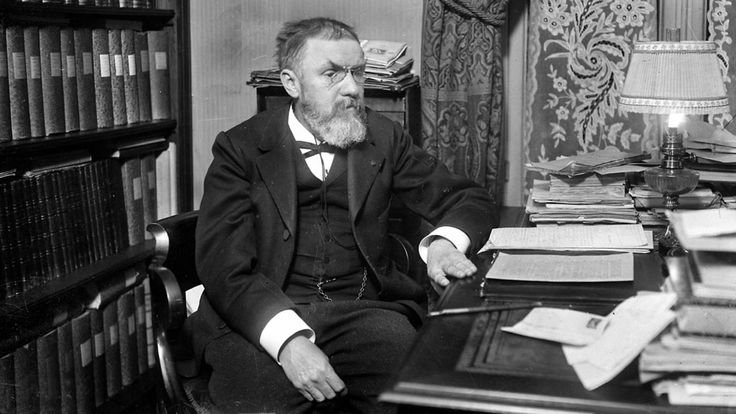
Today marks the birth anniversary of Henri Poincaré (1854–1912), a pioneering French mathematician, physicist, and philosopher of science.
Renowned as "The Last Universalist", Poincaré made foundational contributions to celestial mechanics, topology, chaos theory, and the early development of special relativity. His work laid the groundwork for modern mathematical physics and influenced generations of scientists and thinkers.
Fermi schedule: 7.5 hours of work, 8 hours of sleep, 2-3 hours of recreation. And a hell of a lot of Nobel-winning research done.
Wake up precisely at 5:30 AM and work privately until 8 AM. Get to work by 8:30 AM.
Leave work at 1 PM, come home for lunch, take a nap, wake up and play tennis or another sport until 4 PM.
Go back to work and come home around 7 PM. Sleep at precisely 9:30 PM (Laura Fermi recounted in her memoir how Enrico would force himself to stay up until then, rubbing his eyes and yawning).


![linf1017's tweet photo. Our first TENO paper published in JCP, i.e., [A family of high-order targeted ENO schemes for compressible-fluid simulations, Volume 305, 15 January 2016, Pages 333-359], is now listed by Web of Science as Highly Cited Papers ! https://t.co/iDrrJ3Ct69](https://pbs.twimg.com/media/HGGNWjQa0AEvbIH.jpg)