@snlester@mafevema@DavidHenigUK This language on its express terms still leaves open a number of combination eg by separating out markets, or by sequencing once the stage of countermeasures is reached at all.
[Warning: this may offend some people!]
I think economists have done society a disservice by elevating applied-micro studies that focus exclusively on the relative effects of trade across different groups of workers but are silent about the aggregate effects. Differences-in-differences is a useful hammer, but not everything's a nail.
The paper Arpit cites says that regions that were exposed to NAFTA had worse labor-market outcomes than less-exposed regions. This doesn't mean that NAFTA was bad for US workers! A story that is entirely consistent with their results is that NAFTA increased US manufacturing employment overall, just less so in more-exposed areas.
Autor et al's "China Shock" narrative is the best example. It has colored the debate on trade to such an extent that many economists (not to mention the vast majority of Americans) are convinced that trade with China was a net negative for US workers. But all it says is that regions that were more exposed to Chinese import competition had worse labor-market outcomes than less-exposed regions. It doesn't say anything about the aggregate effects!
An important paper by Wang et al. (https://t.co/oVu1bGyDUi) shows that after accounting for the supply-chain effects of Chinese imports, overall employment and wages actually increased. What's even more striking is that they find positive labor-market outcomes overall even in regions that experienced large manufacturing employment declines via the Autor et al. channel.
I think we also do society a disservice by putting so much focus on labor-market effects. Especially in the case of China, the biggest effects come from lower prices (i.e. higher real wages). Here, there are no tensions between aggregate and distributional effects. Everyone gained, but lower-income households gained the most!
For example, this paper by an old friend of mine (https://t.co/5xjpkM7DBR) finds a "large fall in domestic prices" and that "[p]roduct categories catering to low-income consumers experienced larger price declines."
And this paper by Mike Waugh (https://t.co/NpRu6ZHTzE) which develops a cool model where trade interacts with heterogeneity in the price elasticity of demand across the income distribution. He finds that "gains from trade are pro-poor and that the average gains from trade [is] substantially larger than representative agent benchmarks."
Don't get me wrong: trade isn't a pareto improvement, and the tradeoff between widely-dispersed aggregate gains and concentrated losses is real. But somehow I think society is interpreting many of our findings as saying that trade is a net negative, not a net positive, and that's not good.
Here another virtuous example: constitutional-law verification of strict restrictions on exportation of warfare weapons: fundamental/human right to professional activity, legitimate objective, proportionality.
(In German, by parliamentary research service)
https://t.co/OwwCr3iDa9
A virtuous example in this respect was the European Commission's proposal for an Anti-Coercion Instrument, in the explanatory para on "Fundamental rights". It speaks of "restrictions" of "the freedom to engage in international trade or investment as part of the freedom of ... 1/n
Very funny, I find.
The prior post is instructive of geography. Omsuktshan (near Magadan) seems to be the most remote place in Russia's far east that can be reached all the way by car. At least according to Google. Vladivostok closer; Uelen or even Kamchatka unreachable by car.
@loyaladvisor Your quote relates to Article XXI(b)(iii), but the 1946 stuff to Article XXI(b)(ii). The two are very different; they share the chapeau, but this here is not exclusively about the chapeau; the first is about the "emergency" threshold.
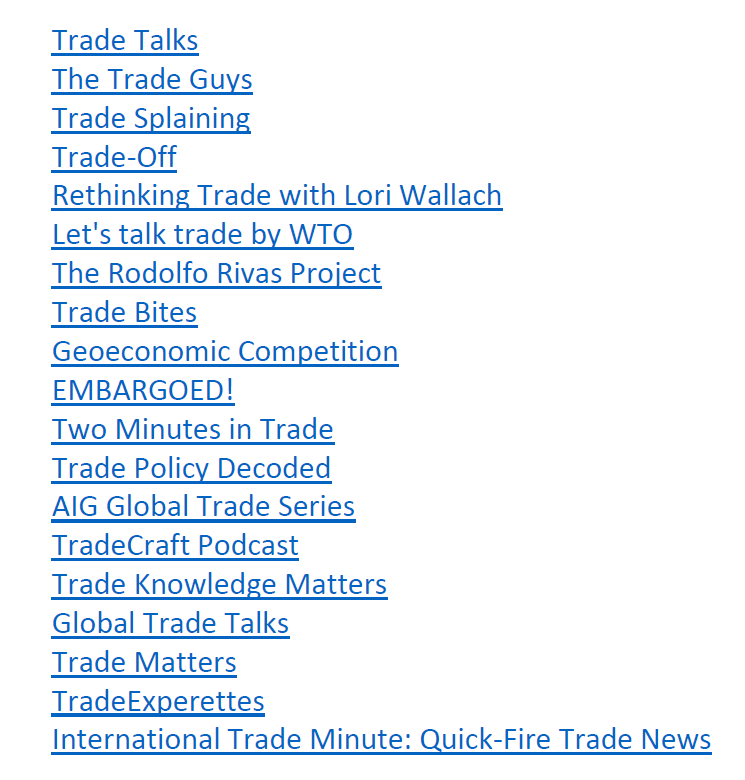
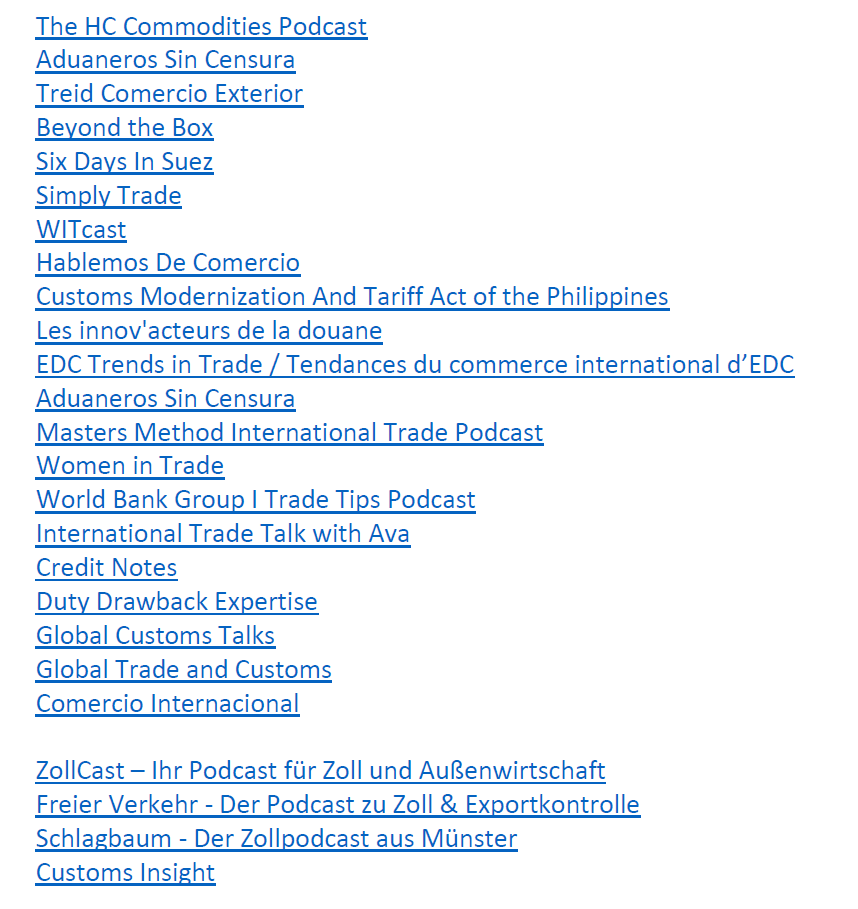
I'm often asked about podcasts on international trade. These are those I know/could find. 1st group: trade policy, 2nd group: trade operations, finance or customs (bottom: DE/NL). Ranking is by no. of Spotify ratings & survey among trade policy pros.
Do send others you know/like!
I know only half of the first group and none of the second. So a lot to discover.
I get the question because I often refer to something I learnt on podcasts, which can be instructive and inspiring.
The list with the hyperlinks will also be published; I will point out where. /
(https://t.co/1mHuHmkW7U) Tariffs are often discussed, but the above constitutional requirements more seldom, it seems. Tax measures are regularly scrutinised constitutionally by the courts (esp. equality and proportionality); aren't tariffs a special case of taxation?
A virtuous example in this respect was the European Commission's proposal for an Anti-Coercion Instrument, in the explanatory para on "Fundamental rights". It speaks of "restrictions" of "the freedom to engage in international trade or investment as part of the freedom of ... 1/n
The word "freely" carries enormous, though underappreciated, significance also under domestic and international human rights law. Trade and investment restrictions are interferences with freedoms, property and equality, thus require a justification that is too seldom verified.
professional activity, the right of property ... or other fundamental rights including equal treatment". Restriction does not mean violation, but it must happen on a "proper legal basis, ... in pursuit of a legitimate objective, and in line with ... proportionality". 2/n
The word "freely" carries enormous, though underappreciated, significance also under domestic and international human rights law. Trade and investment restrictions are interferences with freedoms, property and equality, thus require a justification that is too seldom verified.
Globalization gets a bad rap because we often forget that the exchange it facilitates is between people, engaging freely with each other. This new series of videos helps illuminate that, and I highly encourage you to watch it.
A very different situation is a jus in bello illegality of the trade restriction in question, for which there are several poss. bases in IHL; plus poss. IHRL. Does it disturb the validity of an Art. XXI(b)(iii) GATT defence? That is a question for the Art. XXI(b) chapeau.
A most interesting question (for me) is how obligations of different parts of international law interact. For the "war/emergency" security exception of int'l economic agreements, a jus ad bellum illegality is of no relevance (majority opinion, established since 2019 in the WTO).
Addendum: the link to register for the session of 7 October 24, 2 pm CEST is in the more detailed blog announcement and as follows: https://t.co/QbqofJjGu4
The time was chosen to allow participation from around the globe, with regrets and apologies to the Pacific (NZ, W Coast).
This is an opportunity to learn something fundamental about WTO law and dispute settlement. The webinar Monday at 2 will be to comment on my draft article in honour of Frieder Roessler's legacy. It will be the first comprehensive explanation of litigation rights in the WTO and...
For the WTO law nerds out there:
Seminar on Legal Architecture of Remedies in the WTO Agreement, hosted by @VidigalGeraldo, starring @LotharEhring
https://t.co/3DwNxaMZFE
how this was applied insufficiently correctly in practice. The paper will explain how parts of the WTO Agreement depart from the GATT Article XXIII model. It will also explain how actionable subsidies are not illegal. These differences have been disregarded more often than not. /
In all my years at university, Holger Spamann was the most brilliant law student I met. This is very instructive for anyone interested in common/civil law, the role of jurisprudence & judicial reasoning. From a legal realist perspective, compelling. My high expectations exceeded.
In the latest Conversations from Harvard Law School podcast, Holger Spamann argues that the differences between the two most widely used legal systems in the world are not as stark as many lawyers imagine. https://t.co/OKLz3paHJd