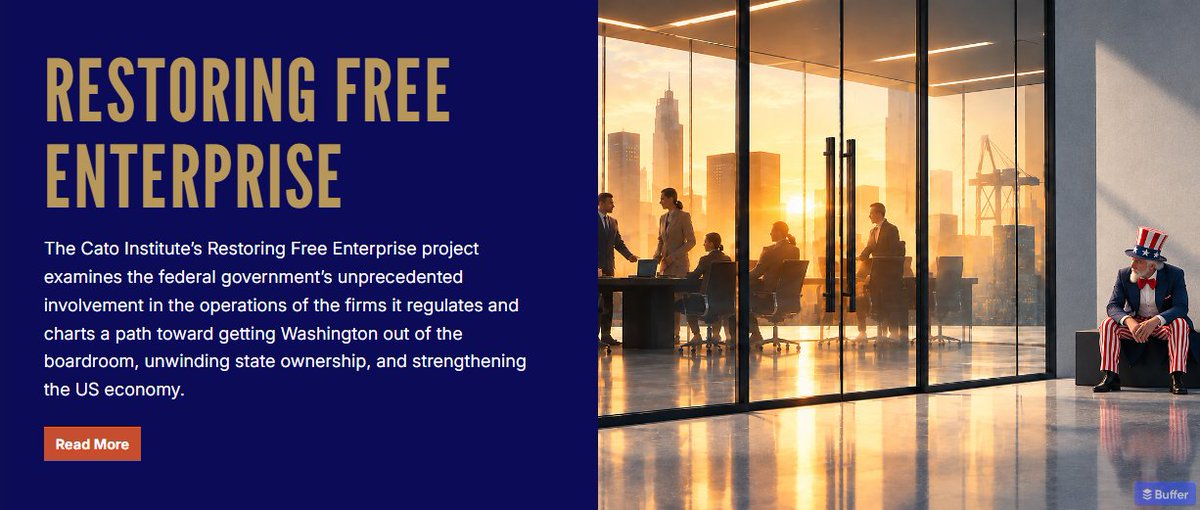
Trump's corporatism is a BIG problem - and not just re Nvidia. The equity stakes, the cut of chip sales, the tariff exemptions, the daily meddling in company business, etc etc. Major (invisible) economic harms.
That's why we launched @Cato_RFE: https://t.co/NbJPxbtkM0
An ongoing development of mapping executive authority concerning the circumstances that threaten to impair US national security. Congress may start to wonder where the boundary lines are when evaluating how manufacturing inputs and technological future-proofing map out controls.
Pres. Trump says he was the one who convinced Nvidia's board to reinstate Jensen Huang as CEO.
Asked what he told the board to change their minds, Trump says: "I spoke to them. Let me just put it that way, and I convinced them."
A stream of unilateral US actions raises challenging questions about the US's contribution to the state of US commerce in global markets. Unintended consequences: dismantling and reconstituting commitments makes it hard for any player to meet the moving target of reasonableness.
U.S. PREPARES NEW TARIFF WAVE AS INFLATION RISKS MOUNT — KPMG'S DIANE SWONK
KPMG Chief Economist Diane Swonk warns that another round of U.S. tariffs is approaching, potentially reigniting inflation pressures.
The Trump administration is pursuing Section 301 investigations covering 16 economies, including China, the EU, Japan and Taiwan.
Trade Representative Jamieson Greer expects recommendations by year-end, while new tariffs affecting AI infrastructure take effect December 4.
The China tariff truce expires January 10, raising the risk of further escalation.
Swonk warns that higher import costs, AI infrastructure demand and Middle East shipping disruptions could complicate the Federal Reserve's inflation fight.
If the only interest were tariff liberalisation, then the US could already achieve that under WTO rules. But the agreements do not stop at tariffs. More valuable, I think, are commitments that could effectively amount to extraterritorial management of Thai border policy &control.
@kyleichan I’m less optimistic about any policy signal from that vague statement. Sure public decision making should involve deliberation and review. I think the statement avoids more complex issues of a top down policy from two economies that could orchestrate separate eco sec blocs.
A major win for the European Commission: provisional EU safeguard measures on hybrid vehicle imports, set to take effect on Dec. 1, received backing from 26 member states today, with only one abstention.
All this talk about the end of international law, but when it comes to global economics, I'd strongly disagree. What we are seeing, I think, is a swap. From public to private. Discrete. Transactional. Expensive.
But law is there, even if disrobed of its normativity.
In principle discrimination by origin sounds straightforward, but in practice it’s an incredibly challenging proposal that requires added border controls and review. Double that if you look past the product to business investment and management.
News: An auto bill that would ban Chinese cars in the U.S. is roaring back to life as advocates push to pass it in the lame duck and are said to be near a deal.
But the wrangling continues, with Mercedes (roughly 20% Chinese owned) at the middle of it.
WTO members including Japan, South Korea and the UK sharply criticised the EU's 'safeguard' on hybrid vehicles at a meeting in Geneva yesterday. More below https://t.co/VFOA3wWUSf
I'm hiring! Great to be expanding the @globalshieldhq Aus team. I'm looking for someone excited to advance Aus policy to reduce AI risk, understands Canberra, and brings great ideas and can deliver on them. Applications close 20 Dec - link in next post.
Tariffs have been justified on the basis of a revival of manufacturing for decades. What is new is seeing the US tout policies that also debilitate its growth. Stability and prioritising R&D keep the train going; as does cross-regulatory cooperation for access to export markets.
📰: "The manufacturing sector in the US is having a renaissance, not just in terms of output but more recently jobs."
@POTUS' economic and trade program is fast-tracking America's reindustrialization as companies continue to reshore jobs and expand their manufacturing footprint on U.S. soil.
Read in @FT: https://t.co/ax0KRynQ8w
Until we know more, it remains to be seen whether the Reciprocity Day EO continues, like a zombie (No longer alive, but still capable of harm). But it also raises another problem: USTR needs to clarify the legal authority for its ongoing powers to negotiate.