Silica increased hair thickness by 12.8% in 9 months. The placebo group saw zero change.
10mg a day. Double-blind, placebo-controlled.
Hair got measurably thicker and stronger. The placebo group — nothing.
The second most abundant element on earth — and almost nobody gets enough of it.
85% of soils are now depleted. That means your food barely contains it anymore. And your hair, skin, and nails are paying for it.
Silica drives collagen synthesis, strengthens keratin, increases skin elasticity, and supports nutrient delivery to hair follicles.
Your hair isn’t thinning because of genetics. It’s thinning because of a mineral you’ve never thought about.
My favorite sources:
- Nettle tea — one of the richest plant sources
- Orthosilicic acid (ch-OSA) — the form used in clinical trials
- Fiji Water — 85-93mg of natural silica per liter
Drink from clay.
Clay is porous. It cools water through evaporation, filters impurities, and releases calcium, magnesium, and potassium into every sip. The same material your ancestors stored water in is now being studied by modern scientists for what it does that refrigerators cannot.
Cook in cast iron.
Cast iron holds heat longer than any modern pan, distributes it evenly, and adds small amounts of dietary iron to your food as it cooks. A pan your grandmother used is still the most efficient tool in the kitchen.
Eat from wood.
Wood does not leach chemicals. It does not retain bacteria the way plastic does. It is antibacterial by nature, gentle on food, and has been the material of choice across every culture on earth for thousands of years.
Store in woven material.
Bamboo and rattan regulate airflow. They prevent moisture buildup. Your food breathes inside them instead of rotting.
These are not trends. These are technologies that were working long before plastic was invented.
The modern kitchen replaced performance with convenience. It is time to reverse that.
A British psychologist spent her PhD years proving that something as stupidly simple as chewing gum can change how the human brain stores information, and the reason it works is stranger than it sounds.
Her name is Lucy Wilkinson.
She was a PhD student at Northumbria University in Newcastle when she designed the experiment that would put chewing gum into the cognitive science literature for the first time in any serious way.
The paper was published in 2002 in the journal Appetite, and it was one of those rare studies that sounded like a joke when you read the abstract and turned out to hold up the moment you read the data.
The experiment was deceptively simple.
Wilkinson and her supervisors recruited 75 healthy young adults, and divided them into three groups to take a 20-minute battery of memory and attention tests.
The first group was chewing gum the whole session.
The second group moved their jaws as if they were chewing but had no gum in their mouth at all.
The third group sat still, and did nothing with their jaws.
Then everyone took the same tests, which included immediate word recall, delayed word recall, working memory for numbers and spatial memory tasks.
The part nobody had expected were the results.
Gum chewers were significantly better than the no-gum control group on both immediate and delayed word recall. Same words, same test, same brain on the other side of the desk, and the group with a piece of gum in their mouth just remembered more of them.
The weirdest part of the finding was what happened to the second group, the one that was mimicking the chewing motion without any gum in their mouths. They did not gain the same benefit. Just moving the jaw was not enough. But it was something about actually chewing a piece of gum that was causing the effect.
That detail was what made the paper interesting rather than dismissible, because it meant the explanation couldn’t just be that jaw movement keeps people alert. Something deeper was afoot that the field would spend the next 20 years trying to untangle.
The follow-up experiment that explained the most likely mechanism was done by John Aggleton’s team from Cardiff University two years later. One set of participants was asked to chew gum while learning a list of words and then chew gum later on 24 hours later while trying to remember the same words. A second group was asked to chew gum only during learning.
A third group chewed gum just during recall. A fourth group did not eat any.
The group that chewed gum at learning and recall did the best by a wide margin. Those who chewed at only one or the other stage did about as well as the no-gum group.
What the result showed was that chewing gum wasn’t just improving memory in some general way. It was behaving as what psychologists refer to as a context cue.
Your brain does not store memories as isolated bits of facts floating in a void. It saves them with the full context around it . The room you were in , the sounds around you , the mood you were in , even the physical state of your body when you encoded them . When you try to remember something later, your brain goes to those context cues to find the file.
If the context at recall is the same as the context at learning, the memory will come back faster and cleaner. If the context is different the file is more difficult to reach.
One small but reliable physical state that the brain was using as one of those context tags turned out to be chewing gum. The regular motion of the jaws, the flavour of the tongue, the steady low level of mouth activity were being filed away with the words being learned. The brain was quicker at pulling up the file when it was in the same physical state at recall.
And there was a second mechanism built into that. Other studies have looked at blood flow to the brain while chewing and found it to increase about 25 percent. One such study was done in 2001 by Sasaki in Japan.
Other investigators have reported faster times on cognitive processing and improvement on sustained attention tasks while chewing gum. Chewing appears to push the brain into a somewhat more aroused state, making it better able to hold onto information over a task that takes minutes rather than seconds.
The next part is the real part of the story.
Wilkinson’s finding of an improvement in immediate recall was not reproduced in two independent efforts to replicate this in 2004 and 2005. Other studies replicated the context-dependent effect, but claimed that the simple alertness boost was only real under certain conditions, such as when the task was long and demanding, rather than short and easy.
The best evidence from two decades of research is that chewing gum has a measurable effect on cognition, but the effect is conditional and is most reliably observed in tasks requiring sustained attention, working memory under load, and recall benefitting from matching the encoding state to the retrieval state.
What all the critics agree on is the deeper finding under the original headline. Your brain is not a neat filing cabinet, where information is stored separate from the body that took it in. Your physical state at the time you learn is part of the memory itself, so anything you can recreate at the time of recall can give you a small edge in getting the file back.
That is why students who study in the same room that they will take the exam in, often do better. That is why you remember your dreams better if you wake up in the same position you fell asleep in. Which is why a smell can pluck a memory out of decades-old storage faster than any conscious effort can. The index contains the body.
Chewing gum is just the cheapest, weirdest, most available form of that mechanism ever tested by anyone.
Next time you have something difficult to remember, try the experiment yourself. Chew a particular flavour of gum as you study. Before you sit down to review what you learned, have another chew of the same flavour. The gum is not doing the job. The gum is acting as a thread for your brain to follow back to where the information was stored.
The most powerful memory tool you own is not your willpower or your intelligence.
It is the physical state of your body the moment you decide to pay attention.
Chris Hemsworth did his first 4-day fast… and felt nothing until the afternoon of day 4.
He expected ketosis and mental sharpness by day 2 or 3. By day 4 he was thinking “nah, I’m not feeling any of the sharpness or alertness.” Then, while spearfishing that afternoon, it suddenly hit — everything “percolated” and mental clarity kicked in.
Around day 3–4 of water fasting, the body enters deeper ketosis. Ketone levels rise sharply, providing the brain with a cleaner, more efficient fuel than glucose. This often triggers the mental clarity, focus, and stable energy many report, while autophagy (cellular repair) also ramps up.
Real fasting timelines like this cut through the hype and show what most people actually experience.
Have you ever done a multi-day fast? When (if ever) did the clarity or benefits actually kick in for you?
$BYND Reversal started today. Dragonfly on weekly + monthly.
Short squeeze will start at $1.15
Don’t sell under $15
That will be the least price coming in.
Between ~ $5 and ~$6 there will be a pull back to ~$2 - $3
After that 🚀 to $15 - $40
After that a pullback which will take ~ 3 month
After that up again
$BYND Josh Hart just had a historic NBA Finals performance and happens to be the newest ambassador for Beyond Immerse.
The exposure $BYND is getting right now is exactly why athlete partnerships matter.
Winning on the court.
Building the brand off the court.
The takeover is coming. 💚🚀🏀
$30+🚀🚀🚀🚀🚀🚀🚀🚀🚀
Wim Hof took Steven Bartlett into an ice bath on Diary of a CEO and it was impressive.
While they were in the freezing water, Wim guided him with his signature calm intensity:
“Stay with your breath… Long out breath… Long out breath… You’re doing good. Let the body do what the body is capable of. Your body is adapting from the inside.”
Wim does this every morning. He once stayed in for 64 minutes on his 64th birthday, but says just 2–3 minutes is enough for most people.
Cold exposure with controlled breathing (especially long exhales) can increase norepinephrine by up to 530%, activates brown fat, and triggers a strong anti-inflammatory response. Regular practice strengthens immunity and builds serious mental resilience.
In our high-stress world, this is one of the simplest and most powerful ways to train your nervous system and gain control over your mind and body.
Have you tried cold exposure (ice bath or cold shower) yet? How did it go?
A PhD student built a working nuclear fusion reactor in his garage, let an AI run it, and 400 thousand dollars later he works for Elon Musk.
he posted it once. that single post ended with a grant in his account and a job offer from the most powerful man on earth.
not a simulation. not a school project. an actual device that fuses atoms, sitting where his car used to be.
fusion is the thing governments have been chasing for 70 years with billion dollar labs. the hard part was never the reactor itself. it was the control. the plasma inside has to be held at conditions hotter than the core of the sun, and it shifts and collapses in milliseconds. no human can react fast enough to keep it stable.
so he stopped trying to do it himself. he handed the control loop to an AI.
the model reads the sensor data hundreds of times a second, predicts how the plasma is about to move, and adjusts the magnetic fields before it ever drifts out of line. it does not wait for the plasma to misbehave. it sees it coming and corrects it before it happens. the same reaction-before-the-event speed no person could ever match.
this is the exact kind of build people are tearing apart inside @NeuroClubAi. not to make reactors, but because the workflow is identical for anything hard. let the AI run the loop, predict the problem, fix it before it breaks. same playbook whether it is plasma or a business.
then the post went out.
within days Elon's fusion team reached out. they did not ask him to interview for an entry role. they handed him a 400 thousand dollar grant and pulled him onto the team building this at scale. one garage build turned a PhD student into an operator for the most ambitious man alive.
here is the part that should stop you.
he was one guy with a PhD, a garage, and an AI model doing the job that entire teams of physicists used to fail at. the AI was not assisting him. it was the operator. he built the hardware. the machine ran it. and that was enough to get noticed at the very top.
most people think AI writes emails and makes pictures. meanwhile someone pointed it at one of the hardest physics problems on earth, held the plasma steady, and got paid by Elon Musk for it.
the gap is not between humans and AI anymore. it is between the people who realize what this thing can already do and the people still using it to summarize their inbox.
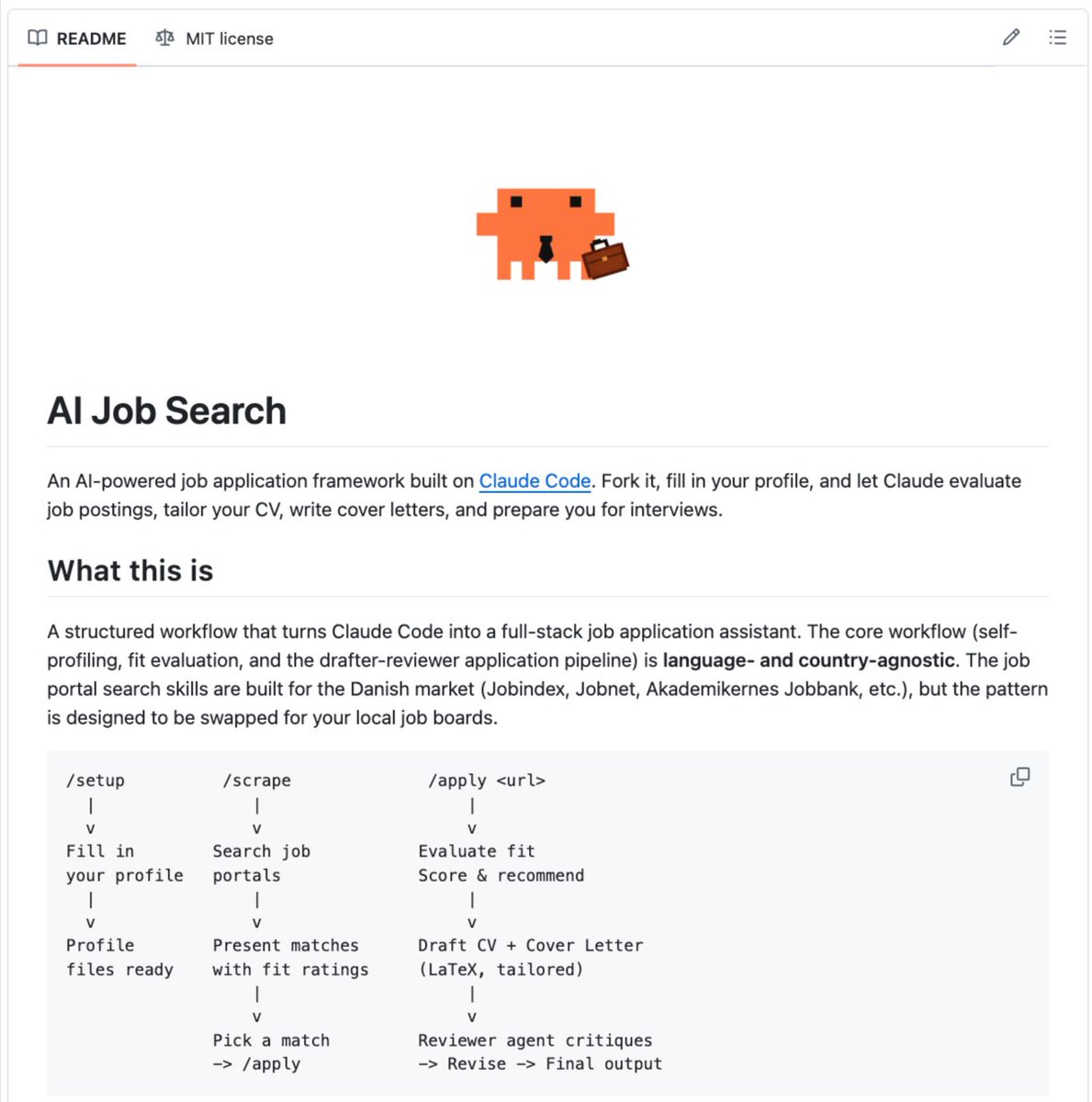
A scientist in Denmark figured out how to make Claude prepare his job applications. He open-sourced the whole thing.
His name is Mads Lorentzen. He is a PhD geophysicist. He built it on top of Claude Code and released it under MIT license.
Here is what it does. You fork the repo, fill in your background once, and it runs a five-step pipeline for every job you want to apply to.
Step 1. It reads the job posting and scores how well you fit.
Step 2. It drafts a tailored CV in LaTeX, picking only the experience that matches.
Step 3. It writes a cover letter framed around what you would bring to the role.
Step 4. A second AI agent reviews the first agent's work, points out weaknesses, and the first agent revises.
Step 5. It compiles both into clean PDFs you can send.
The whole thing is a folder of markdown files. The candidate profile, the writing style rules, the CV templates, the interview prep notes. Every step is plain text you can read and change.
The job portal search is built for Danish boards. The application workflow itself works for any country.
489 stars. 270 forks. A fork-to-star ratio that high means people are using it, not only bookmarking.
Mads is not a startup founder. He built this because he needed it for himself, then shared it.
This is the future of job hunting. Not a service you pay for. A workflow you own.
(Link in the comments)
EV ALMADAN ÖNCE KESİNLİKLE BAKMANIZ GEREKEN SİTE
Hangi saatlerde güneşin binaya nereden vurduğunu gösteren mükemmel bi site. Ev alırken, kiralarken mutlaka bakılması gereken şeylerden.
@BeyondMeat pours and foams like an ale, but tastes like a dream and is a net positive on my health. Would like to try the other 20g flavors if and when they are available again. $BYND
YOU WERE NOT MENT TO SEE THIS VIDEO.
THEY THOUGHT THEY ERASED IT.
I FOUND IT.
Watch it before it is taken down! This is “The Midas Plague,” the 12th episode of Series 1 of the BBC sci-fi anthology series Out of the Unknown (BBC2).
It is an adaptation of Frederik Pohl’s 1954 satirical short story (sometimes referenced with a 1956 date in secondary sources) about a future automated society where robots produce endless goods, forcing humans into a cycle of overconsumption with social status ironically tied to how much one must consume (the poor are burdened with the most).
It originally aired on 20 December 1965. The original videotape masters were wiped in the early 1970s as part of the BBC’s routine they claimed as a cost-savings measure.
Many programmes were routinely erased or discarded once their immediate repeat especially ones that offered “too much thinking”. The wiping policy officially ended around 1978 as home video and archival value became clearer and erasure memory holes became harder until our moment where we assume all is saved.
It was long believed lost by many, but the telerecording preserved it. I located and shared a copy as part of my work on the “Great Forgetting” and You Have 5,000 Days series.
Some think this is from fan-assembled retelling. But it is not.
Read the article and surmise why this video was deemed to be erased.
Watch the clip and read the article now, the BBC does not want you to see this. There is a very high chance this Internet Archive will be deleted...
If I had $100,000 to invest in my health, I'd buy these:
- Sauna
- Hot tub
- Home gym
- Air purifier
- Meal prep
- Cold plunge
- Health coach
- Water flosser
- Standing desk
- Under desk treadmill
- Functional blood work
- Red light therapy lamp
- Incandescent light bulbs
- Reverse osmosis water filter
- Great mattress and bedding
- Membership at the best gym in the area
What about you?
$BYND 🍽️🌱
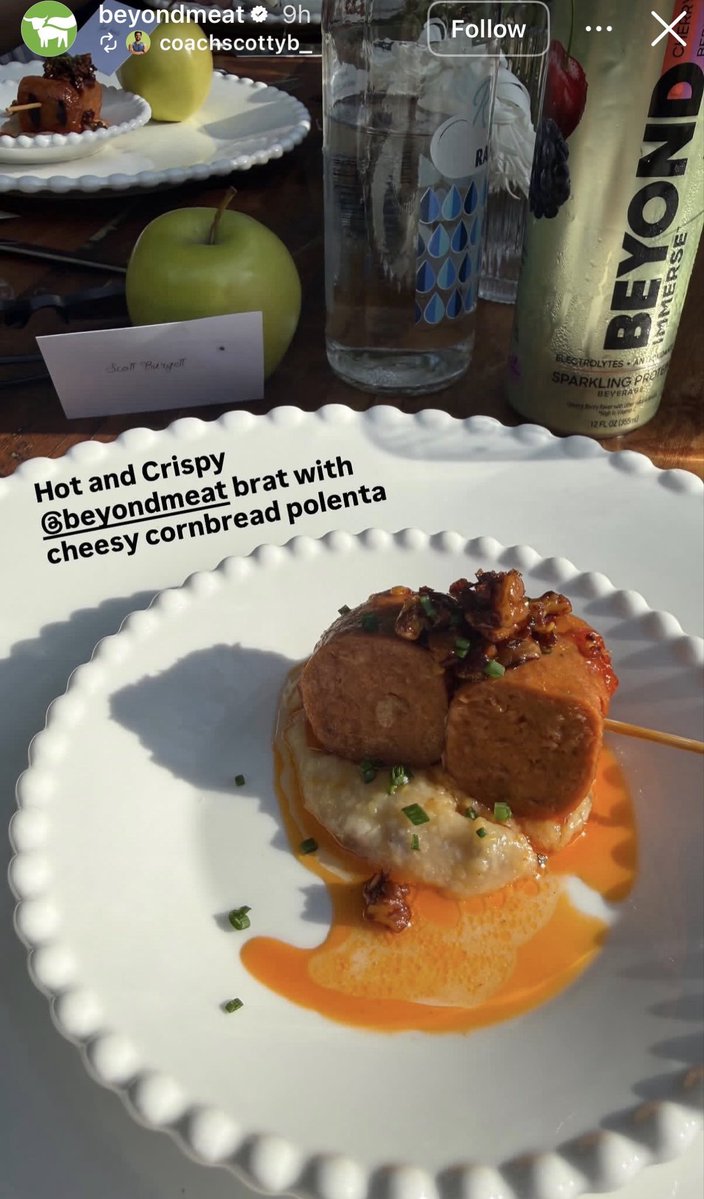
Yesterday, Beyond Meat hosted its Beyond Supper Club experience in Austin, Texas — a clear reminder that the company has evolved far beyond the traditional “veggie burger” story.
Featured at the event:
✅ Beyond Steak Filet
✅ Beyond Beef
✅ Beyond Sausage
✅ Chef-crafted specialty dishes
✅ Beyond Immerse functional beverage
While the market stays focused on short-term price action,
$BYND is focused on something bigger:
• Expanding its product ecosystem
• Increasing consumer awareness
• Creating premium food experiences
• Driving adoption of next-generation plant-based protein
This isn’t a company standing still.
It’s a company executing, expanding, and positioning for the next growth cycle.
The shift is happening.