💉💉A time capsule from the pandemic. Every clip is a public official, on the record, describing their fellow citizens. No commentary needed. Just watch how it sounded.
Wired was founded on Noam Chomsky’s belief: “Optimism is a strategy for making a better future. Because unless you believe that the future can be better, it’s unlikely you will step up and take responsibility for making it so.… If you assume that there’s no hope, you guarantee that there will be no hope.”
Also, that the purpose of journalism is to connect people to reality, because humans need to know what‘s real to survive and prosper.
No hope is not reality.
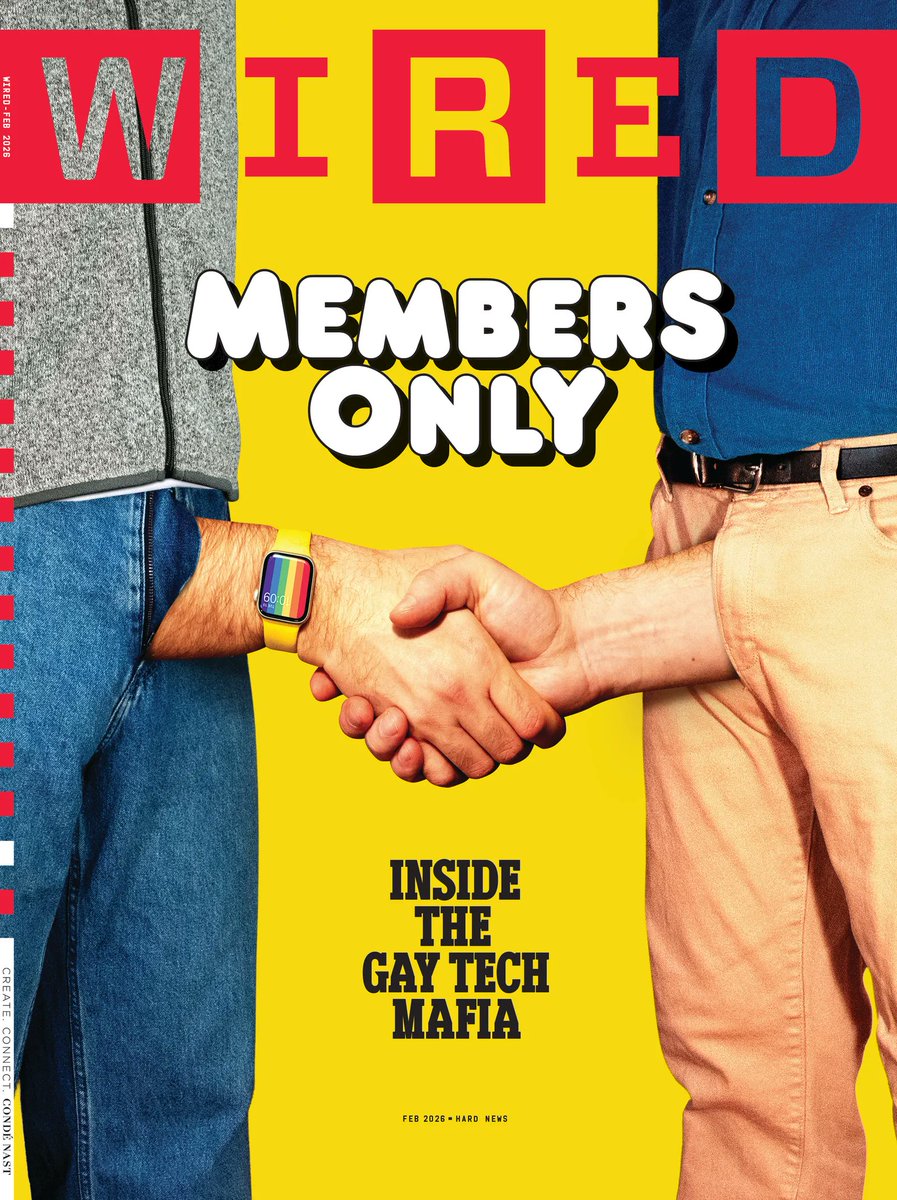
Neither is current Wired cosplaying Teen Vogue.
Change is Good.
Something strange has happened over the last 10 years
When I was a kid, every tech publication (Wired, TechCrunch, Engadget) truly loved and celebrated technology
Over the last 10 years they all collectively decided they absolutely LOATHE technology.
Every article is a hit piece. Every entrepreneur and creative thinker is being destroyed. The greatest inventors of our lives are being villainized.
A lot of people are saying it’s because we live in a clickbait culture and hate is what drive clicks, but I don’t buy it
If hate drove clicks all of these publications would be thriving. Instead, they’re all failing, going bankrupt, laying people off and on top of that I literally can’t name a single person who reads any of them
There is a such a massive opportunity right now for anyone who’s willing to start a tech publication that actually celebrates and loves technology.
I’m DYING for a version of Wired that actually covers real tech with an optimistic lens, and I know many other are too.
Might have to f around and do this myself.
@tigerbeat@AlexFinn Wired delivered critical optimism. Of course, we reported problems. But to build a better future for our children, we need to be optimistic. Not Teen Vogue.
I support @traestephens in his quest to purchase and reform WIRED. I still remember when I subscribed with my own money as a ten year old boy in 2003, attending WIRED NextFest years later - it was truly inspiring.
These days, they call me "the worst of Silicon Valley".
Paul Ehrlich has died. He was 93.
He is survived by 8,300,678,394 people (134% increase from 1968), with a daily worldwide average calorie intake of 2,800 kcal (a 22% increase).
@traestephens@WIRED I was publisher of WIRED for many years. I bought issue 3 on the newsstand in college and never looked back. It changed my world view and working there changed my life. I love that brand and if you buy it, would help in ANY way I can. Board seat, or I'd maybe even run it for you.
1/ During college and early in my career, I would absorb @Wired cover-to-cover on my commute. It is such a bummer that in just a decade, a once-great newsroom has deteriorated into publishing speciously-sourced gossip columns that feel like Gawker 2.0. Why is the tech community still interacting with these people?
@traestephens@WIRED Pirate ship > flag ship > cruise ship > sinking ship
Like Howard @hsmittman, I’d help a rescue effort any way I could. So would a lot of others, I’m guessing.
The world needs militant optimism more than ever.
The entitlement here is astounding. California didn’t make these people money. These people made money for California. No one “deserves” it. When faced with crushing financial losses, it’s entirely rational for business owners to move elsewhere. Wealth taxes inevitably fail.
China Is No Longer Posturing. This Is Coordinated Escalation.
Signal stacking, blockade rehearsal, and what Beijing is really testing.
The late-December 2025 wave of Chinese military signaling represents a meaningful escalation in sophistication, coordination, and intent, not merely an increase in volume. This is not classic saber rattling. It is message stacking across domains, timed to shape U.S. decision-making and normalize coercive behavior short of war.
The key point is not any single reveal or exercise. It is the convergence.
Over a compressed time window, China has publicly showcased containerized missile systems on commercial cargo vessels, advanced stealth aircraft variants, maritime testing of stealth unmanned combat aerial vehicles, road-mobile nuclear systems disguised as civilian infrastructure, and the first officially released footage of a hypersonic anti-ship missile launched from a front-line surface combatant. Simultaneously, the PLA conducted its most explicit and expansive Taiwan encirclement and blockade rehearsal to date, while Moscow publicly reaffirmed diplomatic support for Beijing on Taiwan.
Taken together, this is not coincidence. It is coordinated signaling.
The Taiwan drills themselves mark a qualitative shift. Earlier exercises emphasized demonstrations of force or symbolic punishment. The December 2025 exercises explicitly rehearsed controlled encirclement, port denial, sea-air patrol integration, and denial of external intervention east of the island. Live-fire zones intruded deeper into Taiwan’s air and maritime approaches than in previous iterations. Short notice activation disrupted civilian air and maritime traffic. This is no longer about warning shots. It is about normalizing blockade geometry.
Equally important is what China chose to reveal about civil-military fusion. The containerized missile ship imagery is not about near-term combat utility. It is about signaling that commercial infrastructure is now openly treated as latent military capacity. The same applies to road-mobile nuclear launchers camouflaged as commercial cranes. These are not new ideas, but the decision to showcase them publicly matters. Beijing is challenging assumptions about escalation control, target discrimination, and the legal boundaries between civilian and military space.
The maritime unmanned systems component reinforces this shift. The staging of stealth UCAVs near major shipyards alongside carriers and amphibious assault platforms points toward operational testing, not concept demonstration. Combined with loyal wingman development and rapid sixth-generation fighter prototyping, the message is clear: China is compressing development cycles and integrating systems faster than Western planning assumptions typically allow.
The hypersonic anti-ship missile reveal fits the same pattern. Public live-fire footage from a Type 055 destroyer is not aimed at proving a technical breakthrough. It is aimed at reinforcing anti-access inevitability. The message to U.S. and allied naval planners is not “this weapon is perfect.” It is “your margin for error is shrinking.”
Taiwan is the primary theater, but it is not the only context. What often gets missed is why Venezuela matters to Beijing beyond barrels of oil. China’s presence in Venezuela is not transactional. Through decades of oil-for-loans agreements, infrastructure financing, and debt restructuring, Beijing has embedded itself deeply into Venezuela’s economic survival. That relationship provides China with energy security outside East Asian maritime chokepoints and, more importantly, a durable foothold in the Western Hemisphere.
From Beijing’s perspective, U.S. interdiction of China-bound Venezuelan oil shipments is not simply sanctions enforcement. It is a precedent test. It probes whether Washington is willing to use maritime coercion against commercial shipping tied to Chinese strategic interests outside a declared shooting war. That precedent matters because China’s preferred Taiwan strategy is not amphibious invasion, but quarantine and controlled isolation under ambiguous legal framing. If maritime coercion becomes normalized elsewhere, it becomes easier to justify, mirror, or counter in the Taiwan Strait.
This is why Venezuela cannot be dismissed. It is not the driver of Chinese military signaling, but it is a secondary pressure vector shaping tone and timing. Beijing is watching how aggressively the United States is willing to weaponize maritime control against energy flows, and whether those actions remain compartmentalized or bleed across theaters. In that sense, Latin America functions as a rehearsal space for coercion norms, not a sideshow.
More specifically, it is U.S. escalation managers, alliance planners, and an incoming administration perceived as transactional and escalation-averse. The message is not that war is imminent. The message is that any attempt to coerce China economically, politically, or militarily will be met with cross-domain pressure that cannot be neatly compartmentalized.
China is not threatening to win quickly. It is threatening to make every Western response slower, riskier, and politically messier than Chinese action. By stacking signals across air, sea, space, nuclear, unmanned, and information domains, Beijing is testing whether the United States can still impose clarity under pressure.
What makes this surge noteworthy is not aggression alone. It is confidence. Confidence in gray-zone escalation management. Confidence in civil-military fusion. Confidence that blockade rehearsal can be normalized without triggering crisis framing. That is how escalation thresholds move without anyone formally announcing they have moved.
Ignoring that would be a mistake.
#OSINT