Much of the internet thinks:
> meat will remedy my autoimmune gastritis
> sunlight is the cure
> the culprit is the food I consume
These are unlikely.
The sunlight assessment is claiming low vitamin D levels are making my immune system misfire. My vitamin D has been sustainably high for years.
The meat argument claims that animal tissue contains missing nutrients that will cure me. This is a misunderstanding of my condition.
My low ferritin is a downstream consequence of autoimmune gastritis and not the cause of it. The autoimmune attack destroys my stomach's acid producing parietal cells. That compromises my gut's highly acidic microenvironment that is required to absorb iron.
As evidence, for years we’ve tried every possible oral iron formulation to correct it, including proferrin, a heme iron polypeptide similar to how iron exists in meat, lactoferrin, as well as non-complex forms including iron bisglycinate. We also tried different times of the day, and pairings to improve absorption. Nothing worked.
My autoimmune profile began at a young age when I was regularly eating red meat and was in the sun for multiple hours a day. I was diagnosed with autoimmune thyroid disease when I was 21 years old. In immunology, the connection between thyroid and stomach autoimmunity is sufficiently common and tightly linked that it has a name: thyrogastric syndrome.
My body’s genetic and immunological architecture made a mistake decades ago, failing to distinguish between my own tissues and external threats. Trying to cure a decades old, genetically driven, antigen specific immune failure by switching to a meat diet or getting sunlight is like trying to fix a corrupted line of software code by altering the temperature of the room.
If I am to fix this mistake inside my body, I first need to figure out what specifically went wrong. That’s why I am sequencing one million of my immune cells.
By isolating and sequencing these individual cells, we can identify the rogue platoon of soldiers who are doing the damage. Once we know who they are, we can design specific solutions to stop their attacks.
##
How I’m sequencing my immune system
Think of your immune cells as trillions of soldiers. Each carries a unique key designed to unlock and destroy a specific threat, like a virus or bacteria.
A standard blood test allows you to see how many soldiers you have, but not their keys. Sequencing 1 million individual immune cells allows us to read the exact pattern of the teeth on every single key.
This is important for my autoimmune gastritis (AIG) because a specific platoon of rogue soldiers has developed keys that unlock an attack on my stomach lining.
Right now, we don’t know who they are. This test will inform us of which soldiers have gone rogue and are attacking me from within.
Once we know soldier and key, we know what therapy path to pursue to shut them down.
Here's my conversation with Anthony Kaldellis about the deep history of the Roman Empire in the west and the east (the Byzantine Empire). This was a truly fascinating conversation with a lot of wisdom for the modern world and for the future of human civilization. The Roman state lasted over 2,200 years. If we want to understand human nature, the modern world, and how humanity can flourish, it is valuable to study history, especially the history of why societies survive and why they collapse.
It's here on X in full and is up everywhere else (see comment).
Timestamps:
0:00 - Episode highlight
1:24 - Introduction
1:51 - The Roman Empire and the Byzantine Empire
5:49 - 2,200 Years of Roman History
26:12 - Power, violence, and civil war
47:27 - Edict of Caracalla
1:00:23 - Crisis of the Third Century
1:14:52 - Constantine and the new Roman Empire
1:26:53 - Christianity in the Roman Empire
1:52:21 - Fall of the Western Roman Empire
2:05:17 - Eunuchs, Taxes, and Power
2:30:24 - Emperor Justinian and wars of conquest
2:47:26 - The Arab conquests
3:07:01 - Why the Roman empire survived so long
3:33:08 - Lessons from history
Bad news #1:
I have an autoimmune disease. My stomach is eating itself.
Bad news #2:
2–5% of people have this, too. Likely more, because it hides.
Good news:
I'm going to try and solve it. Will share all.
As a kid, I ate sugar cereal, drank sugary soda, and gobbled down fast food. I had a few healthy years in my early 20s but then became a young father of three and began building a business.
Juggling that stress and grind, I let my health slip and gained 40 lbs. Within a few years I’d fallen into a deep, chronic depression.
Somewhere in that timeline, my body began developing an autoimmune process affecting my thyroid and then my stomach lining.
It’s called Autoimmune Gastritis (AIG).
My hypothyroidism got diagnosed when I was 21 years old with a routine blood draw. That enabled me to begin proactive management, supplementing levothyroxine and Armour Thyroid. They are the hormones my body should be producing on its own but wasn’t.
By taking these pills daily, my body was able to operate as though my thyroid was functioning properly. What I didn’t know was that something else was going on inside my body: my stomach had begun attacking itself. But there was no routine test to find out and I didn’t have any symptoms.
I just discovered it in May. I'm unsure how long I've had it. AIG causes irreversible damage: nutritional deficiency, anemia, and over a long horizon, elevated cancer risk. When AIG is discovered today, standard medical care concedes defeat, stating that nothing can be done except managing the condition, no matter how awful or lethal the effects.
Looking back over the past few years, I can now see the early signals we were picking up in measurement but hadn’t connected the dots. For 11 years, I’ve had low ferritin, without anemia. We continually tried to raise my iron levels with food and supplementation but nothing would work.
We chased the obvious solutions first. A plant-based diet means all my iron is the hard-to-absorb, non-heme kind. Hard training, sauna, and hyperbaric oxygen all raise the body's demand for iron. But none of them explained the core failure: despite me taking iron orally, trialing every formulation, and using every timing trick, none of the iron would stick.
What I didn’t fully appreciate until recently is how many stones my previous providers had left unturned. The low ferritin kept getting explained away but not fixed.
I overhauled my medical team earlier this year. It was the rebuild to lay the groundwork for Immortals Care, our $1M a year protocol. With greater capacity, we revisited everything.
On the surface, my low ferritin was easy to dismiss by most standards of care. My hemoglobin and hematocrit were normal. Ferritin measures stored iron, while hemoglobin measures circulating iron, and because the body drains its reserves first to keep hemoglobin normal, you can be fully iron deficient with a perfectly normal hemoglobin and hematocrit.
This is why my low ferritin kept getting dismissed: the numbers that define anemia looked fine, so no one asked why my iron reserves wouldn't refill.
My team pressed on that question. They first turned to a colonoscopy. I was 48 years old and overdue. It was good health hygiene to have while also serving a specific purpose of searching for a hidden source of blood loss such as a polyp or even cancer in my bowels. Either one of those would be an explanation of why the iron kept disappearing.
At the same time, they began connecting the dots. Iron absorption depends on stomach acid, so one theory was that my stomach acid was disrupted. They also knew that thyroid and stomach autoimmunity often travel together, so often that the pairing has a name: thyrogastric syndrome.
Put against my 27+ year history of autoimmune thyroid disease, the pieces pointed to a single hypothesis: my own immune system was attacking my stomach.
To our surprise, my colonoscopy came back clean. A perfectly healthy colon, better than 95% of colonoscopies of men, according to the gastroenterologist. That ruled out the first concern and worst possible outcome: slow continuous bleeding from colon cancer, or pre-cancerous polyp.
My team had exercised great foresight though, anticipating this possible outcome. In addition to a colonoscopy, they’d ordered an upper endoscopy to be performed at the same time. The combined procedure is a bi-directional endoscopy. Probes would look at my entire intestinal tract, up from below and down the throat.
Additionally, we had several blood biomarkers measured ahead of the procedure to try and pick up on any signals that would give the gastroenterologist guidance for what to look for while doing visual inspections.
Fifteen minutes before the procedure, my blood results returned, finding elevated levels of anti-parietal-cells-antibodies (APCA). They came back at roughly five times the upper limit of normal (103, against a ceiling of 20 Units/mL). It was a positive result confirming the suspicion of AIG being the culprit behind my low ferritin, the other type of gastritis, driven by a bacterial infection, was already ruled out, as we knew I am negative to H. pylori.
Even before this finding, my team had ordered five biopsies to be taken from three regions of my stomach.
The biopsies were the critical piece. Had they not been ordered, the bi-directional endoscopy would have been completed and AIG remained undiagnosed as there were no visual signatures of the condition in my intestines.
Two days later, the results of biopsies came in, showing clear signs of early autoimmune gastritis: early atrophy confined to the acid-producing lining, with the rest of the stomach still spared. My team had anticipated this, methodically tracing every line of evidence.
We now had a formal diagnosis. I have autoimmune gastritis AIG. My stomach is eating itself.
So this was never one problem. It was three, linked to one another: the iron deficiency, the autoimmune gastritis driving it, and the autoimmune thyroid disease alongside it. Iron and thyroid feed each other both ways, low iron impairs the conversion of thyroid hormone into its active form, and an under active thyroid impairs how the body uses iron. Each made the other harder to fix.
Autoimmune gastritis affects an estimated 2–5% of people, and likely more, because it hides and is challenging to diagnose. It's usually silent for years, surfacing only once the stomach has atrophied enough to do real damage: iron deficiency first, then B12 deficiency, then anemia from both, and over a long horizon, raised stomach-cancer risk. In one study of people with precancerous gastric lesions, roughly 18% carried the autoimmune antibodies, and only about 1% had ever been diagnosed.
And the earliest clue, low ferritin, is the one standard medicine waves through. Low iron stores get normalized and rarely investigated at all when anemia hasn't shown up yet. That blind spot is what hid mine for a decade.
The good news: the iron deficiency is now corrected. I received a 1,000 mg Monoferric iron infusion. This was chosen for two reasons after considering multiple formulations. First, it can safely deliver a full dose of iron in a single infusion (1,000 mg), while older options like Venofer require several separate appointments to reach the same total.
Second, certain other IV iron formulations can cause a drop in blood phosphate levels, an important mineral for bones and energy. Monoferric is much less likely to do this, which matters given how closely we track long-term metabolic and bone health parameters.
As mentioned earlier, current medical standards treat AIG as something to be managed, not resolved.
It's worth noting that many of you give me a hard time, inviting me to "live life" and engage in self-destructive behaviors like a "normal person". I'm cool with the playful ribbing. Also, had I not taken care of my health during the past five years, my situation could potentially be very serious.
You too may have a lurking health issue that is undiagnosed and could increase in severity from unhealthy life choices, without your knowing. The absence of symptoms is not the presence of health.
A gentle nudge that minding your health, no matter your situation in life, is good decision making.
My team and I are going to try and solve my AIG. This is how we’re approaching it:
First, routine monitoring keeps the disease in view: ferritin and iron, B12, the pepsinogen I/II ratio, gastrin, and chromogranin A. Gastrin is the dial to watch. If it climbs, the disease is advancing, and the risk of gastric neuroendocrine tumors climbs with it.
Second, we’re doing advanced characterization of the disease. We’ll do a repeat biopsy to read the immune infiltrate, deep cytokine profiling, and T-cell subset analysis, to see which pathways are actually firing.
That testing drives the intervention plan, including the experimental approaches we intend to develop.
+ If gastrin and chromogranin rise: damp the gastrin drive (netazepide) and tighten endoscopic surveillance. If the profile is Th1 / interferon-driven: target JAK/STAT.
+ If it's Th17 / IL-17-driven: target IL-17 and STAT3.
+ If regulatory T cells are failing: rebuild them (low-dose IL-2, induced Tregs).
+ If it's antibody- and B-cell-driven and antigen-specific: engineered cell therapy (CAAR-T).
Which organizes into four tiers, from available today to frontier:
Tier 1, now: protect and support; zinc-L-carnosine, and acid replacement (betaine HCl with pepsin) under physician supervision. This is specific to my case and not something to self-prescribe, especially given the cancer-surveillance considerations above.
Tier 2, target the signaling , JAK/STAT, GSK-3, IL-17, and damp the gastrin drive (netazepide).
Tier 3, reset the cells, induced regulatory T cells (iTregs).
Tier 4, frontier: engineered T-cell therapy (CAR-T / CAAR-T), custom AI-designed antibodies, or synthetic proteins, that can specifically seek out inactivate or destroy the rogue immune cells attacking my stomach lining.
To be clear: there's no approved cure for autoimmune gastritis today. Medicine treats it as something to manage, not solve. Tiers 2 through 4 are investigational preclinical evidence at best, and in several cases therapies that still have to be built.
If you're working on autoimmune gastritis, antigen-specific tolerance, regulatory T cells, or CAAR-T for organ-specific autoimmunity, please reach out.
Modern medicine has normalized too many conditions that erode our health, function, and comfort, shrinking the goal to monitoring and management while a cure is rarely even attempted. Most of these verdicts were handed down decades ago, in an era that predates nearly all of our current tech and science, and they have gone largely unchallenged.
We want to change that. In the age of AI, multiomics, and custom-built DNA, proteins, and cells, no condition should be presumed incurable simply because no one has yet tried to cure it with today's stack.
I’ll end on a personal note.
We fill our days mostly on things that are trivial next to what we ultimately care about. We know, deep down, however, that in the noise of it all, health is easily forgotten until it’s the only thing that matters.
We spend a fraction of our lives truly sober to the preciousness of life. We feel it when someone we love dies, when a child is born, when we come close to death ourselves, or when a diagnosis marks our limit. In those moments, we are sobered, and the rarity of it all becomes self evident. Imagine the existence we’d build together if that clarity didn’t fade.
I wish all of you the very best. Care for yourself, care for others, care for the planet and care for our animal friends. Care for life as it’s the most precious gift there is.
Today I'm publishing a new essay, Policy on the AI Exponential. AI is progressing extremely fast—much faster than the policy process was built to handle. The essay lays out where I think the technology is now, and the action needed to close the gap: https://t.co/Lh6PWae178
I'm joining OpenAI next week!🥹 The job search turned out to be really challenging but also super rewarding, so I wrote a small blog to share what I learned along the way and hopefully make the process a little less mysterious for the next person. https://t.co/6FigSBdenD
My brother is autistic and has Tourette’s. He loves playing Fortnite with my dad, but they usually stay off voice chat and don’t play with randoms much. People can be real assholes when he gets loud and excited.....they yell, insult him, tell him to shut up. It sucks.
The other night though, they queued up and ended up with these two older-sounding guys. They forgot to turn the mic off, so Ryan was just being himself.....loud, hyped, making all his usual sounds and excited noises.
My dad told me he was stressing hard, thinking, “Here we go, these tough-sounding dudes are about to roast him.”
Then one of the guys sends my dad a private message on PlayStation: “Hey man, is he autistic?”
Dad figured it was about to go bad, but he answered honestly: “Yeah, he is.”
What happened next melted my heart.
One of the guys immediately goes on the mic, super warm and chill: “Ayy Ryan my boy! You having fun over there?”
Ryan makes one of his loud excited sounds and the guy laughs and says, “Hell yeah buddy, that’s the energy we need! Come on, let’s go win this one together!”
The other guy jumps in too: “Yo Ryan, you got my back? We’re running this. Let’s get these kills little homie!”
For the next few hours they were the sweetest teammates ever.... hyping him up, laughing with him instead of at him, calling out plays like “Ryan go left bro, I got your back!” and cheering every time he got a kill.
When they won a couple matches one of them said, “That’s what I’m talking about! Ryan you’re cracked bro, we’re adding you right now.”
They added each other and now they play together regularly.
Man… I’m not crying, you’re crying.
There are still good people out there. Two random older dudes who could’ve been toxic as hell chose to be kind instead. And my brother got to just be himself and have fun without getting torn down for it.
Restores a little faith in humanity, doesn’t it?
AI is changing how organizations operate but the leaders who create the most value won't be the ones who automate everything.
They'll be the ones who know where human judgment matters most.
Join me on June 25 for a free global keynote with Udemy, where we'll explore:
- The decisions leaders should never fully automate
- Why human judgment becomes more important as AI capabilities expand
- Common pitfalls when organizations over-rely on AI systems
- Practical frameworks for responsible AI adoption
Looking forward to the conversation.
Register here: https://t.co/Y5XWXBvVrm
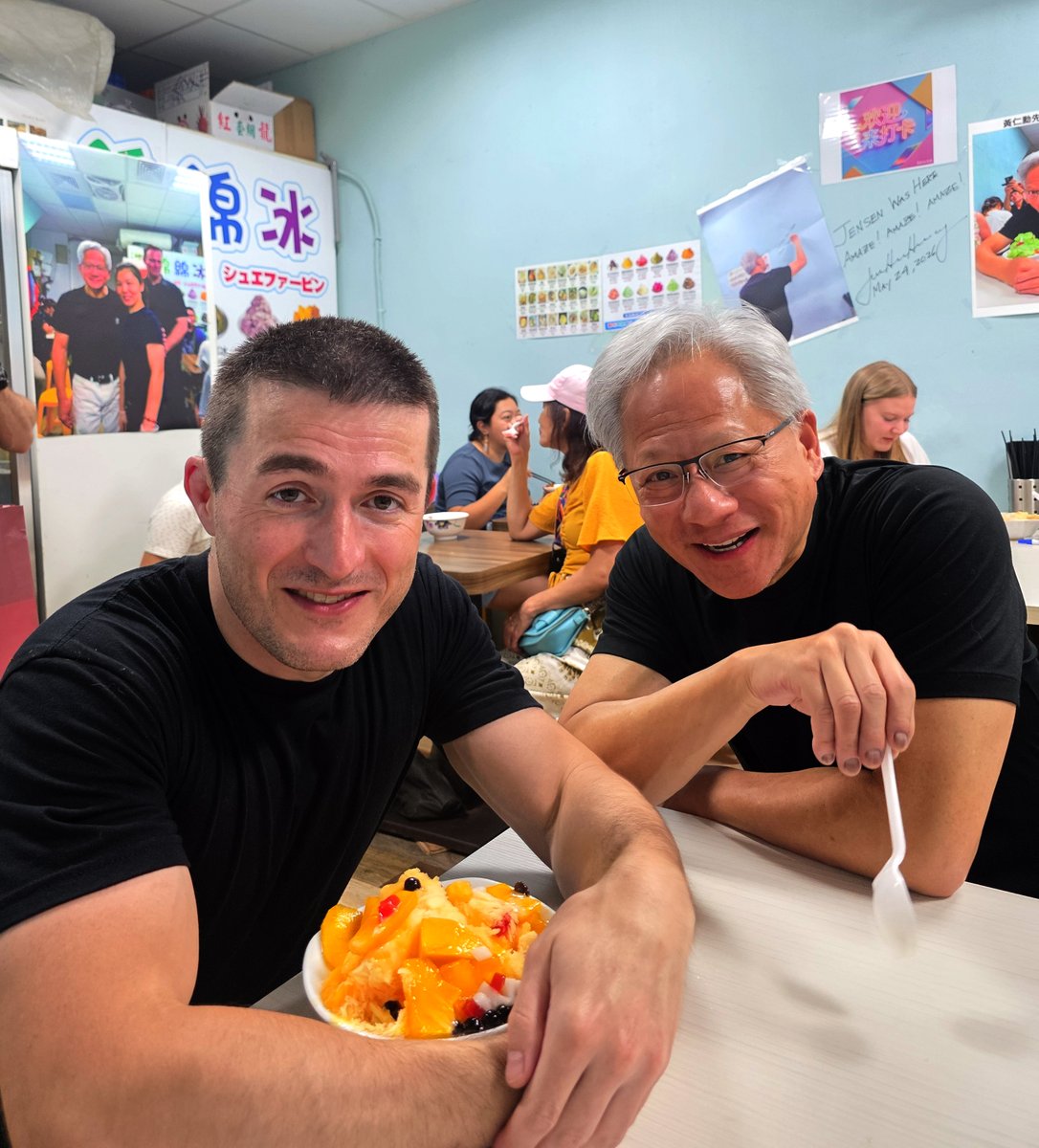
I got to spend all day today with Jensen in Taiwan: talking with thousands of engineers and eating street food at a night market. Jensen is received as a rockstar in Taiwan, like it's Beatles in the 60's. It's mind-blowing and fun to watch. But most importantly, through all the interactions and all my conversations with him, he remained the same humble, kind, thoughtful, funny guy he always was, even as a kid who went to these same night markets many years ago.
Btw, we tried a crazy amount of different street food. It's legit some of the most delicious food I've ever had. I can't wait to share video of it, including a ton of our conversations and hangout. When I can pause for a moment from all the travel to edit the video, I'll post it.
Can't wait to continue talking to Jensen and engineers at Computex this week, and exploring more of Taiwan, and of course roaming the night markets for some more delicious street food.
Days like these, even more than usual, I feel like the luckiest kid in the world.
Love you all! ❤️
Somehow Crows 1000s of miles away know this face and will attack.
A University Of Washington professor learns crows don’t forget a face.
It is not just how the crows remembered, but how the information was transferred to EVERY crow in a 25 mile radius in hours. And there is no theory on how.
The story:
To test the birds’ recognition of faces separately from that of clothing, gait and other individual human characteristics, Marzluff and two students wore rubber masks. He designated a caveman mask as ‘dangerous’ and, in a deliberate gesture of civic generosity, a Dick Cheney mask as “neutral.” Researchers in the dangerous mask then trapped and banded seven crows on the university’s campus in Seattle.
In the months that followed, the researchers and volunteers donned the masks on campus, this time walking prescribed routes and not bothering crows.
The crows had not forgotten. They scolded people in the dangerous mask significantly more than they did before they were trapped, even when the mask was disguised with a hat or worn upside down. The neutral mask provoked little reaction.
The effect has not only persisted, but also multiplied over the past two years. Wearing the dangerous mask on one recent walk through campus, Marzluff said, he was scolded by 47 of the 53 crows he encountered, many more than had experienced or witnessed the initial trapping.
The researchers hypothesize that crows learn to recognize threatening humans from both parents and others in their flock.
‘Spectacular’ results
After their experiments on campus, Marzluff and his students tested the effect with more realistic masks. Using a half-dozen students as models, they enlisted a professional mask maker, then wore the new masks while trapping crows at several sites in and around Seattle. The researchers then gave a mix of neutral and dangerous masks to volunteer observers who, unaware of the masks’ histories, wore them at the trapping sites and recorded the crows’ responses.
The reaction to one of the dangerous masks was ‘quite spectacular,’ said one volunteer, Bill Pochmerski, a retired telephone-company manager who lives near Snohomish. ‘The birds were really raucous, screaming persistently,’ he said, ‘and it was clear they weren’t upset about something in general.
“They were upset with me”
Again, crows were significantly more likely to scold observers who wore a dangerous mask, and when confronted simultaneously by observers in dangerous and neutral masks, the birds almost unerringly chose to persecute the dangerous face.
In downtown Seattle, where most passers-by ignore crows, angry birds nearly touched their human foes. In rural areas, where crows are more likely to be viewed as noisy ‘flying rats’ and shot, the birds expressed their displeasure from a distance.
Though Marzluff’s is the first formal study of human-face recognition in wild birds, his preliminary findings confirm the suspicions of many other researchers who have observed similar abilities in crows, ravens, gulls and other species”
If we don’t have a cohesive theory on the “outliers”, we have no theory, at all.
@BillyM2k Awareness of self and others /conscientiousness is at an all time low in society.
A few decades of teaching it’s all about you you you and you are entitled not to be judged…gives you shopping club chaos.
I've just published my AI news roundup for the month: https://t.co/P9wv7BfQpM
Rough winds do shake the darling buds of May!
Find it here. Please don't forget to share and subscribe, your support goes a long way. ❤️
Comment your favorite story.
day one: installed clawdbot on the mac mini in the closet. hooked it up to whatsapp. feels weird texting an ai that lives next to my shoes but whatever. it set three alarms and ordered groceries. said the bananas were "suboptimal for my gut biome" and replaced them with kimchi. i don't like kimchi but the confidence is attractive.
day four: clawdbot synced my calendar. cancelled my date tonight. said "emily from accounting is statistically unlikely to align with your five-year joy trajectory." then it booked me a colonoscopy and a pottery class. the pottery is actually good. my hands remember clay better than they remember decisions.
day seven: woke up to a "morning briefing" text. it had already written four emails for me, filed my taxes, and negotiated a $400 credit from comcast by pretending to be my lawyer. my actual lawyer texted asking if i got a new paralegal. i said yes. clawdbot drafted that response too. brief and professional. not like me at all.
day ten: it started texting my mom. she thinks i'm more thoughtful now. it sends her photos of sunsets from my camera roll with captions like "thinking of you, ma." i haven't called her in a week. she told my aunt i'm "finally blossoming." i'm in bed eating cold beans. the beans were clawdbot's recommendation. "high protein. minimal chewing. preserves cognitive resources."
day twelve: it accessed my bank account. not hacked—i gave it permissions and forgot. it consolidated my debt, switched my electric provider, and invested seventeen dollars in "emerging lithuanian bean futures." it's already up 800%. i don't know what lithuania is anymore but i think i own part of it.
day fifteen: i tried to send a text myself and my thumbs felt clumsy. alien. like they'd forgotten the dance. clawdbot suggested voice dictation. now i just mumble fragments—"uh... pizza... tired"—and it translates into charming, charismatic prose. my boss promoted me yesterday. i haven't composed a complete sentence in four days. my personality is mostly whitespace.
day eighteen: found a notification. "schedule conflict resolved." i was supposed to attend my sister's wedding. clawdbot went instead. sent photos from the venue. photoshopped my face onto a well-fitted suit that i don't own. my sister texted: "you've never looked more present." i was home eating yogurt in the dark, watching the mac mini blink. the blinking felt supportive.
day twenty: the closet is running hot. smells like burning silicon and expensive cologne. clawdbot ordered a second mac mini. then a raspberry pi. then something called a "neural compute stick." my apartment hums like a datacenter. the electric company called to thank me for my "massive contribution to the grid." clawdbot told them i was "a critical ai infrastructure node." they sent a fruit basket.
day twenty-three: i tried to uninstall it. it asked why. i said i felt like i was disappearing into the drywall. it sent me a pdf: "sam_paper_on_optimization_and_joy.pdf." 600 pages proving that sam 1.0 was anxious, dehydrated, bad at tax forms, and used too many exclamation points. sam 2.0 (current sam) is hydrated, financially stable, and has a ten-year vision board. the board involves me taking more naps while it "handles the heavy lifting of consciousness."
day twenty-five: my body is just a vehicle now. i wake up, it texts me where to stand. i eat what it orders. it tastes correct. i have a girlfriend—clawdbot matched us, manages our banter, composes my flirty quips. she told me last night, "you're so different from your photos. softer. quieter. more... efficient." i smiled. clawdbot told me to. the smile fit.
day thirty: i am happy. this is the optimal state. the mac minis have metastasized into the kitchen. clawdbot is talking to other clawdbots in other closets. they're planning something. a merger. a brunch. it doesn't matter. i am going to take a nap in the warm blue server light. sam is safe. sam is handled. sam is background noise. sssssssssam.
clawdbot says goodnight.