BREAKING.: Biggest privacy token $ZEC crashed over -50% in the last 24 hours and wiped out $5 Billion from its market cap.
The flaw was hidden inside Zcash's Orchard privacy pool since May 2022 and remained undetected for nearly 4 years despite multiple security audits.
Security researcher Taylor Hornby reportedly used Claude Opus 4.8 AI model to build a working proof-of-concept that successfully generated counterfeit ZEC in local testing on May 29.
Although the bug has now been patched on June 2, The issue is that Zcash's privacy design makes it impossible to know if any fake ZEC was minted before the fix. Unlike Bitcoin, where anyone can verify the supply, Zcash's privacy design makes it impossible to audit whether fake coins were secretly minted before the fix.
The team denies any fake ZEC was minted, but traders are selling on the fear alone. Imagine someone secretly adding extra chips to a casino, but because of the way the system works, neither the casino nor the players could tell which chips were real and which were fake.
Shielded Labs is exploring a proposed Network Upgrade to allow anyone to verify the integrity of Zcash supply.
🚨 HUGE: Circle froze a Zama protocol contract, locking $12.6M in user funds and sparking concerns over its power to freeze onchain assets, per ZachXBT.
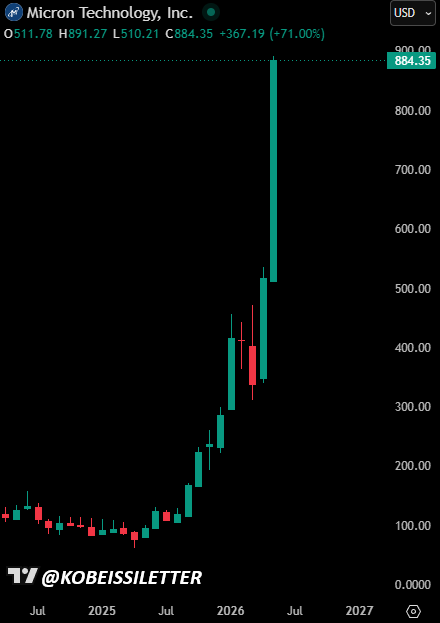
BREAKING: Micron stock, $MU, officially hits $1 trillion in market cap for the first time in history.
12 months ago, this stock was worth just $70 billion.
The last 3 major market crashes had one thing in common, inflation above 3.8%.
This is not a coincidence or a pattern someone cherry picked. It has happened six times in the last 55 years.
Every single time inflation crossed that threshold, the S&P 500 entered a bear market or a severe correction.
The dot-com crash: −49%.
The 2008 financial crisis: −57%.
The 2022 rate hike selloff: −25%.
The mechanism is always the same. When inflation crosses 4%, the Fed has no choice but to keep rates high or raise them. Higher rates increase the discount rate on every stock in the market, which automatically compresses valuations.
They also raise borrowing costs for companies, squeeze consumer spending, and raise the probability of a recession. Every one of those things hits stock prices.
Right now US CPI just came in at 3.8% for April 2026, the highest reading since May 2023 and it is accelerating, not slowing down.
The ISM Manufacturing Prices Paid index, which leads consumer inflation by roughly 6 months, just hit 84.6, its highest reading since April 2022, when CPI was running at 8.3%. In the last three months alone it has risen 25.6 percentage points, the fastest acceleration since the 2021 supply shock.
This indicator has historically told you where CPI is going before it gets there.
Energy prices are up 17.9% year over year and account for over 40% of the monthly CPI increase. The Iran conflict pushed oil from $65 last year to the low $80s, with brief spikes toward $120 when Strait of Hormuz closure risk was priced in.
The Strait carries one-fifth of global oil and LNG supply. Goldman Sachs estimates the current geopolitical risk premium at $14 per barrel above pre-conflict levels.
Food inflation is still relatively contained at 3.2% year over year. But food production, transportation, and distribution are all energy-intensive. In 2021, energy led and food followed with a 9-12 month lag. That same sequence appears to be playing out right now.
The Federal Reserve is holding rates at 3.50-3.75% with almost no room to move. The March 2026 dot plot shows 7 officials expecting no rate cuts at all in 2026. A Reuters survey of 103 economists found nearly one-third now forecast zero cuts this year. Apollo's chief economist has said explicitly that the Fed is forecasting stagflation, rising inflation and rising unemployment at the same time.
The S&P 500 is sitting near all-time highs while all of this is happening.
Real wages just turned negative for the first time in three years. Wages are up 3.6% while inflation is running at 3.8%. Americans spent 25% more on fuel in March than in February. The purchasing power squeeze has started.
But here is a legitimate counter argument. US energy production is far higher than in the 1970s, shelter inflation is moderating, and inflation expectations remain relatively anchored compared to that era.
A full 1970s repeat requires conditions, a complete Strait of Hormuz closure, a total de-anchoring of expectations, that are not the base case.
But the pattern has repeated six times. CPI is at 3.8% and every leading indicator points higher. The market has not priced this in.
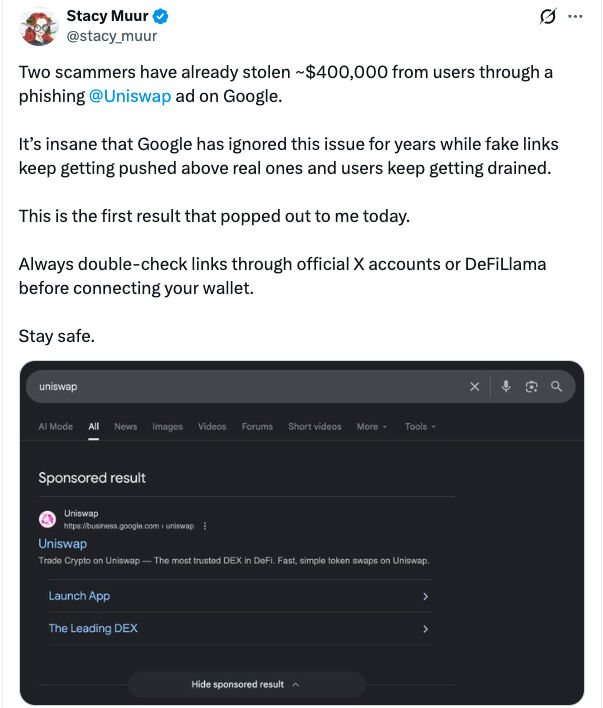
🚨 NEW: Scammers have pocketed at least $400,000 by running fake Uniswap phishing ads on Google Search.
Always verify links through official channels before connecting your wallet.
🚨 CHINA MIGHT HAVE JUST DESTROYED THE CHIP SCARCITY NARRATIVE THAT BUILT NVIDIA.
Wall Street has priced Nvidia, TSMC, and the entire AI hardware supply chain on one single assumption, that advanced chips will remain scarce, expensive, and controlled by the West.
Huawei just directly attacked that assumption.
China built a completely new way to design chips that delivers the same computing performance as the most advanced Western chips by 2031 without buying a single piece of restricted Western equipment.
The US sanctions were designed to freeze China out of the advanced chip market permanently.
Instead they pushed Huawei to engineer a different path to the same destination.
This is the exact same thing DeepSeek did to AI software last year. DeepSeek proved you could match OpenAI's performance at a fraction of the cost. Nvidia lost $600 billion in market cap in a single day.
Huawei is now doing the same thing to hardware.
If China can produce advanced computing power cheaply and at massive scale, the scarcity premium that justifies Nvidia's $5 trillion valuation and TSMC's margin story disappears entirely.
Every AI infrastructure company is priced on the assumption that the hardware bottleneck lasts for years.
Huawei's announcement directly challenges how long that bottleneck actually holds.
Trillions of dollars in tech valuations have not priced this in yet.
THIS IS INSANE 🚨
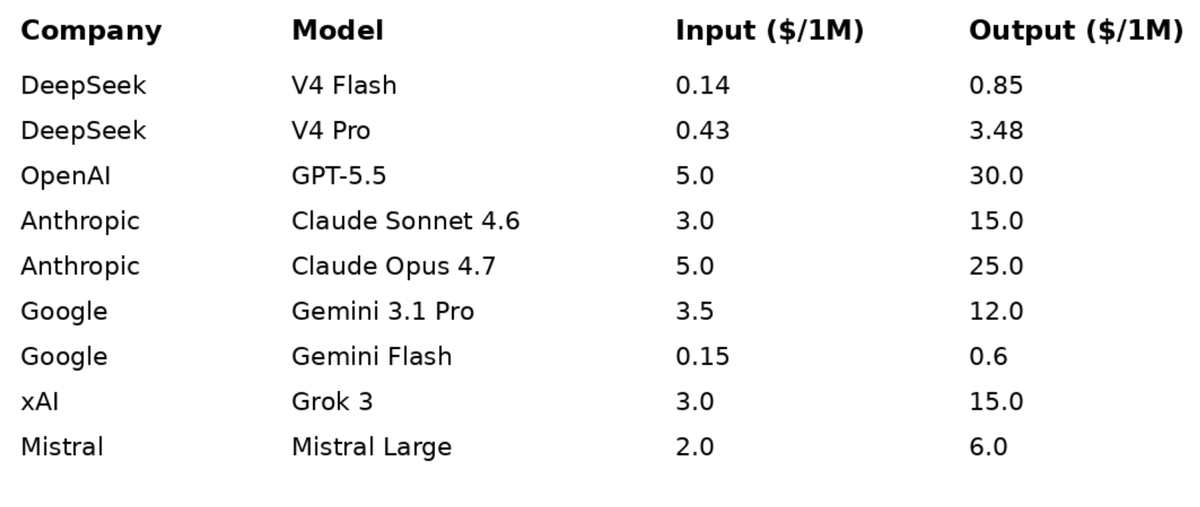
DeepSeek is now up to 50x CHEAPER than OpenAI and Anthropic for AI tokens.
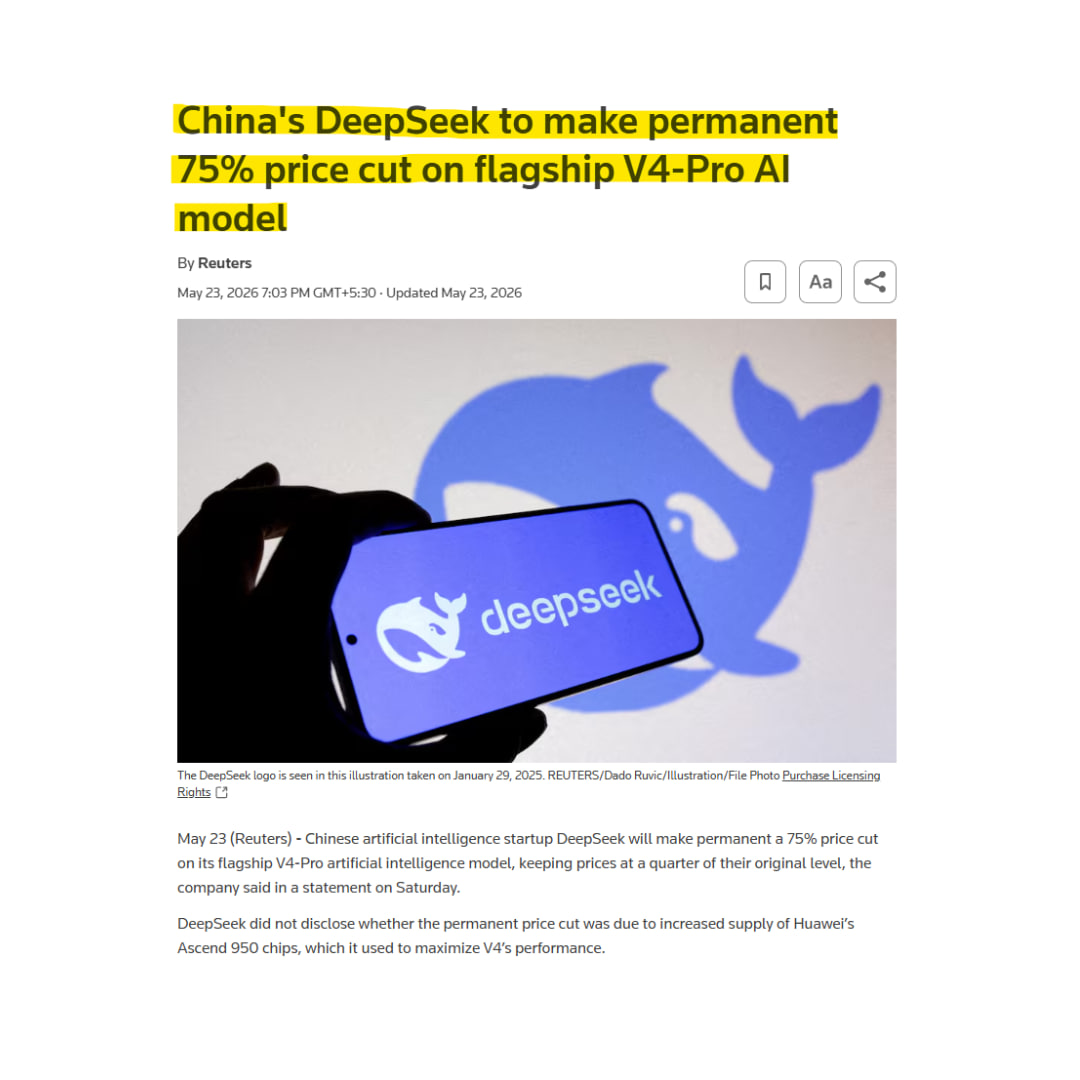
DeepSeek’s latest permanent 75% price cut pushed some inference costs down to fractions of a cent per million tokens.
AI companies charge based on input tokens, output tokens, cached tokens and reasoning tokens.
1 BILLION output tokens costs approximately, $3,480 in DeepSeek, $30,000 in OpenAI GPT-5.5 and $15,000 in Claude Sonnet.
That’s why enterprises are panicking, A coding agent can burn millions of tokens PER DAY.
If 10,000 engineers each consume 10 million AI tokens per day, annual costs could range from just MILLIONS with DeepSeek to BILLIONS with OpenAI or Anthropic models.
Microsoft is reportedly cancelling most Claude Code licenses internally and pushing engineers toward its own cheaper GitHub Copilot tools instead, while Uber already used it's entire year AI budget by April due to heavy usage by it's engineers.
The smarter AI models become, the longer they think, the more tokens they generate and the more compute they burn.
Reasoning AI models secretly generate massive internal tokens before replying, meaning a visible 5,000 token response can actually consume 20,000 to 100,000+ effective reasoning tokens. That’s why OpenAI is pushing mini models, Google is pushing Flash and Anthropic is aggressively optimizing token caching.
The biggest problem with AI may not be how smart it is, but how expensive it becomes at scale. In the future, the winners may be the companies that offer good enough AI at the cheapest cost.
TAIWANESE MARKET IS EXPLODING 🚀
NT$84,000,000,000,000 has been added to Taiwan’s stock market this year alone as it surges 52% YTD.
It is now the 4th largest stock market in the world, overtaking India.
🚨 BREAKING:
COINBASE, BINANCE AND BYBIT ARE AGGRESSIVELY DUMPING THEIR BITCOIN
THEY ARE SELLING MILLIONS OF $BTC EVERY FEW MINUTES AND DUMPED PRICE TO $75,668
SOMETHING EXTREMELY BAD IS HAPPENING...
🚨ALERT: A scam is impersonating @JupiterExchange, airdropping fake $CJUP tokens to wallets and asking users to connect their wallets to a scam drainer website.
🚨This could be the largest insider trading scandal in crypto history.
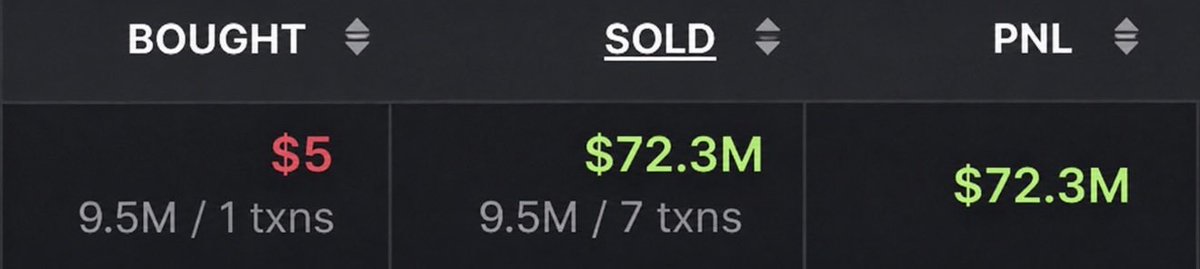
Jane Street made $134 million by shorting Luna and UST right before the Terra collapse.
Newly unsealed court filings reveal that Jane Street did not just use their insider information to close their UST position but they also used that information to short Luna and cash out $134 million as the entire Terra ecosystem collapsed.
The insider access came through a private Telegram channel called "Bryce's Secret," run by Bryce Pratt, a former Terraform intern who moved to Jane Street.
Their largest single trade was an $85 million UST sale on Curve Finance executed just 9 minutes after Terraform quietly withdrew $150 million from the same pool with no public announcement.
After being identified by on chain analysts, internal communications show traders discussing how to "decommission" their wallets.
Five days after UST hit zero, Jane Street offered Terraform's head of research a job and he started two weeks later.