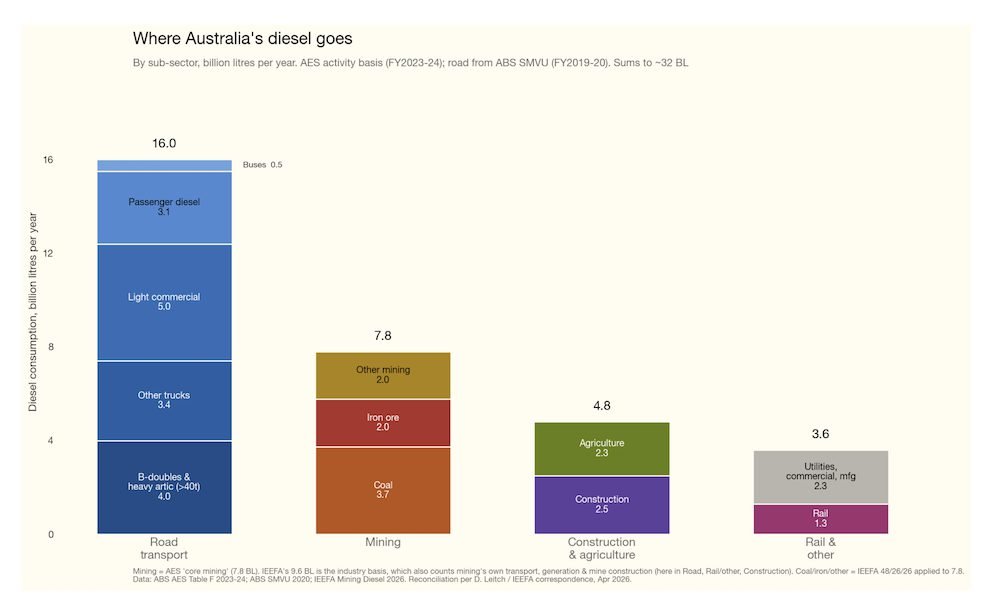
Great article from David Leitch on the importance of electrifying our trucks for economics & national security reasons.
Australia spends ~$40b/yr on importing diesel that is vulnerable to overseas conflict.
This chart shows most diesel use can be electrified with current tech
/1
Our thanks to guest author (Allan O'Neil) who has explored the various factors that contributed to the recent run of elevated prices in the South Australian region - especially the spikes on Sunday evening 21st June 2026 and Monday 22nd June 2026:
https://t.co/HlFY7FhHdm
The bill goes up. The price per unit is collapsing about 10x a year. Both are true at once, and the space between them is the entire AI business.
GPT-4 ran around $36 per million tokens in 2023. Equivalent performance now costs under a dollar. That is one of the fastest cost declines of any computing input ever measured, quicker than the early internet's bandwidth curve.
So why does Altman describe a rising meter instead of a shrinking one? Because usage is outrunning the price drop. Reasoning models burn thousands of hidden tokens before they answer a single question. The query that used to cost you a sentence now costs a paragraph of thinking you never see.
Electricity ran this exact play for a century. Price per kWh fell for decades and the monthly bill still climbed, because every cheaper watt got matched with another device plugged into the wall. AI is compressing that curve into years.
The tell is the comparison itself. When a founder maps his product onto electricity and water, he is describing the margin structure he expects to live in. Those are commodities. And the profit in a commodity never sits with whoever prints the units on the invoice. It sits with whoever controls the scarce input feeding the meter.
For AI that input is power and compute, not tokens. The metered bill is the part you get to see. The real money is upstream of it.
A milestone achieved on Australia's main electricity grid, the NEM.
Energy discharged from utility batteries over the last 12 months now exceeds generation from peaking (OCGT) gas turbines.
Those who thought batteries would only provide ancillary services now looking foolish.
Mike Pezzullo ran Australia's immigration apparatus for nearly a decade.
We discuss how Australia actually selects and integrates migrants.
This is the final episode in my immigration series.
Mike oversaw Operation Sovereign Borders from 2013-2014. He then ran the Department of Immigration and Border Protection (which became Home Affairs) from 2014 to 2023. Across these roles, he was responsible for how Australia selects migrants, screens for risk, and thinks about social cohesion.
Someone with so much institutional knowledge would rarely be both recently retired and willing to speak in great depth about how the system really works.
We discuss:
- How the broad spread of source countries among Australia's overseas-born population (a key to our success with acculturating migrants) is a happy accident, not the result of deliberate policy -- a remarkable fact about modern Australia which is not well understood.
- What the migrant selection process looks like at a concrete level, and whether AI will favour the gamers or the gatekeepers.
- Australia hasn't gotten worse at acculturating migrants. As Pezzullo puts it: "we are incredibly successful at blending together different demographies, ethnicities, religions, and cultures." (With one exception, which we discuss.)
- The two groups that Pezzullo thinks present the greatest extremist-threat.
- Australia vs France as a case study: why we've been much more successful at integrating migrants than France, and what that has to do with the history of France's style of imperialism (different to British imperialism).
- Even with today's federated digital screening and the benefit of hindsight, Pezzullo doubts the father of the Bondi attackers would have been refused a student visa in 1998.
- A never-aired constitutional fix to Australia's "permanent temporaries" problem -- which Pezzullo calls "the Pezzullo special": close off the High Court's original jurisdiction over non-citizens, and replace it with a single 30-day review.
- What a 2027 China-Taiwan blockade would mean for the Australian migration system in real time, and how Pezzullo would manage it operationally.
- The case for "populate or perish" returning as strategic policy: speaking "as a military strategist and a military defence planner," Pezzullo (who is also a former Deputy Secretary of the Department of Defence and wrote the 2009 White Paper that reputedly displeased Beijing) wants Australia at 40 million people by 2050, rather than the projected 35 million.
- And much more.
Watch below, or on YouTube, Apple Podcasts or Spotify.
Timestamps:
(0:00:00) – Introduction.
(0:02:19) – How Australia selects migrants.
(0:37:01) – Australia's broad distribution of source countries is a happy accident.
(1:05:03) – Acculturation services.
(1:48:50) – The temporary migration dilemma.
(2:07:56) – Social cohesion and the politics of immigration.
(2:40:22) – Radical Islamism and the limits of selection.
(3:03:35) – What if China blockades Taiwan tomorrow?
(3:14:13) – Should 'populate or perish' make a comeback?
Great post on FDEs. Everyone should read it if you’re interested in this job category. This is a job that is going to be around as long as AI keeps changing rapidly, which it inevitably will.
People often wonder why isn’t this like just deploying other forms of technology in the past, like cloud.
Because something like cloud adoption affected a fairly concentrated set of users (developers and IT), and generally didn’t require a fundamental change to the workflows of employees to get the benefits of the new service being delivered on the cloud. At best you went to one training session and you were done.
With agents, the work to implement them is not only highly technical, but they directly impact the underlying workflows that people participate in. This means there’s a ton of technical work and change management that comes with it.
Further, the pace of change of cloud wasn’t nearly as quick, so there was a lot more time for best practices to propagate. Now, every model change means either something new can be done that wasn’t possible before, or some piece of scaffolding is now redundant or holding you back.
This is why it’s commonly easier for a vendor or partner that’s seen the implementation hundreds or thousands of times help do the work, even with internal support from the customer.
So, this job isn’t going away any time soon, and will be a great path for a lot of technical talent, especially early career.
Well, I guess the idea that humans will have nothing valuable left to do in the age of AI is going around again, so it is a good time to repost this article
This is turning into a game of telephone.
Yes, this is true *if* you can unlock spare capacity on the system creatively. This is why data centers weren't a problem historically -- because there was lots of excess capacity on the system.
It's important to understand what GridCARE is arguing in the initial commentary. This requires data centers to actually do the hard work, in partnership with utilities, to uncover and certify new capacity through demand flexibility, distributed solutions, and grid-enhancing tech. I do not see many data center developers *actually* doing this work, aside from a couple hyperscalers.
This is not magic. It takes an industry-wide effort to put in the work.
Industrial electrification is the new frontier: Next week I will give the opening keynote at one of Europe’s leading events on Industrial Heat Pumps in the heart of Prague. With electrification rising as a major global trend in heat decarbonisation, the conference will bring together key players shaping the future of energy — from industry leaders to researchers and policymakers.
Gerard and I have an explosive conversation with Bryan Long, Executive Director in JPMorgan’s Commodities Group.
We explore why U.S. energy market signals are failing to support new capacity investments, despite soaring demand (especially from datacenters). Key issues include misaligned pricing, liquidity constraints, and hedging challenges, all of which deter long-term private capital.
Key Takeaways:
Current price signals don’t support investment in new generation, even as large load growth (e.g., datacenters) is accelerating.
Market structures must evolve to better reflect long-term price signals and attract private capital.
Supply-side issues:
New natural gas peakers and battery storage (BESS) face fragmented development, rising CAPEX, procurement delays, and tariff risks.
Industry response:
Major consolidation in the IPP space—private equity-backed assets are being acquired by integrated players seeking scale for hyperscaler deals.
Possible solutions may include Repricing of forward curves, Government-backed long-term contracts, Regulatory reforms, Technological advancements
Bottom line: Something must shift—be it policy, pricing, or tech—to align investment incentives with future demand growth. The next several years should be great for traders in the middle of the action.
Conclusion: Between the Large Load Growth and the Investment Capital, who will blink first?
With the Coalition losing the election, the 7 promised nuclear reactors will now never be built. Which coincidentally is the same as if the Coalition had won the election.
... and with a very interesting 25kW DC two way EV charger / V2G module. Will be an interesting tech supplier to watch. Let's see who (& when) releases the 1st 25kWDC V2G EV?
https://t.co/WR7JIwWwOm
Hi all please find link to Vinnies national tariff tracker - changes in gas electricity and solar offers we follow - NUOS and this year a deep dive into TOU https://t.co/nSmy4CPpSc
Hi all find attached the victorian tariff tracker update - covers gas electricity and solar offer we follow - its a bit of a mixed bag mostly down BUT NUOS is up ( have look at the long term NUOS pricing) https://t.co/pdeIEAFfiX stay safe and see you all in 2025
So excited to share this just published work 📣
Using PISA data from 38 OECD countries over 18 years, we show that student’s aspirations (technically expectations) to attend university *decrease* during hard economic times