AI use for any business function is concentrated in selected sectors and large firms and primarily for augmentation of worker tasks rather than substitution, from Kathryn Bonney, Cory L. Breaux, Emin Dinlersoz, @Lucia_Econ, @JHaltiwanger_UM, and Aditya A. Pande https://t.co/pIHFaDtHCX
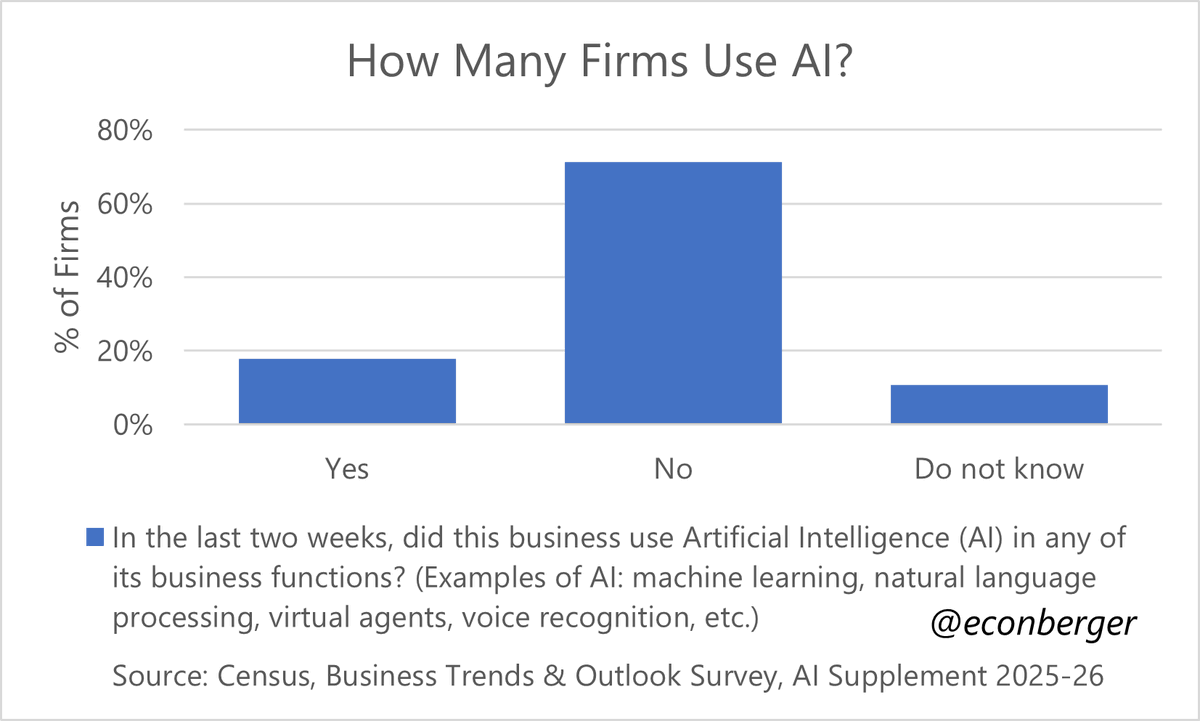
We have a new gold-standard assessment of AI usage by American firms courtesy of the @uscensusbureau Business Trends & Outlook Survey.
1/ AI adoption is fairly high IMHO. Almost 1 of 5 firms. But much lower than discourse on Twitter would lead you to expect.
Now that I've had time to read the paper, here are a few things I'd flag for folks. Do read it. They did a great job with the new BTOS AI Supplement questions and describing the data.
tldr: No big self-reported employment effects of AI use (+ or -), use tends to be augmenting rather than automating, use is associated with better firm performance.
1. The BTOS tables don't give employment weighted stats, but the papers do. Here we get another peek at emp-weighted stats. 18% of firms using AI but they account for 32% of employment.
2. Worker augmentation is far more common than automation, which happens about as often as task creation. 44% of AI-using firms are augmenting workers, 10% use AI to replace tasks, and 11% created tasks. Conditional on automating tasks, 71% say it's for a "small number" of tasks.
3. As John noted, the overwhelming majority of AI-using firms say AI didn't impact their employment (96%), the remaining are split almost evenly between increase (2.3%) and decrease (2%). Capital replacement is more common (16% of AI-using firms).
4. AI use on both the extensive and intensive margin is associated with better firm performance, both now and expectations about the future. This shows up both in the summary stats (Table 8), and in regressions controlling for size, industry, geography, and time (Table 9).
5. AI use is also associated with relatively small increase in the probability of expecting employment decreases, but interestingly, these are pretty stable (current decreases are similar to future decreases). In fact, in some places the coefficient on future emp declines is actually smaller than the one for current declines (Table 10, 11).
A couple other things caught my eye.
6. Interesting that the % of firms only creating new tasks is much higher firm-weighted than emp-weighted, suggesting they tend to be small firms. Easy to tell yourself a story about small firms being able to "do more". (Figure 15)
7. Large firms are doing a lot of training, firm-weighted % of firms saying they are training staff on AI was about 15%, but emp-weighted it jumps to maybe 35% (hard to tell eyeballing the graph). (Figure 18)
8. Even now, a very large share of firms still say AI is not applicable to them, 65% of firms and maybe 45% emp weighted. (Figure 19)
PS: Those here for the debates about AI measurement, there are two easter eggs for you in the paper: (1) there is a nice description about the November 2025 BTOS AI definition switch ("in production" to "any biz function"), (2) there is an exhaustive comparison to other estimates (e.g. Yotzov et al. (2026) finding 69% of firms using AI).
Questions about #ArtificialIntelligence are now updated on our Business Trends and Outlook Survey to help respondents fully capture their business use of #AI.
Here are our latest findings.
Explore more #BTOS data: https://t.co/Yi8p3W648u
Congratulations to Philippe Aghion, Peter Howitt and Joel Mokyr for a well-deserved Nobel Prize. It was nice to see the US Census Bureau's Business Dynamic Statistics featured as motivating evidence in the scientific writeup: https://t.co/DIScyEoo5K
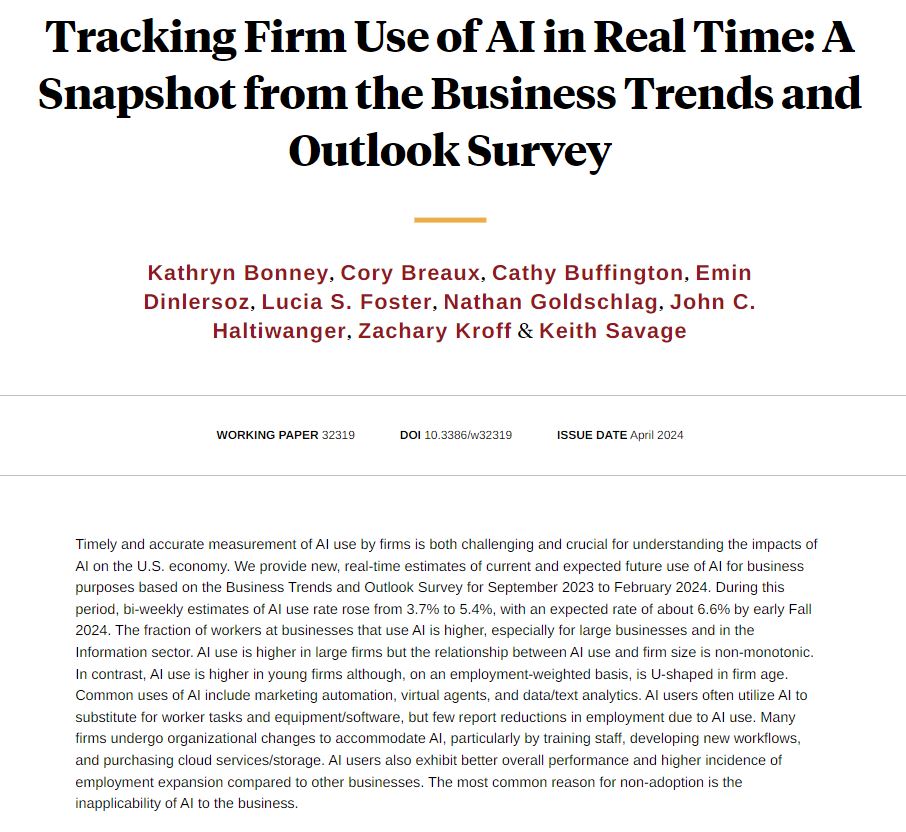
AI use for business purposes is relatively small but growing rapidly, from Kathryn Bonney, Cory Breaux, @cathybuffington, Emin Dinlersoz, @Lucia_Econ, @ngoldschlag, @JHaltiwanger_UM, Zachary Kroff, and Keith Savage https://t.co/IvKOQYsDn3
🤖🔮New *Real Time* Data and Working Paper on AI Use 🤖🔮
Our earlier work using firm survey data on AI use was prior to the rise of LLMs. This new data from BTOS covers Sep '23 to Feb '24 and asks about both current use and future expected use of AI. https://t.co/5SNr39DPnc
📢New data and working paper!📢
Business dynamics of high-growth firms, 44 new tables of BDS stats by firm growth rates with the stock and flow of firms, establishments, and employment covering over 4 decades. @JHaltiwanger_UM@choijk85@jdanielkim https://t.co/2jiFe6XfwI
Released today is Census BTOS data and working paper on AI use by businesses in real time (September 2023-February 2024). Working paper can be found at:
https://t.co/hLnKLN8DrS
AI use for business purposes remains relatively small but growing. Higher at larger businesses:
Lucia Foster (@uscensusbureau) highlighted new data available on adoption of #AI across industry sectors and noted forthcoming survey data asking holdouts why they aren’t adopting it.
#AMEC symposium >>
https://t.co/6hz8OlSY3Z
Registration is open for the next #AMEC symposium—U.S. Productivity Growth: Looking Ahead
See the lineup of sessions and speakers here:
https://t.co/6hz8OlSY3Z
Hybrid event
Friday, Feb. 16
9:30 am-3:00 pm
#AI#supplychain#superstarfirms#productivity#inequality#cities
Nathan Goldschlag finds that fewer inventors are at small, young firms and more at older, larger firms.
How might that affect the nature of innovation?
Responses to our Business Trends & Outlook Survey Oct. 23-Nov. 5 show 3.9% of firms currently use Artificial Intelligence or AI, and 6.5% expect to in the future.
#BTOS indexes measure recent or expected changes to business conditions: https://t.co/T1q8q8v1Xn
#CensusEconData
Join @uscensusbureau for the virtual workshop on Advancing Research on Race, Ethnicity and Inequality on Nov. 14-15, 2023.
Presented research will examine racial and ethnic inequalities in health, employment, education, housing, and more.
https://t.co/mXuBXcOWKa