Traditional prime brokers don't assess risk one position at a time.
They assess the portfolio.
If financing is based on gross positions rather than net portfolio risk, borrowers can end up posting significantly more collateral than the risk actually warrants.
A portfolio is not a collection of isolated positions.
Yet much of crypto credit infrastructure still treats it that way.
Institutional trading firms manage exposure across exchanges, venues, and strategies simultaneously.
Evaluating each position independently can overstate the risk that actually matters: the portfolio as a whole.
That's why portfolio-based margining matters.
Spark Prime uses @ArkisXYZ technology to evaluate exposure across DeFi and CeFi venues, allowing financing decisions to reflect net portfolio risk rather than treating each position in isolation.
Read more about Spark Prime👇
https://t.co/LPiZcYRNnj
People only think about liquidity when markets break.
The real question is whether they understood the risks and structure before they deposited.
Read how @sparkdotfi has built a 5 layer sequential loss absorption framework alongside bounded liquidity coordination, constrained capital movement, and multi-layered risk controls designed to protect user funds under stress.
Inside Spark’s loss absorption & risk frameworks.
Spark’s security architecture is designed around:
• bounded capital movement
• explicit loss absorption layers
• coordinated liquidity management
• multi-layered oracle systems
• constrained automation under governance-defined limits
This deep dive breaks down how Spark structures risk, liquidity, and loss absorption across Spark Savings, SparkLend, and the Spark Liquidity Layer before losses propagate toward user deposits.
Including:
• updated loss absorption waterfall
• Prime Agent risk capital
• Genesis Capital Backstop
• oracle and killswitch architecture
• programmatic liquidity coordination
• constrained allocation design under stress
Security by design.
Resilience by architecture.
See what sits between losses and user deposits: https://t.co/JQrfSxMB4z
$1B isn’t the milestone. It’s the shift.
You’re no longer just using the market...you’re influencing it.
That changes how you think about liquidity, execution, and where capital actually sits.
Liquidity is defined by how systems behave under stress.
Our co-founder Sam MacPherson breaks down how Spark is structured to manage risk across liquidity, collateral, and infrastructure
Most discussions around recent events are missing the point.
This isn’t about one protocol or one exploit.
It’s about how risk is structured in on-chain credit markets.
In many systems, collateral is treated as if it’s self-contained. But in reality, it often depends on: – external issuers – bridges – underlying assumptions that sit outside the protocol
When those assumptions break, the impact doesn’t stay isolated. It flows through to wherever that collateral is used.
Collateral isn’t just an asset. It’s a dependency stack. As markets scale, this becomes harder to manage.
And more important to design for upfront
As DeFi matures, investors deserve accurate, public information about protocols, and protocols need a better way to communicate with investors.
We’re proud to partner with @sparkdotfi to launch the first DefiLlama investor relations portal.
This goes deeper than DefiLlama’s normal dashboard, incorporating additional metrics and granularity, along with a place for Spark to provide context for its analytics. This is a one-stop shop for everything that Spark users need to stay informed:
* Comprehensive analytics about Spark financials and usage
* Quarterly reports
* Recent announcements from Spark
As Tay says, distribution isn’t the bottleneck, conversion is.
It can work well for products that feel like fintechs - the hybrid crypto apps.
Revolut, Wirex, FX brokers, with simple onboarding, fiat rails, and clear UX.
DeFi is different.
The gap between scroll to wallet to a funded position is too wide, and almost impossible to track cleanly.
So campaigns look good on reach, but break on capital.
Attention scales,
Capital doesn't
This pattern is showing up everywhere now.
Scaling isn’t demand constrained anymore, it’s infrastructure constrained.
In robotics = data quality.
In finance = liquidity & execution.
Same underlying dynamic.
Whoever controls those layers defines the market.
After 8 months of building in stealth and testing our infrastructure on 10000+ hours of real-world data and hundreds of unique environments, we're bringing @fpv_labs into the open today.
FPV Labs started with the following bet - if human data proves to be the underlying factor that determines scaling laws in general-purpose robotics, it will trigger the largest economic transformation in human history, and the underlying infrastructure that captures that data will determine how fast we get there.
We will achieve this by building the full-stack infrastructure for capturing, processing, transferring, and evaluating human experience into spatial, temporal, and semantic knowledge for machines.
Despite all the research novelty behind ChatGPT, its success can be attributed to one foundational fact - the scaling law of transformers. We believe the same dynamics have made their way into robotics.
Recent studies showed task completion rates jumping from 30% to 70% when human demonstration data scaled from 1,000 to 20,000 hours, a log-linear trend that mirrors exactly what we saw in language and vision. Seeing these emergent signs of scaling law curves in robotics, we believe we are entering the era of general-purpose robotics policies, which makes the next few years the most exciting time in the history of this field.
But the library of physical interactions required to train general-purpose robot policies does not exist yet. Over the last 8 months, we've seen dozens of companies emerge in this space. We were really happy to see new companies pushing this space forward, but we also saw the same pattern repeat: every egocentric data company was making some tradeoffs between quality, scale, and diversity.
We have built FPV labs on the core principle that high-quality data is orders of magnitude more valuable than sheer volume. Case in point, self-driving cars collect thousands of hours of data per day, but only a small fraction of that data is actually useful for training better models. Several studies, like RT-2, have shown that as little as 1% of data improves as much as 25% on task success. The quality and diversity of data matter a lot more than scale, so there is clearly a power law curve in the downstream impact of data.
We've spent months obsessing over data quality by building our stack, discarding it, rebuilding it, and iterating until we found a formula that doesn't compromise downstream quality at scale.
We believe the downstream impact here is far more profound than most people realize. Workers globally are paid around $60 trillion per year in aggregate, and a lion's share of that compensation goes to physical labor - tasks that require navigating real spaces, manipulating real objects, and negotiating the infinite variability of the physical world.
Human-to-robot transfer will be one of the most important infrastructures that will shape our society in the near future, and if it works, the economic impact will dwarf every technology transition that came before it in an exponential manner and lead to the creation of goods and services we can’t imagine today.
Our mission is to lay the groundwork for us to transition into this future - the future of abundance. We are deeply grateful to our earliest believers, @paraschopra and @lossfunk, who played a critical role in shaping our thinking.
Interesting shift happening around stablecoins.
They’ve largely been treated as something to optimise for yield.
That works when flows are small, but starts to break as regulation tightens and institutional capital enters the market.
At that point it’s less about chasing yield and more about whether liquidity can actually support size, depth, security, execution.
@sparkdotfi is structured around this shift in how its vaults are designed.
Feels like the next phase of growth is going to be defined more by the underlying infrastructure than APY.
This isn’t just Ondo giving access to stocks on Solana.
How it actually works:
– Real U.S. stocks & ETFs are bought and custodied off chain via regulated brokers like Alpaca (@AlpacaHQ)
– Ondo Finance (@OndoFinance) mints a 1:1 token representation on Solana (@solana)
– KYC happens off-chain. Solana enforces compliance on-chain via programmable rules
– Oracles keep pricing in sync with real markets
– Assets trade 24/7 with near instant settlement (rather than T+1 or T+2)
Now live for 200+ U.S. stocks & ETFs
This is how real progress in RWAs actually looks - a real step toward closing the gap between TradFi and DeFi rails.
🔗 Read more: https://t.co/Os90aySjQL
@MariaMa_Meta@tokenterminal Completely agree, with more institutional money flowing in, and stablecoin regulations, I see the days of hype projects taking a back seat in favour of real economic business models over the next few years dominating.
Crypto finally has something close to real business financials.
@tokenterminal revenue isn’t gospel, but it’s the cleanest signal we’ve got.
Fees to usage to revenue to sustainability.
It cuts straight through narrative noise.
Hot take: a lot of the top 20 chains look wildly mispriced on a revenue basis. Agree or disagree?
Check it out 👇https://t.co/OPXIdP95uj
Crypto started with radical transparency because early trust had to be publicly verifiable.
But that assumption breaks as regulation tightens and institutions move serious size onchain. When funds, RWAs and treasury strategies are tokenised, full transparency stops being a virtue and becomes a liability.
No institution wants to broadcast position sizes, execution timing or portfolio construction, especially in a world of MEV and AI-driven flow analysis.
I agree with you @SentinelMaxx . The next phase isn’t about hiding, it’s about verifiable systems with private execution. Institutions will drive blockchain growth over the next few years, and privacy will come back to centre stage as a core architectural primitive, not an opt-in feature.
In 2026, the edge won’t be who’s most open, it’ll be who leaks the least.
Stop Blaming Farmers. The Problem Is Your Airdrop!!
Saw @icobeast venting about airdrop farmers earlier, and honestly, he’s right that the behaviour is damaging.
But here’s the uncomfortable truth:
Farmers didn’t appear out of nowhere.
The industry created them.
Somewhere along the way, crypto forgot what an airdrop was actually for.
It used to be simple:
• Reward early believers
• Give ownership to the people who helped you grow
• Align the community with your future
Airdrops weren’t incentives.
They were acknowledgement.
But in 2025? we created beasts!
• point farms optimised for sybils
• mercenaries screaming 'scam' if they don’t get 4-figures
I joined your socials + did a $3 tx + tweeted using ChatGPT… now where’s my $3k of tokens?
• instant dumps in 30 minutes
• insiders and LP whales carving out half the supply
• ‘Season 2’ airdrops launched because 'Season 1 ' was DOA
This isn’t alignment.
This is extraction.
And here’s the irony:
The community gets blamed for dumping…
while insiders quietly rewrite tokenomics upstream.
You don't need to look far to see what I mean:
Monad squeezed their 'community allocation' to load up liquidity providers for mainnet.
I get the logic, but the balance was way off.
A lot of loyal believers, quite rightly, felt slapped in the face.
Berachain massively favoured whales, insiders, and Bong Bear holders.
Early testnet users are now questioning why they even bothered.
Most new drops reward capital, not contributors.
It’s the rich feeding the rich, wrapped in community language.
Have any airdrops ever worked?
Yes, but for reasons we’ve forgotten.
@Uniswap worked because it rewarded real users in a genuine cultural moment.
The Sushi vampire attack forced everyone to pick a side. Uniswap became the underdog.
Then they dropped UNI, not as a bribe, but as recognition.
The loyalty already existed.
The airdrop just crystallised it.
@arbitrum (one of the largest drops ever, $1B at distribution) worked partly because participation actually mattered.
It wasn’t perfect. Some farmers dumped.
But it respected contributors.
It didn’t treat the community like exit liquidity.
This is what everyone keeps missing:
Airdrops don’t create PMF.
PMF makes the airdrop work.
- You can’t bribe people into caring.
- You can’t 'points season' your way into a community.
- You can’t spray tokens at strangers and expect alignment.
- You can’t give ownership to sybils and expect loyalty.
Airdrops still matter, but only if they return to their purpose:
- Reward belief, not behaviour
- Reward real contributors, not capital
- Reward alignment, not extraction
- Reward the community you already have
Until teams relearn this, every new airdrop will follow the same cycle:
Entitlement → outrage → instant dump → denial → Season 2
The meta isn’t dead.
It’s just being misused.
And marketers - of all people - should know better!
Airdrops work when they follow value, not when you try to commercialise it on the back of a fag packet.
The most underrated truth in crypto right now:
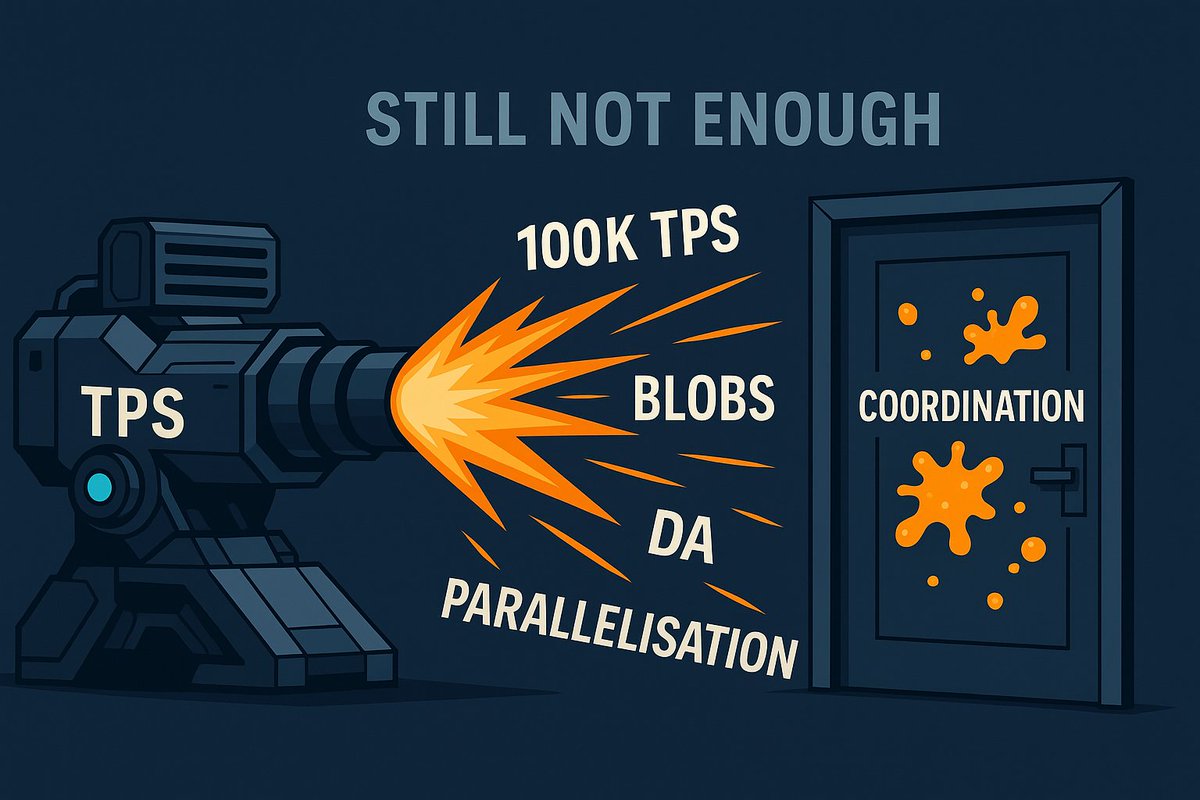
We don’t have a performance problem! chains already push insane TPS. Would another 10k TPS even change anything today?
We have a coordination problem.
Liquidity, identity, compliance, UX… all fragmented across 100+ ecosystems.
Whoever stitches this together wins the next cycle.