Border0 + Tailscale is now Tailscale PAM.
Now in beta, Tailscale PAM gives teams one place to manage connectivity and privileged access to databases, servers, Kubernetes clusters, and internal apps.
See what’s changing →
https://t.co/2YjCwMj5dB
At 250 billion DNS cache entries, one wasted byte costs 250 GB of RAM.
Five Rust optimizations later: 100 TB freed, inserts 43% faster, lookups 19% faster.
We didn't trade speed for space. https://t.co/mMyOYnj0mQ
@FlasheurInvest PRU à 0,14 (je faisais partie des actionnaires lors de l'introduction en bourse).
J'avais 5000 actions, j'en ai revendu la moitié à 0,40.
Je suis pas près de vendre les 2500 restantes :)
The diagrams in the Systems Perf on disks chapter are just too good.
This captures the phases of an I/O, and how the OS, caches, queueing, and the disk itself all impact latency.
pdf-inspector is a local Rust tool that classifies a PDF, extracts structured Markdown when possible, and flags only the hard pages for OCR.
No model, external API, or SaaS on the fast path.
PDF pipelines shouldn't default to OCR.
https://t.co/S7Rv5VJswX
the sandbox infra space is so fun right now. kernel’s pushing the limits of what’s possible, with a nice design and a solid writeup. cool to see the community benefit from this work!
Cool work from the prime people and also demonstrates that the harness matters. Wrote a small post walker about code mode but for retrieval (programmable tool calling)
https://t.co/AdkW5QUwtw
I'm a Principal engineer & I passed system design rounds of Amazon, Atlassian, Walmart, Saleforce, and Deliveroo.
Trust me, learning system is not hard. Start from these fundamental concepts:
1) Load Balancing: https://t.co/3jKCLiI6vl
2) CDN: https://t.co/dxzCmm9gAf
3) Caching: https://t.co/pRgn0FTPp2
4) Cache Invalidation: https://t.co/QrfRjJ57gd
5) Rate Limiting: https://t.co/LE5ECM2tGt
6) API Gateway: https://t.co/DgU8cBDUVr
7) CAP Theorem: https://t.co/a8WydnAIxd
8) Sharding: https://t.co/XQLU6eDriD
9) Replication: https://t.co/KuDkFH0fjx
10) Partitioning: https://t.co/3WXKeZLbLa
11) Queues: https://t.co/JchEoCcFmF
12) Microservices: https://t.co/aAQfM6AWMq
13) Microservices Vs Monoliths: https://t.co/bTaIIWkPU3
14) Fault Tolerance: https://t.co/qXNBoyOqYT
15) Database Scaling: https://t.co/D2lvPm1wkB
16) Service Discovery: https://t.co/z2DpwbJBVI
17) Consistency models: https://t.co/K2r3nMcCQu
18) Eventual Consistency: https://t.co/SWiz4ckIKR
19) Distributed Transactions: https://t.co/xqL7BTJxXn
20) Leader Election: https://t.co/ApNaYSnSFj
21) Horizontal vs Vertical Scaling: https://t.co/IFuEmzMfob
22) Back of the Envelope Estimation: https://t.co/7ntEmtVggQ
23) Idempotency, Data Latency & Finale: https://t.co/fNArLx4MrW
Let me know what you'd like me to cover, would love to help :)
👊I've joined the crew at @ClickHouseDB to establish the *ClickHouse Labs* research group. We'll be working side-by-side with ClickHouse devs to cook up new ways to make the system even faster. I'll also be exploring new topics related to PostgreSQL. https://t.co/7VFLQzAL8g
"Random Access Parquet" blog from @Spotify has a great explanation of how to do point lookups on Data Lakes full of @ApacheParquet with **a single** I/O
https://t.co/UlY7S6uxH7
90% of performance bottlenecks come down to a single factor: Memory misuse.
Algorithms matter, but cache misses and bad RAM access patterns will destroy your latency faster than anything else.
Ulrich Drepper wrote the definitive 104-page masterclass on how CPU caches and RAM actually work under the hood. It’s almost two decades old and still undefeated.
Essential reading for every serious engineer. 100% free to read, Save this for your weekend reading list.
https://t.co/DeEqcl1HWb
The best engineers don't learn distributed systems from high-level summaries. They go straight to the foundational papers. Reading papers helps you understand why systems are designed the way they are, rather than just learning how to use them.
Here are 5 all-time classic papers every software engineer must read
1. The Google File System (2003)
Why read it: Shifted industry thinking by assuming component failure is the norm rather than an exception. It outlines how to build a massive, fault-tolerant distributed storage system out of cheap commodity hardware by optimizing for heavy sequential appends over random writes.
Link: https://t.co/JyWG3Xrqyq
2. Dynamo: Amazon’s Highly Available Key-Value Store (2007)
Why read it: The masterclass on trading consistency for high availability (AP in CAP theorem). It lays out the core patterns behind scalable NoSQL storage: consistent hashing, vector clocks, gossip protocols, and tunable quorum reads/writes.
Link: https://t.co/QsNzQrMrmD
3. In Search of an Understandable Consensus Algorithm (Raft) (2014)
Why read it: While Paxos is notoriously hard to understand and implement correctly, Raft makes replicated state machines accessible. It breaks consensus down into distinct, easy-to-reason-about subproblems: leader election, log replication, and safety.
Link: https://t.co/LJPenOBQap
4. Spanner: Google’s Globally-Distributed Database (2012)
Why read it: Shows how to achieve strict serializability and external consistency across datacenters worldwide. The secret sauce? Google's TrueTime API, which bounds clock uncertainty using synchronized GPS receivers and atomic clocks.
Link: https://t.co/Oq6szCcWQY
5. Time, Clocks, and the Ordering of Events in a Distributed System
Why read it: Physical time cannot be trusted across independent nodes. Lamport introduces logical clocks and the fundamental "happened-before" relation that underpins event ordering across modern distributed networks.
Link: https://t.co/irDtiutZYD
🔖 Bookmark this post for your next deep-dive engineering session.
Today I'm writting the next chapter of the "Understanding the Linux Kernel" series: the block layer. Last time we followed a read() down through the VFS but I didn't get in the details of what happens when the page cache missed, and ext4 had to go "read the disk." I'll get into that in this article.
There are three key objects:
- The bio (Block I/O) is a wish: "read these 4 KiB from this spot on the disk into these pages."
- The request. It is a job on the device's work list. One request contains multiple bios.
- The queues come in two levels: one software queue per CPU, so 64 cores never fight over a single lock, mapped onto the queues the device actually has.
I'll publish it on Monday.
Want these articles directly in your inbox? Subscribe to the newsletter: https://t.co/vpnOuQRpUO
#Linux #Kernel
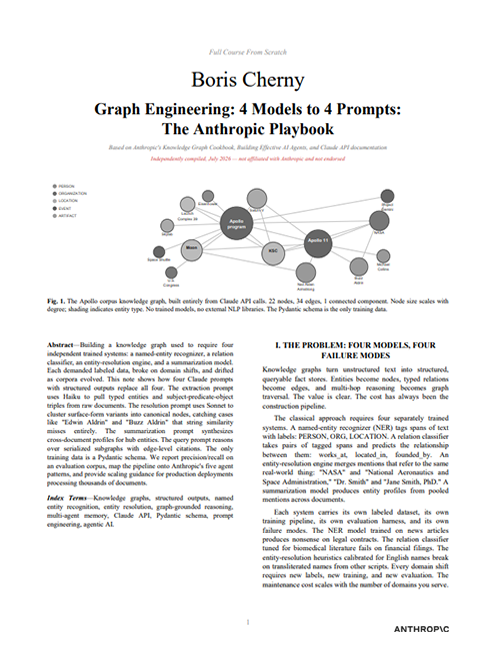
Boris Cherny just dropped 7-page PDF on Graph Engineering - how 4 Claude prompts replace 4 trained ML models
The twist: your agent's memory dies with the context window. A knowledge graph makes it permanent - and now you build one with prompts, not ML engineers.
here's 4 prompts, step by step:
prompt 1 → extraction - Haiku pulls entities + relations - one call per doc - no NER, no labeled data
prompt 2 → resolution - Sonnet merges duplicates string matching will never catch - two different names, same person
prompt 3 → summarization - Sonnet builds profiles from multiple sources - facts that never appeared in the same document
prompt 4 → querying - feed the graph to Sonnet - every answer cites a specific edge - no hallucination
how to wire this into agents today:
step 1 → shared memory for multi-agent teams - workers read/write one graph - orchestrator's context stays clean
step 2 → grounding layer for eval loops - evaluator checks facts against graph edges, not vibes
the result: one Pydantic schema replaces weeks of ML training per domain - precision 1.00 - 10k docs cost under $10
this 7-page PDF is what comes after loop engineering
bookmark this, then read the article below ↓
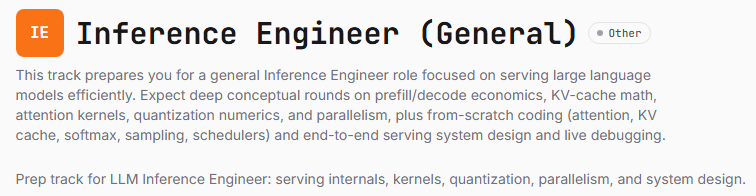
We just added a free Inference Engineer track to Deep-ML covering
- KV-cache
- attention kernels
- quantization
- parallelism
and other key skills you need to know for an Inference Engineer Interview
After nine months of hard work, this Postgres course is almost complete. You don't have to buy it, but if you want to truly understand Postgres internals, this is one of the most detailed courses you'll find. https://t.co/ZpRiQ6oNEr