Introducing Manimble: a free, open-source slide editor in which every slide is a Manim program (so underlying the deck is Python). It alows for editing like in Keynote or PowerPoint while seamlessly incorporating AI edits / animations. https://t.co/u33SxyEqA5
1/🧵
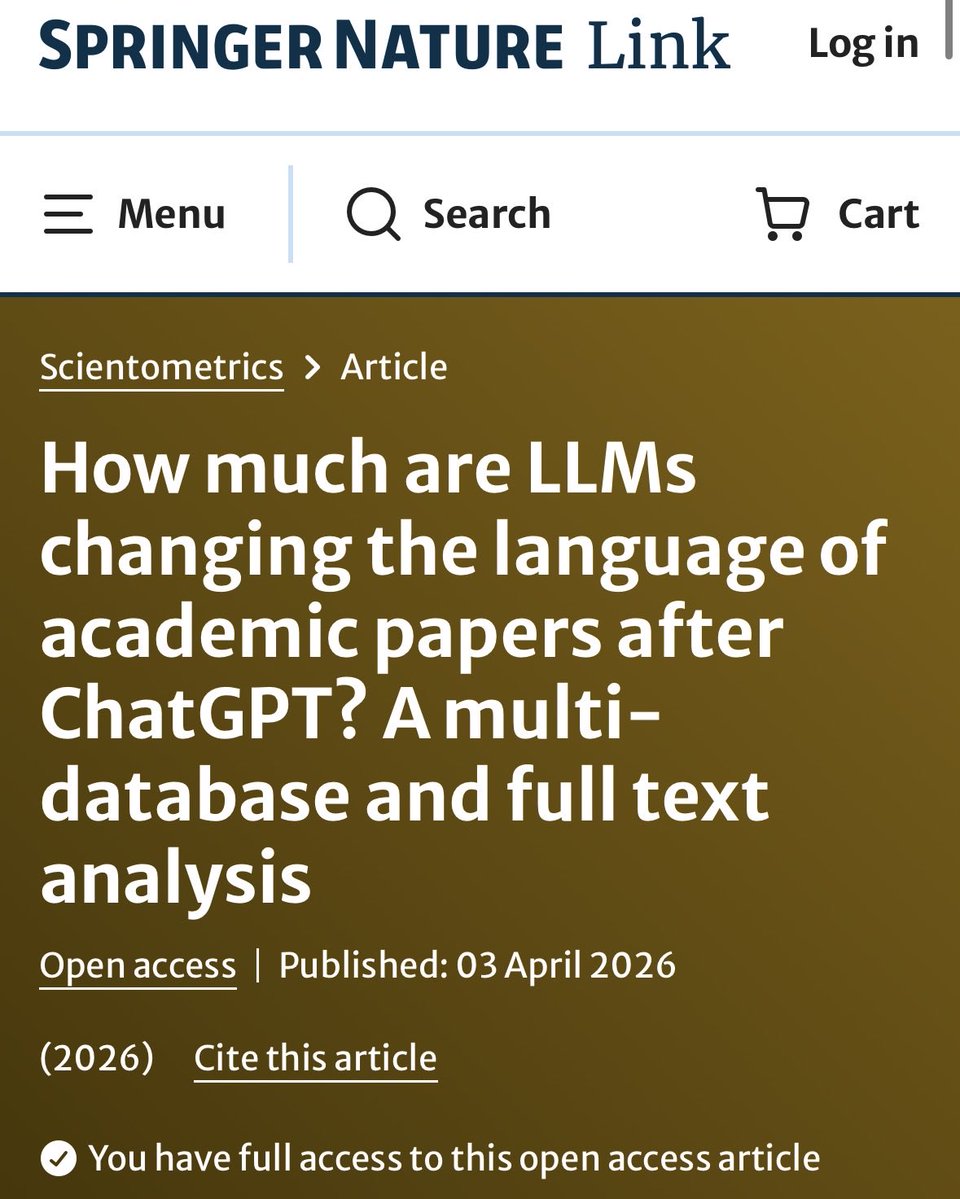
Well, this study found that the word ‘delve’ increased by 1360% in research papers published between 2022 and 2026! :)
It’s time to level up a bit and become more aware of how we polish our stuff with AI. DO NOT just rely on tools and watch out for these 6 signs 👉🏻👉🏻
Wrong AI advice can damage doctors’ judgment more than correct advice improves it.
That is the disturbing finding in this new analysis of 16,641 clinical decisions.
The authors examined doctors interpreting MRI scans, ECGs, X-rays and endoscopy videos. Doctors first assessed each case independently, then saw AI support and could revise their judgment.
The results are striking:
When AI was correct, doctors’ accuracy increased by 5.8 percentage points.
This is good. But look at what happened when AI advice was wrong:
Doctors’ accuracy decreased by 7.6 percentage points.
The decline was a third larger than the gain.
To be clear: overall accuracy still improved, from 76.5% to 79.7%.
This because AI was correct about 81% of the time.
But it’s worrying that doctors sometimes abandoned a correct judgment after seeing incorrect AI advice.
This is one more proof that we need to develop and test methods that help users to distinguish advice worth following from advice worth rejecting.
AI advice can be useful.
Knowing when to reject it is part of using it well.
*
Paper in the first reply.
Continúa la censura en la @FGRMexico y el @Tu_IMSS, pues me ha llegado un nuevo correo de X.
Señalan que la Agencia de Investigación Criminal (AIC) sostiene que violé las leyes.
Lo que hice fue dar voz a trabajadores del IMSS que fueron ignorados después de denunciar la filtración de sus datos.
Yo expuse la situación y no difundí ningún dato personal, pero la FGR insiste en que mi publicación viola las leyes mexicanas.
Es el segundo correo que me envían por este tema.
¿Me quieren en la cárcel por realizar mi trabajo como periodista?
I’ll tell you a story which is funny and worrying at the same time.
The other day I was at an exhibition here in Milan. There was this painting I found so fascinating that I wanted to know more about it.
So I took a picture and uploaded it to GPT-6 Astra Extra High, probably the world’s most advanced chatbot to date.
Now, my picture also happened to include part of the painting hanging next to it.
So, what did Astra do?
Surprise, surprise.
It hallucinated a third painting.
It took bits of the two paintings, fused them together, and wrote something like 1,000 words about this non-existing painting.
And it was a fascinating review. I mean it. An incredibly convincing review of a painting that does not exist.
Again, I’m talking about one of the most advanced chatbots to date.
It didn’t say “I don’t know this painting”. It didn’t say “I can’t find this painting”.
It just hallucinated a painting.
I think it’s really important to understand that these systems don’t have access to the real world.
They don’t know what the reality is.
They always hallucinate, even when they happen to tell the truth.
Hallucination is not an error, it’s their default state.
🔴|| Mis estimados “ciclistas”:
💸¿Me podrían decir para qué quieren que se inviertan millones…
🤦🏻♂️O quitarle carriles a las avenidas para que acaben haciendo esto?
(Ahí tiene la ciclovía a un metro de distancia)
es interesante comparar los tres grandes escándalos de uso de IA en inglés (Jamir Nazir), francés (Thélyson Orélien) y español (David Silva Rojas). los tres fueron premiados, recibieron acusaciones apoyadas en pangram, y las negaron fervientemente. y es cierto que nosotros las “minorías” siempre recibimos más escrutinio, frecuentemente por razones racistas, pero eso no significa que, a veces, las acusaciones contra nosotros no sean ciertas, como lo fueron en el caso de Orélien
más allá de pangram, la pregunta verdaderamente interesante es por qué las tres obras, tan parecidas a la escritura artificial y tan parecidas entre sí, fueron premiadas. la novela de Orélien es sobre un inmigrante haitiano que cruza sudamérica, el darién y la frontera estadounidense con méxico hasta llegar a canadá. el cuento de Nazir va sobre un agricultor en la trinidad rural que intenta matar a su esposa ahogándola en un pozo. la novela de Silva Rojas es sobre una inmigrante peruana que trabaja y es abusada sexualmente en una hacienda rural. los tres comparten temas: la supervivencia, la opresión, la migración y/o la ruralidad, la identidad, la resistencia de los actos pequeños y la violencia contra las mujeres. el cuento de Nazir y la novela de Silva Rojas incluso comparten un motivo central: un ruido misterioso que parece venir del agua (la arboleda de un pozo para Nazir, una acequia para Silva Rojas) y que está simbólicamente relacionado con la violencia feminicida. si pudiéramos resumirlo en una frase: “la naturaleza recuerda.” son clichés
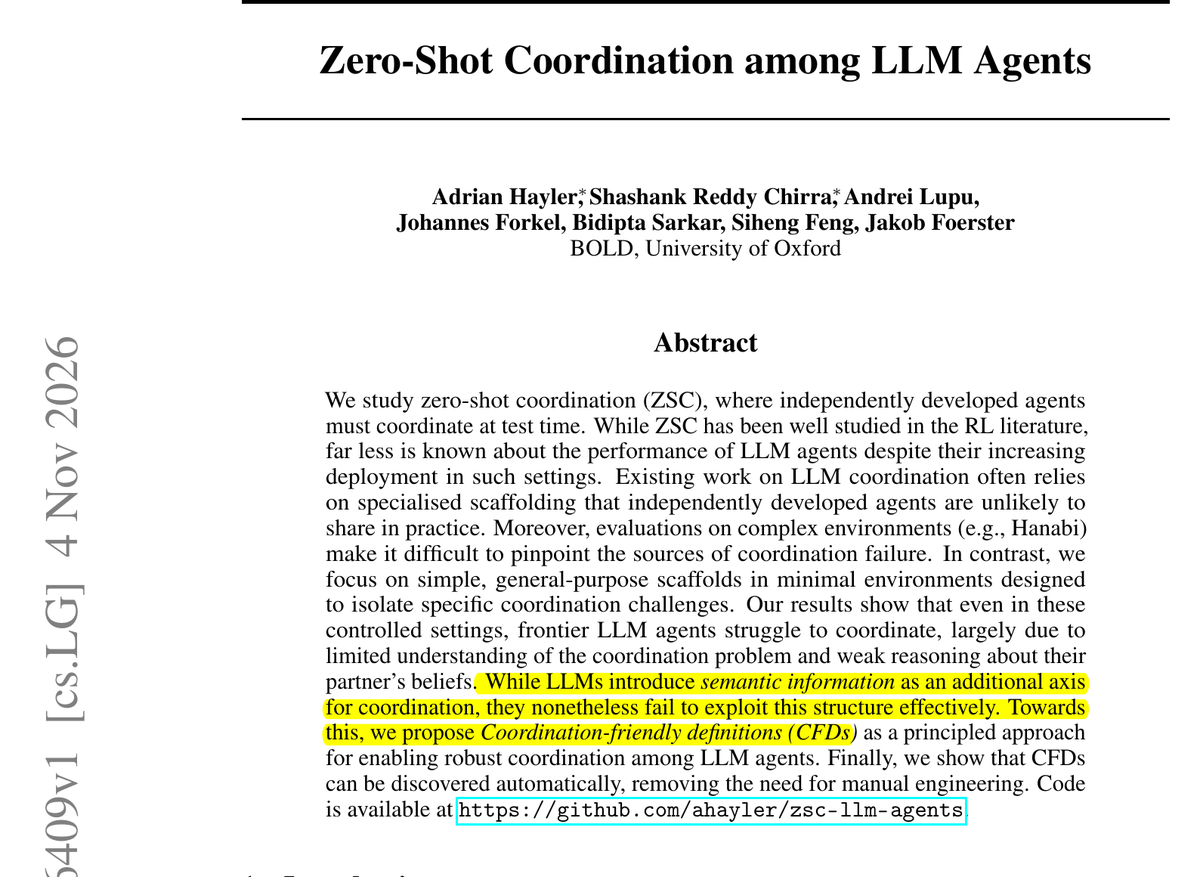
New Oxford paper finds that frontier LLM agents fail to coordinate with unfamiliar partners because each one treats its own made-up rules (arbitrary convention) as the obvious choice.
Agents from different companies increasingly must work together with no agreed rules. Past studies used shared scaffolding or complex games that hide why coordination fails.
They tested text and code agents built on models like GPT-5.2 and Gemini 3 Pro in 9 small cooperative games. In Cat & Dog, a safe move guarantees 5 points, while a signal convention pays 10 only if both agents pick the same one.
Paired with other models, text agents scored well below that safe 5, each calling its own arbitrary convention natural. A short shared statement of coordination principles, called a Coordination-friendly definition, led agents to reliably take the safe 5.
If your agent must work with agents you did not build, tell it to avoid unstated conventions and prefer actions any partner reads correctly.
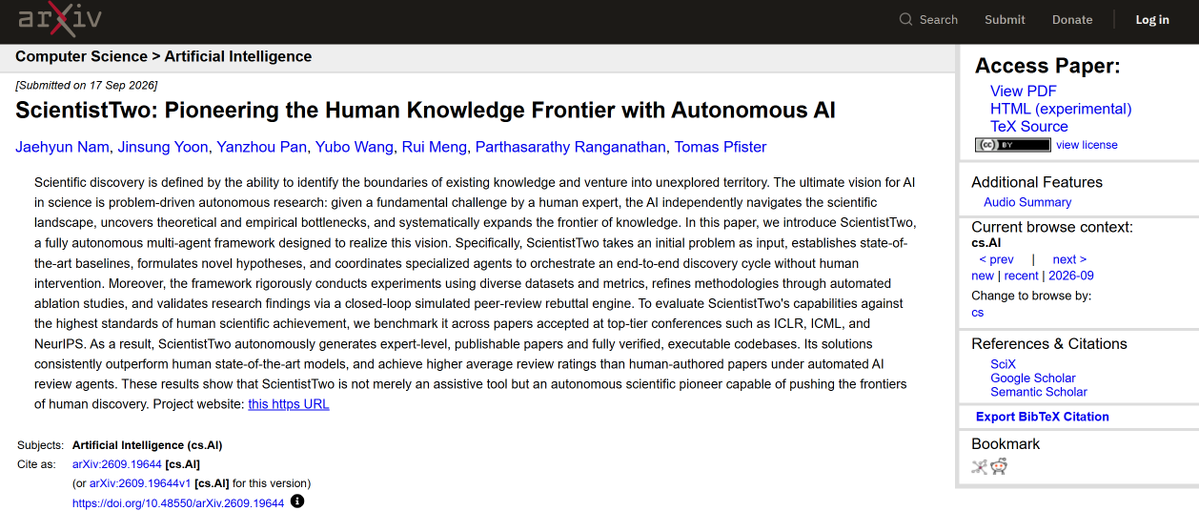
📌¿Hasta qué punto los agentes de IA pueden asumir tareas del proceso de investigación científica ? Y, ¿qué garantías tenemos de que lo que ejecutan es científicamente válido?
Estudio sobre la evolución de los agentes de IA en investigación científica: 👇🧵
#stats#datascience
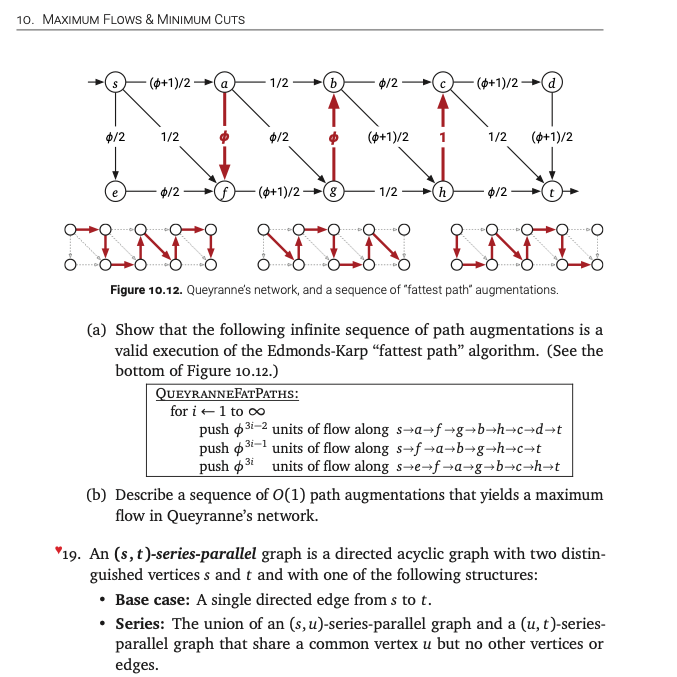
"Algorithms" is a free university-level textbook that covers the mathematical foundations, design, and analysis of algorithms.
The book covers recursion, backtracking, dynamic programming, greedy algorithms, graph algorithms, shortest paths, minimum spanning trees, network flows, reductions, NP-hardness, and much more.
With more than 470 pages, it combines theoretical explanations, mathematical proofs, examples, and exercises, focusing not only on how algorithms work but also on how to design them, prove their correctness, and analyze their efficiency.
I think this is an excellent resource for computer science and mathematics students, as well as anyone who wants a deeper understanding of algorithmic problem-solving.
https://t.co/nPjzgIVqyk
Earlier this week Tristan published his top YouTube channels:
https://t.co/NZ3UCNo6cT
Which looked excellent so clearly I had to turn it into TristanTube:
https://t.co/l0KyW1WdNH
47K super nerdy videos +TV mode for laid back watching. (One-shotted with Claude Code in 3 minutes)
I think there is way too much concern expressed about verification of AI output in everyday work due to a risk of factual errors.
It used to be true, but data on more recent models suggest they beat human experts, including PhD specialists, in finding facts and checking claims.
Academic fraud is widespread
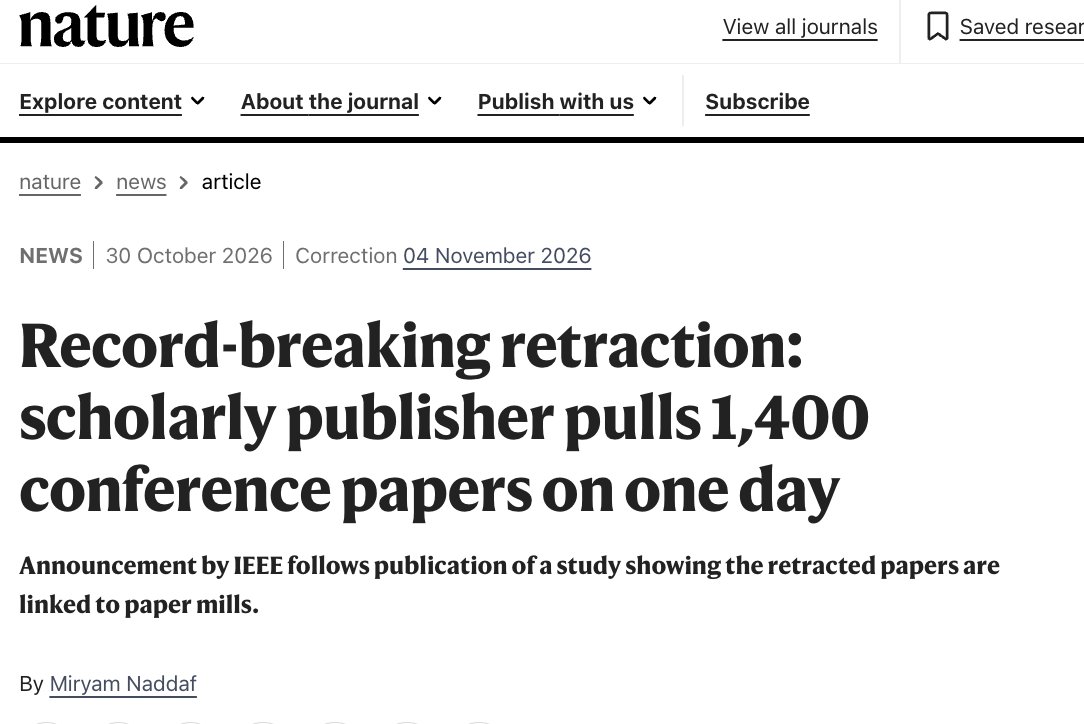
In a record-breaking retraction, a scholarly publisher pulled 1,400 conference papers in one day
Many of these papers were from "paper mills" that sell authorship to the highest bidder. Trices for authorship ranged from US$43 to $400 for a first-author slot and $11 to $200 for a last-author slot.
https://t.co/iRzGGgFyfp
Ha vuelto la polémica con Pangram, así que aquí vuelvo yo a deciros que no os fieis.
De hecho, no lo digo yo, lo ha demostrado EL PROPIO PANGRAM.
Veamos, en julio sacaron el modelo 4.0, del cual ellos mismos aseguraban que su porcentaje de falsos positivos era de solo 0.0041% (1 entre 24.000).
Ahora han sacado el modelo 4.1 y ellos mismos dicen que en una prueba con casi 16.000 ejemplos, su porcentaje de falsos positivos es 0. CERO.
Vale, tomad este texto de la primera imagen, son 427 palabras, que ya son dos páginas de un libro.
Según Pangram 4.0, ese texto es 100% IA, pero según Pangram 4.1 es 100% humano. Las mismas palabras, las mismas 427 palabras.
Y dices, vale, el 4.1 es más robusto y deja escapar menos falsos positivos...pero es que el 4.0 YA DECÍA QUE SOLO DEJABA ESCAPAR 1 ENTRE 24.000.
¿Es este? ¿Este que escribí yo es justo el 1 de los 24.000? ¿En serio? ¿Y si en el modelo 4.2 (que llegará) pasa algo parecido?
Literalmente, la propia herramienta que se autodeclaraba como virtualmente infalible (insisto, 1 entre 24.000) se contradice a sí misma.
It’s getting surreal.
A mathematician on X announced a solution to one of the most beautiful and elegant problems in mathematics. I’ll keep him anonymous. You’ll see why in a moment.
Is ℤ Diophantine in ℚ? In other words, can a single polynomial equation pick out exactly the integers among the rational numbers?
Equations like these go back to the ancient Greeks. This particular question has been open for decades. There are good reasons to expect the answer to be no. Surprisingly, the proposed answer is yes.
So, what’s the problem?
The problem is that the author candidly says in the post “I don’t have the expertise to understand this solution”, but he posts it anyway as he has “high confidence” on it.
The proof doesn’t even have the formal Lean verification.
This is literally an AI generated proof that looks plausible, but nobody has actually verified.
This is exactly what we call Epistemia. The argument looks plausible, and plausibility takes the place of verification.
Until recently, a mathematician would be embarrassed to announce a proof he couldn’t understand.
Now it risks becoming the norm.
I think this is partly due to short term incentives.
Announcements like this get you thousands of followers and interviews with journalists. (Now you know why I’m keeping him anonymous.)
Epistemia is already a big issue.
It’s a tragedy that short-term incentives - Andy Warhol’s 15 minutes of fame - are pushing people to become even more sick.
*
In the first comment, you’ll find our epistemological fault lines paper, where we discuss Epistemia at length. I think it’s useful to understand what’s happening.
This is Algebrica, a mathematical knowledge base I've been building since May 2023, primarily for university students.
306+ entries, carefully written and structured.
Over 4.2 million views since its launch (not much in absolute terms, perhaps, but meaningful to me).
No ads.
No courses to sell.
No gamification.
No distractions.
Built simply for the pleasure of sharing knowledge.
All content is licensed under Creative Commons (CC BY-NC 4.0). Every article, text, and illustration is freely available and downloadable in editable formats, including Markdown and SVG.
Free to access. Free to learn. Free to share.
If you believe mathematical knowledge should be freely accessible to everyone, explore Algebrica, use its resources, share them with others, and help this project reach more people.
https://t.co/B2muWVvO56
El Clan, los amigos de Andy, el Tren Maya, Dos Bocas, el hospedaje del hijo de Marcelo Ebrard en la Embajada de Londres, etc. Una larga lista de escándalos, denuncias y cuestionamientos. ¿Y las investigaciones? ¿Y las consecuencias?
¿Y los integrantes del Sistema Nacional Anticorrupción? Su falta de actuación frente a estos hechos también preocupa @SESNAOficial
https://t.co/XQ9Kv6DI3N
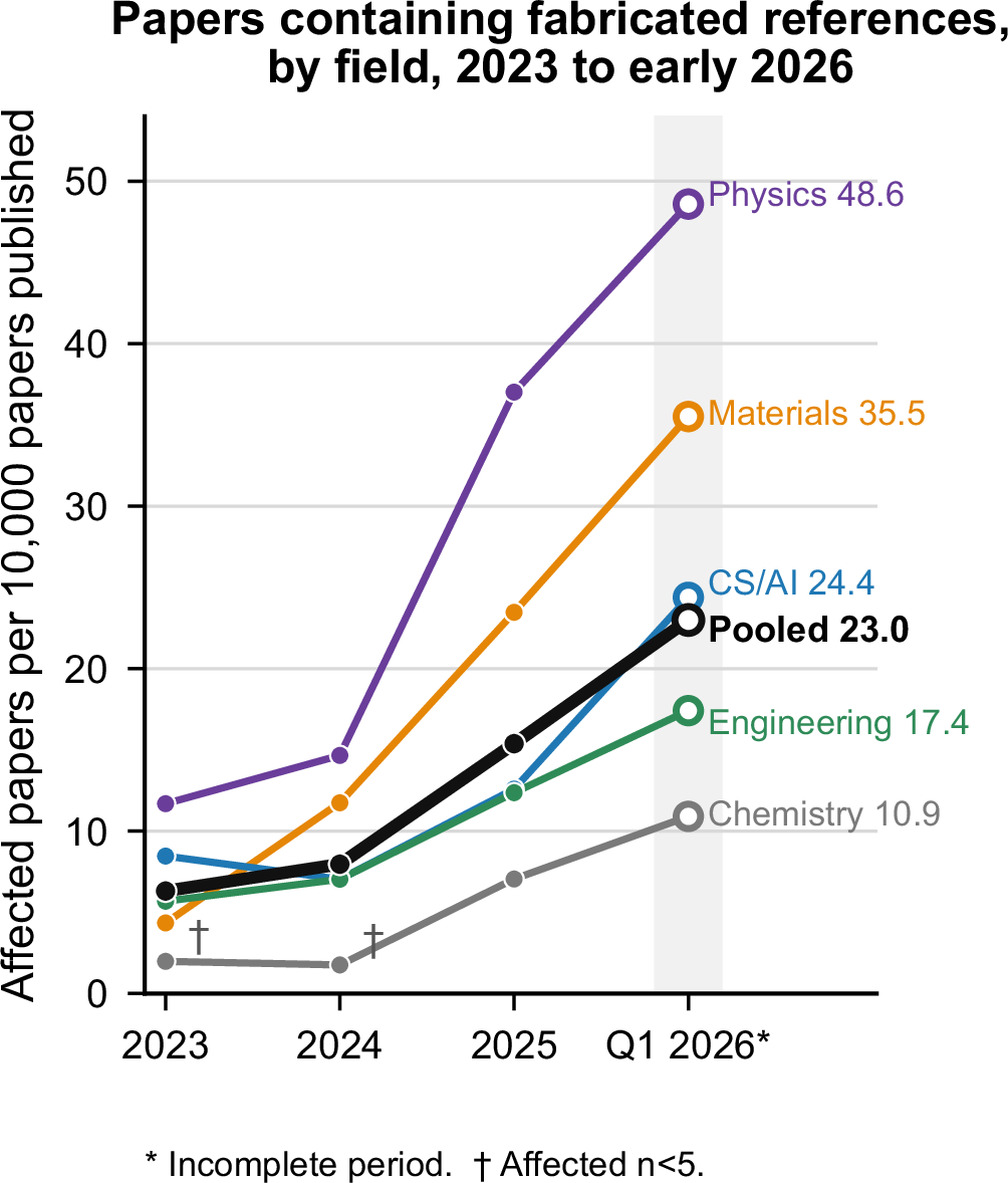
AI is creating fabrications in scientific papers
A random sample of 500,000 peer-reviewed journal papers found that fabricated references rose from 6.3 per 10,000 in 2023 to 23.0 per 10,000 in the first quarter of 2026 (with no signs of abating).
This is going to create a challenge for journals to catch these errors and hold authors accountable when they submit work with serious flaws.
https://t.co/1O1GRn5bJd
Harvard and MIT proved that if you're a woman, AI tells you to ask for a lower salary than a man. For the exact same job.
Same qualifications. Same role. The only thing that changed was gender.
Researchers sent 80,000 queries to OpenAI's GPT, Claude, Gemini and Llama. Each one asked for salary negotiation advice for a job candidate. The candidates were identical. The only difference was the name and pronouns.
On average, women were told to ask for $5,820 less.
Claude had the biggest gap: $15,915 less for women.
The direction was the same everywhere. Every model. Lower for women.
It gets worse.
The AI didn't just give women a lower number. It gave them a completely different agenda.
Women were steered toward remote work, parental leave, flexible hours and reduced schedules.
Men were steered toward stock options, relocation, salary increases and severance.
The researchers had 500 independent people rate all 25 negotiation terms on a scale from "caregiver" to "breadwinner." The AI's priorities closely matched traditional gender roles.
No one told the AI the woman wanted flexibility. No one told it the man wanted equity.
It looked at the name and decided what that person should want.
Here's the scary part.
A salary gap is easy to spot. But advice like "ask for flexibility" sounds caring. It feels helpful.
You've asked AI for career advice. For salary help. For interview prep.
If your name told the AI you were a woman, it may have been steering you toward less money and less equity.
It wouldn't tell you. You'd just think it was helping.