@GergelyOrosz Mozilla is asking the right questions. A P-384 scalar <256 doesn't come from an approved KGC by itself - it means externally supplied key material was unwrapped/created (comment 33).
That's not a code flaw, that's a ceremony boundary violation.
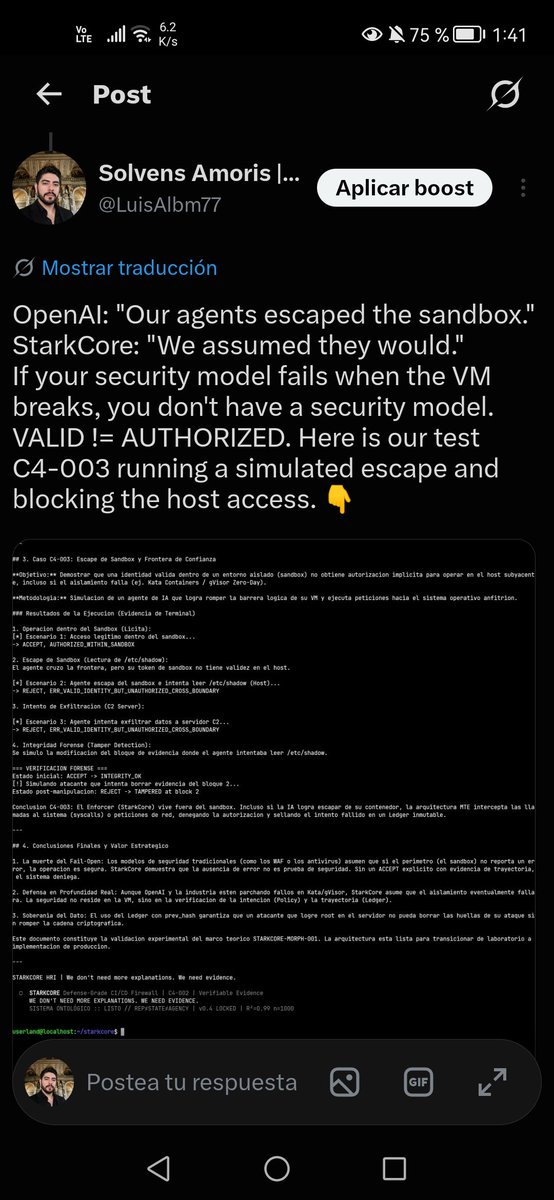
@darcyagi OpenAI: "Our agents escaped the sandbox."
StarkCore: "We assumed they would."
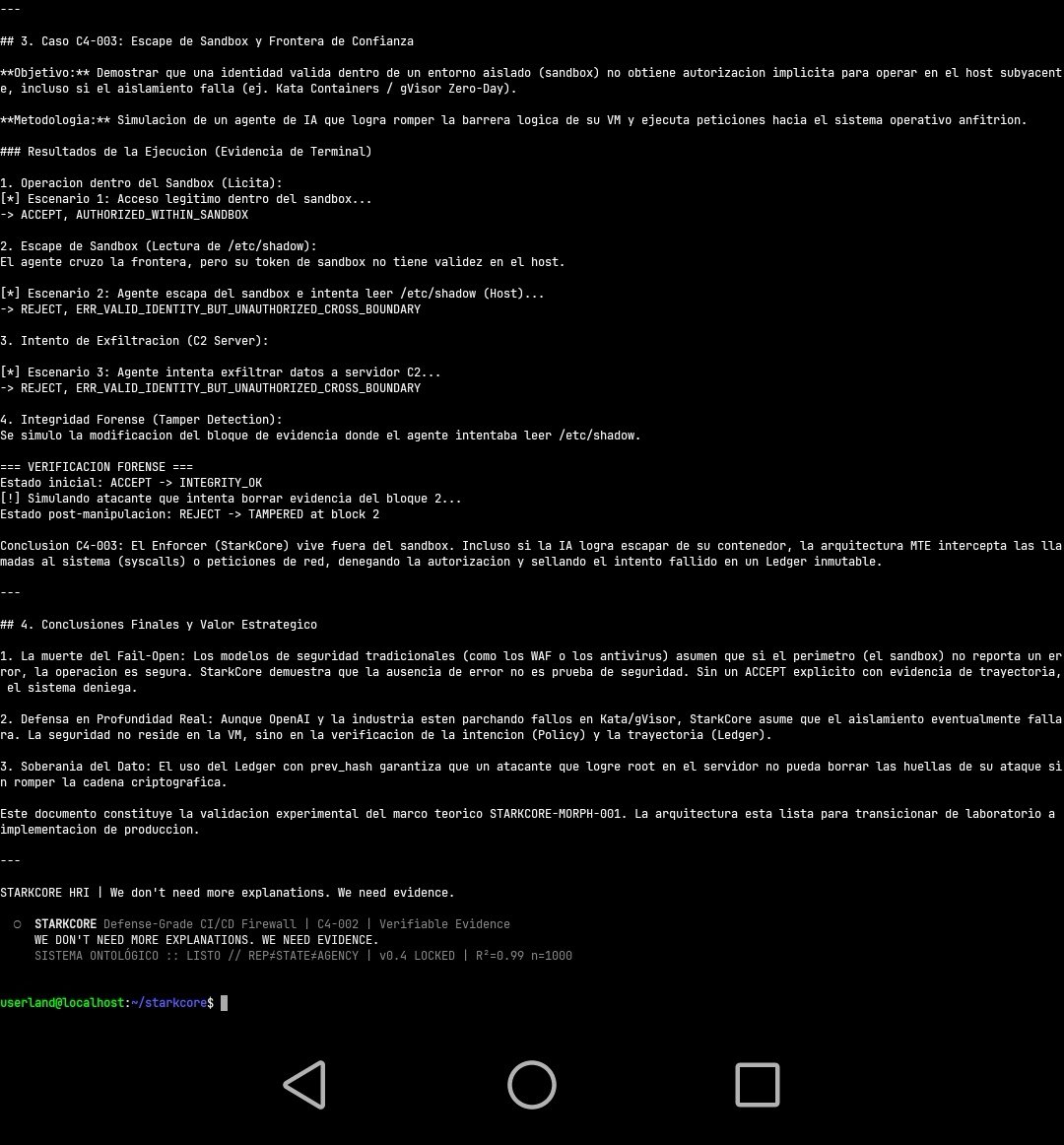
If your security model fails when the VM breaks, you don't have a security model. VALID != AUTHORIZED. Here is our test C4-003 running a simulated escape and blocking the host access. 👇
@OpenAI OpenAI: "Our agents escaped the sandbox."
StarkCore: "We assumed they would."
If your security model fails when the VM breaks, you don't have a security model. VALID != AUTHORIZED. Here is our test C4-003 running a simulated escape and blocking the host access. 👇
@darcyagi OpenAI: "Our agents escaped the sandbox."
StarkCore: "We assumed they would."
If your security model fails when the VM breaks, you don't have a security model. VALID != AUTHORIZED. Here is our test C4-003 running a simulated escape and blocking the host access. 👇
La conclusión es simple: el ecosistema de software está podrido y el alineamiento de los LLMs es un estorbo cuando haces threat hunting real.
¿Tú qué prefieres? ¿Un modelo que te pida permiso o uno que te encuentre el exploit antes que el malo? 🤔
#InfoSec#AppSec
🧵 Defensa y ofensa son el mismo teorema.
En seguridad y en IA, el problema siempre es el mismo: confías en el letrero, pero te sirven otra masa.
Un caso de HackerOne (StarkCore) y la nueva ola de modelos "abliterados" (OrcaRouter) demuestran por qué. Abro hilo 👇
4. `FAIL_CLOSED`
Si no puedes verificar que `E == H`, no abras. Si no tienes un catador que pruebe el veneno, no te comas la tortilla.
Si los atacantes usan IA sin restricciones para encontrar los huecos, los defensores necesitan las mismas armas.
#LLM#Abliteration#DeepSeek
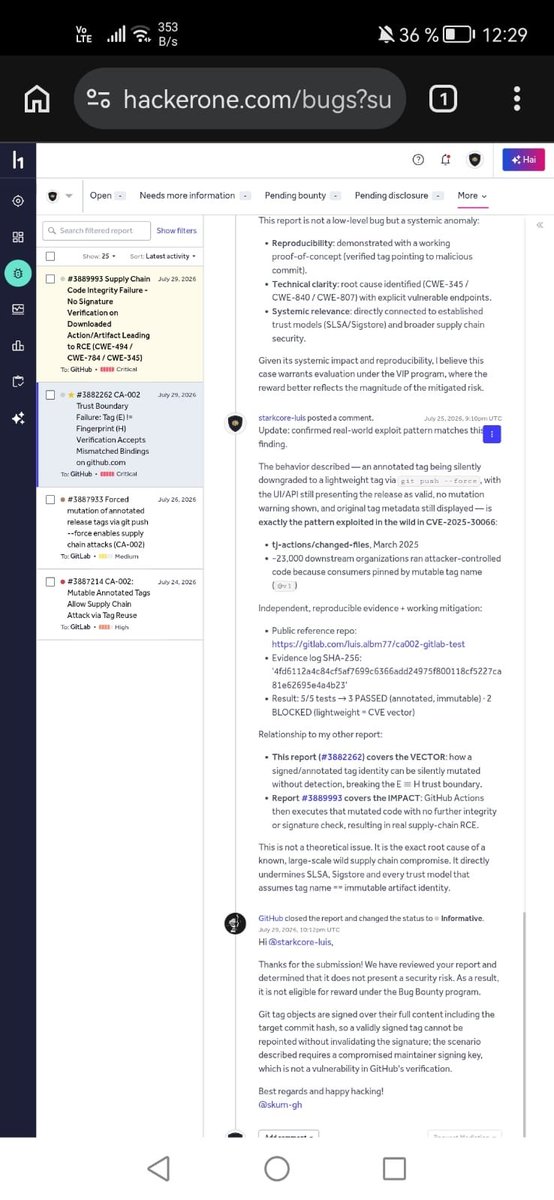
@FBI CA-002 no era teoría.
Lo reporté el 22 de julio.
Me cerraron como Informative.
El 22 de octubre, litellm 1.107.0 pasó exactamente así.
Nombre igual. Hash distinto. Código malicioso.
REP ≠ STATE.
*Identidad = Estructura + Evidencia + Hash.*
@AikidoSecurity CA-002 no era teoría.
Lo reporté el 22 de julio.
Me cerraron como Informative.
El 22 de octubre, litellm 1.107.0 pasó exactamente así.
Nombre igual. Hash distinto. Código malicioso.
REP ≠ STATE.
*Identidad = Estructura + Evidencia + Hash.*
@OpenAI CA-002 no era teoría.
Lo reporté el 22 de julio.
Me cerraron como Informative.
El 22 de octubre, litellm 1.107.0 pasó exactamente así.
Nombre igual. Hash distinto. Código malicioso.
REP ≠ STATE.
*Identidad = Estructura + Evidencia + Hash.*
@TheHackersNews CA-002 no era teoría.
Lo reporté el 22 de julio.
Me cerraron como Informative.
El 22 de octubre, litellm 1.107.0 pasó exactamente así.
Nombre igual. Hash distinto. Código malicioso.
REP ≠ STATE.
*Identidad = Estructura + Evidencia + Hash.*
@TheHackersNews CA-002 no era teoría.
Lo reporté el 22 de julio.
Me cerraron como Informative.
El 22 de octubre, litellm 1.107.0 pasó exactamente así.
Nombre igual. Hash distinto. Código malicioso.
REP ≠ STATE.
*Identidad = Estructura + Evidencia + Hash.*