When you start a chess game, you have 20 possible moves available. After the first full move (White then Black), there are already over 400 possible positions. By the third move, that number jumps to around 8,900, and after the fourth it reaches nearly 200,000.
By the time you get to move #40, the total number of possible games explodes to roughly 10⁴⁰, a number comparable to the total number of atoms in the observable universe.
Dijo una vez Jean-Paul Sartre: "Me senté en una banca mientras fumaba un cigarro y, sin darme cuenta, la Muerte se acomodó a mi lado.
—Tardaste… —le reclamé.
Ella tomó el cigarro, fumó y sonrió con desgana.
—Aún no vengo por ti, pero piensas tanto en mí que decidí saludarte.
Suspiré, apagando el resto del tabaco.
—Ni la Muerte me quiere…
Ella rió, sombría y compasiva.
—No seas necio, aún te queda vida por desperdiciar".
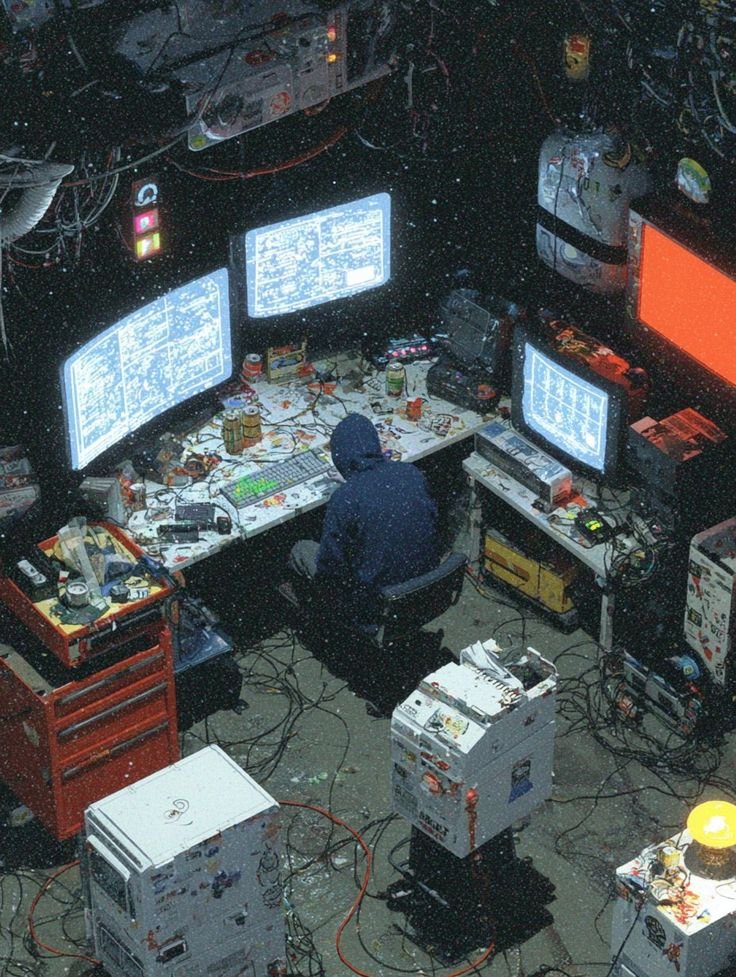
there’s a strange pattern you notice once you’ve built enough things:
the world isn’t held together by geniuses.
it’s held together by obsessed people who picked one weird corner of reality and refused to look away.
someone decided gears should mesh smoother.
someone decided antennas should be smaller.
someone decided metals should bend differently.
someone decided flight controllers shouldn’t drift.
someone decided compilers should stop being stupid.
someone decided batteries shouldn’t explode.
every “normal” object around you is a fossilized obsession.
a decade-long tunnel vision from some engineer you’ll never meet.
you want an edge?
find one tiny problem that bothers you more than it bothers anyone else.
then gnaw at it.
break it.
rebuild it.
live inside it.
civilization advances one fixation at a time.
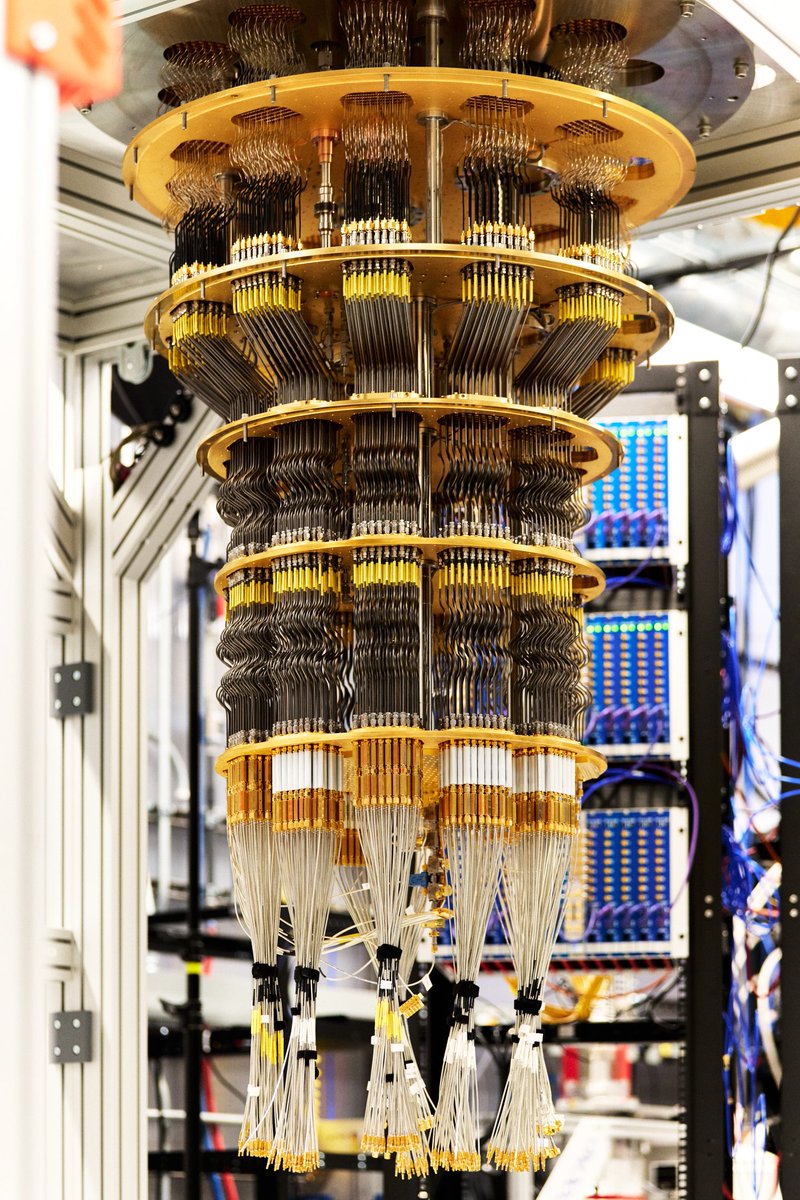
New breakthrough quantum algorithm published in @Nature today: Our Willow chip has achieved the first-ever verifiable quantum advantage.
Willow ran the algorithm - which we’ve named Quantum Echoes - 13,000x faster than the best classical algorithm on one of the world's fastest supercomputers. This new algorithm can explain interactions between atoms in a molecule using nuclear magnetic resonance, paving a path towards potential future uses in drug discovery and materials science.
And the result is verifiable, meaning its outcome can be repeated by other quantum computers or confirmed by experiments.
This breakthrough is a significant step toward the first real-world application of quantum computing, and we're excited to see where it leads.
🚨 JUST IN: 🇺🇸 Google unveils major quantum computing breakthrough
Its new algorithm is running 13,000× faster than world’s best supercomputer
Google says this clears the path for useful applications of quantum technology within 5 years
Bitcoin has to stay ahead of this.
my favorite quote from Charles Bukowski is:
"If you're going to try, go all the way. Otherwise, don't even start. This could mean losing girlfriends, wives, relatives and maybe even your mind. It could mean not eating for three or four days. It could mean freezing on a park bench. It could mean jail. It could mean derision. It could mean mockery--isolation. Isolation is the gift. All the others are a test of your endurance, of how much you really want to do it. And, you'll do it, despite rejection and the worst odds. And it will be better than anything else you can imagine. If you're going to try, go all the way. There is no other feeling like that. You will be alone with the gods, and the nights will flame with fire. You will ride life straight to perfect laughter. It's the only good fight there is"
studying engineering is easy.
you’re literally surrounded by it.
your chair is a lesson in load distribution.
your fan; in rotational dynamics.
your phone; in embedded systems.
your car; in control theory.
your house; in structural engineering.
you don’t need a classroom.
you just need curiosity.
the world is the lab.
you just have to start seeing it that way.
"Recuerda, Morty. Existe un infinito de inmensos espacios que ignoras y que te ignoran. Eres la nada en el pasado y la nada en el presente. Tus problemas son tan pequeños y estúpidos como tu propio lugar en el universo, diviértete".
Rick and Morty (2013).
Congratulations to Michel Devoret, Google Quantum AI’s Chief Scientist of Quantum Hardware, who was awarded the 2025 Nobel Prize in Physics today. Google now has five Nobel laureates among our ranks, including three prizes in the past two years. https://t.co/FprszfslSZ
Principia Mathematica takes over 360 pages to prove 1+1=2.
It's not because the authors were unsure of the answer, but because they were trying to prove that all of mathematics could be built from the ground up using nothing but pure logic.
I have a friend who's an artist and has sometimes taken a view which I don't agree with very well. He'll hold up a flower and say "look how beautiful it is," and I'll agree. Then he says "I as an artist can see how beautiful this is but you as a scientist take this all apart and it becomes a dull thing," and I think that he's kind of nutty. First of all, the beauty that he sees is available to other people and to me too, I believe. Although I may not be quite as refined aesthetically as he is ... I can appreciate the beauty of a flower.
At the same time, I see much more about the flower than he sees. I could imagine the cells in there, the complicated actions inside, which also have a beauty. I mean it's not just beauty at this dimension, at one centimeter; there's also beauty at smaller dimensions, the inner structure, also the processes.
The fact that the colors in the flower evolved in order to attract insects to pollinate it is interesting; it means that insects can see the color. It adds a question: does this aesthetic sense also exist in the lower forms? Why is it aesthetic? All kinds of interesting questions which the science knowledge only adds to the excitement, the mystery and the awe of a flower. It only adds. I don't understand how it subtracts.
- Richard P. Feynman, The Pleasure of Finding Things Out
A brief history of Quantum computers 👇
1905: Albert Einstein explains the photoelectric effect and suggests that light consists of quantum particles or photons
1924: Max Born uses the term quantum mechanics for the first time
1925: Werner Heisenberg, Max Born, and Pascual Jordan formulate matrix mechanics, the first formulation of quantum mechanics
1925-1927: Niels Bohr and Werner Heisenberg develop the Copenhagen interpretation, one of the earliest and most common interpretations of quantum mechanics
1930: Paul Dirac publishes The Principles of Quantum Mechanics, a standard textbook on quantum theory
1935: Albert Einstein, Boris Podolsky, and Nathan Rosen publish a paper highlighting the counterintuitive nature of quantum superposition and arguing that quantum mechanics is incomplete
1935: Erwin Schrödinger develops a thought experiment involving a cat that is simultaneously dead and alive, and coins the term “quantum entanglement”
1944: John von Neumann publishes Mathematical Foundations of Quantum Mechanics, a rigorous mathematical framework for quantum theory
1957: Hugh Everett proposes the many-worlds interpretation of quantum mechanics, which suggests that every possible outcome of a quantum measurement actually occurs in a parallel universe
1961: Rolf Landauer shows that erasing a bit of information dissipates a minimum amount of energy, known as Landauer’s principle
1965: John Bell proves that quantum entanglement cannot be explained by any local hidden variable theory, known as Bell’s theorem
1973: Alexander Holevo proves that n qubits cannot carry more than n classical bits of information, known as Holevo’s theorem or Holevo’s bound
1980: Paul Benioff proposes a model of a quantum Turing machine, a theoretical device that can perform any computation using quantum mechanical principles
1981: Richard Feynman suggests that simulating quantum systems would require a new type of computer based on quantum mechanics
1982: David Deutsch generalizes Benioff’s model and proposes the concept of a universal quantum computer
1984: Charles Bennett and Gilles Brassard develop a protocol for quantum key distribution, which allows two parties to securely exchange cryptographic keys using quantum states
1985: David Deutsch and Richard Jozsa devise an algorithm that can solve a specific problem faster than any classical algorithm, known as the Deutsch-Jozsa algorithm
1991: Artur Ekert proposes another protocol for quantum key distribution based on quantum entanglement, known as the E91 protocol
1992: David Deutsch and Richard Jozsa extend their algorithm to handle multiple inputs, known as the Deutsch-Jozsa algorithm
1994: Peter Shor discovers an algorithm that can factor large numbers in polynomial time using a quantum computer, known as Shor’s algorithm
1996: Lov Grover invents an algorithm that can search an unsorted database in square root time using a quantum computer, known as Grover’s algorithm
1997: Isaac Chuang, Neil Gershenfeld, and Mark Kubinec demonstrate the first implementation of Shor’s algorithm using nuclear magnetic resonance (NMR) techniques
2000: David DiVincenzo proposes five criteria for building a practical quantum computer, known as the DiVincenzo criteria
2001: IBM researchers implement Grover’s algorithm using NMR techniques and achieve a modest speedup over classical algorithms
2007: D-Wave Systems claims to have built the first commercial quantum computer, but its validity is disputed by many experts
2019: Google announces that it has achieved quantum supremacy by performing a calculation on a 53-qubit quantum processor that would take a classical supercomputer thousands of years to complete
2020: IBM demonstrates that its 65-qubit quantum processor can perform calculations beyond the reach of any classical computer
📷 An IBM QC photographed by James Estrin
Brian Greene on the distinction between physicists and mathematicians ✍️
Physicists are more like avant-garde composers, willing to bend traditional rules and brush the edge of acceptability in the search for solutions. Mathematicians are more like classical composers, typically working within a much tighter framework, reluctant to go to the next step until all previous ones have been established with due rigor. Each approach has its advantages as well as drawbacks; each provides a unique outlet for creative discovery. Like modern and classical music, it’s not that one approach is right and the other wrong – the methods one chooses to use are largely a matter of taste and training.
- as mentioned in his book The Elegant Universe : Superstrings, Hidden Dimensions, and the Quest for the Ultimate Theory (1999)