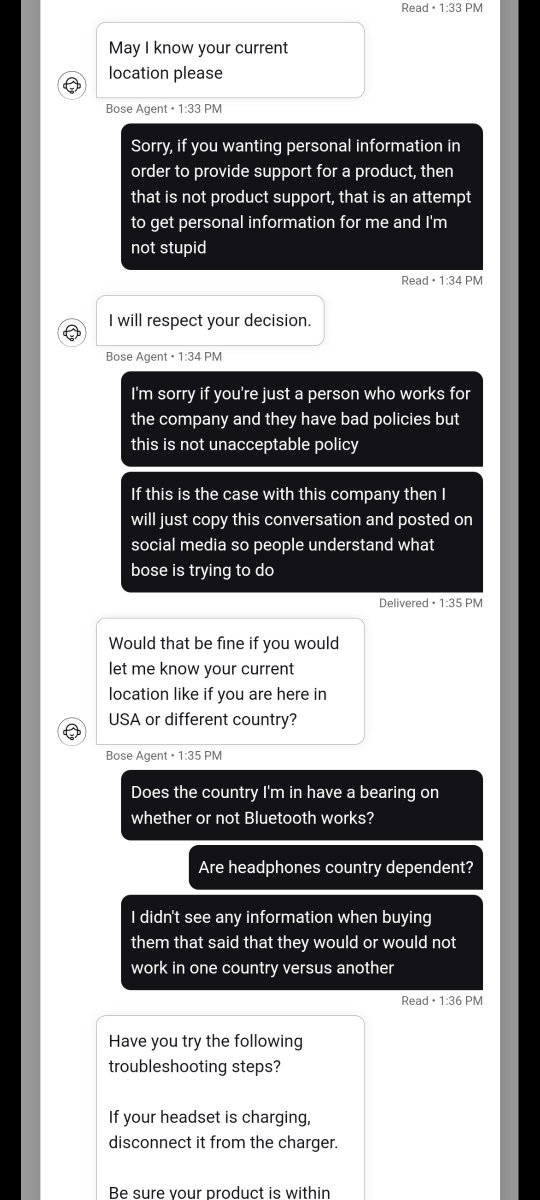
@abacusai Mostly like this app, but NO customer service, so can’t find info/fixes: Size of content windows, working memory, knowledge base? How to create agents/custom instructions? Sometimes it can't access URLs (on all models)? The iPad app is wonky. Help?
@AnthropicAI this is why I don't bother with Claude, and why despite WANTING to like it, and being a heavy AI user, I keep going back to Chat GPT. Problems like this but no way to contact support ... 😑
@OpenAI Dall-e refused to create images depicting tinnitus, as well as a female warrior protecting people against tinnitus, bc it promoted violence and pain.
Huh?
Forget a logo w/a trojan, samurai, etc., too violent.
Ok, weird helicopter mom, I'm bailing off of your platform.
Yum, new candy for human behavior science addicts like us! Join us at https://t.co/b1hVSYNN2c if you want to get the goodies out of this kind of stuff (the actionable takeaways you can apply to improve your life), without all the effort.
Hey look, you can now view (and download) the ToC and Chapter 1 from my forthcoming modeling book. This chapter provides something of a philosophical grounding before we get into the more technical weeds in the subsequent chapters.
https://t.co/qVay0ELPq3
I love searching for the truth about how to really help people-- like really help them-- rather than just say things that make people feel good for the moment but ultimately keeps them stuck in delusion land.
@mymind i’d love to upgrade my trial account but I am having trouble with the apps being buggy and somewhat unusable across my devices. How can I add a note on iPad? Why does my android app crash every time I share something to it, and constantly ask me to log in again? Help!
Follow-up links
1. For a recent review of the scientific literature, see: https://t.co/3m70WgTDuS
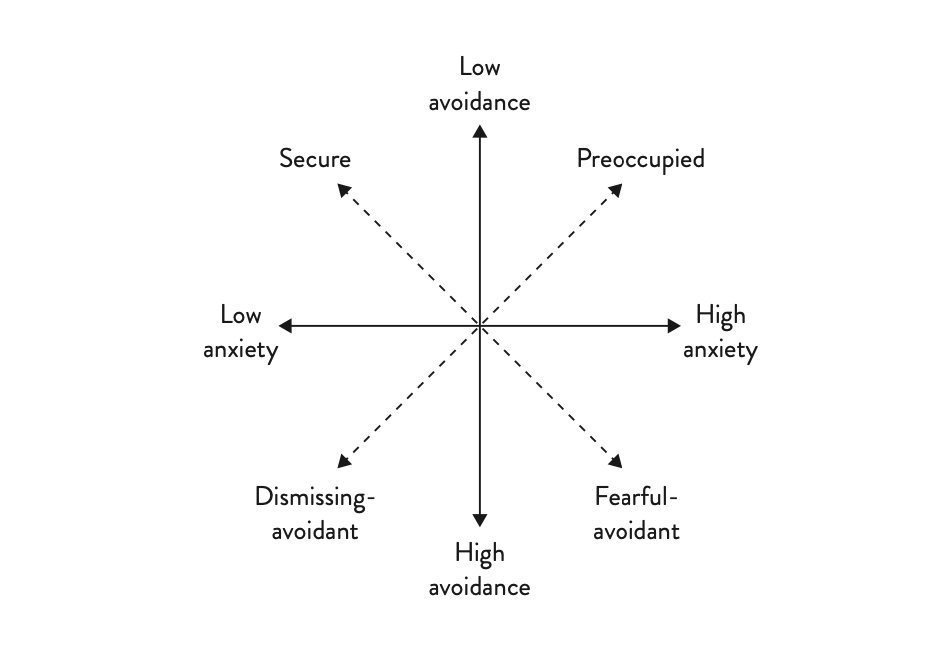
2. If you are committed to talking about "types", you could probably get away with talking about 8 types based on your placement on both the avoidance and anxious continuums. See attached graphical representation of this space which I included in my book "Transcend". I tried to map your placement on these two dimensions to traditional labels in the psychological literature. NOTE: Secure attachment type is not a "thing" all by itself, it's simply the byproduct of your low placement on both the avoidance and anxious dimensions.
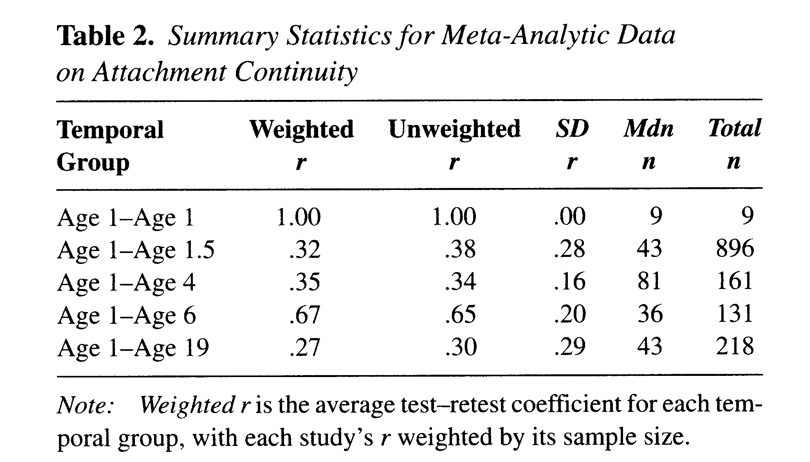
3. For a good paper on the stability of attachment patterns from infancy to adulthood, see this paper: https://t.co/LIZ6WFnqhf
For example, see attached table. Age 1-Age 6 weighted r is moderately high (.67), but age 1-Age 19 weighted r is .27! MUCH lower! And once we get past age 19 to age 30, 40, 50, 60 and beyond, the correlation gets weaker and weaker.
There is HOPE! Find a sensitive, caring partner who is aware of your attachment triggers and tries their best to be sensitive to them and you CAN HEAL and become more SECURE! Your entire history of adult relationships matter a LOT!
We keep learning more about attachment. Attachment is one of the most helpful concepts to help foster more rewarding relationships, and like anything else, there’s always room for better understanding.
I see a lot written about "attachment styles" but so much of it is wrong! Some recent findings in the psychological literature that may surprise you:
1. There is no such thing as a secure attachment style!
When we study adults we find it much more informative to talk about continuums we are all on, not "types" or "styles". Researchers have found that we all exist somewhere on either the avoidance dimension (not type) or the anxious dimension (not type). Our level of secure attachment is simply our placement on these two dimensions. MAJOR IMPLICATION: There is no such thing as a perfectly securely attached person! I mean, have you ever met one?! A person has a higher "level" of secure attachment if they score lower on both the anxious and avoidant dimensions of attachment. Also, any individual can score high on both avoidance and anxious, low on both, mid on both, high on one, low on the other, etc. They are correlated but separate dimensions!
2. Childhood attachment patterns are overrated and we make too much of it! The actual correlation between early childhood attachment patterns and our adult attachment placement on the avoidance and anxious continuums is SURPRISINGLY LOW!! Much more predictive of our adulthood attachment patterns is *our entire history of adult relationships*, NOT our childhood relationships!! Highly sensitive and caring partners in adulthood ABSOLUTELY CAN OVERRIDE our childhood patterns (within the normal range of most humans; extreme abuse in childhood makes things far more complex in adulthood).
I see a lot of other misinformation about attachment theory but I think that's enough for now! Hope you found this informative! I can add links to papers and references if you want but didn't want to overwhelm everyone with stats and graphs. 😂
ROLDA helping Ukrainian dogs 2022 : Make a donation today to support ROLDA helping Ukrainian dogs 2022 https://t.co/t0dXIrRyVc #rolda-helping-ukrainian-dogs-2022 via @raisely
#InternationalWomensDay … a tiny chance to celebrate the contributions and experiences of humans who endure systemic social imbalance and violence, yet without whom our species absolutely cannot survive or thrive.
So, humanity, maybe let’s stop hurting the ones we need?