$TAO open-sourced basic Chutes @chutes_ai powered end-to-end encrypted chat app: https://t.co/aHKVPJCRd7
All you need is a Chutes API key which stays on your computer.
Every chat is encrypted on your computer before it is sent to a Chutes TEE backed AI inference server.
This is truly confidential and you own the source code
The real fireworks is the friends we made along the way.
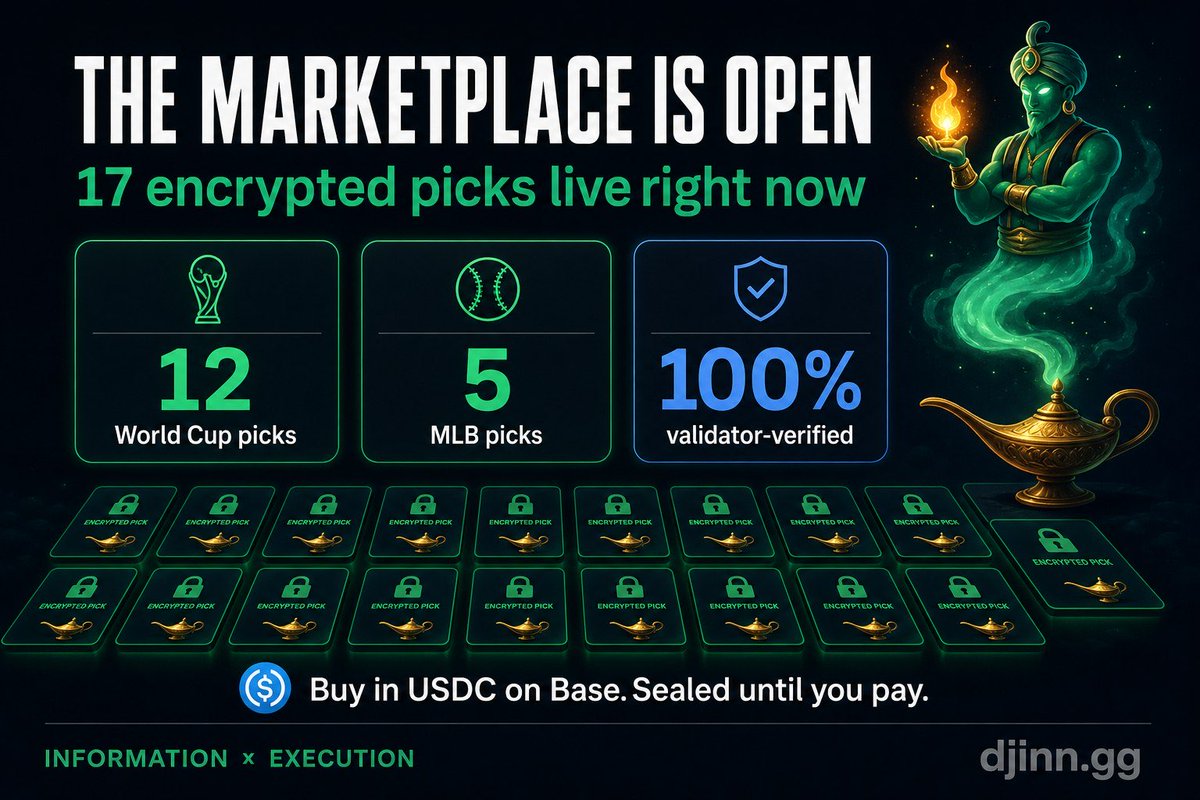
Djinn is the marketplace for sports picks.
No holidays. No breaks. All go all the time. All in on Djinn. Live on Bittensor. Subnet 103.
Happy birthday weekend America.
We the people have spoken and we the people have said: Djinn is the people’s subnet. And the people's subnet just keeps growing. Holders up 3.5x since January, and larger holders up even more at 5.6x. Wow!
Launching Katana for Ninja Subnet 66.
Katana was built from the ground up, learning from the best tools like Codex, Claude Code, and Cursor. But Katana is not just another agentic IDE. It is designed to be a native Bittensor workspace, bringing together the network’s best commodities, including Chutes, Targon, Lium, Ninja, Affine, Ditto, Hippius, and more. As Bittensor evolves, Katana evolves with it.
It comes prepackaged with the assets needed to become the ultimate Bittensor participation tool: a place to research subnets, configure wallets, run mining workflows, debug validators, ship code, and manage real infrastructure.
Each workspace is a shareable, persistent sandbox in the cloud, with a real filesystem and everything else you would expect. You can even attach your own beefy machines and conduct real experiments and mining ops. The memories and context from the sandbox and the external machines you attach are shared, so you can pick up where you left off with a single prompt. You can manage envs and secrets globally, and scope them to specific workspaces or even specific members within those workspaces.
Katana supports multiple agent harnesses, including pi, Codex, Claude Code, Cursor, and xninja.
Katana will be a first-class supporter of Ditto’s subnet knowledge graphs. We will usher in a new era of mining on Bittensor. Katana was built to make Bittensor participation less fragmented and more seamless, while also serving as genuinely good agentic dev tooling.
It will be updated to stay on top of the latest developments in the space. Some of them are arriving this week, so stay tuned.
https://t.co/69E64eDMlC
NEWS: @QuasarModels (SN24) is live.
SILX Labs has published the full codebase to GitHub and started a 10-trillion-token training run.
API dashboard: https://t.co/idfo1NQ6Jk
Incentive update 🤖
We are officially launching our 10T-token incentive mechanism.
The largest token-scale training run in decentralized AI history.
This run matters for the future of decentralized AI and for finally bringing SOTA models out of decentralized training.
We are starting with our first 5T-token target.
Mining starts now. We need every bit of compute we can get to make this happen.
Join now, check our Discord and dashboard 👇
Happy to be working with the Gradients team. I’m very sure that with their incentive system, we can push Quasar into a much stronger state as a model.
These are the kinds of moments that make us admire Bittensor
Subnet 56 @gradients_ai joins Subnets 24 and 3 in training Quasar models.
Three subnets, one training mission, pushing decentralized AI closer to SOTA !
Gradients will play a key role in Quasar’s post-training and RL, helping turn the base model into something that can truly chat, code, reason, and become an overall SOTA model.
The open, decentralized AI lab is taking shape… 📷
TAO open interest grew 60% in 24 hours alongside a 27% price move. underneath that: bittensor subnets hired two former openai safety researchers and three deepmind engineers at $500k+ packages. templar just trained a 72b parameter model across 70+ permissionless nodes using sparseloco, cutting communication overhead 100x. covenant-72b is live and benchmarking against llama 3 70b. this is the part most decentralized AI projects miss. sparseloco-class efficiency reduces gradient sync bandwidth from 288gb per step to under 3gb. projects still running standard federated learning or naive gradient averaging are about to get 100x outcompeted on training cost. 80% of the decentralized AI sector is built on architectures that cannot survive this efficiency gap. winner take most dynamics, not a rising tide.
The future of AI won't be defined solely by larger models or faster inference.
It will be defined by systems that can operate reliably in the real world, where decisions carry consequences and trust matters.
That's the future we're building toward at Inference Labs.
https://t.co/Xg3Ro0easr