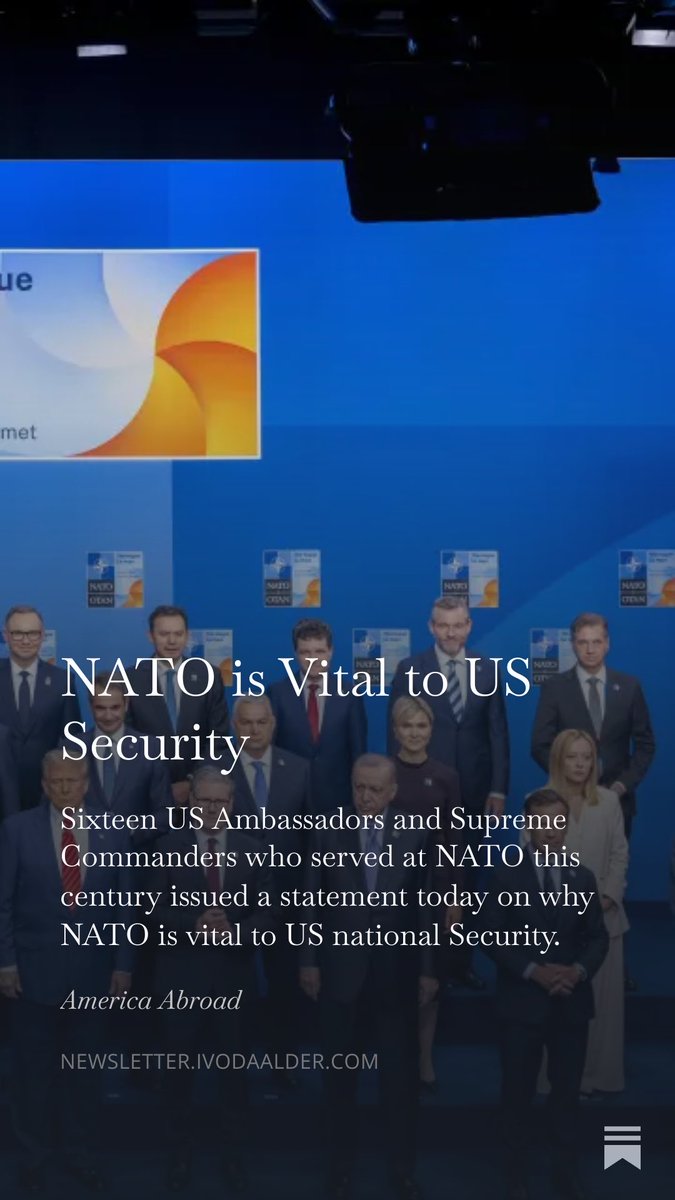
In a letter, U.S. Ambassadors to NATO and Supreme Allied Commanders argue that NATO is imperative to American national security. They write, "America’s allies are its single greatest geo-strategic advantage." https://t.co/lOqtQXaLxR
NATO is a strategic bargain that ensures the US remains the world’s most powerful and economically secure nation at a fraction of the cost of going it alone—statement by US Ambassadors and Supreme Allied Commanders who served at NATO this century. https://t.co/kuw72wLst1
Proud to join this forceful defense of our historic NATO alliance with Denmark and opposition to U.S. threats to invade Greenland and coerce the Danish government. We are 15 former senior officials of Republican and Democratic Administrations. https://t.co/lWZF9U86f8
In this convincing critique, retired Lieutenant General Ben Hodges, former Commander of U.S. Army Europe, expresses deep skepticism regarding the feasibility of proposed security guarantees by Trump for Ukraine.
“There is no such thing as Article 5-like.” - Ben Hodges.
“Does any Ukrainian, any Ukrainian believe for one second that vladimir putin will live up to any agreement? Of course not. Nobody believes that, that putin could be trusted.
The only way that he would not fill into the whatever part that Ukrainian troops came out of would be if there were thousands of American, German, British, French soldiers sitting there. That's, otherwise, it will be a very short amount of time before you have either Russian troops or you have Rosgvardia or some other unknown separatist quasi-things that the Russians would try to say, "Well, that's not us. We didn't do that," just like they did back in 2014.
So how anybody could trust that Russia would actually live up to some agreement like that, I think that that would really be, you'd have to suspend belief to accept that.
The idea of this when I hear this phrase "Article 5-like," I mean, what does that mean? Article 5 means an armed attack on one shall be considered an armed attack on all. So if the United States is offering Article 5-like, that means if Russia attacked Ukraine again, then that would be as if Russia had attacked the United States. Do you really think, does anybody really think that this administration would actually do something about it?
And what's an attack? Is it one Shahed drone or does it have to be 500 Shahed drones or Russian troops overrunning, you know, another Ukrainian city? I mean, what constitutes an armed attack?
So there is no such thing as Article 5-like. I mean, this administration does not even enforce the sanctions it has already put in place. India's oil import from Russia has gone up in October and then again in November, even though these latest tough sanctions were put in place.
So I personally, I have zero confidence that the Trump administration would do anything to enforce this kind of agreement.
Now again, the burden and the risk is on Ukraine, not on old retired people like me on the outside watching. But as I look at what's happened over the last year and indeed over the last several years, I would be very reluctant to agree to something with Russia if it depended on Russia living up to it in good faith or depending on the United States.
This is where you would have to see a very strong European force that was there, not one that's sitting in Poland, but a European force in Ukraine that has real capability, has real rules of engagement, and has the capability to shoot back immediately when Russia tests—as they inevitably will test immediately.”
( Full interview in the comments )
NEW: @CSISDefense president @SethGJones sits down with @LuteDoug, former U.S. Ambassador to NATO, to discuss President Trump’s proposed peace plan aimed at ending the Russia-Ukraine war.
Listen to The Last Line of Defense: https://t.co/J3oRjieUSs
TUESDAY🕟4:30PM ET | What is the path towards a durable peace in Ukraine?
Former 🇺🇦 prime minister @Yatsenyuk_AP headlines an expert panel discussion with Amb. Paula Dobriansky, Kimberly Kagan, & @LuteDoug, moderated by @JohnEdHerbst.
https://t.co/4qGgkJaEmq
Want to know more about the Russian drone attack on Poland and how NATO should respond?
Tune into #BrusselsSproutspodcast to hear me and @jteurope discuss w/ 2 former US Ambassadors to NATO: @LuteDoug and @kvolker.
https://t.co/nEAVNq3g1G
There has been a diplomatic flurry around Ukraine in recent days, yet the theme of talks has been hollow words and flip-flopping. @LuteDoug, @MaxBoot, @AKendallTaylor, and Rosa Brooks join David Rothkopf to break it down.
https://t.co/fgIIeY6U5Y
@terischultz Article 10 of the NATO treaty requires all 32 current allies to agree on a new member, so suggesting an “instant” accession is not realistic. Remember that several allies held up the accession of Sweden not long ago.
Where do we stand after the opening night of Trump does Ukraine? The first glimpse of substance from Hegseth suggests huge concessions will be demanded from Kyiv with no sign of similar pressure on Moscow - rather the reverse, with Trump running hard after Putin. Bottom line? 1/7
And I will add to the Ambassador‘s excellent comment that when I was supreme commander of NATO I watched Canadians fight and die bravely under my command in Afghanistan just 10 years ago. They weren’t attacked. We were.
For countries like Germany, for the government to appear it was increasing its defense spending because of Trump's pressure was highly unpopular, even when Germans KNEW they needed to ramp up of their own accord.
Right. The president most responsible for 10 consecutive years of real increases in NATO defense spending is Putin — not Obama, Trump or Biden. Data shows that the rate of increase for many allies actually decreased under Trump.
That's not true. Every US president has demanded European gov'ts spend more on their own defense albeit evidently too politely.
It IS true Trump likely spurred some increased funding faster but he didn't reverse the decline -- Putin did that in 2014. 2/2
That's not true. Every US president has demanded European gov'ts spend more on their own defense albeit evidently too politely.
It IS true Trump likely spurred some increased funding faster but he didn't reverse the decline -- Putin did that in 2014. 2/2