I can finally announce my participation in @Apple’s inaugural Entrepreneur Camp for Black Founders and Developers. All the late nights were worth it. Onward and upward 🚀 #BlackHistoryMonth https://t.co/P6YwsTZUYp
I rely on gift cards since for historical reasons my account is US-based and Apple made switching borderline impossible. (e.g. you cannot have *any* active subs, and cancelled is still active until finished, so the process would take a year, and there are far more gotchas). CCs are geo-locked so they don’t work.
This makes me very uneasy. https://t.co/4zbSmozkCP
In Apple's keynote yesterday, we saw a glimpse into how multiple AI Agents will likely work together in the future. While they may not have been trying to make a broader point than just Siri's capabilities, Apple illustrated an emerging design pattern that we're in the very early days of figuring out around multiple AI Agents working together to complete the user's task.
What Apple demonstrated onstage was the idea that you would ask Siri a question and depending on whether the question leveraged on-device data and insights or requiring broader knowledge, the answer would route to the appropriate AI. In this case, if you had a question that required calendar, email, or map information, Apple Intelligence would be the underlying AI; but if you had a question about a dinner recipe, this query would be detected as needing broader knowledge, and route to ChatGPT.
Interestingly, we can see this generalizing to how heterogeneous AI Agents will interact with each other in the future. You may be in one platform and ask a question of an application, and that application will go out and federate the question to other AI Agents in another system that they're allowed to talk to. Imagine a scenario where you're inside of Slack and ask Slack AI a question about an HR policy, where that underlying content is stored in Box. We can imagine that this workflow would be accomplished by the Slack AI Agent determining that the question can leverage data sitting inside of Box and ask the Box AI Agent for the answer. This gets even more interesting (and wild) when multiple systems are involved.
Of course, this will introduce a whole new set of challenges (and opportunities) around authentication, permissions, handling non-deterministic interactions between software, and response latency, but it's clear that in a world mediated by AI interactions, our AI Agents will be working together to accomplish tasks for us. And this will introduce all new questions around how we will design software in the future when AI is mediating much of the way work gets done behind the scenes from the user. What a cool time to be building technology!
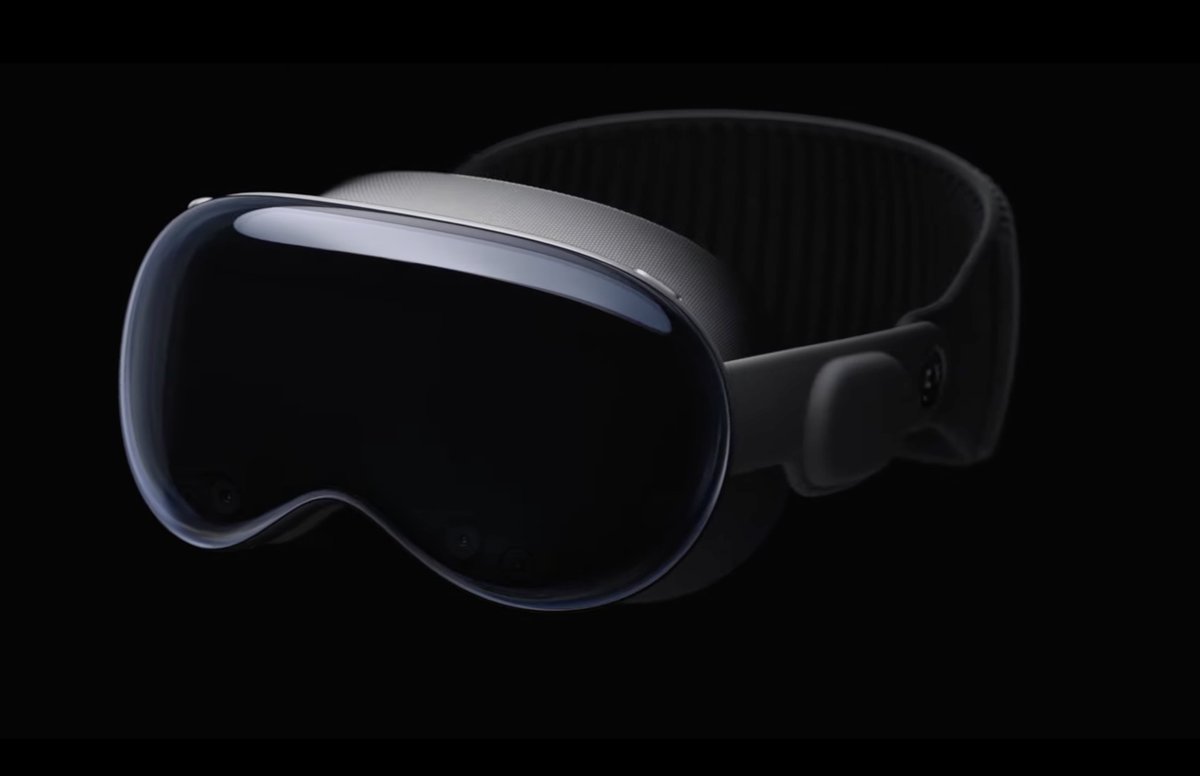
So you wanna learn how to design for Apple Vision Pro? 👀
We just dropped 3 must-watch #WWDC23 videos that go over it all
Principles of spatial design
https://t.co/Z6IFqBRr0j
Design for spatial interfaces
https://t.co/0JkklnGZlF
Design for spatial input
https://t.co/nmrVm73xcP
I spent 10% of my life contributing to the development of the #VisionPro while I worked at Apple as a Neurotechnology Prototyping Researcher in the Technology Development Group. It’s the longest I’ve ever worked on a single effort. I’m proud and relieved that it’s finally announced. I’ve been working on AR and VR for ten years, and in many ways, this is a culmination of the whole industry into a single product. I’m thankful I helped make it real, and I’m open to consulting and taking calls if you’re looking to enter the space or refine your strategy.
The work I did supported the foundational development of Vision Pro, the mindfulness experiences, ▇▇▇▇▇▇ products, and also more ambitious moonshot research with neurotechnology. Like, predicting you’ll click on something before you do, basically mind reading. I was there for 3.5 years and left at the end of 2021, so I’m excited to experience how the last two years brought everything together. I’m really curious what made the cut and what will be released later on.
Specifically, I’m proud of contributing to the initial vision, strategy and direction of the ▇▇▇▇▇▇ program for Vision Pro. The work I did on a small team helped green light that product category, and I think it could have significant global impact one day.
The large majority of work I did at Apple is under NDA, and was spread across a wide range of topics and approaches. But a few things have become public through patents which I can cite and paraphrase below.
Generally as a whole, a lot of the work I did involved detecting the mental state of users based on data from their body and brain when they were in immersive experiences.
So, a user is in a mixed reality or virtual reality experience, and AI models are trying to predict if you are feeling curious, mind wandering, scared, paying attention, remembering a past experience, or some other cognitive state. And these may be inferred through measurements like eye tracking, electrical activity in the brain, heart beats and rhythms, muscle activity, blood density in the brain, blood pressure, skin conductance etc.
There were a lot of tricks involved to make specific predictions possible, which the handful of patents I’m named on go into detail about. One of the coolest results involved predicting a user was going to click on something before they actually did. That was a ton of work and something I’m proud of. Your pupil reacts before you click in part because you expect something will happen after you click. So you can create biofeedback with a user's brain by monitoring their eye behavior, and redesigning the UI in real time to create more of this anticipatory pupil response. It’s a crude brain computer interface via the eyes, but very cool. And I’d take that over invasive brain surgery any day.
Other tricks to infer cognitive state involved quickly flashing visuals or sounds to a user in ways they may not perceive, and then measuring their reaction to it.
Another patent goes into details about using machine learning and signals from the body and brain to predict how focused, or relaxed you are, or how well you are learning. And then updating virtual environments to enhance those states. So, imagine an adaptive immersive environment that helps you learn, or work, or relax by changing what you’re seeing and hearing in the background.
All of these details are publicly available in patents, and were carefully written to not leak anything. There was a ton of other stuff I was involved with, and hopefully more of it will see the light of day eventually.
A lot of people have waited a long time for this product. But it’s still one step forward on the road to VR. And it’s going to take until the end of this decade for the industry to fully catch up to the grand vision for this tech.
Again, I’m open to consulting work and taking calls if your business is looking to enter the space or refine your strategy. Mostly, I’m proud and relieved this has finally been announced. It’s been over five years since I started working on this, and I spent a significant portion of my life on it, as did an army of other designers and engineers. I hope the whole is greater than the sum of the parts and Vision Pro blows your mind.
@DonnyWals I’ve had my head down lately banging out updates for Health Auto Export adding support for Live Activities, new Automation widgets, new health metrics, bug fixes, etc. Here are the fruits of my labor! https://t.co/eRkdpvjKeT
@simonbs I’ve also found targeting the markets where most of your sales are helps keep costs down. Advertising where you dont typically get high conversions due to language or market fit also burns money unnecessarily. Those have been some of my lessons so far 😊
@simonbs I single most important thing you can do is disable Search Match on Advanced Search Ads. It wastes money. After that consider how much you’re willing to spend to acquire a customer vs how much your app costs/LTV. If it cost $5.00 to get a customer and your app costs $1.99 👎
@simonbs You probably already know the top keywords people use to find your app vs what Apple or an algorithm can figure out in the beginning. Use that as a starting point, and then it’s really a matter of experimenting with what brings the best results.