postdoc in Astrophysics at @OhioStateUniversity, was research Analyst at @FlatironCCA, love to sing, 🐈 lover, currenty learning ukulele and german language.
Our new paper is out on the arXiv https://t.co/NMOonWxroQ. Our simulations show that CR pressure reshapes cold gas clouds in the CGM, helping them grow, survive longer, and boost gas inflow to the galaxy.
#Astrophysics#CGM
1/4
6. Interestingly, when such a displacement is observed, it can provide a "direct probe of the pitch-angle scattering rate of cosmic rays", offering new insight into how these particles propagate through astrophysical plasmas.
1. https://t.co/bY4PjdZSHr
In some systems, the non-thermal emission appears "displaced from the actual cosmic ray acceleration site", making it difficult to connect the radiation we observe to where the cosmic rays were born. We develop a general framework to understand it.
5. We show that CRs are injected with a "anisotropic pitch-angle distribution" (45 deg w B), they can travel a significant distance away from their acceleration region before scattering off magnetic fluctuations and becoming isotropic enough for their emission to be visible to us
Congrats to Princeton astro. grad., student, Matt Sampson (@Space_Boy_Matt), on his first author paper, now accepted for publication!
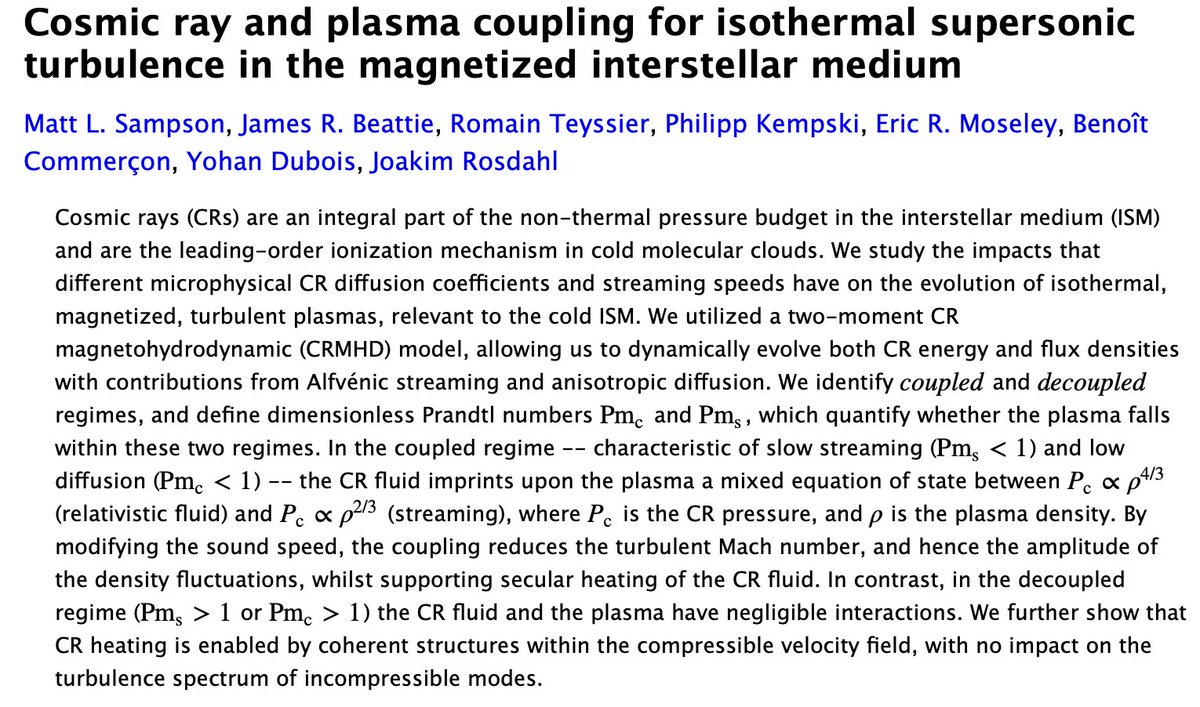
If you’re interested in MHD / CR fluid coupling (mostly via the acoustic response of the plasma) then check it out: https://t.co/EzVviW9DaJ
In this paper, we explore how, during cosmic reionization, velocity anisotropies in ionization fronts can trigger the Weibel instability, which may act as a mechanism for generating seed magnetic fields in the early Universe.
New Paper alert "https://t.co/SxM4Rgwkrz" : (This paper is special as it is led by a bright undergrad student who started this project as a summer program)
However, there are still large uncertainties about the origin and strength of magnetic fields in the Universe. In particular, how seed magnetic fields were initially generated remains a major open and actively debated question in astrophysics.
What about Magnetic Field?
This is one of the most frequently asked questions at almost every conference. As a cosmic ray enthusiast, I also find myself thinking about magnetic fields often, since cosmic rays (charged high-energy particles) propagate through magnetic fields.
As a result, CRs can boost the total cold gas mass in the CGM and enhance cold gas inflowinto the central galaxy — fueling more star formation. 🌠
Cosmic rays, once seen as by-products, may be key regulators of the galactic ecosystem.
4/4
Our new paper is out on the arXiv https://t.co/NMOonWxroQ. Our simulations show that CR pressure reshapes cold gas clouds in the CGM, helping them grow, survive longer, and boost gas inflow to the galaxy.
#Astrophysics#CGM
1/4
We find that cosmic ray pressure reshapes cold gas clouds stripped from satellite galaxies in a Milky Way-like halo. CRs “puff up” these clouds, increasing their surface area, hence cooling in their mixing layer, helping them grow and survive longer.
3/4
Motivated by eclipse flares in HMXBs, we extended our study to LMXBs and found a very interesting type of eclipse bursts - using them, we estimated the reprocessing efficiency of these systems.
Read more about our recent work:
https://t.co/y92wDSkJvu
We are excited to present our monthly colloquium series by Dr Chandreyee Maitra, IUCAA! Please do join us via Zoom on 18 Sept, 6:00 PM IST to know about the High-Energy Universe. Please share it with your colleagues and acquaintances. #womeninastro
We’re excited to announce the release of our 4th newsletter, marking 1st Newsletter in 2025! 📖 Check out the newsletter [https://t.co/l7TWcnrzEZ] and join us in celebrating the bright minds that are paving the way for new frontiers in science and academia!
#carinas#youngfaculty




![we_the_carinas's tweet photo. We’re excited to announce the release of our 4th newsletter, marking 1st Newsletter in 2025! 📖 Check out the newsletter [https://t.co/l7TWcnrzEZ] and join us in celebrating the bright minds that are paving the way for new frontiers in science and academia!
#carinas #youngfaculty https://t.co/dXZf4RPXVL](https://pbs.twimg.com/media/GyrcRxlWkAMcRq6.jpg)





