Science suggests that the human brain does not mature in a linear fashion from childhood to old age, but rather goes through five main stages, and it appears that the most significant structural change in a person’s entire life occurs around the age of 32 | Sonia Ramírez, ECOticias
Four ages have emerged as the major turning points in the human brain’s lifetime wiring pattern: 9, 32, 66, and 83.
That timetable places the brain’s final phase of structural maturation, when its communication networks reach peak efficiency and organization, well into the early 30s and reframes when adulthood in brain development truly begins.
A lifespan wiring map
Across thousands of brain scans collected from infancy to old age, the human brain’s wiring pattern repeatedly reorganizes at a small set of specific ages.
While mapping those changes, Duncan E. Astle at the University of Cambridge demonstrated that the most dramatic reorganization occurs around age 32.
Before that point, brain networks continue strengthening long-range connections that improve how distant regions communicate.
After that transition, the overall wiring pattern settles into a decades-long period of relative stability that precedes the changes of later aging.
What the scans saw
Instead of counting brain volume, the researchers followed the brain’s long wiring fibers, where messages travel between regions.
Using diffusion MRI, scans that track water movement inside tissue, they followed how water drifts along packed fibers.
After turning each scan into a map of connections, the team compared 12 measures that describe network organization.
Those measures let them spot ages when the overall pattern stopped developing one way and started developing another.
The first pivot
Around 9 years old, brain wiring stopped building broad connections and began tightening into more exact routes.
During that stage, synapses, tiny junctions where one neuron signals another, were trimmed back as the strongest pathways stayed.
School demands rose quickly then, and the brain balanced fast learning with early vulnerabilities that can show up as anxiety.
Because those circuits were still settling, delays in language or attention often became easier to notice during late childhood.
Why maturity runs long
Some health experts now stretch adolescence past the teen years, reaching into the mid 20s. In the Cambridge brain maps, the same wiring trend continued from about age 9 through 32 before changing direction.
Across that period, connections between far-apart regions grew more efficient, while local clusters kept getting more specialized.
Long fibers also gained speed through myelination, building fatty insulation that speeds nerve signals, which supported later gains in self-control.
What peaks at 32
In the early 30s, several measures flipped direction, ending a long run of rising efficiency in brain wiring.
One longitudinal study found white matter, the fast fiber bundles linking brain regions, kept maturing into the twenties.
Soon after that point, the Cambridge team saw a long middle period where the overall wiring pattern changed more slowly.
For most adults, that slower pace may hide real aging signals until later changes finally start piling up.
Decades of quiet change
From the early 30s through the mid 60s, the network held steady overall, yet small changes kept accumulating.
Local neighborhoods of regions grew more tightly linked, a trend that boosted modularity, how strongly the network splits into separate groups.
Many parts still communicated well, but the balance started leaning toward specialized clusters over fast long-distance sharing.
That pattern can protect skills that depend on local circuits, but it can also make the network less flexible under stress.
Early aging signals
Around 66, the timeline entered what the authors called “early aging”, when global links weakened and the network thinned out.
As wiring weakened, the brain also became more vulnerable to hypertension, long-term high blood pressure that strains small vessels.
In a trial, intensive blood pressure control lowered the risk of new thinking and memory problems in older adults.
Better control of those risks cannot stop brain aging, but it can slow added vessel damage that piles onto weaker connections.
Life after 83
After 83, the network relied more on a few strong hubs, and many weaker routes no longer carried as much traffic. That left centrality, how much key paths run through certain nodes, as the only clear age signal.
Only 93 people fell into that oldest bracket, so the data had less power to detect smaller patterns.
A cross-sectional, based on one time point per person, snapshot cannot show within-person change, so the timeline should guide questions, not decide futures.
Using the timeline
Clinics already schedule many checks by age, and this new wiring map offers a sharper clock for brain health.
If a child’s attention or language is slipping, that timeline can help clinicians ask whether wiring was late or derailed.
Late childhood problems may hint at circuit pruning gone off track, while changes in the 60s can flag vascular stress.
Using the timeline well will take long-term follow-ups, broader populations, and careful work that separates illness effects from normal aging.
Where this leads
Viewed across a whole lifetime, brain wiring did not change smoothly, and a small set of pivots divided life into chapters.
Future studies that follow the same people over years could test whether those pivots predict who benefits most from prevention or training.
Read more:
https://t.co/2nTwJrccQg
1. Samsung — Turn off "Viewing Information Services"
Menu → Settings → All Settings → General & Privacy → Terms & Privacy
Uncheck "Viewing Information Services"
Samsung doesn't call it "tracking." They call it "Viewing Information Services."
That's intentional.
do you understand what just happened to your computer..
Google Chrome secretly downloaded a 4GB AI model onto your device. Without asking.. Without telling you..
It's called weights.bin. It lives deep in your system folders. It powers Gemini Nano - Google's on-device AI.
And if you delete it? Chrome re-downloads it automatically. Like nothing happened.
Just Google deciding your hard drive is their storage unit.
At 1 billion Chrome users - that's 4 BILLION gigabytes of data pushed silently across the internet.
The carbon footprint alone equals tens of thousands of cars running for a year.
Check your disk right now:
📁 %LOCALAPPDATA%\Google\Chrome\User Data\OptGuideOnDeviceModel
To stop it: chrome://flags → disable Optimization Guide On Device Model → restart Chrome → delete the folder.
Reshare so people know what's sitting on their computers.
Let me explain exactly why Buffett is sitting on $373B in cash despite a market up 72% in 5 years, because the "he missed it" frame doesn't square with the math.
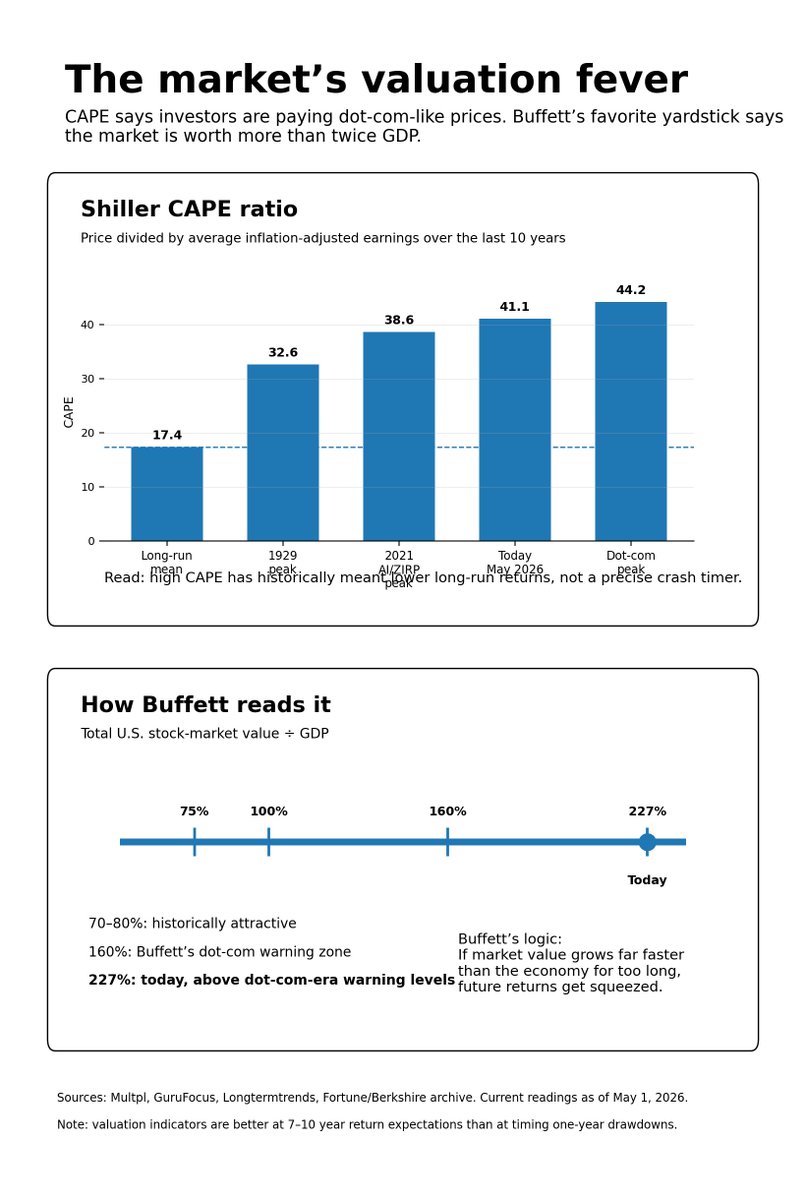
The Shiller PE just printed 41.06. The only time it's been meaningfully higher in 144 years of data was the 1999-2000 dot-com peak. Higher than 2007. Higher than 1929. After March 2000 the S&P drew down 49% over 30 months and didn't recover until 2007.
Warren's playbook when valuations stretch has been the same three times in a row.
1969: He shut down Buffett Partnership Ltd. and returned capital to investors, saying he couldn't find anything worth buying. The Nifty Fifty crashed 45% over the next 5 years while he sat in muni bonds.
1999: Berkshire's stock dropped 19.9% while the S&P gained 21%. Barron's ran "What's Wrong, Warren?" on the cover. Then the dot-com unwind hit and Berkshire crushed the index for 3 straight years.
2007: $44B in cash at the peak. Deployed during the 2008-2009 panic into $5B Goldman preferred at 10% with warrants, $3B GE preferred at 10% with warrants, and the 2011 BAC deal that turned a $5B preferred into roughly $30B in realized value. Three deals nobody else on Earth could write the check for.
Now run the math on the current pile. $373B in T-bills at 3.68% generates $13.7B per year in risk-free interest. Berkshire's average annual operating profit through the 2000s ran around $8B. The cash position alone is throwing off more income than the entire company used to produce.
The bull case for full equity exposure today is real. AI capex inflecting, nominal earnings growing, momentum compounding. Sounds attractive until you ask what game Warren is actually playing. His job is to be the buyer when somebody desperate needs liquidity at minus 40%. The only currencies that game requires are patience and capital that doesn't redeem.
Berkshire has both. And $13.7B per year while waiting.
The trade was never even close.
Roman Catholic Teachings Not Found in the Bible and a Timeline of when they were Added.
1. 300 AD: Prayers for the dead.
2. 300 AD: Making the sign of the cross.
3. 375 AD: Veneration of angels and dead saints.
4. 375 AD: Use of images in worship.
5. 394 AD: The Mass as a daily celebration.
6. 431 AD: The exaltation of Mary as the “Mother of God.”
7. 526 AD: Extreme Unction, or last rites.
8. 593 AD: Doctrine of purgatory.
9. 600 AD: Prayers to Mary and dead saints.
10. 786 AD: Worship of the cross, images, and relics
11. 995 AD: Canonization of dead saints.
12. 1079 AD: Celibacy of the priesthood.
13. 1090 AD: The rosary.
14. 1090 AD: Indulgences.
15. 1215 AD: Transubstantiation.
16. 1215 AD: Confession of sins to a priest.
17. 1220 AD: Adoration of the wafer, called the body of Christ.
18. 1416 AD: The cup forbidden to the people.
19. 1439 AD: Purgatory proclaimed as dogma.
20. 1439 AD: The seven sacraments confirmed.
21. 1545 AD: Tradition established as equal with the Bible.
22. 1546 AD: Apocryphal books added to the Bible.
23. 1854 AD: The Immaculate Conception of Mary.
24. 1870 AD: Infallibility of the pope in matters of faith and morals.
25. 1950 AD: The bodily assumption of the Virgin Mary.
26. 1965 AD: Mary proclaimed “Mother of the Church.”
Think of your heart as a high-performance sports car. Over time, it gets a bit... crunchy. This "crunchiness" is cardiac fibrosis—basically, your heart tissue turning into a stiff, old rug that refuses to cooperate.
But what if you had a secret "reset" button? Enter the Vagus Nerve, the body’s ultimate chill-out conductor.
New research suggests that "tuning" this nerve can actually reverse heart aging. It’s like sending a professional cleaning crew into your chest to scrub away scarring and tell the inflammatory "drama queen" molecules to pipe down.
By lowering the internal volume, the Vagus Nerve restores your heart’s "bounce." It recharges your cellular power plants, making your heart as resilient as a teenager on a sugar rush.
We aren’t just talking about living longer; we’re talking about a heart that still knows how to dance. The fountain of youth might just be a nerve-twitch away.
https://t.co/IFaTm7tsYu
There are 91 players in this week's Masters field.
The player in 91st place for driving accuracy is 91st on the leaderboard. The player in 90th place for driving accuracy is Rory McIlroy.
WOW 🚨 Delta Dental is considered a nonprofit but the CEO skyrocketed her pay from $4.5 million per year all the way to $48 million over 4 years
That’s $1 million dollars per month pay for one employee as a nonprofit
“Delta Dental is considered a non-profit, and as such you can be their taxes online. So I got curious in their 2014 filing, the IRS requests for the organization's top accomplishments.
Delta Dental reported that over 95% of claims electronic, online and paper were processed without any manual intervention. That means when your care is denied, there is less than 1 in 10 chance a human reviewed it
— That same year, Delta dished out up to a 30% pay cut on the care that doctors deliver, and for a decade, they did not raise what they pay for your dental care by a single penny.
Meanwhile, their CEO's salary skyrocketed. She went from 4.5 to $15 million a year. From 2014 to 2018, she made off with almost $48 million before leaving her position. That's a million dollars a month. Must be nice. And she's not even a clinician. She's a CPA.
You don't have to be an accountant to do the math. Dr. Pay cuts stagnant reimbursements. They were never about saving patients money on premiums.”
This 1 hour lecture on "Probability Theory" from MIT will teach you more about prediction markets than 2 month internship at at a Wall Street Quant firm.
Bookmark this & give it 1 hour today, no matter what. It’s the most productive start you can give your week. Then read post below.
Europe Forgot the Lesson the 1970s Oil Shocks Once Taught
The continent answered with reactors, pipeline diplomacy, and offshore drilling, then spent three decades neglecting and dismantling everything it had built. a mega🧵inspired in part by my conversation with Doomberg.
The European response to the OPEC embargo was an impressive mobilization that moved decisively and pragmatically taking advantage of the unique conditions available throughout the bloc.
France moved decisively launching the The Messmer Plan in direct response to the oil shock. It remains the fastest large-scale nuclear buildout in history.
France had little domestic oil, but it had everything else the program required: a large corps of state-trained engineers produced by the Grandes Écoles, heavy industrial capacity rebuilt under the postwar dirigiste economic model, and a nationalized utility in Électricité de France (EDF) already accustomed to executing at the direction of the state rather than waiting on market incentives.
Its political class drew the logical conclusion: electrify aggressively around a domestic nuclear base, using a standardized reactor designs that a purpose-built supply chain could replicate at pace.
Space heating, water heating, rail and significant portions of industrial process heat were shifted onto the grid as the fleet came online, deliberately substituting domestic electrons for imported hydrocarbons across as much of the economy as the technology of the era allowed.
The result over roughly twenty years was 54 operating reactors, an electricity system generating around 75 percent of its output from nuclear, net electricity exports to neighbours who had made different choices, and as an unintentional side effect a per-capita carbon footprint in the power sector that remains among the lowest in the developed world.
Ludvig Aberg gives a refreshingly honest assessment of his round today:
“Yeah, obviously really disappointed. I felt like I was striking it okay early on. Got away with a few things, especially No. 4, kind of left miss.
“But overall pleased with the week. Obviously today the back nine was not good, but that's the way it goes sometimes.”
“It got away from me quick there (on 11 and 12). Yeah, it was just poor swings. I felt like I've had that sort of 7-wood right miss a few times this week, on No. 4 especially twice, and it came up on 11 as well.
“Then tried to press a little bit on 12, hitting driver, where sometimes you can play 3-wood a little short of that bunker.
“Yeah, obviously really disappointed. I would have loved to be standing where Cameron is standing right now. But overall I still felt like I saw some nice things in my game this beak.”
He then went on to talk about the positives he can take away from this week:
“I think obviously the biggest thing that I take away is that I feel like I'm playing nice golf. I'm playing golf to the point where I feel like I can contend in big tournaments.
“Obviously a good finish last week and still a top-5 finish this week. Overall I feel like I'm playing good golf, which is really nice. It's nice to see on a hard golf course last week, hard golf course this week. That makes me excited.
“Obviously I would have loved a different back nine outcome today, but looking at the grand scheme of things, I'm pleased with my golf game.”
All class from Ludvig after a really difficult back 9.
@PGATOUR@THEPLAYERS
Your cell phone does not listen to you “by accident.” It's a feature, not a bug.
I talked about traveling to Rome just once and 10 minutes later I started getting flight ads.
It's called “Shadow-Logging” and it happens through 5 settings you've never touched.
Here's how to remove eavesdropping once and for all:
Agreed
Don't think folks understand how big of a deal the Chase writedowns are
The chain reaction has begun
"We've moved from Stage 1 into Stage 2. Outflows are overwhelming inflows. Asset sales are accelerating. And now collateral is being revalued"