On the International Day of Reflection on the 1994 Genocide Against the Tutsi in Rwanda, we mourn the victims & pay tribute to the survivors.
We must learn from past failures & protect the living — by rejecting hatred, inflammatory rhetoric & incitement to violence.
📢📢: Wetlands Week from 26 January to 2 February 2026: Let’s restore and protect our wetlands to support livelihoods, biodiversity, and Rwanda’s green growth.
#GreenRwanda 🇷🇼🌿
Congratulations President @KagutaMuseveni on your re-election as President of the Republic of Uganda. I extend my best wishes to you and the people of Uganda as you continue to serve your nation for the prosperity of your people. I look forward to the continued strong and productive cooperation between our two countries.
What’s holding Africans back? President Kagame asked.
Prof. Murigande told Kagame that the main reason is that African leaders don’t care about their people. They seek to enrich themselves — to eat, and to eat alone. The president agreed with him, but he pressed further, asking why this problem seems peculiar to Africa.
Kagame doesn’t ask rhetorical questions. He has identified a problem and is involving Rwandans in finding a solution.
Here’s my take:
To overcome challenges like those faced by postcolonial societies, a people must rediscover a sense of collective self-worth. Usually, this comes from the memory of their past achievements— who they were as a people informs who they are and who they aspire to be.
While Africa was not the only region to experience colonization, it is one of the few where colonialism either erased the memory of past greatness or created new countries with no shared memory of such greatness.
Colonisation captured African minds. In that sense, although Africa was colonised last, it was colonised the worst.
Colonial education deepened this alienation, distorting African aspirations, turning them from collective to individual.
In the 1950s, the small group of “educated” African elites aspired to join the white world : the colonial administration. Today, with colonial education still intact and keeping African minds in chains, the elites it creates do not aspire to uplift their people; they aspire to join the global elite. They don’t seek to improve their own societies; they seek to escape from them.
Accordingly, these elites measure their self-worth by:
•how fluently they speak foreign languages,
•which foreign schools they send their children to,
•which foreign hospitals they can afford,
•how many houses they build, and how much money they invest abroad.
At the heart of this lies a quiet acceptance that Africans are somehow defective as a people, and that the only way to succeed is individually. Even those who once believed they could change things often abandon the quest for collective improvement once they grasp the scale of the effort it demands.
The kind of heavy lifting required for real transformation breeds a sense of hopelessness, one that pushes people from collective ambition toward individual greed.
So, the individual’s aspiration becomes to join the global bourgeoisie. But these are strategies of self-evacuation. They are attempts to flee backwardness by moving from the rural village to the capital, then on to the enlightened colonial metropolis, and ultimately to disappear into cosmopolitan anonymity - a form of self erasure rather than a search for self restoration.
This journey became the measure of progress. Those who remain in Africa do so with one foot already out (through dual citizenship or close connections to the representatives of their desired metropoles) for themselves, and especially for their children.
Although Kagame brings up this topic, it has been a theme he turns to whenever he notices that some ethic is creeping in amongst the leaders, only that this time he is more specific.
For example, while he has been teaching agaciro as a form of mental decolonization, most people over the years understood agaciro merely as a material pursuit.
Yet agaciro is, at its core, about retracing and reclaiming the memory of self-worth and therefore the basis for collective pursuit.
We sincerely thank all our partners whose support made the 6th World Congress on Agroforestry a great success and contributed to a greener future.
#WCA2025🌳| #Agroforestry
Rwanda is proud to have hosted this historic UCI Road World Championships. I congratulate all the riders who competed across our capital city for their remarkable achievements and resilience. My sincere appreciation to my friend, David Lappartient @DLappartient, the UCI team, our partners, the security organs who kept the race route secure and the people of Rwanda whose energy and support made #Kigali2025 truly unforgettable.
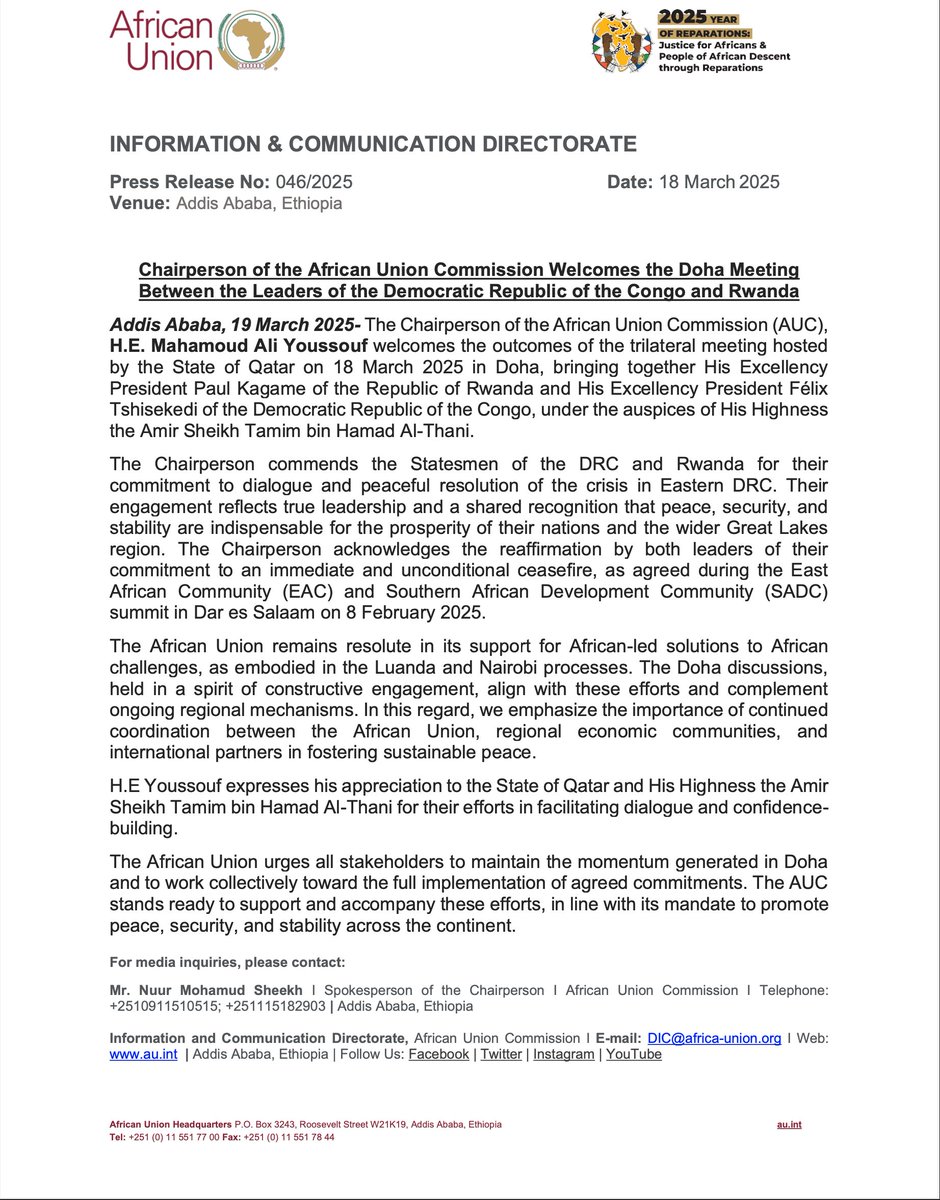
The Chairperson of the @_AfricanUnion Commission , H.E. Mahmoud Ali Youssouf @ymahmoudali, welcomes the Doha Meeting Between the Leaders of the Democratic Republic of the Congo #DRCongo and #Rwanda
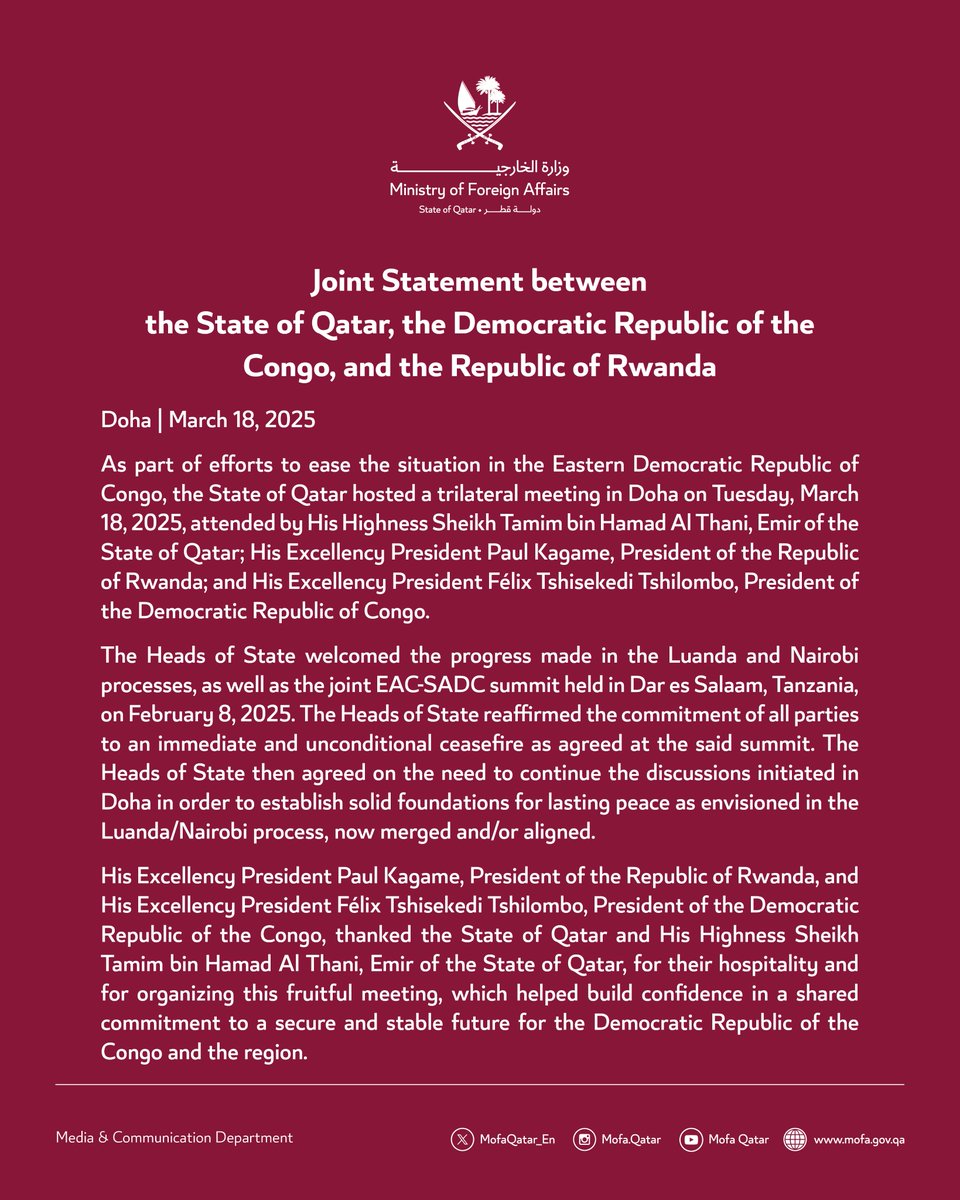
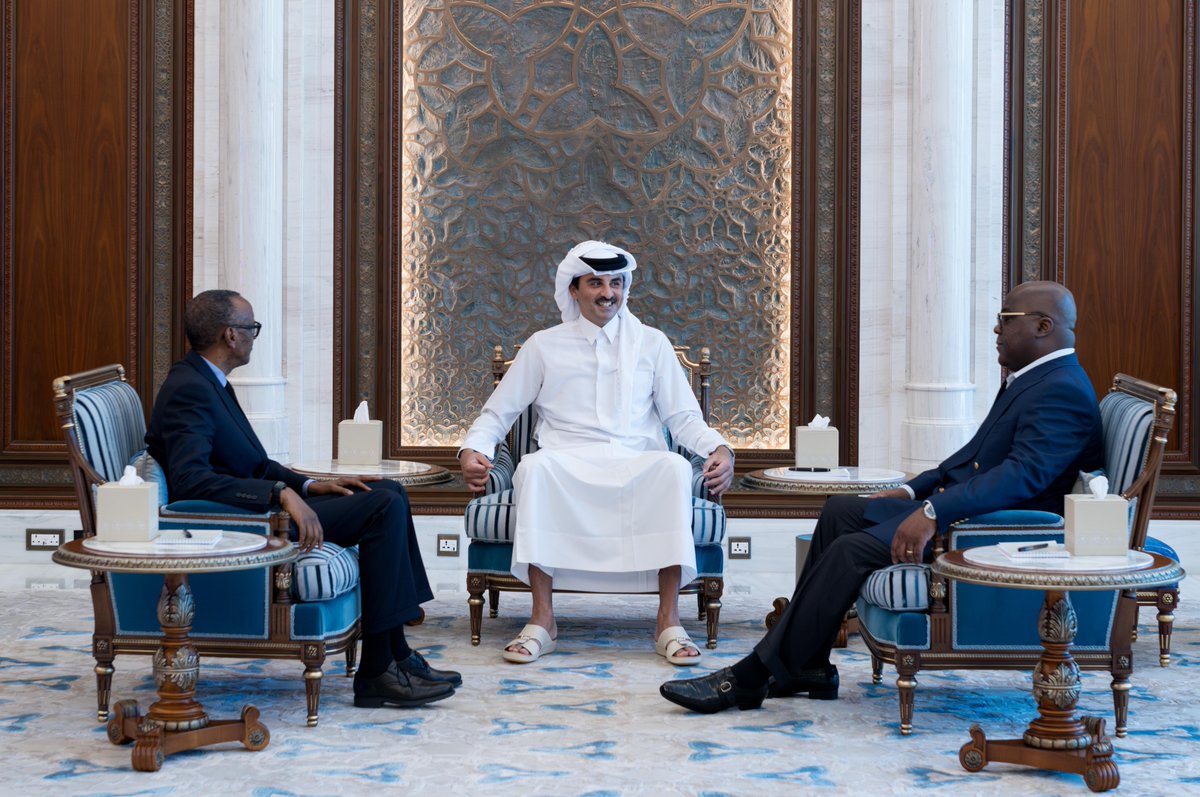
President Kagame attended a meeting with President Tshisekedi hosted by His Highness Sheikh Tamim bin Hamad Al Thani @TamimBinHamad, Emir of the State of Qatar, at Lusail Palace.
The meeting reiterated the leaders’ support to the EAC-SADC process as the primary mechanism towards a sustainable solution to the conflict in DRC. The need to address the issue of FDLR genocidal forces and to have security guarantees for Rwanda and the region was also emphasized.
The leaders also discussed the urgent need for direct political dialogue with AFC/M23 as key to addressing the root causes of the conflict in Eastern DRC.
President Kagame expressed his belief that with all parties working together, things can move forward faster. He thanked His Highness Sheikh Tamim bin Hamad Al Thani for his support towards constructive dialogue and tangible solutions to achieve durable peace in DRC and the region.
In the last month, Rwanda has shown you:
🔹The FDLR
🔹The European Mercenaries
🔹The offensive foreign forces
🔹The stockpiles of weaponry at our border.
Yet the world still downplays the gravity of the security threats we face. Why? Is it racism? Is it disdain? Is it a calculated geopolitical choice?
The only irrefutable proof left of the danger we face is our destruction. And it seems this is an acceptable outcome for many international actors. They will swoop in with something as truly useless as MONUSCO or another UNAMIR, then spend the next 20 years giving our people biscuits and cardboard.
One thing is certain: The Government of Rwanda will protect its people and everyone who lives here—resolutely and decisively. The question is not whether Rwanda will defend itself, but what must happen to prevent further escalation.
The answer is obvious. The root of this crisis lies in the DRC’s continued collusion with genocidal forces and its deliberate fueling of regional instability.
International actors must demand an immediate end to Kinshasa’s support for FDLR and associated extremist elements. The presence of offensive foreign forces in the region, operating under the guise of ‘peacekeeping,’ must be removed. Permanent security guarantees must also be established along our shared border.
Regarding the inter-Congolese conflict, dialogue between the DRC government and M23 is not only the most pragmatic approach but the only one that offers the prospect of lasting peace.
Anything short of this is a meaningless delay, a refusal to confront reality, and a failure to learn from history.
As a British citizen, I am appalled by the level of ignorance of Africa by some of the British politicians. Today I focus on @DavidLammy, the UK Foreign Affairs Secretary, and @Lord_Collins, Minister of Africa. Starting with David on the DRC and Rwanda conflict. David, I was in the DRC and Rwanda exactly when you were there. Unlike you, I visited the cities of Bukavu and Goma (this is in the DRC by way!), which are under the control of the M23 military-political opposition group. In your video following the visits, David, you talked about the humanitarian crisis and IDPs in Goma. While I was there this week, I have interviewed people on the ground and visited the different IDP sites. All IDPs had left the camps before you visited the #DRC. Though you were at 2000km from the IDPs sites. Your video was not representative of your talks with @PaulKagame and @fatshi13. Instead, it patronises and reinforces the deep-rooted moral hierarchy of power and knowledge. Forgive me for suggesting that you played a white colonial aristocrat in black skin. It was no longer David Lammy who used to display and express values of shared humanity using authentic politics.
Secondly, in your extremely partial diplomacy, you referred to the territorial integrity of the DRC, and your position is that #DRC security threats to Rwanda should be resolved diplomatically. I want to challenge you on this, David. The UK government is part of the NATO effort to defend Europe against any potential security threats from Russia. The UK has deployed troops along the EU border with Russia and has established the Operation ORBITAL training mission to Ukraine following the annexation of Crimea by Russia. Questions: Should the UK instead resolve this diplomatically and end the war in Ukraine? Should the UK respect territorial integrity of Russia? Have you been briefed about the many diplomatic efforts between Rwanda and DRC? You rightly suggest political solutions to the conflict but you then give lessons and apply sanctions to one country? David, the underlying factors of conflict in the DRC are all home grown. Continuing to baby-sit the DRC gov because the UK wants desperately a share in the potential natural resource in the DRC is also part of the problem.
On @Lord_Collins, you misled the parliament when asked about the brutal killing of 70 civilians by an ISIS-linked group referred to ADF in Mayba in the territory of Lubero. You suggest this incident was discussed with @onduhungirehe, alluding to ADF being a Rwandan armed group! This ignorance is not only beyond understanding and unacceptable as @YolandeMakolo suggested in the Rwandan official response. It is also racist as it fails to make a difference between who is who between the black people in Africa. There are over 250 armed groups in the DRC. Please get an accurate briefing or read about these groups and conflict dynamics in this region. Some of these groups are foreign, others are DRC government-sponsored, and others operate independently with freedom to kill, destroy, lynch and eat human flesh in Ituli and South Kivu area simply because of ethnic hatred. The dual actor's idea in the understanding of conflict in Africa is not only colonial and racist, but it dehumanises Africans. I call on decolonising UK-Africa relations but this must start with accurate knowledge of Africa and Africans. It is a pre-condition for a meaningful partnership of equals. It must also end humanitarian economy and patronisation attitudes. @DavidLammy please see below images of Bukavu and Goma @SugiraMireille@MaishaRdc@i_Birere@guardiannews@ElikiaBenYosef
To those international actors who say #Rwanda exaggerates the threat of #FDLR: eliminate them. Call Rwanda's supposed bluff & eliminate FDLR. As long as FDLR remains, with the support of the Congolese state, Rwanda will continue to cite this as a major security threat. 1/2