The control & training of single motor units … - absolutely pleased to share with you our latest publication! Once again, huge thank you to all collaborators, reviewers, & editors @eLife https://t.co/AsVFTVFYp8
Non-invasive neural-machine interfaces: can we control motor neurons as flexibly as their cortical counterparts? Find out more in our latest pre-print:
big thanks to @jaimeibper, @DBarsakcioglu, Jon Eden, Etienne Burdet, Carsten Mehring, and Dario Farina @NeuroCon_ICL
Tired: Keyboards & touchpads
Wired: Surface electromyography (sEMG)
We believe sEMG is the future of human-computer input. Be the first to understand the next wave of innovation. Today, we’re releasing a white paper that describes sEMG’s potential to revolutionize how we interact with computers. https://t.co/MDGMe6RTQR
1/
We just open-sourced two large wrist electromyography (EMG) datasets - one towards typing without a keyboard and the other for predicting hand poses - with baselines.
We believe these will help advance research into making high bandwidth non-invasive neuromotor interfaces a reality!
emg2pose: Hand pose estimation anywhere with neuromotor interfaces
A Dataset and Benchmark @ Neurips 2024 https://t.co/6i9xwinnCu
See blog: https://t.co/tvLqddClM3
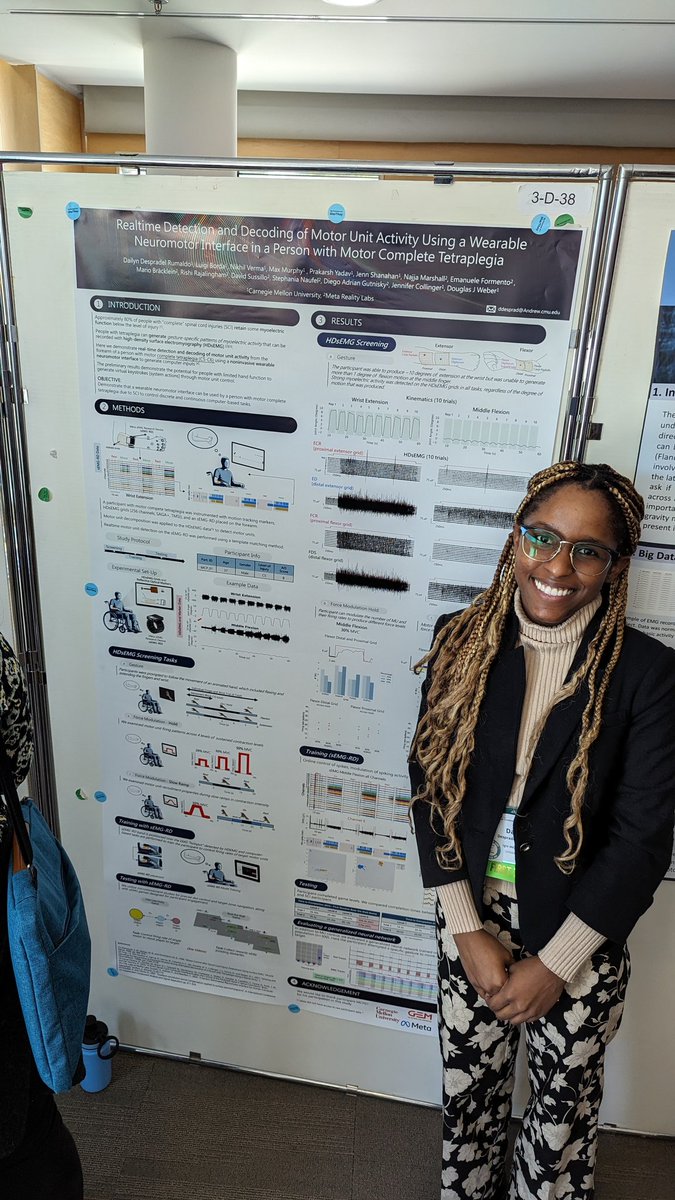
We are thrilled to present the first results from our new partnership with @Meta. @DailynDespradel is leading the project to use a wearable neuromotor interface for people with tetraplegia to use computers and play games. Please stop by 3-D-38 #NCMDub24@cmuneurosci @CMU_Mech
#NCMDub24
Come check out our posters today
1A34 - Towards human motor augmentation by learning to control novel wrist muscle co-contractions
1D35 Motor unit activation states: extracting a high-dimensional control signal from a single muscle for novel machine interactions
#NCMDub24
Come check out our posters today
1A34 - Towards human motor augmentation by learning to control novel wrist muscle co-contractions
1D35 Motor unit activation states: extracting a high-dimensional control signal from a single muscle for novel machine interactions
A generic sEMG interface! Thrilled to share what @RealityLabs (previously CTRL-Labs) has been working on over the last years. I'm proud and grateful to have contributed a tiny piece to this monumental team effort! Check it out below:
1/7
For the past decade, our team at Meta Reality Labs (previously CTRL-labs) has been dedicated to developing a neuromotor interface.
Our goal is to address the Human Computer Interaction challenge of providing effortless, intuitive, and efficient input to computers.
Don't miss our upcoming poster submission deadline (Feb 19) for @ncm_soc Satellite meeting (April 15, Dubrovnik) on artificial sensorimotor control!! Dedicated to Sliman Bensmaia, we are awarding 2 @Meta sponsored $1000 cash prizes for best posters: https://t.co/jh0HK6aYGe
Time to say thank you for 5 years of wonderful, challenging & valuable experiences! Deeply grateful for my supervisors, collaborators, examiners, colleagues, friends, reviewer#2 and family. Thank you for this remarkable opportunity to become a scientist!
More congrats in order for our fabulous @CDTNeurotech students! 👏👏to Jonny Taylor and @_HristoD for submitting and to @MBracklein for his successful viva!
Our paper on "Neurocognitive and motor-control challenges for the realization of bionic augmentation" is now out. We (Tamar Makin @plasticity_lab, Lee Miller
@PresNCM, and I) provide suggestions on #motor#control approaches for #robotics#augmentation
https://t.co/rYOnRykX6g
We are advertising for several PhD Studentship and Research Associate/Assistant positions within the newly established Imperial-Meta Wearable Neural Interfaces Research Centre. The closing date for applications is 18 August 2022.
https://t.co/u70jfeuVL3
The control & training of single motor units … - absolutely pleased to share with you our latest publication! Once again, huge thank you to all collaborators, reviewers, & editors @eLife https://t.co/AsVFTVFYp8
Non-invasive neural-machine interfaces: can we control motor neurons as flexibly as their cortical counterparts? Find out more in our latest pre-print:
big thanks to @jaimeibper, @DBarsakcioglu, Jon Eden, Etienne Burdet, Carsten Mehring, and Dario Farina @NeuroCon_ICL