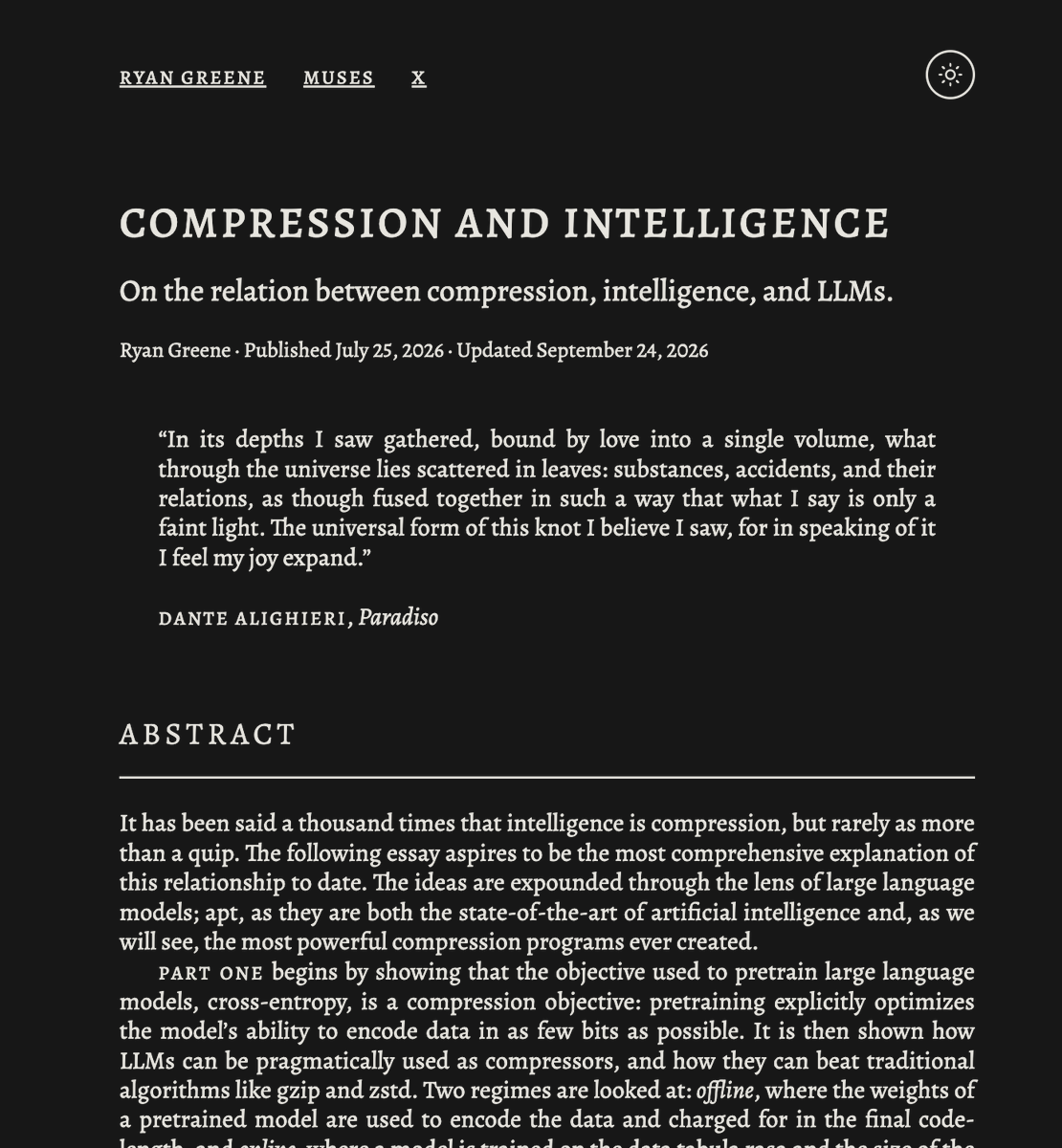
Looks like a great writeup on the prediction-compression duality, Solomonoff Induction, and how this measure of pretraining tracks intelligence progress. But it also raises a fundamental question of whether we could arrive at a (tractable) compression-oriented measure for RL / post-training (or more generally, for agency).
Specifically, what is the duality between reward-maximization (rather than prediction) and compression, and can we optimize against such an objective to get capable agents instead of how RL is done today?
Jakub's post acknowledges this as well https://t.co/6OtRI3CR8l
> Not accounting for advances outside of pretraining. Most notably, chain-of-thought reasoning does not reduce perplexity achieved by the model, even though it leads to a drastic increase in capabilities.
I fully agree with this.
- First, the problem of "reward hacking", where the gap between specified rewards and the underlying intentions is "exploited" by agents, is a fundamental limitation of RL and the current paradigm IMO.
- Then, there's the question of aligned to whom? With the centralization of AI, the objectives designed by those in power needn't reflect the diverse nature of society. It's unclear how human flourishing is possible in such a future without massively differentiated multi-agent systems aligned to the viewpoints of different subcultures and keeping the ecosystem in balance.
Doing the "right thing" for everyone (i.e. technically "solving alignment" in the current paradigm) is
impossible.
Doing something that nobody wants (i.e. replacing humanity with AI) is irresponsible and inexcusable. Let that combo sink in.
> Then, there is the question of work. On this topic, most lab leaders anticipate a future in which human labour is largely displaced. This raises questions about meaning, self-determination and even political rights. It is unclear what consequential role people would retain in a world without jobs. Work is more than a source of income: it is also a source of leverage, political as well as economic. I have heard people describe a future in which we would live on the returns from owning capital rather than from working; Sam Altman, too, has discussed shifting towards ownership. But there is no explanation to how most people would acquire that capital. Or, if wages cease to be a meaningful source of income, what route to capital ownership remains for those who do not already possess it.
What are the visions of the post-AGI future in San Francisco? Many think we're all going to die, but even the "positive" visions seem rather dystopian. Here, I wrote about "handoverism," which involves handing control of the future to an AGI God, with humans outside the loop.
https://t.co/bLxgiG65vi
We are on the cusp of RSI or recursive self-improvement: this means that AI systems can self-improve, without the need for human intervention. This means our world stands to be transformed in what many call “the singularity”. I moved to SF around three weeks ago and one of the things I have been trying to understand is where we are heading, at least according to those developing the tech.
The worst scenarios are plainly bleak: all of us, or vast numbers of us, die. But what is striking to me is how little reassurance even some of the happiest scenarios offer. But one common and ostensibly optimistic vision is known as “handoverism”: humanity cedes control of its future to a godlike AI and we become the comfortably maintained inhabitants of a civilisation whose direction is no longer ours to decide. It is difficult to see what democracy would mean in such a world, or where the consent of most of humanity to the instantiation of such a regime enters the picture.
The permanent displacement of human labour is treated almost as a given. At the same time, there is scarcely any satisfying answer to the question of how we might remain useful to one another. Even our relationships seem uncertain. The promised utopia looks to me much closer to a kind of dystopia.
“It’s not my preferred outcome,” someone working at one of the big labs told me, “but once we achieve superintelligence, which we cannot stop at this point, I cannot see any other option for where humanity will go.” Then, after a pause, he added: “It is still much better than what I actually fear most, which is that we might all die.”
He sounded resigned, as if the question of what humans would be for (apparently not much?) had already been settled somewhere else and by someone else. All that remains, it seems, is to wait for this pre-destined fate to unfold before our eyes.
But I do not think that is the case. I believe we always have a choice and that we should try and steer this technology in a way that maintains our agency and control. And even if that looks hard and daunting, the immensity of the stakes here make it worth trying at least.
I do not know whether the handoverist vision will come to pass. That the people building this technology consider it plausible, and often desirable, guarantees nothing: proximity to a technology does not correlate that well with predicting its impact on society.
But they are the ones closest to it, and what they say deserves to be at least taken seriously. The rest of society, including some very intelligent people, has been far too quick to wave these scenarios away and not even get involved in the debate. Whether or not the belief is correct, it is sincerely held, and it is not “marketing hype.” I am writing this because I think it is high time that more people, inside San Francisco and out, engaged with the arguments about what our future will look like, and answered them.
the most import skill in 2026 is still being able to tell your agents "wtf is this crap, no, not like this"
if you stop doing that, you're basically fucked, despite what some devfluencers would like you to think.
I know many PhD students are questioning what their paths mean as AI accelerates scientific discovery. That anxiety deserves to be taken seriously.
I wrote some reflections in a recent blog post. My students found them helpful, so I’m sharing them more widely.
I hope it offers a little light as we navigate this strange time. Please share it with someone who might need it.
https://t.co/wr1upnki47
Nice interview of my former colleague @SussilloDavid on the complicated relationship between AI and neuroscience: https://t.co/1jmlPT3r0V
Whether studying neuroscience helps AI or not, it'd be really cool for humanity to understand how the brain works!
to prepare for an upcoming release (👀) we dug into the pretokenizer a little more. are people aware that hand-crafted regexes are part of every frontier LLM and doing some pretty heavy lifting?
some quick examples 🧵
99% of current alignment work is after-the-fact treatments rather than preventative cures. we should not naively assume these are gonna be sustainable. extend ur planning horizon. get down to the roots. ask urself: how does one raise a good person?
Proposing a novel concept such as diffusion / flow matching, formalizing it, making at work at scale without compromising on generality or losing much of the underlying simplicity / beauty, persisting against criticism (i.e., not changing course just because a human prompter expressed doubts, even when step-by-step verifiability is weak or absent).
It'll happen, just a matter of time.
Love it! There was so much organizational resistance at Meta to opening up the SDK and access to raw EMG. It was a struggle to even release the small datasets that we managed to do with https://t.co/DUkxLVuqoZ and https://t.co/mH6fvqsmVv
An exciting platform opportunity was lost.
Did some light reverse engineering work on the meta neural band, managed to get it working standalone and reading out EMG and gesture data from my hand
What is the role of academic computer vision research in the age of increasingly powerful large models? Is GPT-6 Astra a step change? How can a researcher have an impact today in academia?
These are the questions I ask myself as I head off to ECCV 2026, a conference I’ve attended since 1992. One of my papers this year is VIGA, a method that takes an image as input and outputs a 3D Blender scene that represents that image. This is a classical inverse-graphics task and VIGA was the first method to solve it using an agentic approach.
The idea is now several years old and the first version of the paper was rejected. This delayed publication significantly. After it was accepted at ECCV, it was quickly surpassed by people using Claude Code for the same purpose. Today GPT-6 Astra blows away all previous results. But we still head off to ECCV to tell the community about our invention that is now fully out of date.
The way academic work often progresses is that one reads recent papers, notices that they have limitations, comes up with a new idea, explores this, publishes it, etc. Any published paper I read today is based on ideas that are at least a year old. And those ideas were based on the literature of the time, which was also a year old. That means that any paper I see at ECCV is likely two years out of date. In AI today, two years means your work is likely irrelevant.
At CVPR this summer I noticed that many authors have not gotten the message. They continue to work on “old” problems that have a long history. This history is based on assumptions about how the “vision problem” will be “solved”. The truth is that it is being solved in a very different way and many of these problems are no longer relevant. Another group of papers focuses on very niche problems where large models likely fail because of insufficient data or lack of business interest. The impactful papers were largely from industry and had long author lists and massive data+compute behind them. These papers were also out of data, describing systems that had been released months before, but at least they served to provide the community with more complete documentation and analysis of commercial systems.
So what should academics do? First, we need to put aside the tools we’ve used for years and start from scratch. Every project should start by trying really hard to solve the problem with existing tools. I would like to see every paper begin with a detailed experimental analysis of how existing models perform and why they fail (if they do). This gives the kind of insight we need today. Then, assuming current models fail, the solution should provide some fundamental insight that will outlive the next release of such models.
Reviewers today still focus on technical novelty. This pushes people to focus on tweaking architectures rather than clearly moving the field forward. Papers need to be judged based on their novel insight and not their novel technical contribution. This is a real shift in thinking but it focuses us on what matters - progress of the field.
If we want there to be a “field” of computer vision, then it can’t become a marginal backwater, focusing on esoteric problems. If you haven’t tried using Astra (or whatever comes next) to solve your problem, then you have not done your homework. This omission should be seen as negatively as not having a previous work section.
Concretely, I think papers should include a new section analogous to “Related Work” where that related work is current models and how they perform on the task. Reviewers should start asking for this and expecting authors to be able to articulate their insights about the limitations of existing large models.
I'm interested in your thoughts.
welcome to the 9th annual @stateofai report!
ai building better ai, world models, physical ai, geopolitics, cyber defense and 12-month predictions.
read it at stateof(dot)ai or watch my editor’s cut here.
a few of this year’s biggest findings follow: