Excited to see this. I’ve talked to hundreds of venture investors over the years, and @Rewkang is one of the most technical robotics investors I’ve met. He deeply understands the market and our products — actually doing the work to fly to our facility, spending time using our robots, and finding and visiting our customers. He’s one of very few investors with whom I’ve discussed model architectures and debated research papers. That technical depth doesn’t just help him make better investment decisions; it makes him a genuinely more useful partner to founders.
Proud to announce my position as CEO of @RoboStrategy.
When I initially started looking into investing in robotics 2 years ago most VCs I consulted with recommended not to invest in the space. Robotics companies at this time did not have an easy time raising capital. The industry didn’t have a track record of big venture winners, was perceived to be challenging for a variety of reasons, and was not well understood. But it was clear to me that the rate of acceleration of physical AI development would dramatically change the industry. I invested $19m into FigureAI as my first investment.
I believed it was a question of when, not if we could imbue machines around the world with physical intelligence. To accomplish this, the industry would need a tremendous amount of capital to grow, and also an investment firm that deeply understood the needs of robotics/physical AI companies so that it could build a platform to better support them. It will take hundreds of billions to capitalize the mechanized future meaning there is a big gap in the market. We decided we wanted to fill it.
Previously, Mechanism Capital had never taken outside capital, but to do this at the scale I envision, I would need to do so. However, the private markets don’t have that scale. The public markets do, and it was clear that there is and likely will be tremendous appetite for public market investors to participate in the immense value creation happening in AI & robotics that only private market investors currently have the privilege of accessing. The explosive growth of AI companies is a precursor of what will happen in physical AI. So in 2025, we founded RoboStrategy and a year later, we took it public on Nasdaq. Throughout this year, we’ve assembled a great portfolio, started leading rounds of some amazing companies, and have built the foundation to be ready to scale to the next level after going public.
We look different from a traditional VC firm in ways that founders appreciate. Our structure as a closed end fund means our capital is permanent - no fund life meaning we can invest with extremely long time horizons. Our investment firm also of course needs to have deep industry and research experience so that it can make the best risk reward optimized investment decisions. In the last year, we’ve brought on some truly exceptional robotics industry veterans who have previously served for decades as founders/operators. Many founders we talk to consider us as the most sophisticated venture capital firm they’ve talked to and we only intend to grow our expertise in the industry. RoboStrategy’s success depends on our ability to distribute the fund and capture maximal mindshare. This plays to our team’s strength in digital marketing and social media. We’re building a special marketing engine that serves as an attention amplifier for both us and our founders so that our products and stories can reach more people.
A source of inspiration for our fund structure, Strategy (MSTR) raised tens of billions from public capital markets to invest in Bitcoin. I believe robotics will be a much larger industry than Bitcoin and the asset class is orders of magnitude less accessible. We are aiming to raise more and not only become the largest robotics investor globally, but also one of the largest venture capital funds in the world. Venture capital has traditionally been restricted to a limited group of investors. We are changing the paradigm and bringing it to the rest of the world.
Be sure to follow @RoboStrategy.
Job’s not finished.
Staffers told me today's House Committee on Science, Space, and Technology hearing was the first robotics hearing in 20 years — and possibly the first time anyone has brought a live robot to a congressional testimony.
I got to show Chairman @RepBrianBabin one of ours.
No topic closer to our hearts than "Robots Made in America." My message to Congress: "We need to build American robots and put them in our factories. The future of our country depends on it."
@politico picked up the story right away — that's how much traction robots are getting in Washington. The opening statements from the chairmen made it clear: lawmakers understand the need for urgent action.
We need a National Robotics Strategy, and we need it now. Our seat at the table represents not just Standard Bots but the hundreds of U.S. manufacturers we partner with every day.
Video: https://t.co/NM305HsEtb
Written testimony: https://t.co/EuGL0LLyVC
Proud of the progress, but so much more to do. Now back to work. 🫡 🇺🇸
Testifying to Congress again on Tuesday - Science, Space, and Technology Committee - on making robots in America. If you had 30 seconds with the subcommittee, what would you tell them? Reply or DM. I'll put the best ones on the record.
Since 2023, the top quartile of AI spenders on @tryramp have more than doubled their revenue. Bottom quartile? Flat
A roofing company in Texas. A window installer in Utah. A construction firm in Florida that grew 65%
The gap is accelerating and most companies don't feel it yet
🎙️ @evanbeard is the co-founder and CEO of @standardbots, building AI-trained industrial robot arms designed to automate real factory work, not demos:
In this episode, Evan shares a founder path that started in software startups and Y Combinator long before robotics. Seeing engineers at YC building giant robots convinced him this was a “cheat code on life” and he taught himself mechanical and electrical engineering to make it possible
We talk about the early years spent building prototypes in a small apartment, running more than one hundred calls with manufacturers, and discovering the same problem every time. Companies wanted automation, but robots were too expensive and too difficult to program
Evan explains why Standard Bots focuses on usable automation instead of chasing hype. The goal was not a slightly better robot but something ten times easier to deploy, trained through demonstration and physical AI rather than complex programming
We also discuss surviving the near-death phase, raising funding weeks before running out of money, rebuilding electronics during the chip shortage, and learning electrical engineering while debugging exploding circuit boards remotely
A conversation about persistence, customer obsession, and why the future of robotics will be decided by real ROI on factory floors, not humanoid spectacle.
Building Deep Tech #100
"You Need To Be 10x Better"
With Evan Beard, Co-Founder and CEO of Standard Bots
00:00 – Why Evan moved from software to robotics
04:40 – Teaching himself hardware from zero
11:30 – Talking to 100+ manufacturers
18:20 – The near-death phase of the company
26:10 – Why robots must be 10x better to win
33:50 – Demonstration vs programming
41:30 – What factories actually care about
49:20 – The future of American manufacturing
🎧 Spotify: https://t.co/g66epUOXC7
🎧 Apple: https://t.co/HPkf9rTftj
🎬 YouTube: https://t.co/3rexuds20x
🎙️ @evanbeard is the co-founder and CEO of @standardbots, building AI-trained industrial robot arms designed to automate real factory work, not demos:
In this episode, Evan shares a founder path that started in software startups and Y Combinator long before robotics. Seeing engineers at YC building giant robots convinced him this was a “cheat code on life” and he taught himself mechanical and electrical engineering to make it possible
We talk about the early years spent building prototypes in a small apartment, running more than one hundred calls with manufacturers, and discovering the same problem every time. Companies wanted automation, but robots were too expensive and too difficult to program
Evan explains why Standard Bots focuses on usable automation instead of chasing hype. The goal was not a slightly better robot but something ten times easier to deploy, trained through demonstration and physical AI rather than complex programming
We also discuss surviving the near-death phase, raising funding weeks before running out of money, rebuilding electronics during the chip shortage, and learning electrical engineering while debugging exploding circuit boards remotely
A conversation about persistence, customer obsession, and why the future of robotics will be decided by real ROI on factory floors, not humanoid spectacle.
Building Deep Tech #100
"You Need To Be 10x Better"
With Evan Beard, Co-Founder and CEO of Standard Bots
00:00 – Why Evan moved from software to robotics
04:40 – Teaching himself hardware from zero
11:30 – Talking to 100+ manufacturers
18:20 – The near-death phase of the company
26:10 – Why robots must be 10x better to win
33:50 – Demonstration vs programming
41:30 – What factories actually care about
49:20 – The future of American manufacturing
🎧 Spotify: https://t.co/g66epUOXC7
🎧 Apple: https://t.co/HPkf9rTftj
🎬 YouTube: https://t.co/3rexuds20x
JP Morgan: "A rotation from the Digital world back into the Physical one."
We've been building @standardbots on this thesis for years.
VCs are about to learn that software-only bets look very different when Claude can rebuild your portfolio in a weekend. Capital will rotate hard.
Physical AI moats — hardware, software, training data — compound in ways pure software can't. Ford still hasn't caught the Model 3 after 10 years.
Standard Bots is building robots right here in Glen Cove!
I stopped by their new facility to see CEO Evan Beard and watch their newest model robots in action. Let’s make Long Island the robotics center of America!
Standard Bots is building robots right here in Glen Cove!
I stopped by their new facility to see CEO Evan Beard and watch their newest model robots in action. Let’s make Long Island the robotics center of America!
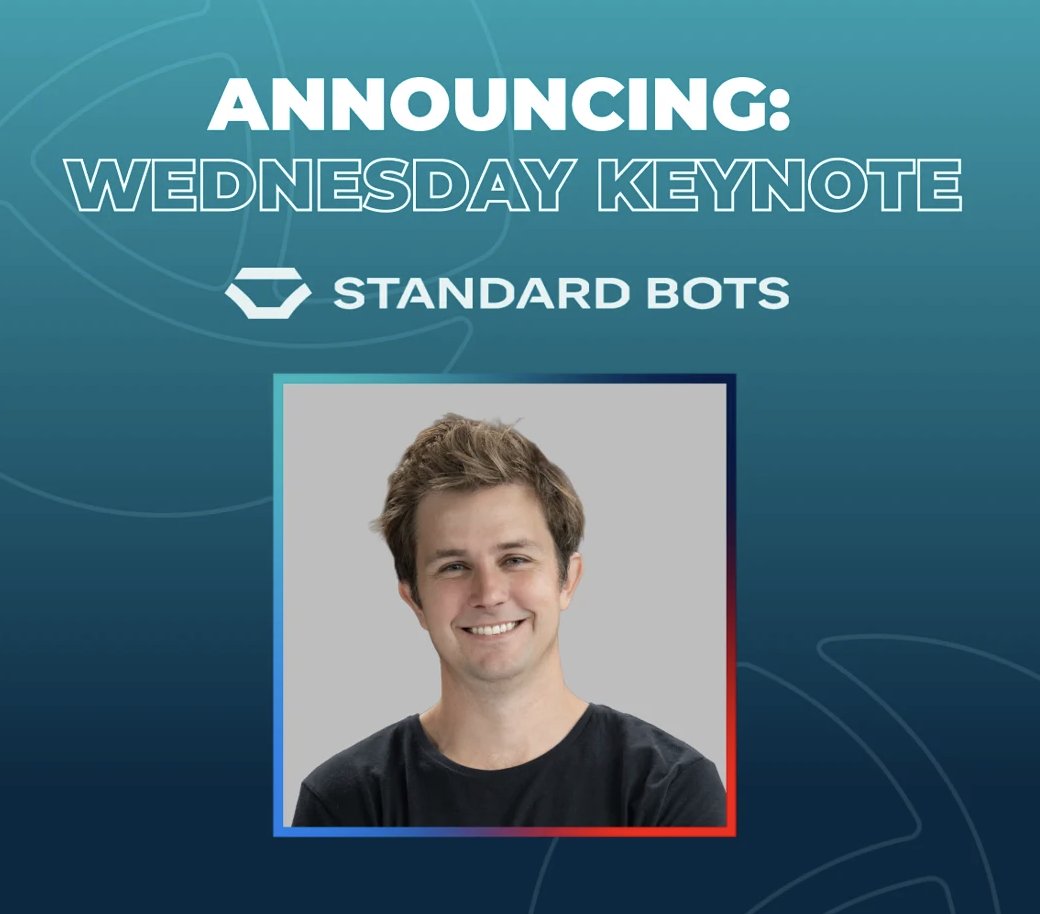
Excited to be giving the keynote at Automate, the biggest robotics and automation event in North America, on the main day. I'm going to cover what’s new and what’s next for AI-native robots that can learn through hands-on demonstration and adapt to real-world variability in real time - along with some major product announcements. If you're in the robotics space don't miss it - and our team would love to connect with you at our booth at the show!
@Ro’s first Super Bowl ad. Featuring the GOAT, @serenawilliams, and her journey on Ro—from weight loss to steady blood sugar levels to, as Serena says, having “knees like Megan.” Check out our spot. Couldn’t be more proud of the team. Still just the beginning!