Movement Disorders Clinical Practice is the exclusively online Journal of the International Parkinson and Movement Disorder Society (MDS) @movedisorder.
Want to learn DBS microelectrode recording? Start listening.
This superb educational resource teaches the characteristic MER recordings encountered along Vim, STN and GPi trajectories, combining narrated audiovisual examples with Anki flashcards for self-testing. https://t.co/UsT0vGKHvU
Shortening the MDS-UPDRS Part III rating scale risks hindering its prognostic reliability, per findings from a longitudinal item response theory model analyzed by @movedisorder#COA Program. https://t.co/Mb33NPftWm
Not every request for rescue levodopa represents motor OFF.
In refractory DDS, severe anxiety accompanied self-perceived OFF states and drove escalating dopaminergic use. Pregabalin was followed by resolution of rescue levodopa use and a substantial reduction in LEDD.
Before escalating dopamine, distinguish objective motor OFF from affective distress and medication craving. https://t.co/cEZ0y4g9CV
Is adaptive DBS really better than conventional DBS?
Not yet, at least with this beta-guided dual-threshold approach.
In a blinded randomized crossover pilot, aDBS and cDBS had comparable clinical efficacy, with substantial patient-to-patient variability.
The future of aDBS may lie in personalization, not simply adaptation. https://t.co/eCDG7Y3QfG
Expertise exists. Access doesn’t always follow.
Across Latin America, children with movement disorders face highly variable access to genetic testing, imaging, DBS, medications and emerging targeted therapies.
This viewpoint proposes a powerful solution: regional networks + shared education + collaborative research + locally adapted care pathways. https://t.co/Ky8Tn3PJWK
Same UPDRS improvement. Different motor physiology?
Both L-dopa and STN-DBS improved finger-tapping scores in PD, but kinematics told a more interesting story:
-L-dopa → fewer hesitations
-STN-DBS → fewer interruptions
-Sequence effect → improved by neither
Bradykinesia is a complex, not a single deficit. https://t.co/DmmGDFoARI
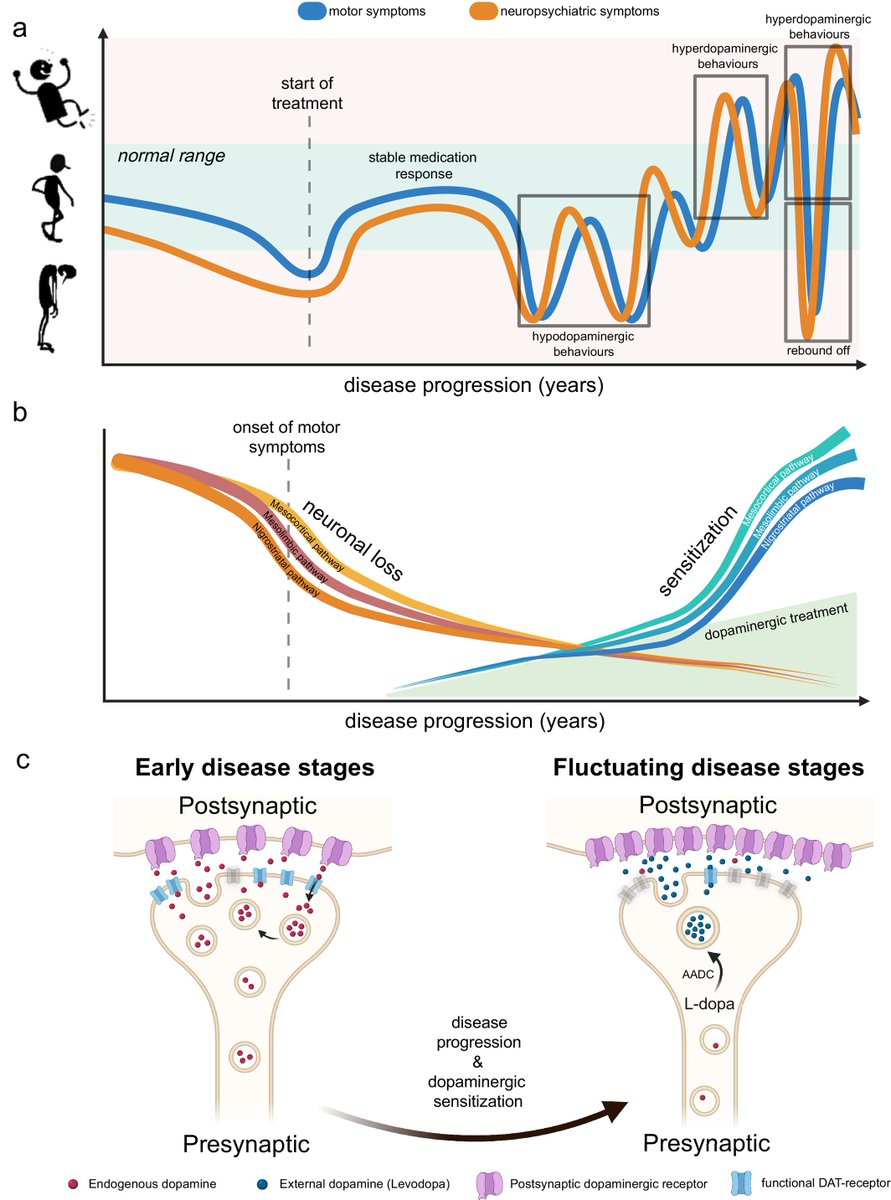
Your patient is motorically ON. But are they neuropsychiatrically ON?
This excellent review reframes neuropsychiatric fluctuations in PD as dynamic, dopamine-linked phenomena that may precede, exceed or occur independently of motor fluctuations.
-OFF: anxiety, apathy, low mood, fatigue, cognitive slowing
-ON: increased drive, impulsivity, disinhibition, hyperactivity
Don’t just ask “When do you wear OFF?” Ask how mood, thinking and behaviour change around each levodopa dose.
https://t.co/mwcnjhJw5x
Which bedside gait tests are most informative when assessing possible iNPH for shunting?
In this cohort, greater baseline impairment and a larger CSF drainage response on TUG and 10-m walk were independently associated with greater post-shunt gait improvement.
Interestingly, stationary balance and functional endurance measures did not show the same association with surgical outcomes.
📌 For falls: assess multiple domains.
📌 For shunt response: dynamic gait speed may matter most.
https://t.co/bFA2zAosJC
Have we been dismissing groaning in PSP as a curiosity instead of a symptom?
This large cohort study suggests groaning is associated with:
⚠️ More severe disease
⚠️ Worse cognitive-behavioural dysfunction
⚠️ Greater functional dependence
⚠️ Higher caregiver burden
Maybe groaning is a clinical marker of advancing PSP rather than an incidental feature.
https://t.co/YjdDMzI1xk
A post-void residual may tell you more than another scan.
This practical review reframes lower urinary tract symptoms as diagnostic clues in parkinsonism:
✅ Storage symptoms → usually PD
⚠️ Early retention or PVR >100 mL → think MSA
⚠️ Urge incontinence + magnetic gait → think NPH
The bladder deserves a place in the neurological examination. https://t.co/sEu5lnWYjm
"I'm not sleeping because I'm up 4 times every night."
For many patients with advanced PD, nocturia can be as disabling as motor fluctuations.
This real-world study found that overnight foslevodopa/foscarbidopa infusion improved nocturia, urinary symptoms and quality of life after 3 months of treatment.
Don't just ask about OFF periods. Ask about nights. https://t.co/tMUF5TrN3V
We measure tremor. We score bradykinesia. We quantify rigidity.
But what about the symptoms that often determine whether a patient can safely eat, communicate with family, or avoid aspiration pneumonia?
This review makes a compelling case that "Breathe, Eat, Talk" should become a routine part of every movement disorders assessment. https://t.co/rwNMiTG82k
Patient on foslevodopa/foscarbidopa infusion. Levodopa levels look fine. OFF periods persist. What are you missing?
This case highlights 3-O-methyldopa (3-OMD) as a potential culprit, competing for LAT1 transport at the blood-brain barrier. COMT inhibition with opicapone dramatically reduced 3-OMD and improved motor symptoms.
A reminder that plasma levodopa ≠ central levodopa availability. https://t.co/b78MS4QnOa
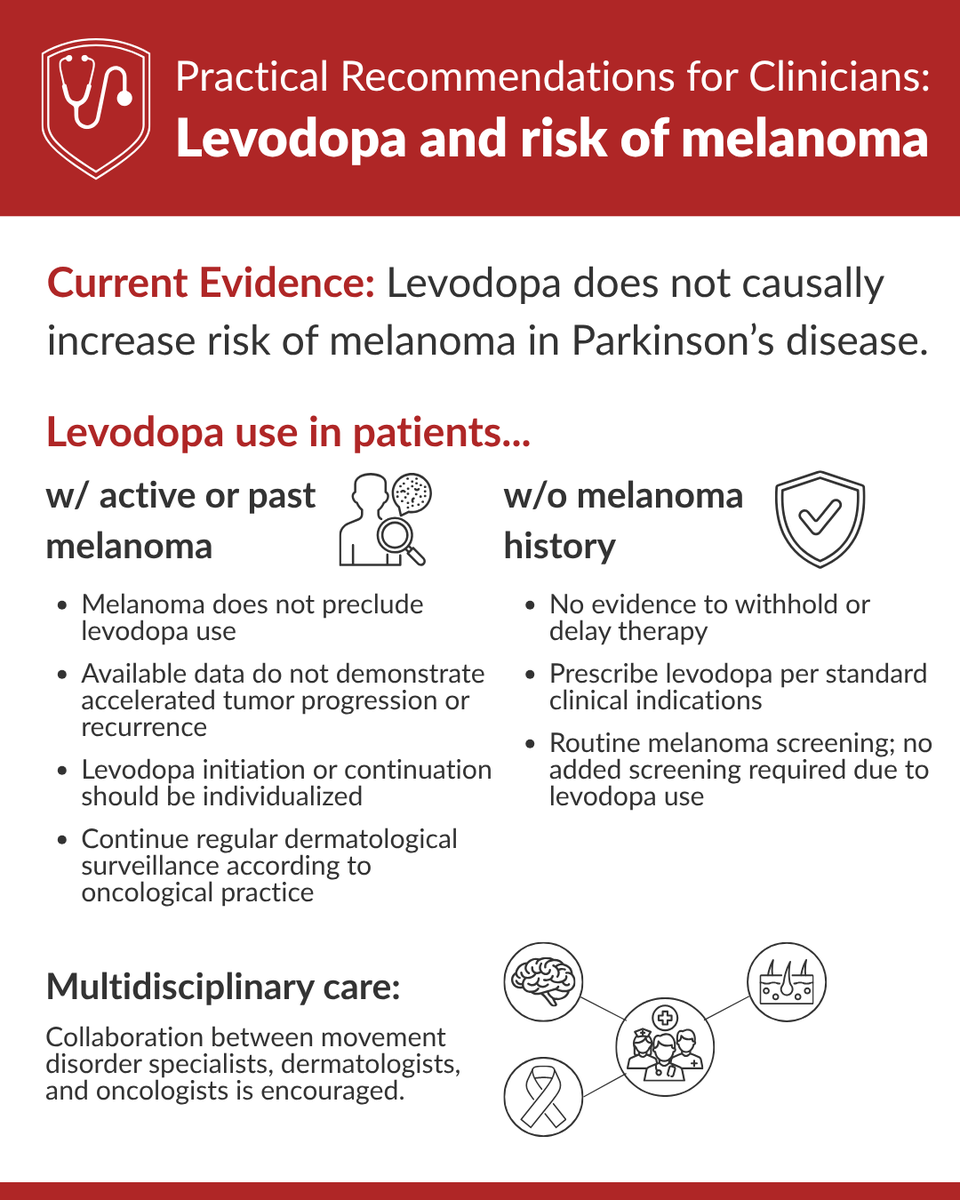
Viewpoint by @movedisorder Scientific Issues Committee deconstructs past reporting on levodopa use by patients with PD and the relative risk for developing melanoma to clarify a contemporary evidence-based clinical approach. https://t.co/uV9id8L7tM
The level of diagnostic precision in clinical neurological assessments of speaking or swallowing dysfunction is often insufficient. Early referral to speech-language pathology can reduce such day-to-day complications in people living with movement disorders. @movedisorder https://t.co/rwNMiTGFRS
Does Parkinson’s disease reduce creativity? Maybe not.
In interviews with 5 professional artists living with PD, all reported changes in technique or style, but none felt their creativity had diminished. Instead, they adapted to motor fluctuations, changed their tools, and continued creating meaningful work. https://t.co/eK6L2G0bft
A patient with Parkinson's disease and prior melanoma needs levodopa. What do you tell them?
According to this MDS Scientific Issues Committee viewpoint:
-Melanoma history does not automatically preclude levodopa use
-No convincing evidence that levodopa promotes melanoma
-Continue routine dermatological surveillance
A practical review addressing one of the most persistent controversies in PD care. https://t.co/gvK4yDB2DP
Have we been asking the wrong question?
Exercise is one of the best interventions we have for Parkinson's disease.
Yet this meta-analysis found no measurable effect on levodopa-induced dyskinesia or wearing-off.
Maybe the issue isn't that exercise doesn't work... but that most trials enrolled patients with minimal motor complications and used relatively insensitive outcome measures. https://t.co/M1rDAUwjPw