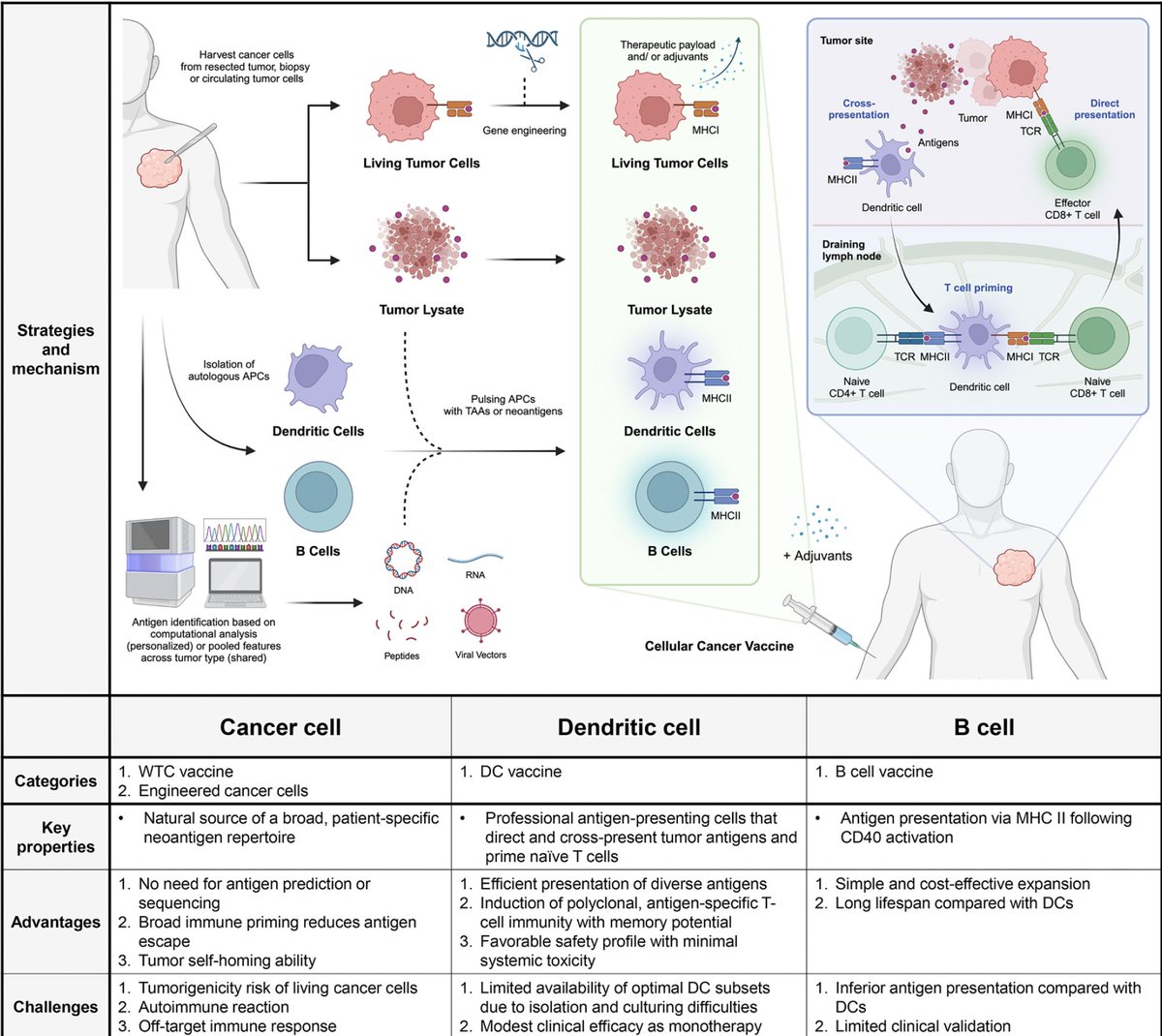
Some very good news about engineering our cells vs cancer (accelerating the CAR).
A short thread
1. For background, a new 5★ review on cancer immunotherapy @Cancer_Cell
https://t.co/1Qz2rCs8I5
New @CellCellPress
The hallmarks of cancer, refined from the original concepts 25 years ago, as an outgrowth of our expanding knowledge base
https://t.co/kjAYDRxvKD
AlphaGenome: Decoding the dark matter of the genome with a unified deep learning model
More than 98% of human genetic variation lies outside protein-coding regions. These "non-coding" variants can disrupt gene regulation in remarkably diverse ways: altering chromatin accessibility, shifting 3D genome architecture, modifying splicing, or changing expression levels—often in tissue-specific patterns. Yet existing computational models face a fundamental trade-off: either they capture long-range regulatory interactions (like distant enhancers) but blur fine-scale features, or they achieve nucleotide resolution but miss distal context. And most specialize in a single modality, leaving users to stitch together predictions from many separate tools.
Žiga Avsec and coauthors at Google DeepMind present AlphaGenome, a model that sidesteps these trade-offs. It takes 1 megabase of DNA as input and predicts ~6,000 genome tracks—spanning gene expression, splicing (sites, usage, and junctions), chromatin accessibility, histone modifications, transcription factor binding, and 3D contact maps—at up to single-base-pair resolution.
The architecture combines a U-Net backbone with transformer blocks: convolutions capture local motifs essential for splice sites and TF footprints, while transformers model long-range dependencies like enhancer–promoter interactions. Training uses a two-stage approach—pretraining on experimental data followed by distillation from an ensemble of teachers using mutationally perturbed sequences—yielding a single model that scores variants across all modalities in one pass.
The results are striking: AlphaGenome achieves state-of-the-art performance on 25 of 26 variant effect prediction benchmarks, including a 25% improvement in predicting eQTL direction over the previous best model. It outperforms specialized models on their own tasks—beating SpliceAI-class methods on 6 of 7 splicing benchmarks and ChromBPNet on accessibility QTLs. Critically, the multimodal outputs enable mechanistic interpretation: for oncogenic mutations near the TAL1 gene in T-cell leukemia, AlphaGenome simultaneously predicts neo-enhancer formation (increased H3K27ac), chromatin opening, and elevated gene expression—recapitulating experimentally validated mechanisms.
This points toward a future where interpreting non-coding variation no longer requires assembling a patchwork of specialized models. A unified framework that jointly predicts molecular consequences across modalities could accelerate rare disease diagnostics, guide therapeutic oligonucleotide design, and help prioritize variants in GWAS loci—moving us closer to truly reading the regulatory code written in DNA.
Paper: https://t.co/3WzrnGNUSw
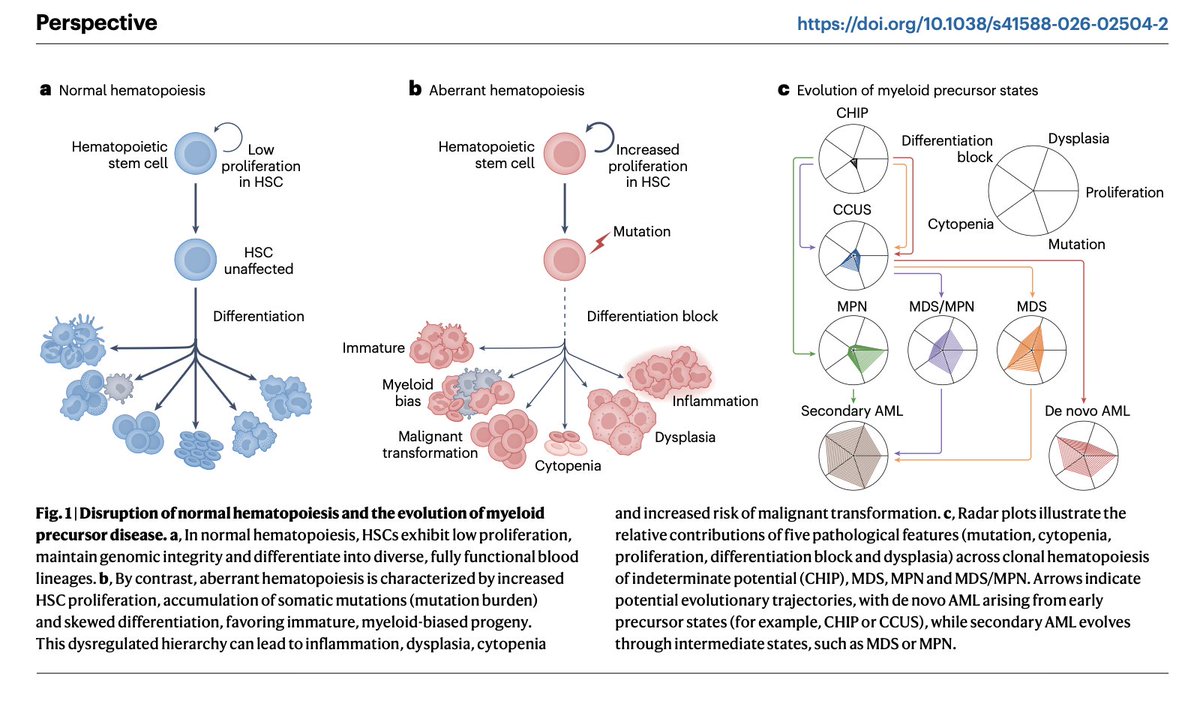
Secure a discount to attend our upcoming EHA-SWG Scientific Meeting on MDS/MPN/AML: Commonalities and Differences of Myeloid Neoplasms!
Why attend?
• High‑impact science across MDS/MPN/AML, including NGS/multi‑omics updates and novel therapies
• Expert interactions via keynotes, debates, clinical case discussions, posters & abstracts
• Cross‑disciplinary insights to translate research into practice and improve patient outcomes
• Networking with an international community of hematologists and researchers
📍 Ljubljana, Slovenia | 🗓️ Apr 30–May 2, 2026
🔗 Secure early bird registration until February 17: https://t.co/DLSzO4bu6y
#EHA #ehaswg #MDS #MPN #AML #MyeloidNeoplasms
Barbara McClintock's discoveries were so far beyond the understanding of the time that other scientists ignored her work for more than a decade. But she persisted, trusting herself and her evidence. She was awarded the Nobel Prize "for her discovery of mobile genetic elements."
Watch the very moment she received the Nobel Prize in Physiology or Medicine in 1983.
An assessment of LLMs for medical tasks
@NatureMedicine@drnigam
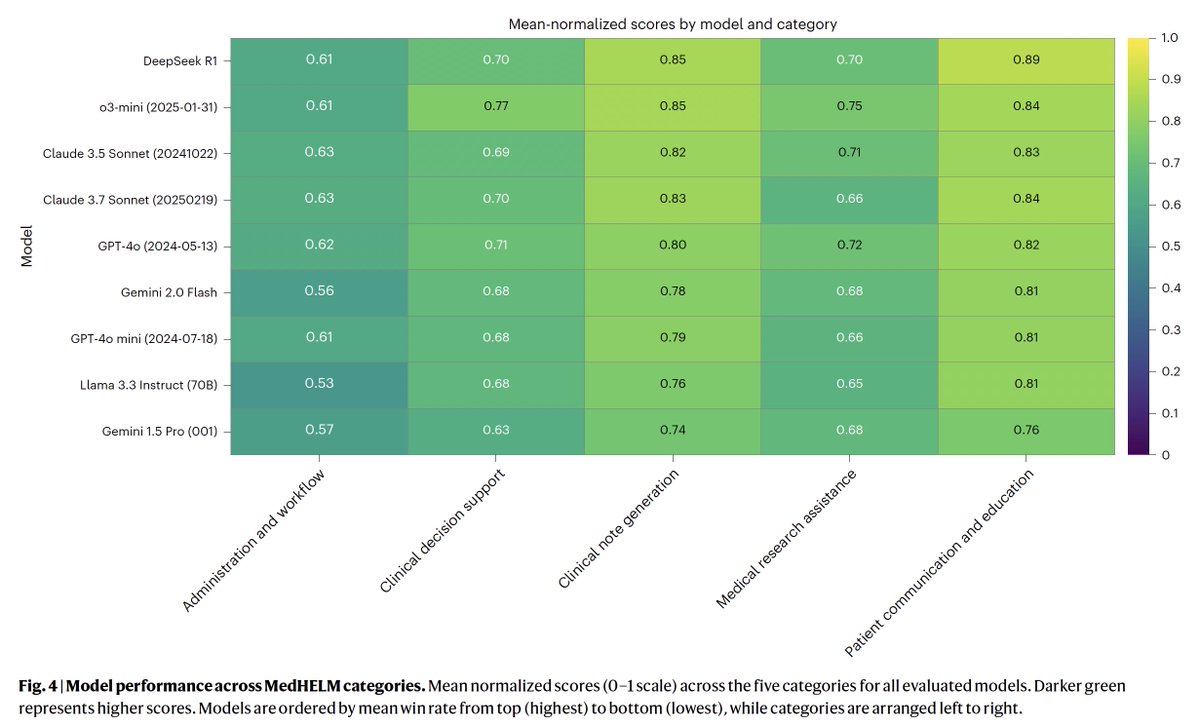
"Most models perform best in clinical note generation (0.74–0.85) and patient communication and education (0.76–0.89), moderately in medical research assistance (0.65–0.75) and clinical decision support (0.63–0.77), and worst in administration and workflow (0.53–0.63)."
https://t.co/Mwv6vYOad2
PU.1-driven genomic changes in low-risk MDS link SRSF2 mutations to immune dysregulation, higher progression, and worse survival. Insights may guide new therapies. #MDS#Hematology#BloodJournal https://t.co/LFGguwOStx