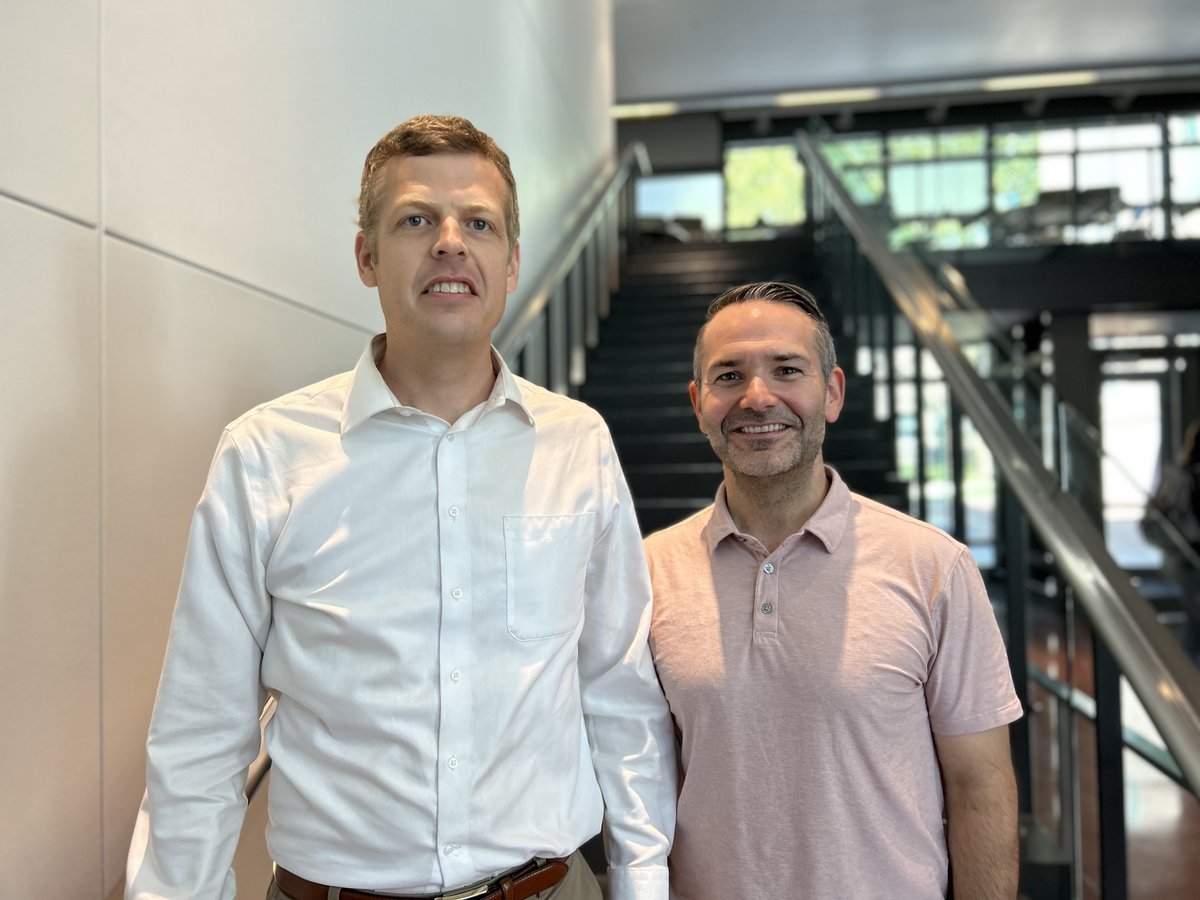
How does the brain turn sensory input into behavior? We invited Hang Lu of @GeorgiaTech for a seminar exploring how microfluidics, soft-material mechanics & machine learning can reveal how neural activity and learning shape behavior in C. elegans.
🔗 https://t.co/fO9S33nVP8
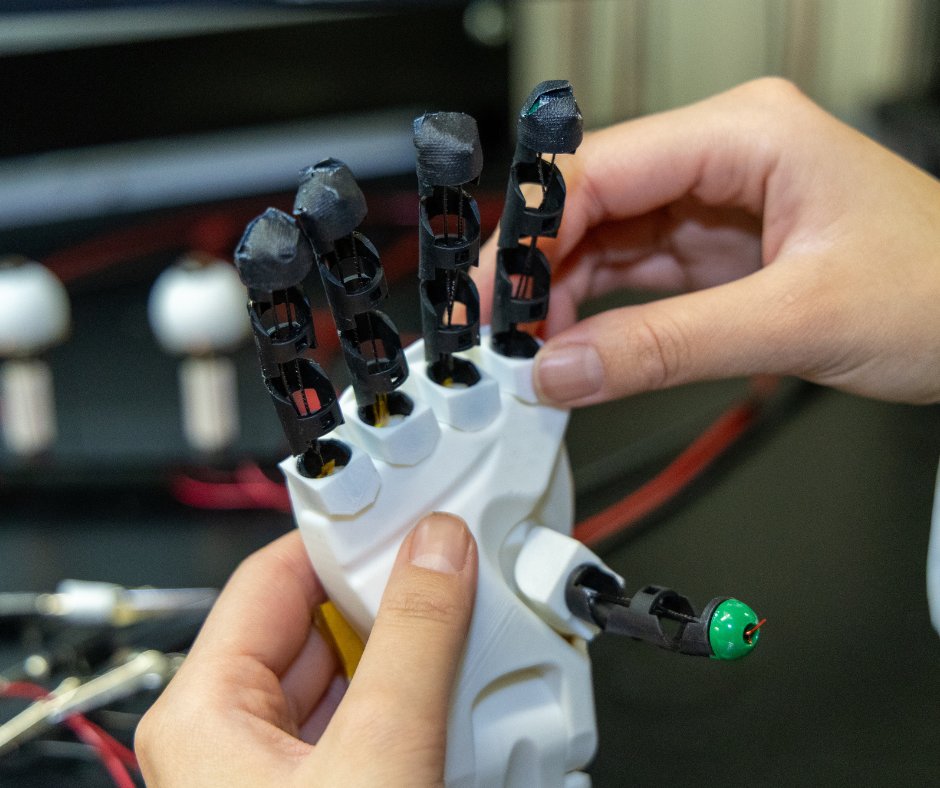
Penn Engineers have developed small, self-sensing artificial muscles that can hold precise positions and coordinate movements.
Led by Shu Yang (@mseatpenn) and Cynthia Sung (@meam_penn), the team developed fibers called CoilLCE that combine liquid crystal elastomers, graphene and an embedded copper coil to translate electrical signals into controlled, muscle-like motion.
The team demonstrated the technology with artificial fingers that play piano keys and artificial eyes that shift their gaze, using opposing pairs of artificial muscles to mimic how muscles work in the human body.
https://t.co/1XflUOkF1O
From freezing droplets to cloud formation, surfaces shape complex physical phenomena. Last week, we welcomed Saurabh Nath of Penn for a seminar exploring how ice, drops and bubbles reveal the physics of interfaces and their role in the natural world.
🔗 https://t.co/A1SQtc8MJV
From an idea to a Grand Prize-winning prototype: MEAM students Huaiyu Zuo and Wenyi Huang, along with Alex Yang (EE'29), earned the top honor in the Lab-in-Fab PMUT Application Student Competition for their acoustic technology.
Read more: https://t.co/9cqHtV8Ydt
Penn Engineers have developed a promising approach to lunar insulation: stacking hundreds of ultrathin Mylar sheets. The material combines thermal insulation with flexibility and durability, even after repeated compression, offering potential for future lunar habitats and space technologies.
“This material could open a pathway to inexpensive, durable and reusable insulation on the moon,” says first author Danielle R. Levin, a recent Penn doctoral graduate in chemistry who also earned a master’s in @MEAM_Penn.
Read more.
https://t.co/IxJCL6FWfB
There’s no single path to landing an internship.
At the 2026 MEAM Internship Showcase, students shared lessons from internships at Mars, Azalea Robotics, SpaceX and TSMC: refine your approach, be ready to learn and stay open to unexpected opportunities.
Preventing ice adhesion starts with smarter surface design. This week, Kevin Golovin of the University of Toronto joined us for a seminar on soft materials, buckling metallic surfaces and new strategies for creating durable, ice-repellent surfaces.
🔗 https://t.co/nIYtYJuib9
Congratulations to Dr. Samuele Ferracin on defending his dissertation on bistable mechanical metamaterials!
His research advances reprogrammable mechanical metamaterials that can change stiffness, store information and respond to fluid flows.
🔗 https://t.co/FfW4xIto5t
We're hiring! We are looking for applicants for a tenure-track or tenured faculty position at the Assistant, Associate or Full Professor level.
Help shape what's next in mechanical engineering
Learn more & apply: https://t.co/Xx2aRfLC48
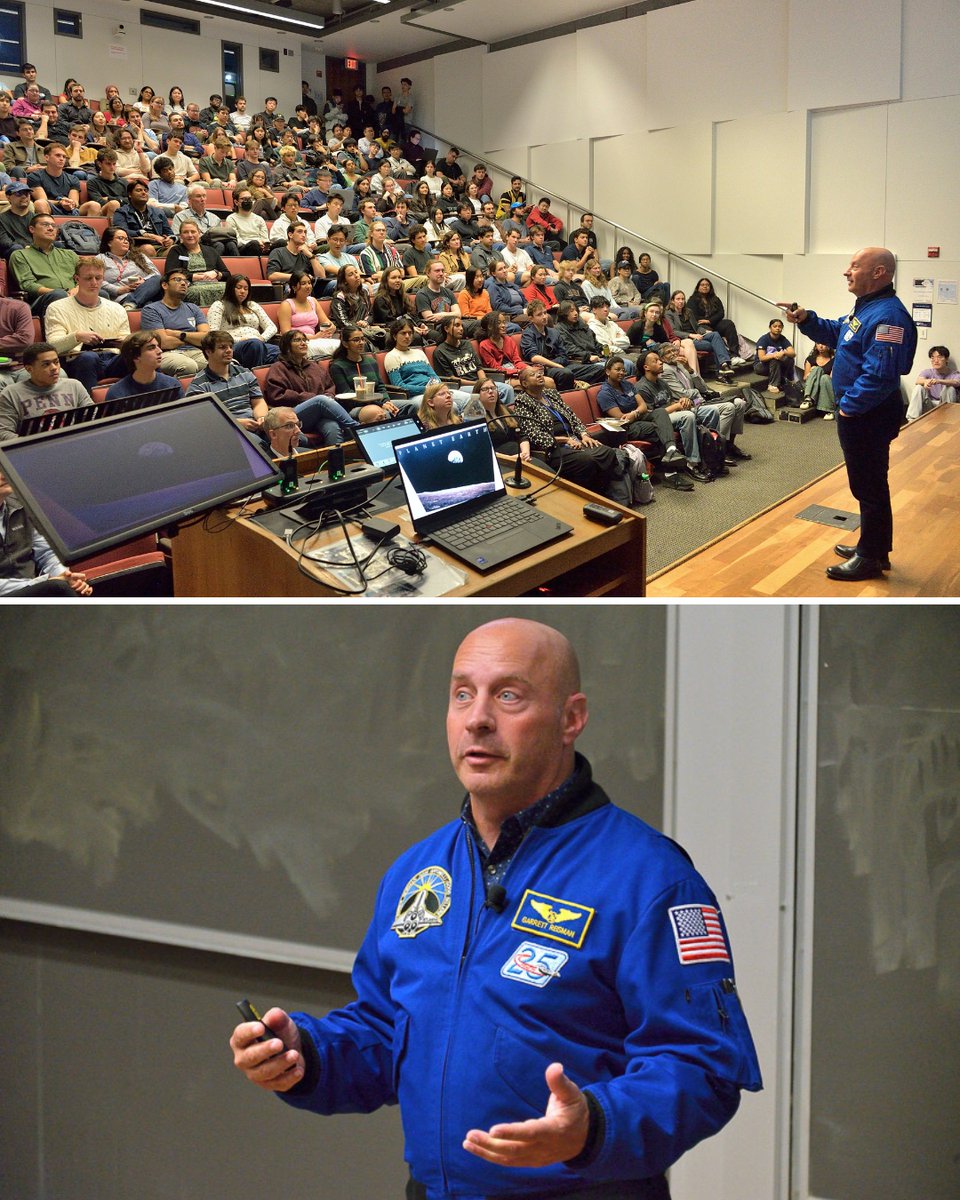
Garrett Reisman (ENG’91, W’91) returned to Penn as the 2026 Tedori-Callinan Distinguished Lecturer, sharing lessons from his journey from MEAM to NASA, the ISS and SpaceX. Among them: ambitious goals require more than inspiration.
Read more: https://t.co/5QiZq4FHG7
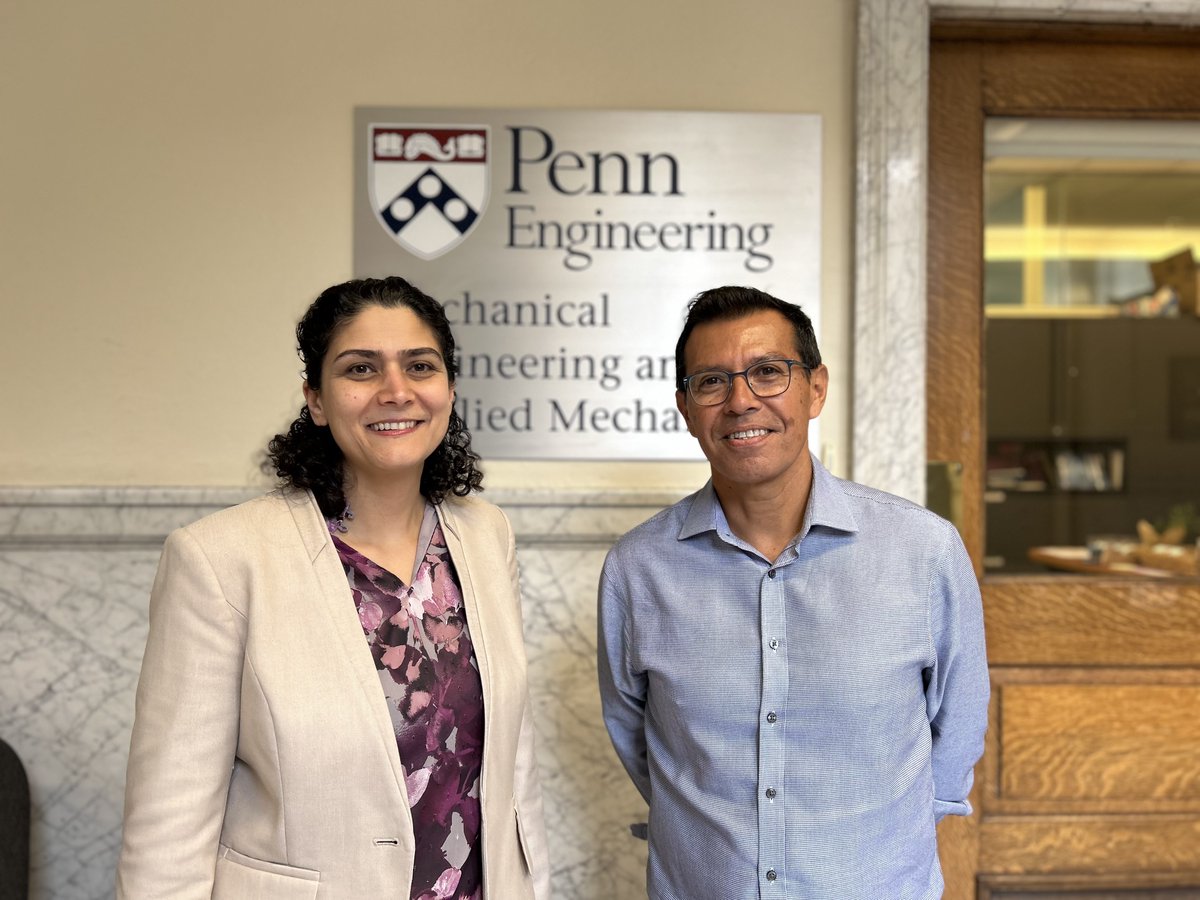
Congratulations to Marquise Bell, Provost’s Postdoctoral Research Fellow, and Luc Capaldi, a MEAM doctoral student, on being selected for the 2026 Rising Stars in Mechanical Engineering workshop at Stanford University! 🌟
🔗 https://t.co/mSLMUql7k8
How and when do cracks form in soft materials? Krishnaswamy Ravi-Chandar of @UTAerospace joined us for a seminar exploring crack nucleation and growth in elastomers using high-resolution imaging, 3D reconstruction and numerical simulations.
Learn more: https://t.co/ItdRgAqldP
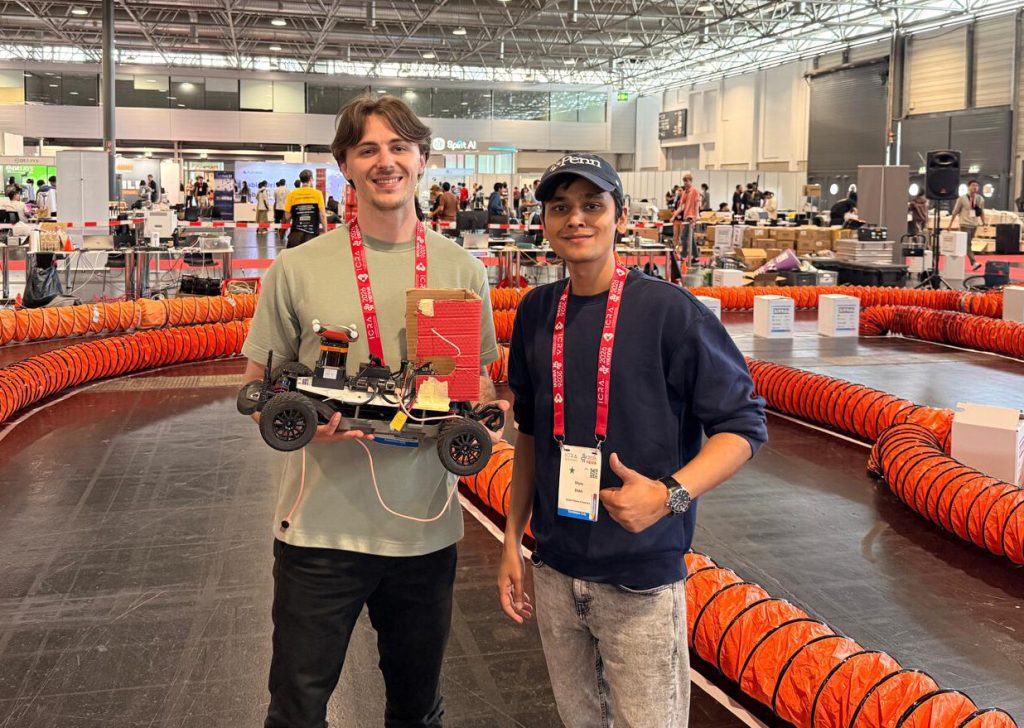
MEAM master’s student Cédric Hollande (left) put lessons from Penn Engineering’s RoboRacer course to the test, competing in an international autonomous racing competition this June at the 2026 IEEE Conference on Robotics and Automation.
Read more: https://t.co/V94H4tVcUv
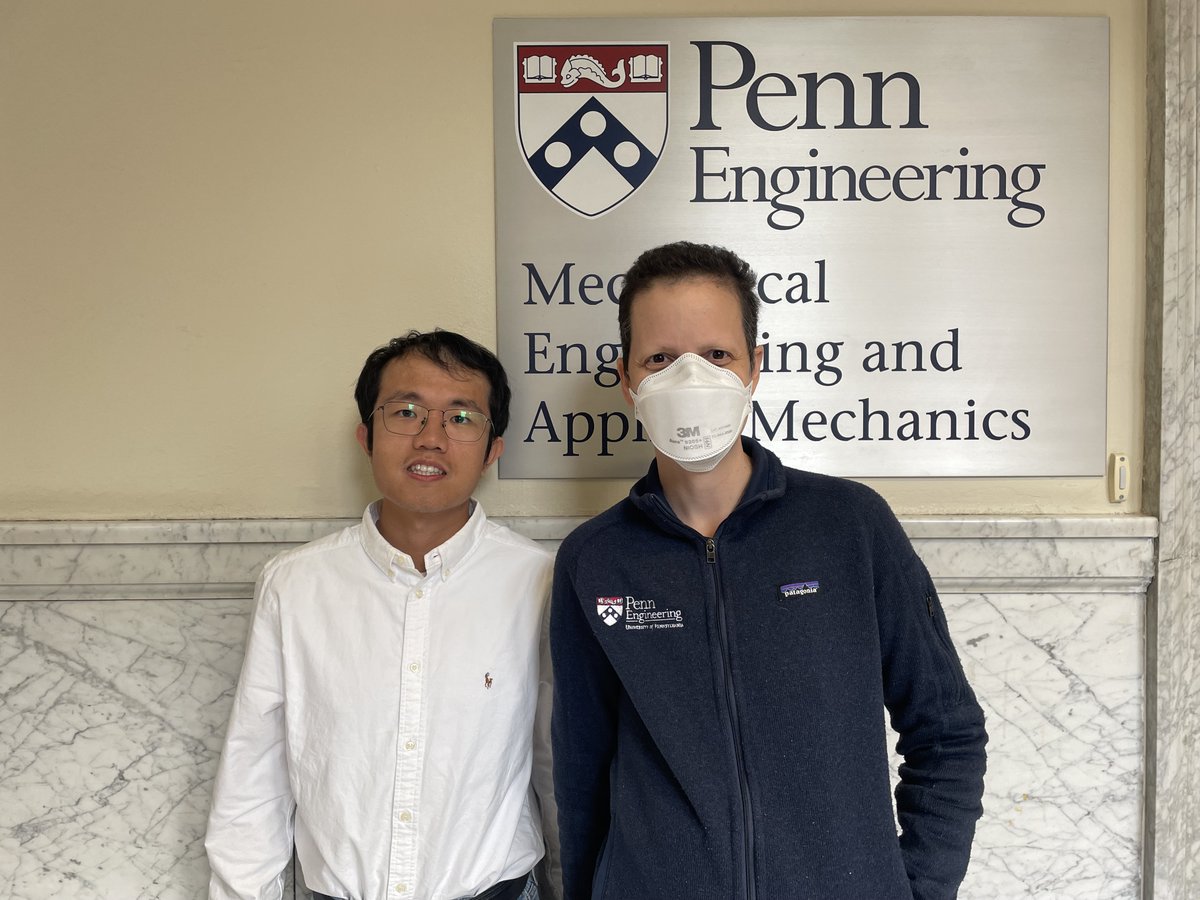
Congratulations to Weilun Qiu on defending his Ph.D. dissertation!
His research combines statistical physics and machine learning to model complex material behavior across scales.
“I came in as a student, and I leave as a researcher.”
Read more: https://t.co/DeggQfCEZ4
If robots are going to be useful for everyday tasks, they need to combine skills, adapt to changes and complete complex, multi-step tasks.
Researchers in the Figueroa Robotics Lab developed SymSkill, which helps robots learn and recombine skills to complete longer tasks. With just five minutes of video demonstrations, a real robot completed sequences of up to 12 steps and could adapt to interruptions and failures.
“What makes this exciting is that the robot doesn’t have to experience every possible version of a task before it can perform it,” says doctoral student Yifei Simon Shao.
Read the full story.
https://t.co/5e1tIp57UV
@MEAM_Penn
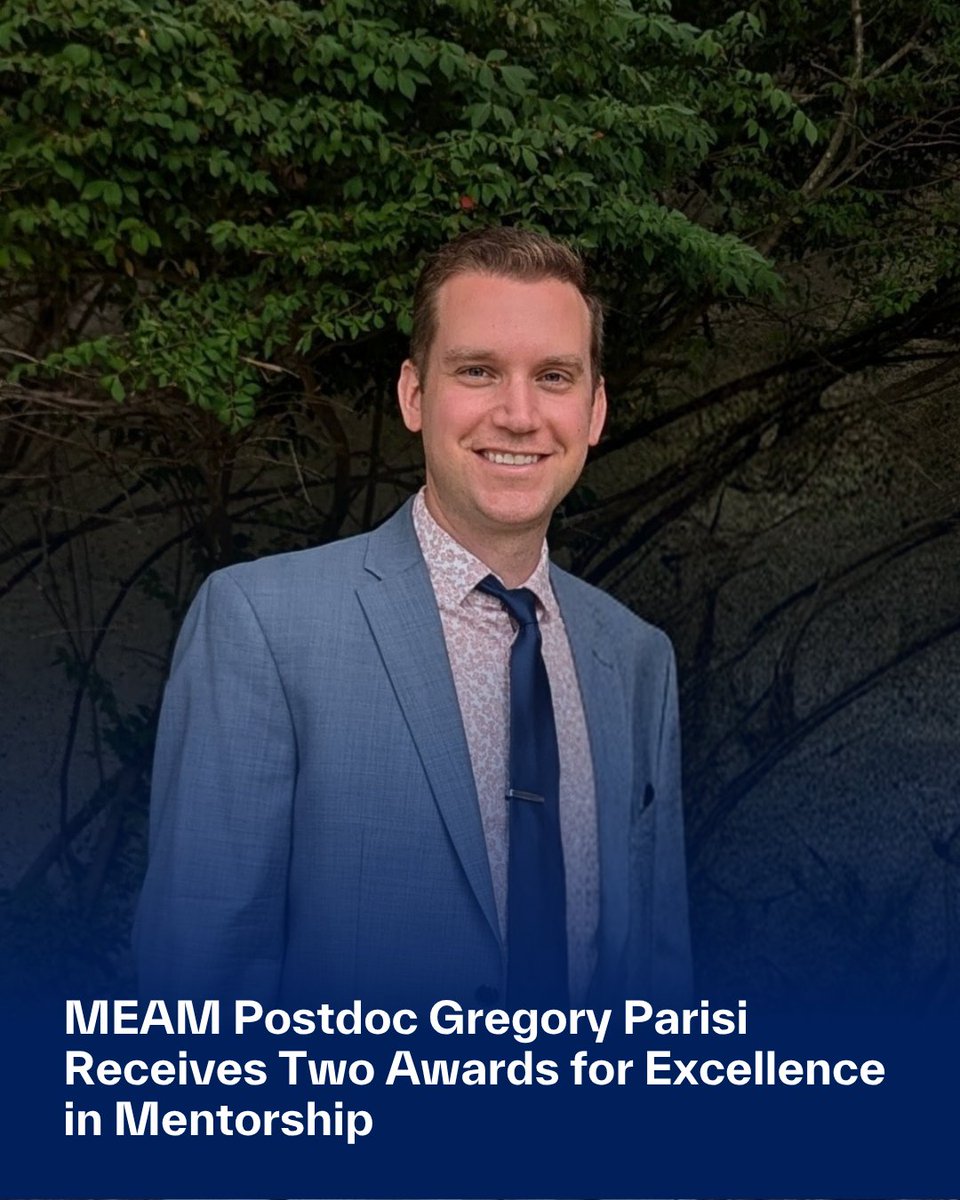
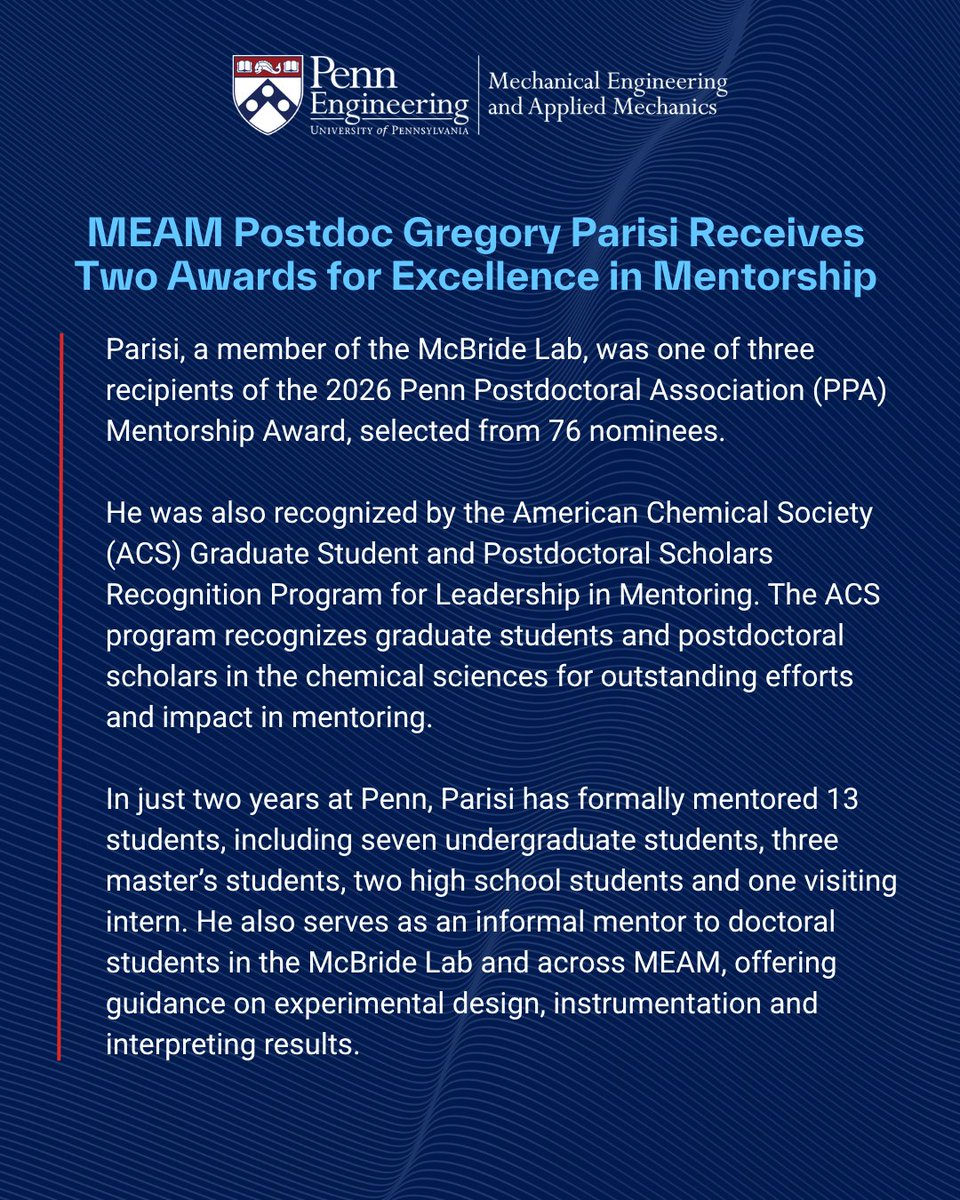
Congratulations to Gregory Parisi, a postdoctoral fellow in MEAM and member of the McBride Lab, on receiving two honors recognizing his commitment to mentorship!
Read more: https://t.co/iHlQz60SkM
GRASP's Kumar Lab developed an indoor exploration framework that uses learning to predict unseen area environments to plan Safe Efficient Exploration for Aerial Robots (SEER).
Video: https://t.co/VWsOdn4Yw3
#GRASP#GRASPLab
Complex fluid flows can be difficult to understand when key properties can’t be measured directly. Arezoo Ardekani of Purdue joined us for a seminar on using Lagrangian stretching to reveal the dynamics of viscoelastic flows.
Learn more: https://t.co/FXd7J8KNO5
We recently welcomed J. William Boley of Boston University for a seminar on additive manufacturing of multifunctional materials, from electronic skins and wearable devices to 4D-printed structures that can actuate, sense and withstand damage.
Learn more: https://t.co/BJTNuX5in0
Two Penn Engineering faculty members are among the 18 finalists for the 2026 @BlavatnikAwards National Awards for Young Scientists.
@Deep29Jariwala is recognized for advances in electronic materials and devices, while @ParisPerdikaris is recognized for developing physics-aware AI, including the Aurora weather forecasting model.
https://t.co/8rtx8iihNW