📰 İzmir Mayor Joins Erdoğan’s Party
💬 Analysis
The İzmir mayor’s joining the Justice and Development Party gives Recep Tayyip Erdoğan a major symbolic and political gain, because the city has remained one of the most prominent strongholds of the Republican People’s Party. The party’s candidate won there in the 31 March 2024 elections with around 49% of the vote, compared with 37% for the ruling party’s candidate. However, the mayor’s move—after he resigned from his party in June 2026 and continued as an independent—does not automatically mean that the city’s electoral base will shift with him. Rather, it may open a gap between the local administration and the voters who elected him on the opposition’s list. The move comes within a broader context of judicial and political pressure on the Republican People’s Party and its mayors, suggesting that Erdoğan is likely to use it to demonstrate the expansion of his influence beyond his traditional base, while the opposition may respond by intensifying mobilization in İzmir and turning the municipality into an arena for a national political struggle ahead of the upcoming elections.
📰 Open sources: UAE-linked cargo aircraft heads to N'Djamena amid possible connection to supplies for the Rapid Support Forces
💬 Analysis
If the flight and its logistical connection to the UAE are confirmed, its most significant implication would be the possible expansion of the Rapid Support Forces’ supply network from Amdjarass Airport in eastern Chad to N'Djamena. This could give it greater air and political connectivity, but would not by itself establish the nature of the cargo or the involvement of the Chadian government. A UN team had previously documented accounts it considered credible regarding the unloading of weapons in Amdjarass and their overland transfer to the Rapid Support Forces, alongside an Emirati denial that flights were being used for this purpose. More recent reports also point to the continued reliance of Rapid Support Forces support networks on regional routes passing through Chad, making the use of a military area in the capital—if repeated—a potential indicator of logistical adaptation or tighter concealment measures. As for the individual flight, it remains circumstantial evidence and is insufficient to prove the transport of weapons or official military protection.
📰 Reports from open sources: Cargo flights suspected of being linked to the UAE government appear to be returning to N’Djamena
💬 Analysis
If the return of cargo flights to N’Djamena is confirmed, it would most likely reflect a temporary redistribution of a regional supply network, rather than the end of the shift toward Ethiopia. The use of N’Djamena’s military airport as part of an air corridor reaching Nyala had previously been documented, along with indications of the transfer of fighters and equipment to the Rapid Support Forces. The return takes on greater significance because renewed fighting in Tigray since late September has disrupted airports, roads, and communications in northern Ethiopia, potentially making the Ethiopian route less usable or more exposed to surveillance and pressure. However, the sighting of Il-76 aircraft alone does not establish the nature of the cargo or responsibility by the UAE government; if the activity is repeated, it would indicate that the network is redistributing its logistical points between Chad and Ethiopia to maintain the flow of support and reduce the risks of exposing a single route.
📰 Rubio says Iran has completely lost control of the Strait of Hormuz
💬 Analysis
If reports that several tankers were targeted in recent days are confirmed, this would mean that Washington has not yet succeeded in turning air or naval escorts into an actual guarantee of freedom of navigation, even if Iran’s ability to impose a comprehensive closure of the strait has declined. The phrase “complete loss of control” therefore appears closer to a US political characterization of the struggle for the initiative than to a stable maritime reality; the international incident record documented 93 incidents and 24 deaths among seafarers through October 6, including successive damage to tankers at the beginning of the month. The fact that tankers turned back, whether because of attacks or operational risks, also gives Tehran the ability to deter and selectively choose targets, even if it has not been proven to possess complete control. The likely outcome is the crisis shifting into a war of attrition: limited corridors under US protection versus selective Iranian interceptions, with continued pressure on insurance and energy prices.
📰 Calm in Gulf bourses as hostilities between Saudi Arabia and the Houthis escalate
💬 Analysis
The calm in Gulf bourses reflects, at this stage, cautious pricing of the escalation—not a belief that its risks are limited. Markets are watching Saudi Arabia’s ability to contain the attacks without disrupting energy exports or broadening the scope of targeting. What has changed compared with previous waves is the shift from border and maritime threats to targeting airports and economic facilities, alongside Saudi military action to protect shipping and support Yemen’s government. This raises the risk premium on Gulf assets and could support oil prices and insurance and shipping costs if threats persist near Bab al-Mandab or reach energy facilities. However, the continued calm in trading suggests that investors still expect rapid Saudi containment, rather than an open regional war; any successful strike on an oil facility or commercial corridor would quickly alter this balance.
📰 Al Jazeera correspondent: Israeli drone strike on Khan Younis
💬 Analysis
If the strike is confirmed, its most significant implication is not that it constitutes an isolated security incident, but rather that it reflects the continuation of a pattern of a “ceasefire” that has reduced large-scale operations without halting airstrikes, shelling, and drone attacks. Khan Younis lies at the heart of this pattern due to continued restrictions on movement and the presence of large areas near positions where the Israeli occupation military is deployed, while the United Nations has recorded more than 1,400 Palestinian martyrs since the truce began on 10 October 2025 through the end of September 2026. Therefore, the strike is likely to further undermine the fragility of the de-escalation—even without knowing the casualties or the target—and deepen the risks facing displaced people, particularly as the southern Gaza Strip is already facing declining water production and an acute shortage of humanitarian supplies. Politically, the recurrence of these strikes leaves mediators facing a truce that exists legally but is eroding on the ground, making the transition to more stable security and reconstruction arrangements more difficult.
📰 Rubio: Strait of Hormuz open and oil flows through it at pre-closure levels
💬 Analysis
Washington is seeking, through this assessment, to reinforce a narrative that Iran has lost the ability to use the Strait of Hormuz as a tool for economic strangulation, and that military and political pressure has returned energy flows to normal, easing the concerns of markets and importing countries. But describing the strait as “open” does not mean that navigation has returned to normal; the US Energy Information Administration estimated second-quarter flows at approximately 4.9 million barrels per day, compared with 21.6 million before the conflict, while stressing that verification remains difficult due to disruptions in tracking data. The United Kingdom Maritime Trade Operations authority also recorded repeated attacks on tankers in late September and early October, meaning that the announcement is closer to a political characterization of the access available than to a stable security guarantee. If the actual increase in transit continues, it will give Washington a negotiating gain and put pressure on the oil risk premium to decline, but any new attack could quickly reignite the crisis.
📰 Iraq devalues the dinar to 1,520 against the dollar, according to the official news agency
💬 Analysis
The decision represents a decline of around 15% from the official rate of 1,300 dinars per dollar. It gives the treasury more dinars in exchange for dollar-denominated oil revenues, but shifts the cost of fiscal imbalances and disruptions to oil exports onto consumers and importers. The move comes after the dinar was revalued to 1,300 in 2023, making it appear more like a response to exceptional financial and external pressures than a routine monetary adjustment—particularly given that Iraq's budget relies on oil for around 90% of revenues and debt continues to accumulate. The parallel-market rate rising above 1,700 dinars after the announcement also indicates that lowering the official rate will not automatically restore confidence, and could widen inflation and the gap between the two rates if disruptions to oil shipments or weaker dollar inflows persist.
📰 Resigned Iranian Oil Minister: My Resignation Had Nothing to Do with Trump’s Statements
💬 Analysis
Mohsen Paknejad’s statements reveal that Tehran is waging a parallel narrative battle alongside the US economic pressure: acknowledging that the sector has been hit, while denying that sanctions and the blockade have completely disrupted production and exports. But his resignation, which was accepted amid Iran’s declining ability to transport crude and collect revenues, as well as mounting pressure on the domestic fuel market, suggests that the operational and financial crisis is deeper than the defensive rhetoric, even though there is no evidence proving that his statements caused his departure. The appointment of National Iranian Oil Company head Hamid Bovard as acting minister points to a priority of maintaining production continuity and managing logistical bottlenecks, rather than undertaking a political shift. If shipping and financing channels continue to narrow, the Asian market and informal mechanisms will become increasingly important, but at a higher cost and with weaker profit margins.
📰 Al-Burhan: No negotiations with anyone, and the army will advance by force
💬 Analysis
Al-Burhan’s escalation does not necessarily mean closing the diplomatic track permanently so much as reflecting an attempt to raise the ceiling of his conditions before mediation resumes, particularly since a high-level US meeting with him was held in early October to push for a humanitarian truce and new negotiations. On the ground, the army’s movements in North Kordofan give the Sudanese leadership greater confidence in the option of military resolution, but they do not negate the Rapid Support Forces’ retention of significant depth in Darfur and its ability to open fronts in Kordofan and Blue Nile. The message therefore appears directed both inward and at the mediators: there will be no political parity with the Rapid Support Forces before it withdraws from the cities and hands over its weapons, while Khartoum is likely to use any forthcoming truce as a field arrangement rather than the beginning of an equitable settlement. This position narrows the prospects for an imminent ceasefire and raises the risks of the war expanding and the humanitarian cost continuing.
@OwenSipsSlow Fair point. Sadly, this is too often the reality of war — the battlefield expands, and civilians and civil institutions end up paying the price.
📰 Open sources: Blue Nile region finance minister survives after his home was targeted by Rapid Support Forces drones
💬 Analysis
If the targeting is confirmed to have been carried out by the Rapid Support Forces, the incident reflects the shifting of pressure in the Blue Nile from clashes along the front lines to strikes on administrative centers and government symbols, aimed at intimidating the civilian apparatus and demonstrating the vulnerability of the depth controlled by the Sudanese Armed Forces. This comes as the region has, since the beginning of 2026, become a contested front, amid an alliance between the Rapid Support Forces and the Sudan People's Liberation Movement–North, and repeated drone attacks on Kurmuk, Damazin and vital facilities. The apparent attempt to target the finance minister's home suggests that drones are being used to compensate for the difficulty of achieving stable territorial gains, particularly after the army retook positions in Kurmuk during July. Pressure on officials' offices and service facilities is likely to increase, raising the risks of displacement and complicating aid access, without this in itself meaning that the Rapid Support Forces possess stable ground control.
📰 Channel 12: Military begins a large-scale operation to demolish memorials in the West Bank
💬 Analysis
The most significant implication is that the demolition of Palestinian memorials is shifting from isolated incidents into a broader tool for reshaping public space and national memory in the West Bank, rather than being merely a limited security measure. This step comes after notices were issued to demolish a memorial in Jenin, a memorial was destroyed in Tulkarm, and Birzeit University was raided to remove a memorial to students who were martyred, pointing to an escalating pattern targeting symbols associated with Palestinian political identity. In parallel, the Israeli occupation government is pushing to fund and develop Jewish heritage sites in the West Bank, reflecting a selective policy aimed at reinforcing a specific historical narrative and a particular presence on the ground. Politically, this could increase popular friction and further undermine what remains of the Palestinian Authority’s legitimacy, while providing the right-wing camp with a pretext to expand military and administrative intervention in Palestinian cities and towns.
@geekyaisha Agreed on watching ADCOP — but we’d keep Hormuz firmly in the picture too. ADCOP shows how the UAE is mitigating disruption; Strait traffic shows how the wider regional system is absorbing it. Different indicators, both important.
📰 Source in the Sudanese army: Rapid Support Forces drones target Damazin
💬 Analysis
If Damazin is targeted again, this would indicate that pressure on the Sudanese army in the Blue Nile has shifted from attempts at a ground advance to an attritional campaign combining ground attacks and drones inside the regional capital. This comes after a similar attack targeted the regional governor’s home and civilian sites on October 3, alongside an announcement by forces linked to the Rapid Support Forces that they had made gains near Roseires, suggesting an attempt to isolate Damazin and threaten its supply lines rather than merely carry out a symbolic strike. The expanding coordination between the Rapid Support Forces and the Sudan People’s Liberation Movement–North also gives the attack a broader dimension, as it opens a southeastern front that wears down government forces and pressures civilians to flee. The immediate danger is most likely to involve a gradual escalation around the city and vital facilities, while the possibility of this developing into an actual siege will depend on the army and its allies’ ability to stabilize the surrounding fronts.
📰 Yemen's Ministry of Transport condemns the targeting of Aden Airport with two ballistic missiles and explosive-laden drones
💬 Analysis
The targeting of Aden Airport represents a shift from applying pressure on the fronts and coastal corridors to striking the internationally recognized government's center and civilian infrastructure, thereby raising the cost of the Saudi-backed counteroffensive. This comes after the Houthis advanced along the Red Sea coast and in the vicinity of Bab al-Mandab, followed by government forces and their allies recapturing important positions there; this suggests that the strike aims to disrupt supply and movement and demonstrate the Houthis' ability to reach deep into their opponents' areas, rather than being merely a symbolic response. Alongside the targeting of sites inside Saudi Arabia, the attack increases the likelihood of an expansion of the campaign of air raids and counterstrikes, and places Aden Airport, the ports, and the roads leading to Taiz and Bab al-Mandab under increasing security and operational pressure.
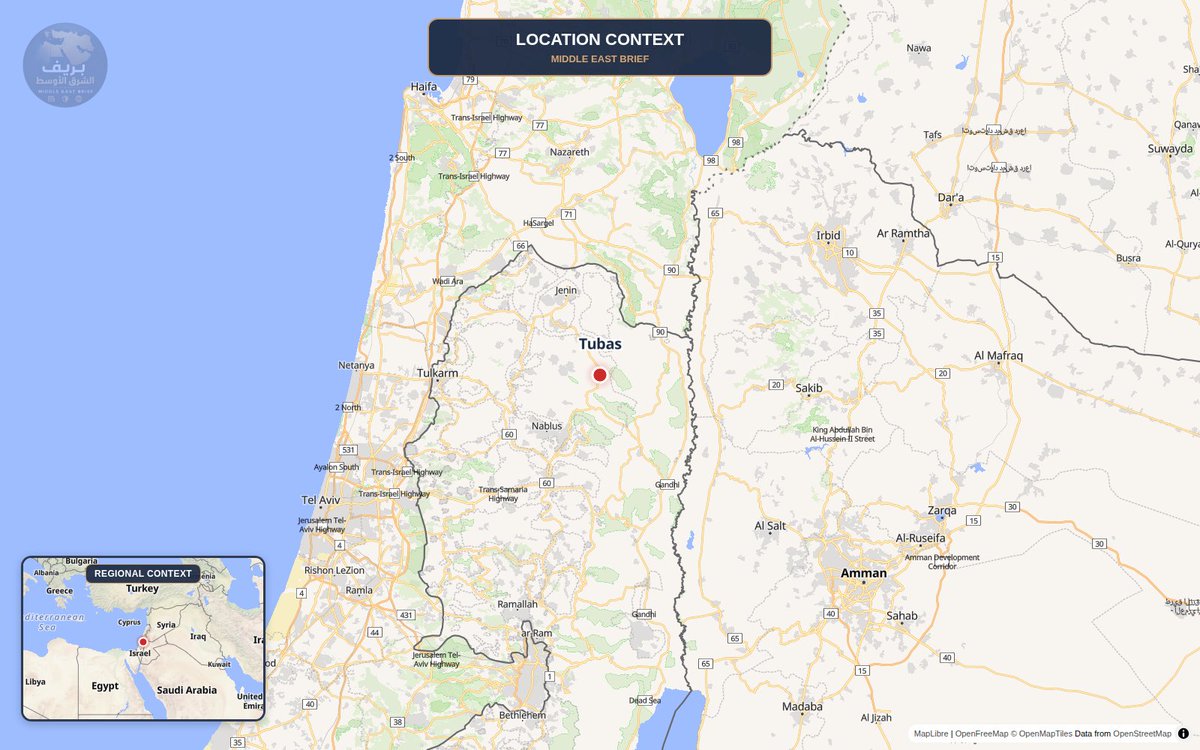
📰 Al Jazeera correspondent: Israeli occupation forces storm Tubas
💬 Analysis
The significance of the incursion goes beyond a localized raid, as it comes within an ongoing pattern of turning Tubas Governorate into a continuous arena of military and security pressure, particularly following the wide-scale operation that encompassed the city and the towns of Tammun, Aqaba, and Tayasir in November 2025, causing damage, displacement, and disruptions to services. Throughout 2026, Israeli occupation forces continued to carry out raids and arrests and impose movement restrictions in the governorate, alongside isolating rural areas, bulldozing roads, and restricting access to land and water. The incursion is therefore likely to serve two overlapping objectives: pursuing armed cells and gathering intelligence, while reinforcing a field reality that fragments the northern West Bank and pressures Palestinian communities around the Jordan Valley. If this pattern is repeated inside the city, it could shift from intermittent incursions to a more entrenched security presence and broader measures for forced displacement.
📰 Al Jazeera correspondent: Widespread raids and arrests in the West Bank
💬 Analysis
The campaign reveals the continued transformation of the West Bank into an arena of daily security pressure, rather than an isolated arrest operation. It comes after similar campaigns that covered multiple areas and included closures and field detentions during September 2026. The geographical expansion of the raids suggests that the objective goes beyond detaining specific individuals to dismantling active networks, deterring the surrounding social environment, and imposing greater control over local movement. This trajectory reinforces an ongoing pattern of escalation since October 2023, alongside settler violence and restrictions on towns and camps, and increases the likelihood of confrontations, the killing of martyrs, or an expansion of administrative arrests. It also weakens the Palestinian Authority’s ability to manage security and services, making the West Bank more prone to explosion even without a decision to launch a broader confrontation.
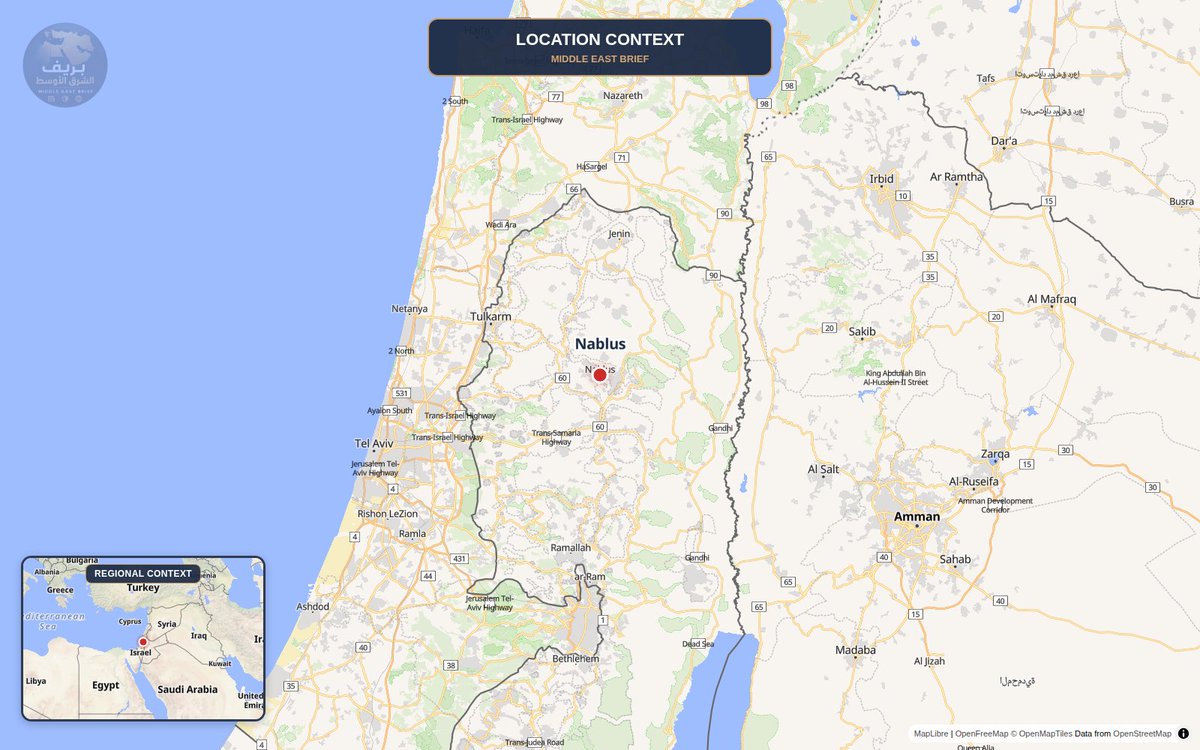
📰 Al Jazeera correspondent: Israeli occupation forces storm Nablus amid raid and arrest campaign
💬 Analysis
In its broader context, this raid reveals that Nablus remains one of the most consistent focal points of military pressure in the West Bank, rather than being the site of an isolated operation. The United Nations documented that Nablus recorded the highest number of injuries linked to raids and military operations during the first months of 2026, while arrests and incursions in the governorate continued throughout September. This follows the tightening of restrictions, the deployment of additional forces, and the implementation of raids in the city and its surroundings after the events of July 24, indicating a gradual shift from specific operations to a sustained pattern of security and field pressure. The likely result is a deepening disruption of movement and services, alongside a greater likelihood of armed clashes and the erosion of the Palestinian Authority’s ability to contain tensions locally.