2023 Liberty University • 1986 Graduate of VanderCook School of Music •1996 Graduate of Troy State University •1982 Graduate of Georgia Southwestern College
John Coltrane quartet with McCoy Tyner (piano), Elvin Jones (drums) e Jimmy Garrison (bass) playing the jazz standard "My Favorite Things" live in Belgium in 1965.
#SMLPDF
https://t.co/KOduF8Q223
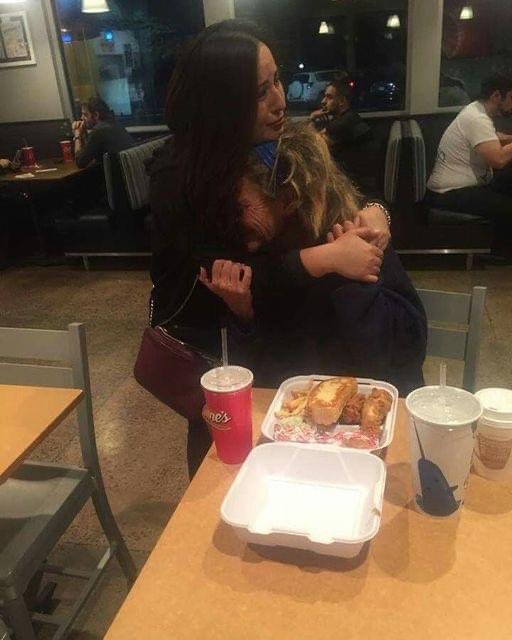
“I debated posting this picture but I changed my mind.
I didn't know my boyfriend had captured this moment.
A couple of day's ago we went to eat late at night and as we waited for our order, I saw this homeless lady walk in asking people that were throwing away there leftovers if she could have them.
Not one person said yes, they all ignored her and threw it away it broke my heart.
I have been volunteering with the homeless now for many years. I hold them all with so much love.
So I told Fred if I see her before we are done eating I will give her my food.
I looked for her as we were getting ready to leave and couldn't find her.....I felt sad knowing all the rejection she had that night searching for a warm meal.
As I was going to throw away my one leftover chicken strip and 5 fries, I heard a very quite voice ask me if I had anything left.
I turned around and it was her..l gave her my food and watched her sit and eat it.....but something didn't feel right...I felt like a horrible human being feeding her my leftover chicken strip..she deserved so much more...so I bought her a whole meal.
She deserved to eat a hot meal.
When I ordered the meal I asked the employee for a huge favor to please do not kick her out as we waited...I could already see the disgust on people's faces as she sat at the table eating the leftovers I had given her.
She was getting ready to get up and leave when I surprised her with this meal, the look on her face said it all.
I have never felt something like this. Pure, real gratitude.
That hug she gave me was like a hug I had never felt. Those tears she shed were felt deep in my heart. I held her tight and let her let it out.
I just held her. And that is a moment I will never ever forget.
So next time you judge a homeless person think twice.”
Credit: Carmen Mendez
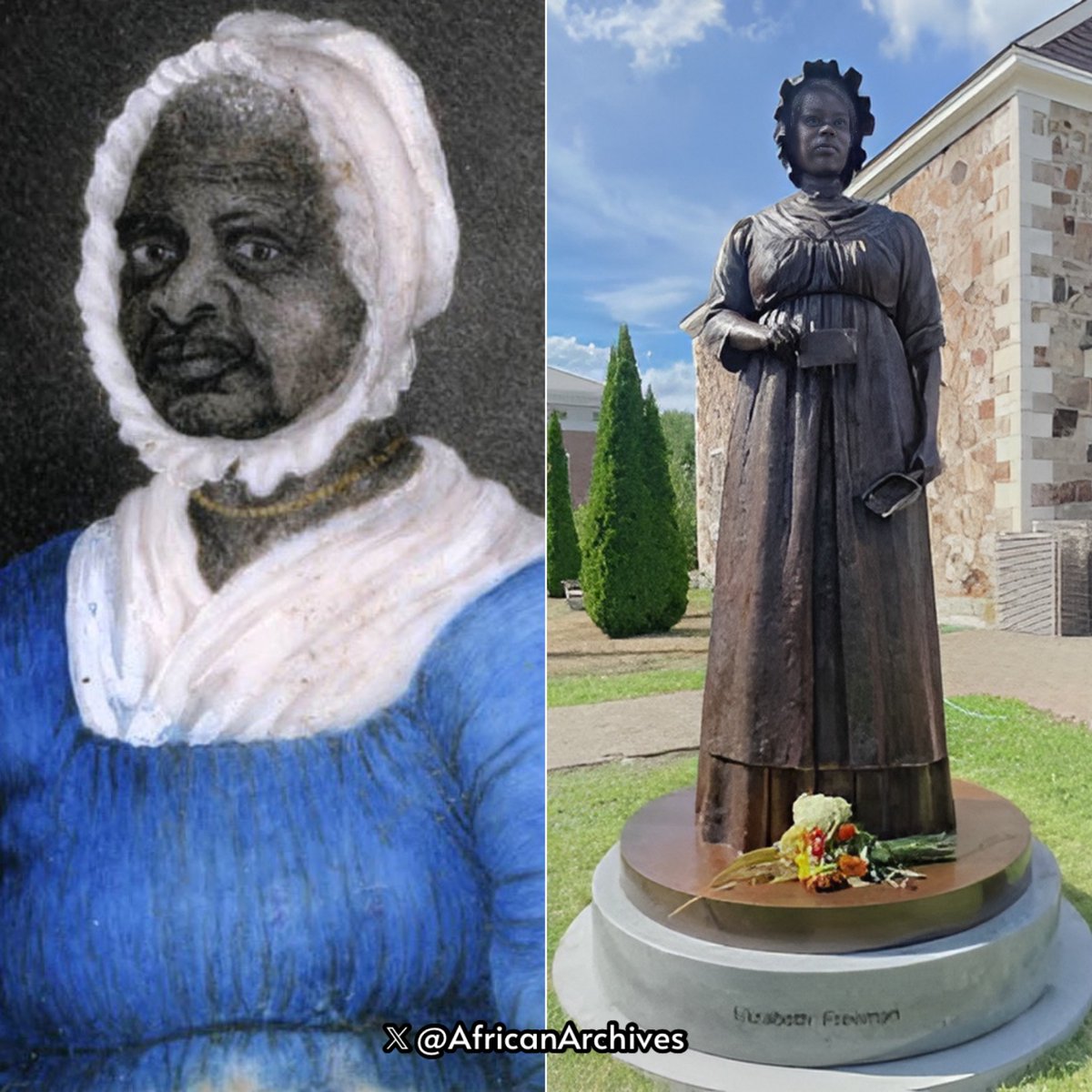
Mum Bett was one of the first enslaved black American to sue for freedom and win in Massachusetts. As a free woman she took up the name Elizabeth Freeman.
She was W.E.B Du Bios great grandmother.
Her case served as precedent in the state that brought an end to the practice of slavery in Massachusetts.
Freeman's real age was never known, but an estimate on her tombstone puts her age at about 85. She was buried in the Sedgwick family plot in Stockbridge, Massachusetts. She died in 1829.
Freeman was among the first enslaved black Americans in Massachusetts to file a "freedom suit" and win in court under the 1780 constitution, with a ruling that slavery was illegal. Her county court case, Brom and Bett v. Ashley, decided in August 1781, was cited as a precedent in the Massachusetts Supreme Judicial Court appeal review of Quock Walker's "freedom suit". When the state Supreme Court upheld Walker's freedom under the constitution, the ruling was considered to have informally ended slavery in the state.
LIFE & TRIAL:
Elizabeth Freeman was illiterate and left no written records of her life. Her early history has been pieced together from the writings of contemporaries to whom she told her story or who heard it indirectly, as well as from historical records.
Freeman was born into slavery about 1742 at the farm of Pieter Hogeboom in Claverack, New York, where she was given the name Bett. When his daughter Hannah married John Ashley of Sheffield, Massachusetts, Hogeboom gave Bett, then in her early teens, to them. She remained with them until 1781, during which time she married and had a child, Betsy. Her husband (name unknown, marriage unrecorded) never returned from service in the Revolutionary War.
Throughout her life, Bett exhibited a strong spirit and sense of self. She came into conflict with Hannah Ashley, who was raised in the strict Dutch culture of the New York colony. In 1780, Bett prevented Hannah from striking her daughter Betsy with a heated shovel, but Elizabeth shielded her daughter and received a deep wound in her arm. As the wound healed, Bett left it uncovered as evidence of her harsh treatment.
Soon after the Revolutionary War, Freeman heard the constitution read at Sheffield and these words:
“ All men are born free and equal, and have certain natural, essential, and unalienable rights; among which may be reckoned the right of enjoying and defending their lives and liberties; that of acquiring, possessing, and protecting property; in fine, that of seeking and obtaining their safety and happiness." —Massachusetts Constitution, Article 1.
Bett sought the counsel of Theodore Sedgwick, a young abolition-minded lawyer, to help her sue for freedom in court. Sedgwick willingly accepted her case. He enlisted the aid of Tapping Reeve, the founder of America's first law school, located at Litchfield, Connecticut.
The case of Brom and Bett vs. Ashley was heard in August 1781 before the County Court of Common Pleas in Great Barrington. Sedgwick and Reeve asserted that the constitutional provision that "all men are born free and equal" effectively abolished slavery in the state. When the jury ruled in Bett's favor, she became the first African-American woman to be set free under the Massachusetts state constitution.
The court assessed damages of thirty shillings and awarded her compensation for their labor.
After the ruling, Bett took the names Elizabeth Freeman.
LEGACY:
The decision in the case of Elizabeth Freeman was cited as precedent when the State Supreme Judicial Court heard the appeal of Quock Walker v. Jennison. Walker's freedom was upheld. These cases set the legal precedents that ended slavery in Massachusetts. Vermont had already abolished it explicitly in its constitution.
🖋️if you love our content, please consider supporting our page on https://t.co/MkzBtV9AwG (follow the ko-fi page too for weekly posts roundup)
In 1893, Frederick Douglass invited Ida B. Wells to lunch. She noted a place across the street, but indicated they would not receive service there. “Mr. Douglass, in his vigorous way, grasped my arm and said, ‘Come, let’s go there.’” Together, they “sauntered in...as if it were an everyday occurrence, cocked and primed for the fight if necessary.” Douglass grabbed a table and chair for him and Wells, as “paralyzed” staff looked on. A stand-off ensued with wait staff until the proprietor realized it was Frederick Douglass, and warmly welcomed him while sharing stories of a time past when Douglass visited his hometown. “When [the proprietor] finally went to another part of the room, Mr. Douglass turned to me with a roguish look and said, ‘Ida, I thought you said that they didn’t serve us here. It seems we are getting more attention than we want.’”
Frederick Douglass spent his life fighting for justice and equality. He never knew the date of his birth. This is something he struggled with throughout his lifetime. Douglass believed that he was born in the month of February in 1817. In fact, records show that Douglass was born in February of 1818. He chose the 14th of February for his birthday because his mother would call him her “little Valentine." Unfortunately, Douglass never knew much about his parentage. His mother, Harriet, was sold off when Douglass was but a child, and he only met her a few times before she passed away. Though born enslaved in Maryland, he escaped as a young man and became a leading voice in the abolitionist movement.
🖋️if you love our content, please consider supporting our page on https://t.co/16fHyPFENu (follow the ko-fi page too for weekly posts roundup)
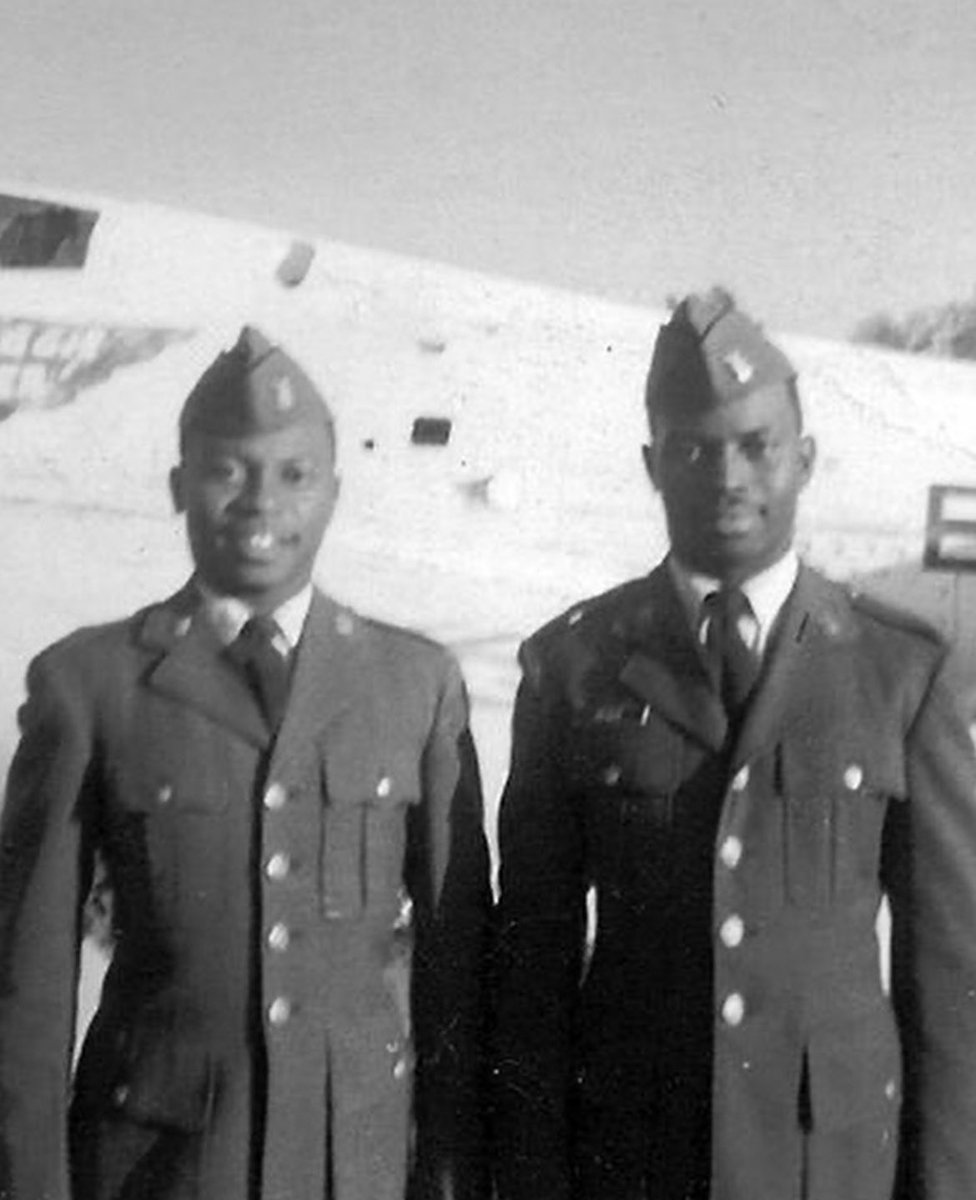
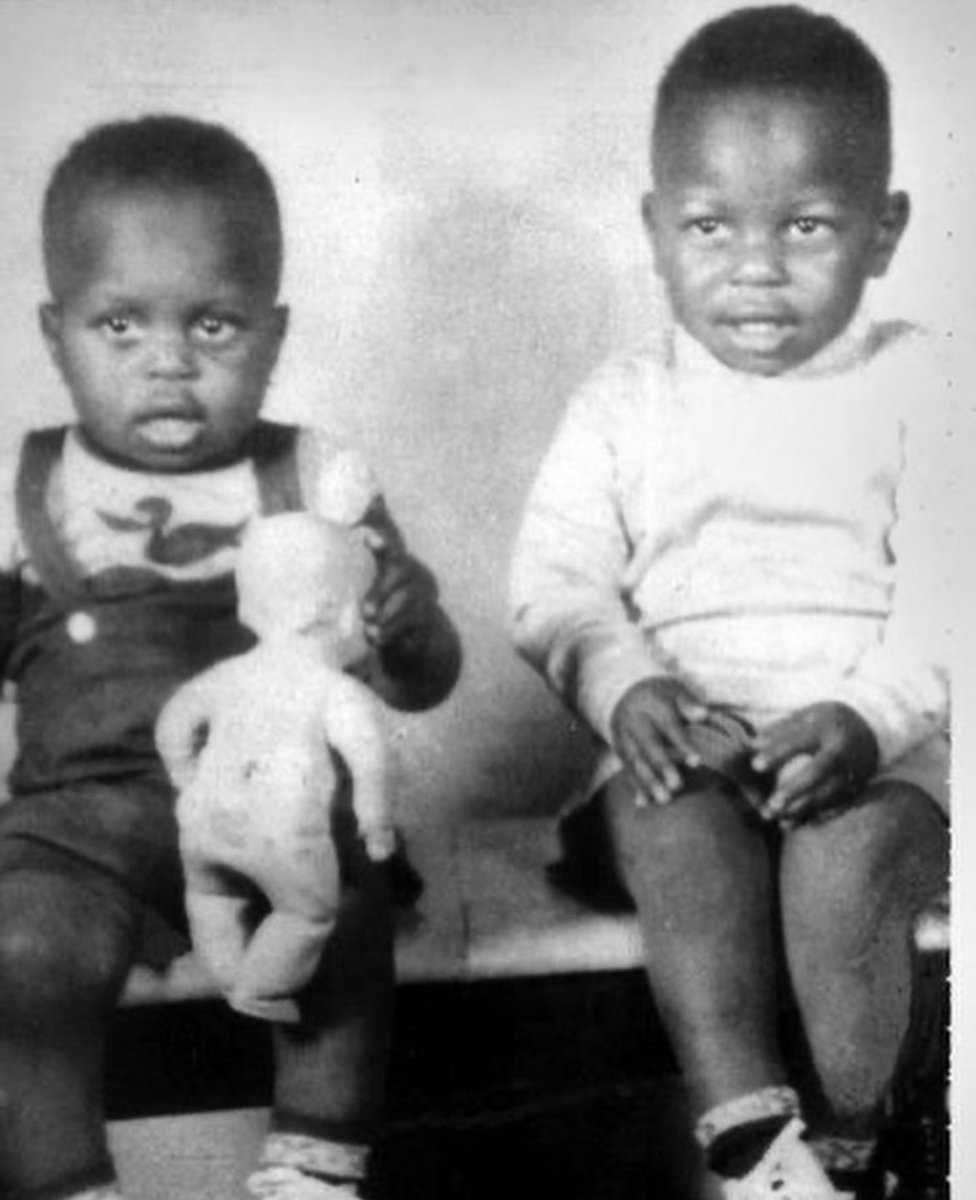
Ronald (left) and Carl McNair (right) were born 10 months apart in the Segregated South. The two were inseparable as toddlers and well into adulthood.
In 1959, 9-year-old Ronald McNair went to a public library in Lake City, South Carolina because he was looking for more advanced books on science. Carl accompanied his younger brother and described what happened next:
"So, as he was walking in there, all these folks were staring at him - because they were white folk only, and they were looking at him and saying, you know, 'Who is this Negro?' So, he politely positioned himself in line to check out his books. Well, this old librarian, she says, 'This library is not for coloreds.' He said, 'Well, I would like to check out these books.' She says, 'Young man, if you don't leave this library right now, I'm gonna call the police.' So he just propped himself up on the counter, and sat there, and said, 'I'll wait.'"
The police and their mother were called to the library. Despite the librarian's protest, the police officer allowed Ronald to borrow the books.
Ronald went on to get a PhD in Physics from MIT in 1976 and then soon after applied to join NASA. Carl supported his brother all the way, often in disbelief: "So how was a colored boy from South Carolina-wearing glasses, never flew a plane-how was he gonna become an astronaut?" Carl went on to say that "Ron was one who didn't accept societal norms as being his norm... That was for other people... he got to be aboard his own Starship Enterprise.”
Ronald became the second Black astronaut when he flew as a mission specialist from February 3rd to 11th, 1984. Ronald was then chosen to be one of the 7 astronauts onboard the space shuttle Challenger. He died along with six other crew members on January 28, 1986, at the age of 35.
Today, the library that refused to lend him books is now named after him.
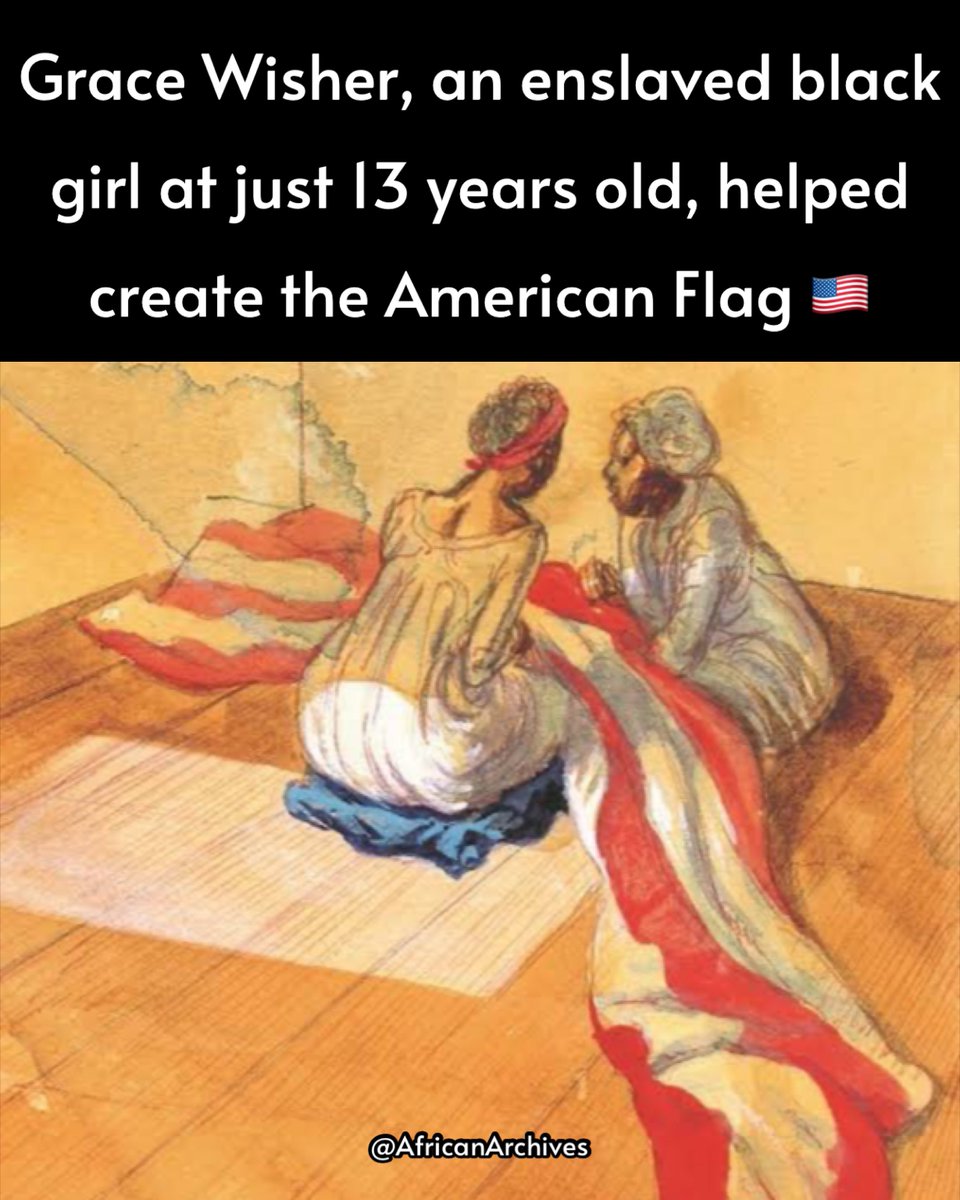
Grace Wisher, an enslaved black girl at just 13 years old, helped create the American flag which inspired the national anthem. She is often overlooked in the storytelling of the nation’s most prominent visual emblem.
Two hundred years ago, an African American girl made history—literally. She was an indentured servant named Grace Wisher in the household of Mary Pickersgill. Helen Yuen and Ms. Asantewa Boakyewa of the Reginald F. Lewis Museum share her story.
The likeness of Grace Wisher is unknown. However, the Star Spangled Banner Flag House is home to a portrait with her figure traced in, to recognize her contribution. Detail of "Placing the Stars on the Flag that Inspired Francis Scott Key to Write Our National Anthem" by Robert McGill Mackall, ca. 1962.
Mary Pickersgill is often credited with sewing the Star-Spangled Banner which flew over Fort McHenry in Maryland and inspired Francis Scott Key to write our national anthem. Less known is that Grace Wisher, an African American girl at just 13 years old, also helped make the flag. It's another testament to the deeply rooted, yet oft unmentioned, contributions of African Americans to the very core of this country.
Indenture was a waning practice in early 19th century Baltimore, although Maryland law did allow for courts to take away children of African Americans who were considered "lazy, indolent, and worthless free negroes" to bind the youngsters into apprenticeship. Orphans usually met a similar fate.
The size of the Star-Spangled Banner and its six-week timeline for completion would have necessitated many people working on the flag, including Mary Pickersgill's three nieces and Grace Wisher. The household also had an enslaved person, whose name we do not know.
The home where Pickersgill and Wisher lived is now a museum called the Star-Spangled Banner Flag House. It holds a 1962 painting by famed Baltimore artist Robert McGill Mackall. The portrait features the Pickersgill household and the three men who commissioned the garrison and storm flags for Fort McHenry: Commodore Joshua Barney, General John Stricker, and Colonel George Armistead. As a tribute to Wisher, the Star-Spangled Banner Flag House drew in a ghost figure into the painting that represents the young girl. Due to our uncertainty of what she looked like, the placeholder is a traced line, but the recognition is tangible.
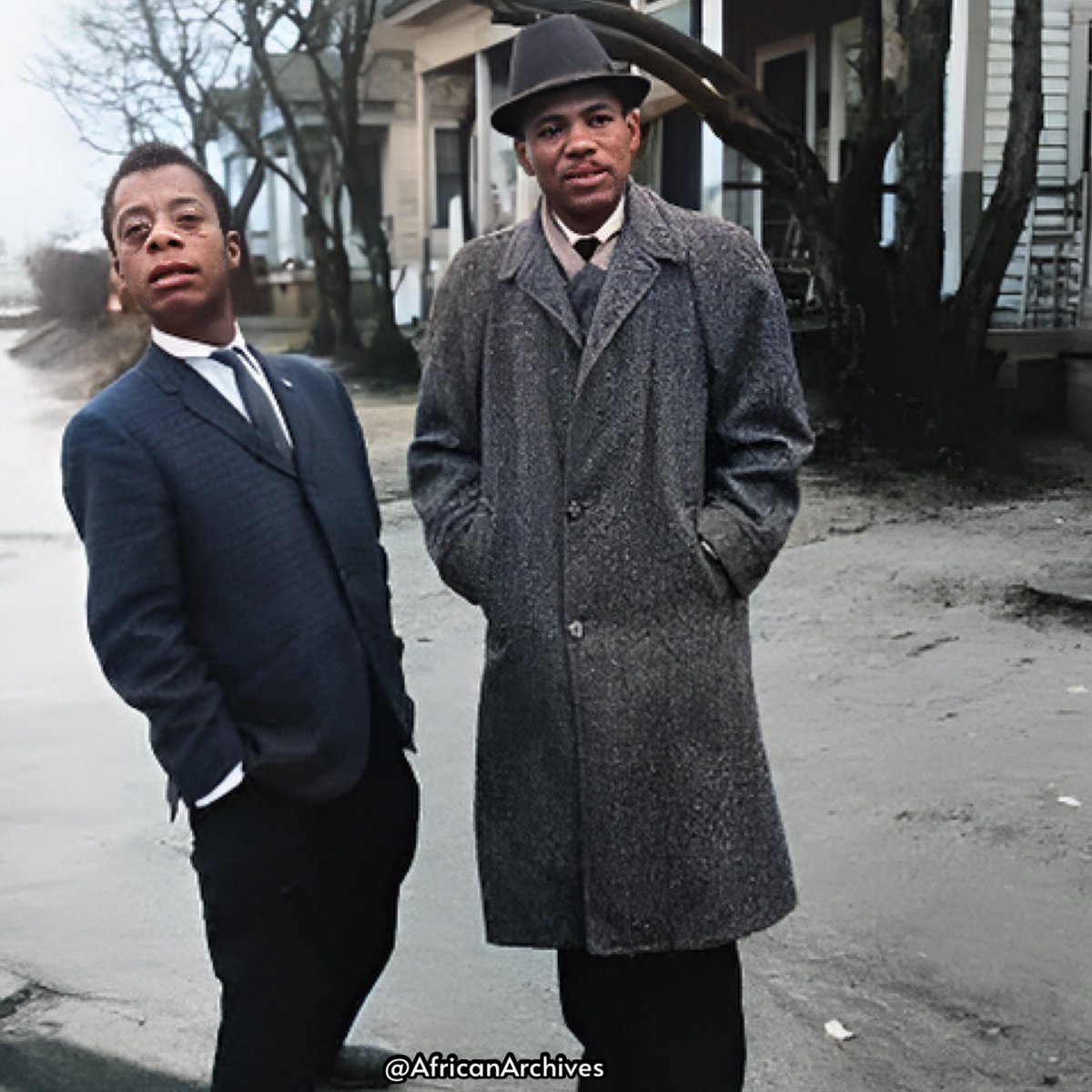
James Baldwin with activist James Meredith, Jackson, Mississippi, in 1963, a year after Meredith became the first African American student admitted to the University of Mississippi.
James H. Meredith, in 1962, became the first African American to attend the University of Mississippi.
A former serviceman in the U.S. Air Force, Meredith applied and was accepted to the University of Mississippi in 1962, but his admission was revoked when the registrar learned of his race.
A federal court ordered "Ole Miss" to admit him, but when he tried to register on September 20, 1962, he found the entrance to the office blocked by Mississippi Governor Ross Barnett.
On September 28, the governor was found guilty of civil contempt and was ordered to cease his interference with desegregation at the university or face arrest and a fine of $10,000 a day. Two days later, Meredith was escorted onto the Ole Miss campus by U.S. Marshals — setting off riots that resulted in the deaths of two students. He returned the next day and began classes.
In 1963, Meredith, who was a transfer student from all-black Jackson State College, graduated with a degree in political science.
Three years later, Meredith returned to the public eye when he began his March Against Fear. On June 6, just one day into the march, he was sent to a hospital by a sniper's bullet. Other civil rights leaders, including Martin Luther King, Jr., and Stokely Carmichael, arrived to continue the march on his behalf.
It was during the March Against Fear that Carmichael, who was leader of the Student Nonviolent Coordinating Committee, first spoke publicly of "Black Power" — his concept of militant African American nationalism.
James Meredith later recovered and rejoined the march he had originated, and on June 26 the marchers successfully reached Jackson, Mississippi.
Tweeps. You have GOT to give this drummer some. She's one of *the* baddest around and she's celebrating her birthday today.
Join me in wishing drummer, composer, arranger, educator, and overall BADASS, Terri Lyne Carrington, a very Happy Birthday!
John Coltrane and Eric Dolphy performing “Impressions” with McCoy Tyner on piano, Reggie Workman on bass and Elvin Jones on drums live in Germany, 1961.
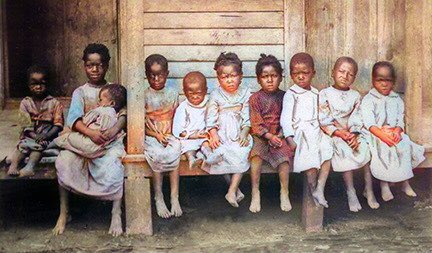
To combat the high rate of death among slaves, plantation owners demanded females start having children at 13.
By 20, the enslaved women would be expected to have about five children.
—THREAD—
On this day in 1972, Reporters exposed the Tuskegee Syphilis Experiment — a secret study to examine the effects of untreated syphilis in Black men.
American medicine has been built upon the abuse of black people with no oversight.
A THREAD!
So who taught a young Jack Daniel how to distill what would become the world’s best-selling whiskey?
Nathan "Nearest" Green, an enslaved Black master distiller, taught distilling techniques to Jack Daniel, founder of the Jack Daniel Tennessee whiskey.
—Uncle Nearest, as he was fondly called by family and friends grew up in Lynchburg, Tennessee, and began working on the farm of a country preacher and distiller in Lincoln County around the mid-1800s. It was there that he learned the skill of distilling and specialized in a process of distillation known as sugar maple charcoal filtering which was also called the Lincoln County Process.
Nearest was such a skilled distiller in the process he specialized in but he kept working with the preacher in the Lincoln County and fortunately it was there that Jack Daniels met him.
In the mid-1850s, Jack Daniels who was just a young white boy from a large family and who also lost his mother to a sudden illness at the age of four months began working as a chore boy for the preacher whom Uncle Nearest worked for.
It is said that Jack Daniels was a curious young boy who kept asking about the smoke coming up through the hollow on the 338-acre property and why men kept hurrying back and forth from that area which he was never allowed to go with mules and wagons.
He never stopped asking, until the preacher whim he worked for decided to give in to his curiosity took him to the area on the property where the smoke came from.
As later described in the boy’s biography, it is said that the preacher introduced the young boy to a “coal-black negro” which was uncle Nearest.
He introduced Uncle Nearest by saying “This is Uncle Nearest. He’s the best whiskey maker I know of”. The preacher went further to ask Nearest to teach the young (Jack Daniels) everything he knew about distilling and also the process of sugar maple charcoal filtering. A request Nearest obliged and taught the young boy the special filtration process of the Tennessee whiskey.











![AfricanArchives's tweet photo. In 1893, Frederick Douglass invited Ida B. Wells to lunch. She noted a place across the street, but indicated they would not receive service there. “Mr. Douglass, in his vigorous way, grasped my arm and said, ‘Come, let’s go there.’” Together, they “sauntered in...as if it were an everyday occurrence, cocked and primed for the fight if necessary.” Douglass grabbed a table and chair for him and Wells, as “paralyzed” staff looked on. A stand-off ensued with wait staff until the proprietor realized it was Frederick Douglass, and warmly welcomed him while sharing stories of a time past when Douglass visited his hometown. “When [the proprietor] finally went to another part of the room, Mr. Douglass turned to me with a roguish look and said, ‘Ida, I thought you said that they didn’t serve us here. It seems we are getting more attention than we want.’”
Frederick Douglass spent his life fighting for justice and equality. He never knew the date of his birth. This is something he struggled with throughout his lifetime. Douglass believed that he was born in the month of February in 1817. In fact, records show that Douglass was born in February of 1818. He chose the 14th of February for his birthday because his mother would call him her “little Valentine." Unfortunately, Douglass never knew much about his parentage. His mother, Harriet, was sold off when Douglass was but a child, and he only met her a few times before she passed away. Though born enslaved in Maryland, he escaped as a young man and became a leading voice in the abolitionist movement.
🖋️if you love our content, please consider supporting our page on https://t.co/16fHyPFENu (follow the ko-fi page too for weekly posts roundup)](https://pbs.twimg.com/media/F63vgfgXQAAbdfj.jpg)