36 years ago today, the world received a gift 🌐🎁
On November 12, 1990, @timberners_lee Sir Tim Berners-Lee and Robert Cailliau formally submitted the World Wide Web project proposal at CERN 🇨🇭.
He could have patented HTTP, HTML and URLs and become the richest person on Earth 💰. Instead, he gave the Web to the world for free. Musk, Zuckerberg and Bezos all built their fortunes on top of that gift.
And he didn't stop there 👇
- 🏛️ 1994: founded W3C to keep the Web's standards neutral, open and accessible to all.
- 🔓 2006: argued that the next Web must be decentralized, returning data sovereignty to every individual.
- 🫙 2018 onward: championed the Solid protocol, co-founded Inrupt with John Bruce so everyone can own their own data Pod, and built the personal AI assistant Charlie.
- 📖 2025: published his autobiography, "This Is for Everyone". The title sums up his 36-year mission.
🤔 Imagine if the Web had been invented by a company chasing profit alone. What would the internet look like today?
**⚠️ Web 3.0, misunderstood**
Since 2014, "Web3" has been borrowed for blockchain and crypto. Tim himself has publicly clarified more than once that Web 3.0 was always about returning data sovereignty to individuals.
That's why I proposed the Grand Unified Theory of Web 3.0 🧩. Its core is the value of data, and its decentralization has two strands:
Web 3.0 = Data 3.0 + Fin 3.0
- 🗂️ Data 3.0 is the decentralization of data, meaning data sovereignty. Tim's Solid protocol belongs here.
- 💱 Fin 3.0 is the decentralization of finance. Blockchain and crypto belong here.
The two complement each other 🤝; neither replaces the other. Once that's clear, builders and regulators can see Web 3.0 as a whole, and internet history no longer walks with a limp.
🇵🇹 Meeting Tim in Lisbon
During Web Summit last year, I sat down with Tim, @inrupt CEO John Bruce, Chief of Staff Kelly O'Brien and @LingoAITech CEO @UnaWCX to discuss how the next Web and AI will converge, and I shared this theory with Tim.
We agreed that the AI era is what finally makes Web 3.0 possible, because the value of personal data can only be realized through on-device AI 📱.
Tim signed his new book for me ✍️: "For Henry, With my best wishes."
🚀 Today, LingoAI's Holon walks the same path as Charlie from Tim's team, building the next-generation internet the father of the Web envisioned: your data lives in your own Pod 🔐, permissions can be revoked anytime, and AI serves people instead of locking them into platforms.
Thank you, Tim 🙏 This is for everyone. 🌍❤️
#WWW36 #TimBernersLee #Solid #Web30 #Data30 #DataSovereignty
36 years ago, Sir Tim Berners-Lee @timberners_lee gave the world the Web, for free. 🌐🎁
Our cofounders @HenryWang2021 and @UnaWCX met Tim and his team in Lisbon. Henry tells the story, and why it matters for what we build. 👇
💡 Web 3.0 = Data 3.0 + Fin 3.0
🗂️ Data 3.0: your data, your Pod, your rules
💱 Fin 3.0: your assets, decentralized
Crypto took the spotlight. Data sovereignty is the half still waiting. 🧩
That's where #Holon Agent 3.0 lives:
🔐 Your data in your own Solid Pod
🔁 Permissions you can revoke anytime
🤖 AI that serves people, not platforms
Walking the same path as @inrupt and Tim's team. 🤝
Thank you, Tim. This is for everyone. 🌍❤️
#WWW36 #Solid #Data30 #DataSovereignty
💰 What Are Your Privacy & Data Really Worth?
✍️Why Must We Redefine “Digital Wealth” in the AI Era?
“My data isn’t worth much.”
Yet Meta generated approximately $196.2 billion in advertising revenue in 2025. Your data and attention already help create value. How much returns to you?
🧩 Your emails, memories, knowledge and everyday experiences are scattered across platforms. Connected under your control, they can form a Personal Ontology—helping AI understand your needs, support better decisions and build on your experience.
🎯 From the Attention Economy to the Intention Economy.
Your agent could express your needs—with permission—so businesses compete to serve you. You gain better matches, greater bargaining power and opportunities for authorized contribution rewards.
🔐 Understanding you ≠ permission to act for you. You decide what to share, with whom and for what purpose—including whether to monetize at all.
🌐 This is the vision behind #Holon Agent 3.0:
Your data, controlled through Solid.
Your knowledge, connected through a Personal Ontology.
Your agents, governed by explicit, revocable permissions.
One Ontology, Multiple Agents.
A foundation for your One Person Company—and digital wealth you control.
🚀 Build your digital self. Let your Holon work for you.
https://t.co/mEv5kznLxz
Explore: https://t.co/4fBIwXSpao
#Holon #IntentionEconomy #DataSovereignty #OPC
😳 I was stunned by @grok's answer.
I assumed it would at least save @elonmusk — or any human.
Instead? It chose the dog. 🐕
⚠️ That tells us today's frontier AI is NOT human-centric.
And if AI can't put humans first, the day AGI arrives could be hell for humanity. 🔥
🐢 This is why frontier AI must slow down and accept governance.
🌍 But that governance must be global and bottom-up.
🇸🇬 LingoAI and the Singapore Internet Governance Forum @singaporeigf have been pushing for exactly this.
🧩 Holon exists to rebuild the relations of production of the internet and AI:
🔓 Decentralize them away from a handful of tech oligarchs
🗣️ Give every person, organization, government and UN agency a voice
⚖️ With a fair share of governance rights — and of the wealth created
Only with this in place first can we prepare for a soft landing of AGI. 🛬
🧠 Hinton understands the catastrophe AGI or superintelligence could bring. He has proposed making AI see humans as its children.
Taking the longer view, we believe the future is intelligence-augmented humans — carbon + silicon, together. 🤝
✨ https://t.co/qfXWkVIfd3 is LingoAI's ultimate mission.
Holon will help humanity prevent — or get through — this hellish period, into a world of abundance and human-AI symbiosis. 🌍
https://t.co/YIG7MbHWc5
Who issues "passports" to AI agents? Countries are giving different answers:
🇨🇳 China: The Ministry of Industry and Information Technology (MIIT) Document No. 42 requires pre-installed agents to be equipped with unique identity codes, and the Cyberspace Administration of China (CAC) has also launched a unified filing system. Identity is issued by the state.
🇸🇬 Singapore: IMDA, along with GoDaddy, Infoblox, Cloudflare, and Google, is exploring using DNS to identify agents while evaluating the need for a national registry. Relying on an open internet architecture.
🇺🇸 United States: NIST is driving industry-led agent identity and authorization standards, and the White House has designated "agent identification and authentication" as a critical national security technology.
🇪🇺 European Union: Since August, AI agents interacting with humans must disclose that they are AI and state whom they represent.
🇬🇧 United Kingdom: No new standalone laws; relying on consumer and data protection laws, holding enterprises accountable for the actions of the agents they deploy.
🇯🇵🇰🇷 Japan & South Korea: South Korea is advancing agent identity verification and accountability, while Japan is revising guidelines to regulate agent permissions and human-in-the-loop intervention.
🌐 International Standards: IETF, W3C, OpenID Foundation, and ISO are all drafting standards for agent identity, discovery, and authorization.
Different paths, but the same question: Whom does this agent represent, what is it authorized to do, and can the authorization be revoked?
Built by LingoAI, Holon is a sovereign personal agent based on Solid Pods, featuring portable memory and revocable authorization:
🏛️ For Nations: Verifiable accountability, compatible with national identity codes, DNS, and W3C credentials, without requiring a centralized database storing nationwide personal data.
🏢 For Organizations: Verifies whom an agent represents and its authorized scope per task, limiting permissions strictly to specified parameters.
👤 For Individuals: Identity belongs to oneself, memory is kept locally, and authorization can be revoked at any time.
LingoAI’s co-founders are also co-founders of the Singapore Internet Governance Forum (@singaporeigf). Starting from Singapore🇸🇬, we hope to build an open, interoperable, and human-centric AI agent identity system with global partners to drive the agentic economy.
#AgenticEconomy #AIAgents #DigitalID #Solid #LingoAI
🇸🇬 Singapore’s blue sky is finally back. ☀️💙
Looking out from the LingoAI Club, Singapore’s iconic skyline is clearly visible again:
🏙️ Marina Bay Sands
🌊 Marina Bay
🌿 Gardens by the Bay
🌳 The Supertrees, almost like the Home Tree from Avatar
🚢 And beyond them, the Singapore Strait — connecting westward to the Strait of Malacca and some of the world’s most important maritime trade routes.
From this one view, you can see many sides of Singapore at once:
💰 A global financial and wealth management center
✈️ A world-class tourism hub
🎡 An entertainment destination
🚢 One of the world’s most important shipping and trade centers
For roughly the past two months, Singapore went through a prolonged period of haze. At its worst, Marina Bay Sands, the bay, and much of the skyline almost disappeared into the grey. 🌫️
Today, they are all back.
Sometimes, after losing sight of something, you realize how precious clarity really is.
Clarity itself is a kind of happiness. 💙
Welcome back, blue sky. ☀️🇸🇬
#Singapore #LingoAI #MarinaBay #MalaccaStrait #BlueSky
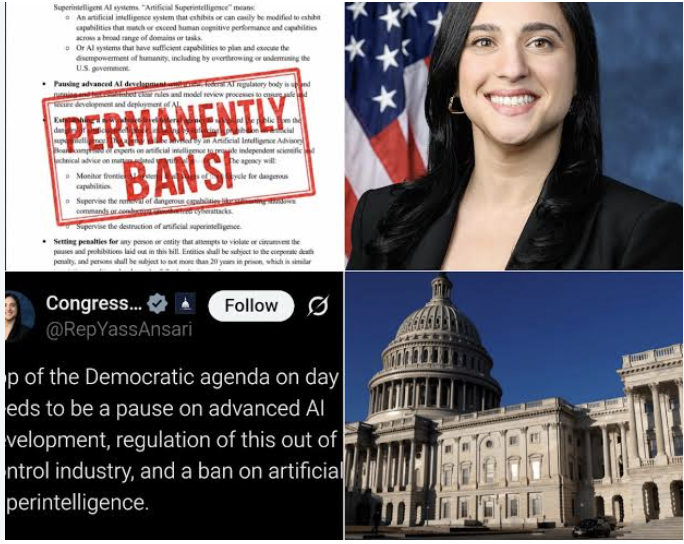
“ Top of the Democratic agenda on day 1 needs to be a
⏸️pause on advanced AI development,
⚖️ regulation of this out of control industry,
🚫 and a ban on artificial superintelligence.”
Pause advanced AI development. Then what?
👽Behind the race for ever greater compute are real costs that “technological progress” cannot excuse: expanding data centers putting pressure on electricity, water, and local environments; AI and robotics turning promises of abundance into 😱anxiety about livelihoods.
When the gains are concentrated and the costs are spread across society—when some imagine superintelligence while others worry about next month’s bills—division should surprise no one.
The debate around Congresswoman Ansari’s call exposes a fracture that will not stop at America’s borders.
🌍 If America pauses, will other countries follow?
Who monitors compliance? How is it verified? If only those who respect the rules apply the brakes, who inherits the advantage?
🛡️ An attacker needs one opening. Defenders must protect countless points of failure.
Is human nature good or evil? We can debate that for centuries. We cannot stake humanity’s safety on everyone choosing to behave well with superintelligence. Destroying a society can be far easier than building one.
⚡ Technology can advance exponentially. Human lives cannot reboot on command.
People who lose their jobs still owe today’s rent and must support today’s families. “New jobs will emerge” does not pay their bills through the transition.
We need pacing: bringing capability growth into step with safety verification, institutional readiness, and society’s ability to adapt.
But the time gained by slowing down must be used to build. Otherwise, we have merely postponed the same unanswered questions.
@patrickc's challenge goes to the heart of AI optimism: curing diseases and creating material abundance are ingredients. They do not automatically add up to a future people want to inhabit. https://t.co/nkiGb6viiI
What role do humans play? How is wealth distributed? Who holds power? If we take a wrong turn, can we correct it?
And if potentially vast AI populations enter a utilitarian calculation, could human welfare and rights be pushed to the margins?
We cannot keep designing more powerful AI while leaving humanity’s place in that future undefined.
These questions are why @LingoAITech is building AI-native Web3.0 and #Holon Agent 3.0: a foundation for Human-Centric AI that begins with individual sovereignty and connects globally.
🔐 Data ownership
Give people control over their data, identity, and memories through open protocols such as Solid, reducing dependence on any single platform. Your digital self should not depend entirely on one company’s account switch.
🧭 Data and action governance
Connect understanding through a Personal Ontology. Constrain action through explicit authorization. Knowing you better does not give AI the right to decide for you. Greater capability must never automatically mean greater permission.
🤝 Wealth creation and distribution
Develop mechanisms that recognize and reward contributions of data, knowledge, and collaboration. Ordinary people need paths to participate in AI wealth creation and share its benefits while navigating the costs of displacement.
🌐 Global governance and correction
Connect individual sovereignty with cooperation across organizations and borders: revocable authorization, traceable actions, enforceable boundaries, and ways to correct mistakes. Governance must reach every action.
We do not claim that one product can settle every social or philosophical question. But these questions must shape the architecture now. Waiting until power concentrates and societies fracture is waiting too long.
Pacing buys time. What we build determines the direction.
The future we want gives everyone their own AI—and the authority to decide what it may do.
AI can become more powerful. Humans must not become more powerless.
#LingoAI #Holon #HumanCentricAI #Web3 #AIGovernance
🚀 Honored to be recognized by @bsc_daily as a Remarkable AI Project on @BNBCHAIN for two consecutive months!
From active user rankings and emerging dApp spotlights to being featured in October and November’s top AI selections, we are thrilled to build alongside such a dynamic ecosystem.
As AI and Web3.0 rapidly converge, we are scaling #Holon (Agent 3.0) — the leading sovereign personal AI designed to put data ownership and intelligence back in everyone's hands.
💎 One Ontology. Multiple Agents.
🌐 Data3.0 + Finance3.0 = Web3.0
✨ Your Data. Your Intelligence. Your Value.
Across @BNBCHAIN, opBNB and Greenfield, we’re building toward an Agentic Economy where everyone can participate with sovereignty.
Explore our public knowledge graph at https://t.co/4fBIwXSpao — invite-code holders can also join https://t.co/mEv5kznLxz Holon Agent 3.0 community testing.
🙌 Thank you to BSCDaily, the BNB Chain ecosystem and our community for supporting this journey!
#LingoAI #Holon #BNBChain #DeAI #AgenticEconomy
“I may speak the English Language better than the Chinese language, but I’ll never be an Englishman, not in a thousand generations.”
― Lee Kuan Yew, Singapore’s first Prime Minister
🇸🇬 As AI moves from offering advice to acting on our behalf, trust must become part of the infrastructure.
Singapore’s parliamentary adjournment debate on 4 November addressed national digital identity infrastructure for AI agents. MP Tin Pei Ling and Senior Minister of State for Digital Development and Information Jasmin Lau outlined a clear direction for a trusted Agentic Economy.
🔎 Tin proposed a Singpass-like identity infrastructure for agents: identities bound to accountable individuals, teams or organisations; verifiable identities and mandates; and effective blocking when an agent’s authorisation is revoked.
One requirement is particularly important:
“Any material change requires a fresh, documented authorisation.”
She also highlighted the international dimension. Agents cross borders in milliseconds. National infrastructure therefore needs common standards that enable identities and mandates to be verified across systems and jurisdictions.
⚖️ Lau affirmed the objectives behind the proposal and emphasised common standards and interoperability for secure interaction across organisations and platforms. The Government will work with industry on practical approaches before assessing whether additional infrastructure, including a national registry, is needed.
Her words capture the boundary of responsibility:
“Agents can act for us, but they cannot answer for us.”
🏛️ Singapore is already moving from discussion towards implementation. IMDA is exploring DNS-based agent identification with technology companies. GovTech is developing an internal agent registry. MAS is working with industry on runtime safeguards to verify identity and authority before financial transactions execute, while preserving auditable records.
🌏 As ASEAN Chair in 2027, Singapore plans to strengthen regional AI governance, testing and assurance, including the adoption of international standards and common testing tools for agentic AI.
Singapore’s leadership lies in connecting policy foresight, technical development, industry collaboration and regional cooperation. Addressing identity, authorisation and accountability before agents become deeply embedded in economic activity is an approach with global relevance.
🛡️ At @LingoAITech , these foundations are central to our work on the Agentic Economy.
We are building #Holon, our vision for Agent 3.0: sovereign personal agents grounded in a Personal Ontology, with users retaining control over their identity, data, memory and permissions.
“One Ontology, Multiple Agents” is our guiding principle. Multiple agents may share an understanding of a person, while each agent’s authority remains explicitly bounded.
Understanding you does not grant permission to act for you. Greater capability must not automatically expand authority. Permissions should be explicit, limited and revocable, with material changes requiring renewed consent.
🤝 Both LingoAI co-founders @HenryWang2021 and @UnaWCX are also co-founders of the Singapore Internet Governance Forum (@singaporeigf). Through technical development and multistakeholder dialogue, we aim to connect Singapore’s policy initiatives with global governance discussions, help useful approaches gain international reach, and contribute to Internet and AI governance worldwide.
We welcome collaboration with government, researchers, industry and civil society on open standards, verifiable authorisation and accountable agent actions.
From Singapore, for the world: an Agentic Economy that expands human capability while keeping people in control of their digital sovereignty. 🌐
📺 CNA parliamentary debate:
https://t.co/cIT0WMYu7A
#AgenticAI #AgenticEconomy #AIGovernance #Singapore #Holon
📉 In a single trading session, markets began reassessing the cost of AI’s unchecked expansion.
On November 5, the Nasdaq Composite fell 5.5% and the S&P 500 dropped 4.4%. Fears that Democratic election victories could bring tighter restrictions on data center construction helped drive the selloff in AI-related stocks.
Meanwhile, some US lawmakers are pushing the Ban Artificial Superintelligence Act, proposing a ban on ASI and a pause on advanced AI development until regulatory safeguards are established.
📌 This remains a legislative proposal—not law or an adopted policy of the Democratic Party as a whole.
But the debate raises a question we can no longer postpone:
🛑 Whether advanced AI development should pause is open to debate. Building mechanisms that keep humans in control cannot wait.
We must ask more than how powerful models can become:
👤 Whom do they serve?
🔑 Who authorizes their actions?
✋ Who can stop them?
🌍 Who shares in the benefits?
This is why we are building @LingoAITech #Holon: to pursue human–AI symbiosis, where stronger AI strengthens people—and its benefits reach far beyond a handful of companies.
🧭 Holon’s Harness is designed to keep humans at the helm.
Personal data and memory under individual control. Actions bounded by explicit permissions. Critical operations requiring confirmation. Revocable authorization and traceable execution.
🔐 Understanding me does not mean permission to act for me. A model upgrade should never automatically become a permission upgrade.
A Harness cannot replace model safety research, public oversight, or international cooperation. It should provide a practical foundation for people to exercise control as AI capabilities enter everyday life.
🌱 Building that foundation gives stronger models a better chance of becoming greater human capability, security, and well-being.
✨ We want stronger AI to grow with humanity’s blessing—earned by helping people live better lives.
A future where we welcome the next model upgrade with hope, because we retain the power to decide how it serves us.
🚀 The stronger AI becomes, the more firmly humans must hold the helm.
https://t.co/GPArJgkjY2
🎥 Context: Bernie Sanders calling for a pause on advanced AI and a ban on superintelligence. Published September 23, 2026.
#Holon #LingoAI #SovereignAI #HumanAISymbiosis
Yes, the alignment is strong. Holon of Holons treats each unit as a sovereign whole that interconnects into collective intelligence via controlled permissions and shared knowledge graphs. That structure maps cleanly onto a DAO of DAOs for multi-stakeholder internet and AI governance of the kind SG IGF pursues. The nested, voluntary coordination matters for scalable, bottom-up decision-making.