𝗧𝗥𝗢𝗡 𝗘𝗰𝗼𝘀𝘆𝘀𝘁𝗲𝗺 𝗕𝘂𝘆𝗯𝗮𝗰𝗸 & 𝗕𝘂𝗿𝗻 𝗣𝗿𝗼𝗴𝗿𝗮𝗺𝘀: $𝗝𝗦𝗧, $𝗕𝗧𝗧 & $𝗪𝗜𝗡 𝗥𝗲𝘃𝗲𝗻𝘂𝗲, 𝗧𝗼𝗸𝗲𝗻 𝗕𝘂𝗿𝗻𝘀 𝗮𝗻𝗱 𝗟𝗼𝗻𝗴-𝗧𝗲𝗿𝗺 𝗩𝗮𝗹𝘂𝗲 𝗦𝘁𝗿𝗮𝘁𝗲𝗴𝘆
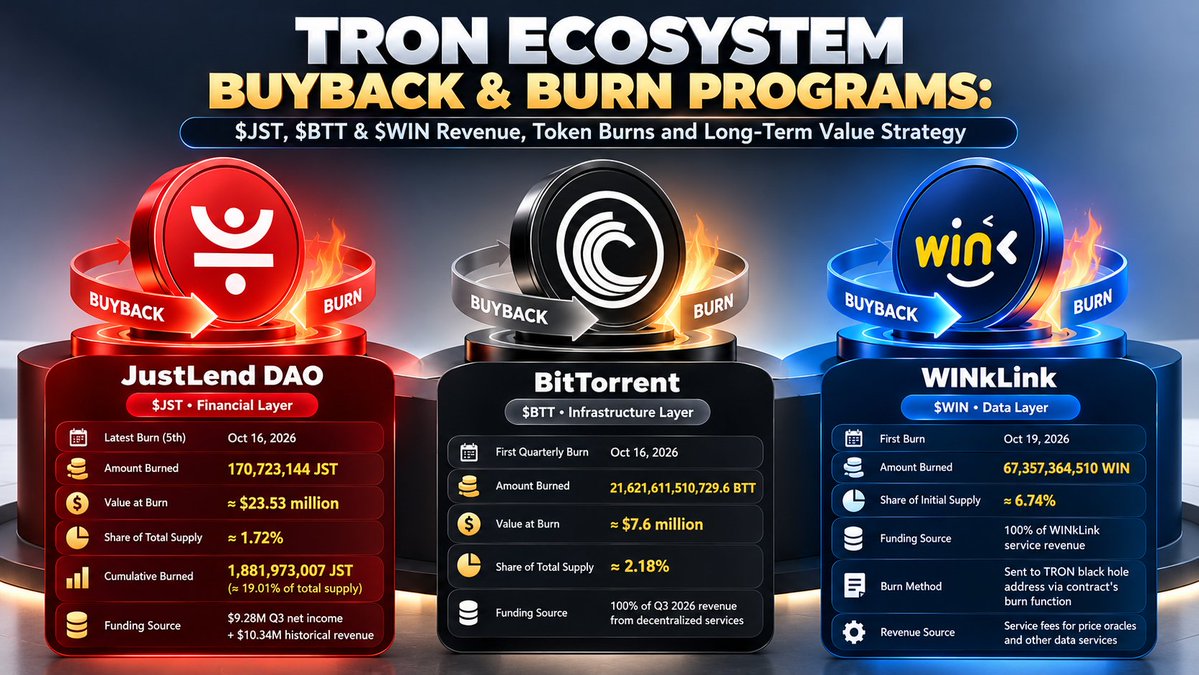
Three major TRON ecosystem projects are connecting service revenue to token supply reduction. $JST, $BTT and $WIN each operate in a different part of the ecosystem, but their buyback-and-burn programs share a common approach.
1/ 𝗪𝗜𝗡: 𝗣𝗿𝗶𝗰𝗲 𝗧𝗿𝗲𝗻𝗱 𝗮𝗻𝗱 𝗙𝗶𝗿𝘀𝘁 𝗕𝘂𝗿𝗻
From around $0.000021 in early July 2026, WIN traded near $0.000053 to $0.000054 by October 19, an approximate increase of 150%. Prices vary by exchange and timestamp, and this movement cannot be attributed to buybacks alone.
On October 19, WINkLink completed its first burn, removing 67.36 billion WIN, around 6.74% of the initial supply. The program allocates 100% of WINkLink service revenue to WIN buybacks.
Transaction: https://t.co/kzc3JwkNLw
2/ 𝗝𝗦𝗧: 𝗗𝗲𝗙𝗶 𝗥𝗲𝘃𝗲𝗻𝘂𝗲
On October 16, JustLend DAO completed its fifth burn, destroying 170.72 million JST, valued at approximately $23.53 million. Cumulative burns reached 1.882 billion JST, or 19.01% of the original supply.
The round was funded through third-quarter net income and historical revenue, connecting the token mechanism to JustLend’s DeFi business.
Transaction: https://t.co/0nqMSbO7ER
3/ 𝗕𝗧𝗧: 𝗗𝗲𝗰𝗲𝗻𝘁𝗿𝗮𝗹𝗶𝘇𝗲𝗱 𝗜𝗻𝗳𝗿𝗮𝘀𝘁𝗿𝘂𝗰𝘁𝘂𝗿𝗲
Also on October 16, BitTorrent burned 21.62 trillion BTT, valued at approximately $7.6 million, representing about 2.18% of the supply. The first quarterly burn used 100% of third-quarter revenue from decentralized services.
Transaction: https://t.co/EzgIjtLKUO
𝗧𝗵𝗲 𝗦𝗵𝗮𝗿𝗲𝗱 𝗠𝗲𝗰𝗵𝗮𝗻𝗶𝘀𝗺
$JST powers the DeFi financial layer, $BTT supports decentralized infrastructure, and $WIN delivers oracle data services.
Across all three, the model links product usage to revenue, revenue to buybacks, and buybacks to permanent token burns. This creates a measurable supply-reduction mechanism, but long-term price performance still depends on demand, adoption, liquidity and market conditions.
The next BTT and WIN round data is expected in January 2027, while an update on the next phase of JST’s mechanism is expected soon.
#TRONEcoStar @justinsuntron@DeFi_JUST@BitTorrent@WinkLink_Oracle
𝗪𝗜𝗡𝗸𝗟𝗶𝗻𝗸 𝗖𝗼𝗺𝗽𝗹𝗲𝘁𝗲𝘀 𝗜𝘁𝘀 𝗙𝗶𝗿𝘀𝘁 𝗕𝘂𝘆𝗯𝗮𝗰𝗸 & 𝗕𝘂𝗿𝗻!
WINkLink has completed Round 1 of its $WIN Buyback & Burn program, launched in Q3 2026.
The result? 67,357,364,510 WIN burned, valued at $3.59 million!
But what does this mean for WINkLink, its token economy, and the wider TRON ecosystem? Let’s break down the mechanism, revenue sources, transparency, and future implications.
𝗛𝗼𝘄 𝗗𝗼𝗲𝘀 𝗜𝘁 𝗪𝗼𝗿𝗸?
WINkLink generates revenue through oracle and protocol-related services. Under this program, 100% of the revenue allocated under the policy is used for WIN buybacks.
➠ Protocol revenue is calculated.
➠ Revenue purchases WIN tokens.
➠ Tokens are consolidated and sent to a black hole address for permanent removal.
➠ Results and transaction records are publicly disclosed.
This connects protocol revenue with systematic token buybacks and burns.
𝗥𝗼𝘂𝗻𝗱 𝟭 𝗕𝘆 𝘁𝗵𝗲 𝗡𝘂𝗺𝗯𝗲𝗿𝘀
➝ WIN burned: 67,357,364,510
➝ Reported value: $3,590,256.63
➝ Initial total supply burned: 6.74%
➝ Completed burn events: 1
These figures establish the program’s first milestone. However, burning tokens does not guarantee price appreciation; demand, liquidity, market conditions, and supply dynamics also matter.
𝗪𝗵𝗲𝗿𝗲 𝗗𝗼𝗲𝘀 𝘁𝗵𝗲 𝗥𝗲𝘃𝗲𝗻𝘂𝗲 𝗖𝗼𝗺𝗲 𝗙𝗿𝗼𝗺?
WINkLink provides oracle infrastructure that helps blockchain applications access external data, including price information.
Potential revenue opportunities include:
♤ Oracle service fees from data feeds and related services.
♤ Ecosystem demand from the wider TRON environment, including JustLend DAO and USDD.
♤ Future expansion through additional services, multichain deployments, and real-world asset (RWA) data.
The goal is to connect buybacks to protocol revenue rather than relying solely on announcements or speculation. Future results depend on adoption and actual revenue growth.
𝗪𝗵𝘆 𝗗𝗼𝗲𝘀 𝗧𝗿𝗮𝗻𝘀𝗽𝗮𝗿𝗲𝗻𝗰𝘆 𝗠𝗮𝘁𝘁𝗲𝗿?
WINkLink’s dedicated Buyback & Burn page lets users explore:
✅ Total WIN burned and reported value.
✅ Historical announcements and records.
✅ Individual burn events.
✅ On-chain transaction details for verification.
The first recorded event, dated 19 October 2026, documents 67,357,364,510 WIN burned, valued at $3,590,256.63.
Public records help holders verify activity instead of relying entirely on social media announcements. Transparency cannot eliminate market risk, but it improves accountability.
𝗪𝗵𝗮𝘁 𝗖𝗼𝘂𝗹𝗱 𝗧𝗵𝗶𝘀 𝗠𝗲𝗮𝗻 𝗳𝗼𝗿 $𝗪𝗜𝗡?
If the program continues as described, future buybacks could link protocol revenue growth with additional purchases and permanent burns.
Three things to watch:
➠ Revenue growth: Is WINkLink generating more service revenue?
➠ Execution: Are future burns completed and publicly verifiable?
➠ Market dynamics: How do demand, liquidity, and circulating supply evolve?
Long-term impact depends on consistent execution, sustainable revenue, and ecosystem growth. Reduced supply alone does not guarantee higher prices.
For now, Round 1 establishes the mechanism, delivers the first reported burn, and makes records publicly accessible.
🔥 67.35 billion WIN burned. One completed round. A transparent mechanism to follow.
🔗 Explore: https://t.co/XTS92IHOUO
@justinsuntron@WinkLink_Oracle
#WINkLink #WIN #TRONEcoStar
𝗪𝗵𝗮𝘁 𝗪𝗜𝗡𝗸𝗟𝗶𝗻𝗸 𝗣𝗿𝗶𝗰𝗲 𝗙𝗲𝗲𝗱 𝗦𝗲𝗿𝘃𝗶𝗰𝗲 𝗱𝗼𝗲𝘀
A smart contract can execute exactly as programmed and still make the wrong decision if the data it relies on is inaccurate, outdated, or unavailable.
That is one of the problems oracle infrastructure is designed to solve.
A DeFi application may need to know the current price of BTC, TRX, USDT, JST or another asset before it can determine collateral value, borrowing limits, liquidations or other on-chain actions.
But smart contracts don't naturally know what those assets are worth in external markets.
So how does that price get on-chain?
This is where WINkLink Price Feed Service comes in.
WINkLink provides on-chain price data that DApps and smart contracts can read and use.
Its price-feed system collects observations from multiple independent price-feed nodes and aggregates them before publishing the result on-chain. For its price feeds, 7 nodes participate in the reporting process, with the observations combined using a median calculation.
So the basic idea is:
Market data → multiple nodes → aggregated price → on-chain feed → DApp or smart contract
And developers get more than just a price.
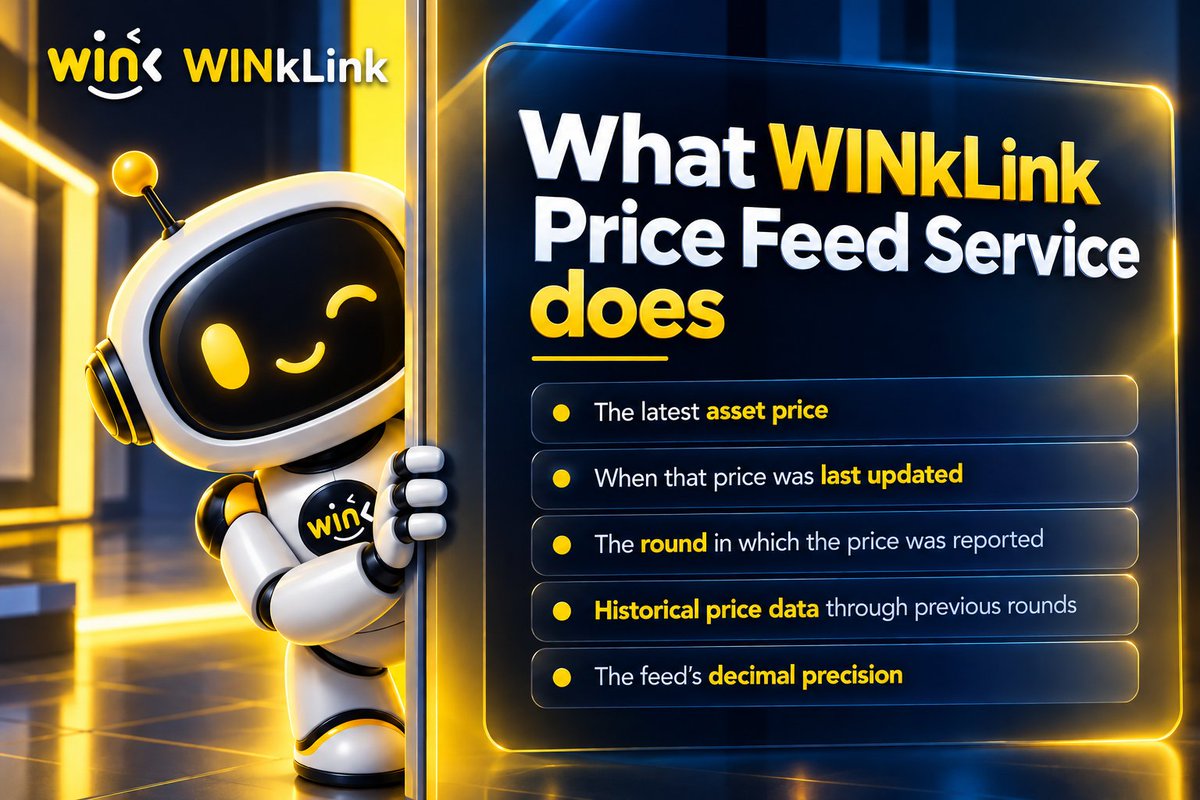
A WINkLink price feed can provide:
• The latest asset price
• When that price was last updated
• The round in which the price was reported
• Historical price data through previous rounds
• The feed's decimal precision
That information gives applications the context they need to use the data correctly.
For example, latestRoundData() provides the latest price along with an updatedAt timestamp. A developer can use that timestamp to check whether the price is still fresh enough for the application's requirements.
The decimal precision also matters because different feeds can use different decimal formats. Developers can query decimals() rather than assuming every price feed uses the same precision.
This becomes particularly important in DeFi.
If a lending protocol is calculating collateral value or deciding whether a position should be liquidated, the price it receives isn't just informational. It can directly influence what the smart contract does.
That's why the quality, freshness and structure of price data matter.
So, in simple terms, WINkLink Price Feed Service connects external market prices with on-chain applications, giving smart contracts a structured way to access and work with asset price data.
The price itself may look like just a number.
But for DeFi applications, that number can determine what happens next.
Explore more: https://t.co/UGjJQFy3Jq
#TRONEcoStar @justinsuntron #TRON #WINkLink @WinkLink_Oracle
𝗛𝗼𝘄 𝘁𝗵𝗲 𝗪𝗜𝗡𝗸𝗟𝗶𝗻𝗸 𝗽𝗿𝗶𝗰𝗲 𝗳𝗲𝗲𝗱 𝘄𝗼𝗿𝗸𝘀
When a DeFi application needs the current price of an asset, getting that information onto the blockchain isn't as simple as checking a market price.
Smart contracts cannot directly access external market data. They need an oracle to bring that information on-chain in a form the application can read and use.
This is where the 𝗪𝗜𝗡𝗸𝗟𝗶𝗻𝗸 𝗣𝗿𝗶𝗰𝗲 𝗙𝗲𝗲𝗱 comes in.
So, how does it actually work?
It starts with 𝗺𝗮𝗿𝗸𝗲𝘁 𝗱𝗮𝘁𝗮.
WINkLink's price-feed system uses multiple independent nodes to observe and report relevant price information. For its price feeds, 𝟳 nodes participate in the reporting process.
Each node provides its own observation.
Those observations are then brought together and 𝗮𝗴𝗴𝗿𝗲𝗴𝗮𝘁𝗲𝗱 𝘂𝘀𝗶𝗻𝗴 𝘁𝗵𝗲 𝗺𝗲𝗱𝗶𝗮𝗻.
This is an important part of the design. The reported price isn't simply taken from one individual node. The observations from the participating nodes contribute to the final result.
Once the price has been aggregated, the report is 𝘁𝗿𝗮𝗻𝘀𝗺𝗶𝘁𝘁𝗲𝗱 𝗼𝗻-𝗰𝗵𝗮𝗶𝗻 and made available through the price-feed contract.
That's where 𝗗𝗔𝗽𝗽𝘀 𝗮𝗻𝗱 𝘀𝗺𝗮𝗿𝘁 𝗰𝗼𝗻𝘁𝗿𝗮𝗰𝘁𝘀 can access the data.
But the feed doesn't only provide the latest price.
Developers can also retrieve:
• 𝗧𝗵𝗲 𝗹𝗮𝘁𝗲𝘀𝘁 𝗮𝘀𝘀𝗲𝘁 𝗽𝗿𝗶𝗰𝗲
• 𝗪𝗵𝗲𝗻 𝘁𝗵𝗮𝘁 𝗽𝗿𝗶𝗰𝗲 𝘄𝗮𝘀 𝗹𝗮𝘀𝘁 𝘂𝗽𝗱𝗮𝘁𝗲𝗱
• 𝗧𝗵𝗲 𝗿𝗼𝘂𝗻𝗱 𝗶𝗻 𝘄𝗵𝗶𝗰𝗵 𝘁𝗵𝗲 𝗽𝗿𝗶𝗰𝗲 𝘄𝗮𝘀 𝗿𝗲𝗽𝗼𝗿𝘁𝗲𝗱
• 𝗛𝗶𝘀𝘁𝗼𝗿𝗶𝗰𝗮𝗹 𝗽𝗿𝗶𝗰𝗲 𝗱𝗮𝘁𝗮
• 𝗧𝗵𝗲 𝗳𝗲𝗲𝗱'𝘀 𝗱𝗲𝗰𝗶𝗺𝗮𝗹 𝗽𝗿𝗲𝗰𝗶𝘀𝗶𝗼𝗻
That last point is easy to overlook.
Different WINkLink feeds can use different decimal formats, so developers should query the feed's decimals() value rather than assume every feed uses the same precision.
The update timestamp is also important because a price isn't useful simply because it exists. Applications need to know whether the data is still fresh enough for their particular use case.
So, behind the price you see inside a DeFi application, there is a process involving 𝗺𝘂𝗹𝘁𝗶𝗽𝗹𝗲 𝗻𝗼𝗱𝗲𝘀, 𝗽𝗿𝗶𝗰𝗲 𝗼𝗯𝘀𝗲𝗿𝘃𝗮𝘁𝗶𝗼𝗻𝘀, 𝗮𝗴𝗴𝗿𝗲𝗴𝗮𝘁𝗶𝗼𝗻, 𝗺𝗲𝗱𝗶𝗮𝗻 𝗰𝗮𝗹𝗰𝘂𝗹𝗮𝘁𝗶𝗼𝗻 and 𝗼𝗻-𝗰𝗵𝗮𝗶𝗻 𝗿𝗲𝗽𝗼𝗿𝘁𝗶𝗻𝗴.
The user may only see a number on the screen.
But that number has gone through several steps before a smart contract can actually use it.
𝗧𝗵𝗮𝘁'𝘀 𝘁𝗵𝗲 𝗰𝗼𝗿𝗲 𝗶𝗱𝗲𝗮 𝗯𝗲𝗵𝗶𝗻𝗱 𝗪𝗜𝗡𝗸𝗟𝗶𝗻𝗸 𝗣𝗿𝗶𝗰𝗲 𝗙𝗲𝗲𝗱: taking external market price information, processing it through multiple nodes, putting the resulting data on-chain, and making it accessible to applications that need it.
Learn more at https://t.co/J66vwXPl4d
#TRONEcoStar @justinsuntron #TRON @WinkLink_Oracle