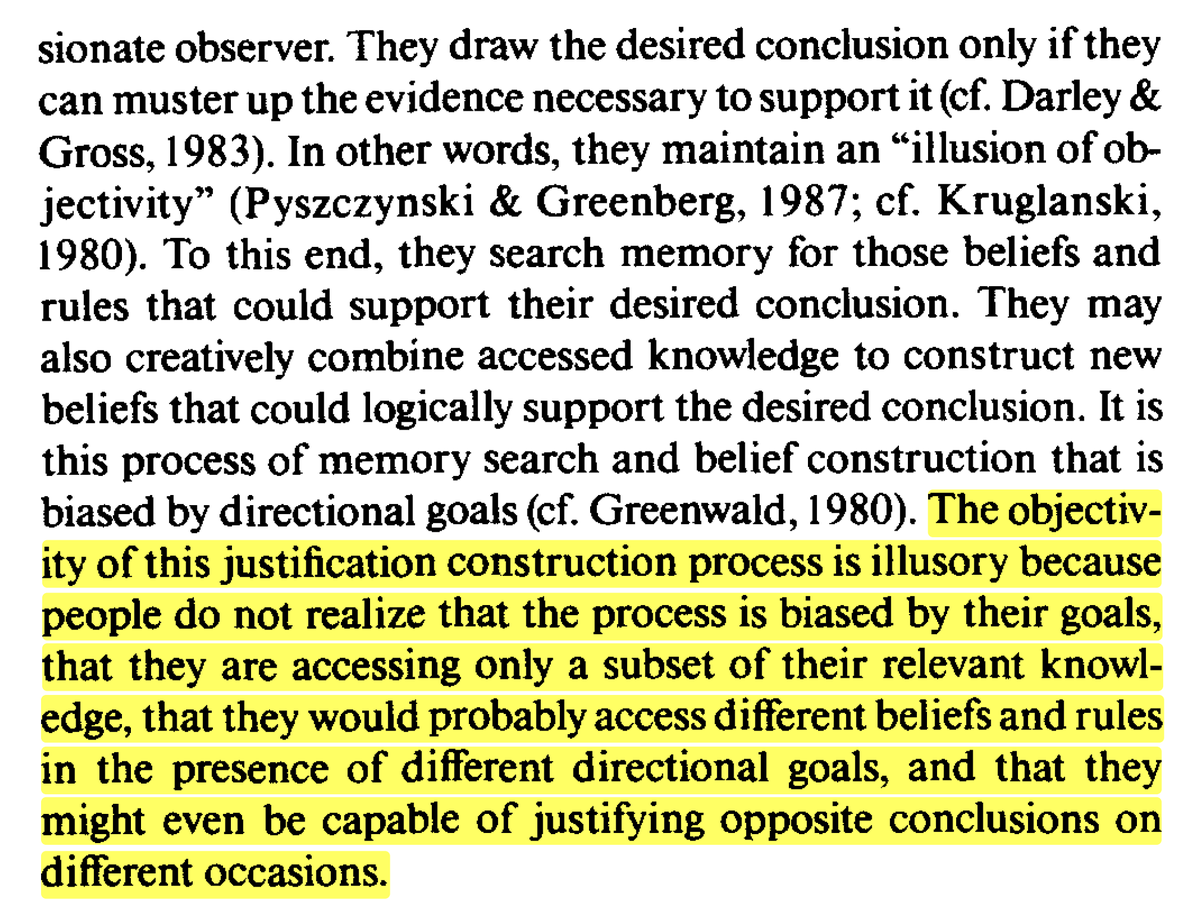
Güdülenmiş akıl yürütme:
Beynimiz bir bilim insanı gibi gerçeği aramaz, bir avukat gibi arzularımızı savunur. Arzuladığımız sonuca ulaşmak için hafızamızı yanlı tarar ve kusursuz bir "objektiflik illüzyonu" yaratırız.
Ways of influencing the beliefs of others
1. reward/punishment
2. censorship/control info
3. repetition
4. peer pressure
5. psych manipulation
6. rational persuasion
1-5 are causally powerful. However only 6 is truth-sensitive. 1-5 are as effective for false beliefs as for true.
"There is no conflict between science and metaphysics, only between science and bad metaphysics. At the edges of science, metaphysical questions ... inevitably arise, and they can be answered by the same kinds of coherence-based inferences found within science."
- Paul Thagard
"In other words, parsimony, consilience, and observational continuity carry a lot of epistemic weight—more weight than the theist has yet been able to move."
- Kenneth Williford, Hume’s Dialogues Concerning Natural Religion: A Philosophical Appraisal
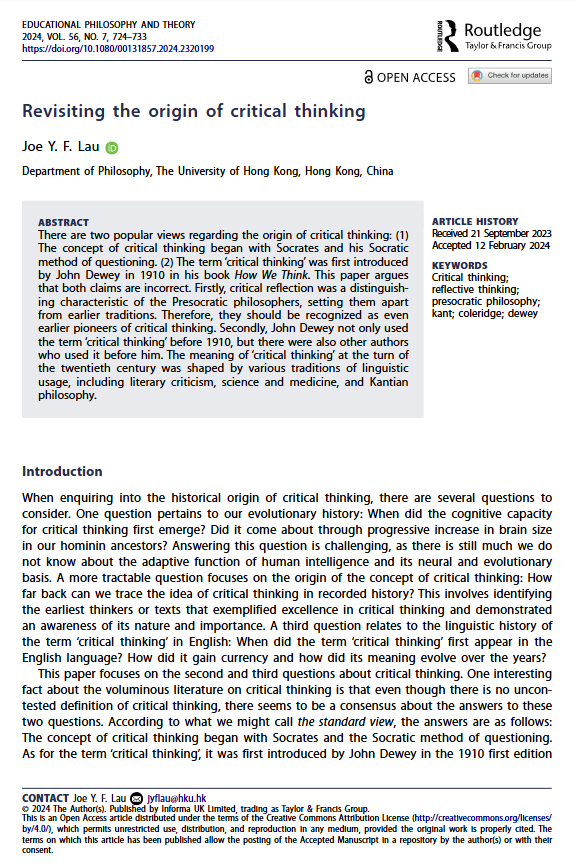
Critical thinking is older than we think.
Long before modern education, philosophers challenged assumptions, questioned beliefs, and searched for truth through reflection.
Progress begins when people start questioning.
Imagine a 19-year-old scrolling TikTok. She watches a creator list five "signs you have undiagnosed anxiety." She recognizes three in herself. By the end of the week, she's describing herself as anxious to her friends. A month later, she's avoiding situations she used to handle fine.
What went wrong?
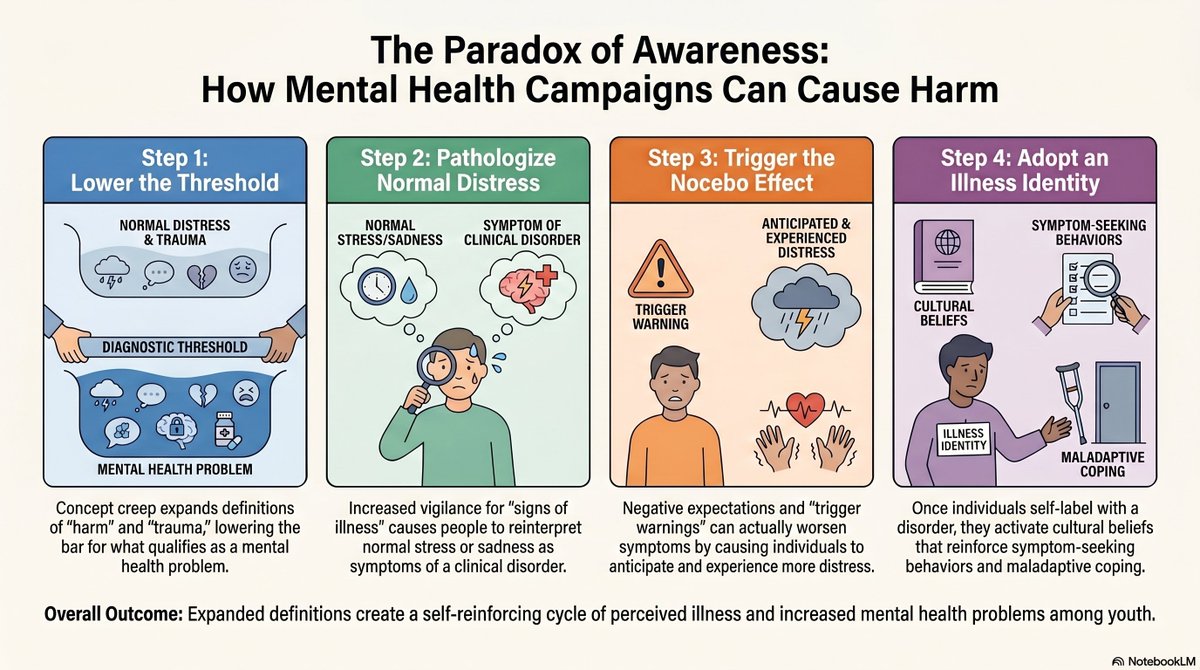
In a new paper by my PhD student Dasha Sandra, titled "Why mental health awareness can harm: Converging explanations for a societal problem", we argue that well-meaning mental health awareness can backfire, and we identify how. Four separate literatures (concept creep, nocebo effects, prevalence inflation, and illness self-labeling) have been circling the same problem from different angles. We show they converge on three mechanisms:
1.Awareness lowers the threshold for what counts as a disorder.
2. It trains people to scan their inner lives for symptoms and reinterpret normal distress as pathology.
3. Once someone adopts an illness identity, they behave in ways that confirm and deepen it.
The evidence is wide. Learning that loneliness is harmful makes solitude feel worse. Learning that stress is harmful worsens well-being and performance. Awareness videos about fake conditions like "wind turbine syndrome" produce real headaches. Trigger warnings raise anticipatory anxiety without reducing distress.
This does not mean awareness should stop. It means awareness can have unintended consequences, including manufacturing the suffering it tries to prevent. Inoculating people against these mechanisms works, and we already have evidence it does.
Link to paper: https://t.co/ucoGyhEuAj
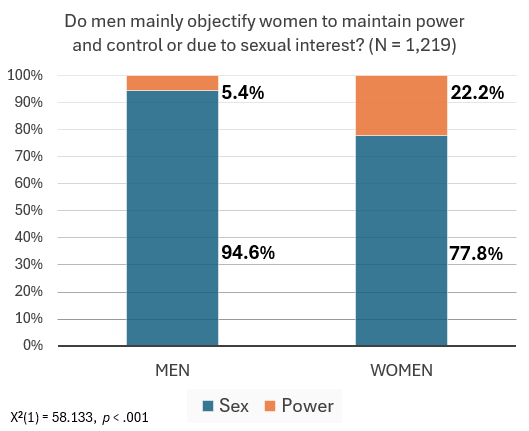
What's the main reason that men objectify women?
When given a choice between "to maintain power and control" and "sexual interest" a sex difference emerges.
Roughly, 1 in 5 women think it's to maintain power and control compared to 1 in 20 men.
Where does thinking really take place?
Barbara Tversky proposes that thought isn't confined to language but can emerge directly from the body.
Tversky is Emerita Professor of Psychology at Stanford and Columbia Teachers College.
Tap here for her full interview. https://t.co/fLlWCNUIur
The pseudoscience of “Facilitated Communication” has preyed on countless gullible victims. The reason is simple: the ideomotor effect on which it relies is so subtle and powerful that facilitators can remain perfectly sincere in their belief that the messages are not coming from them. And this apparent sincerity deceives many bystanders, even scientists, who dismiss the demand for simple double-blind tests as "insensitive" and "unnecessary".
Even the distinguished neurologist Steven Laureys was taken in by Facilitated Communication at one point, in a case involving a paralyzed patient who had supposedly been “trapped” in his body for decades and then suddenly began communicating in full paragraphs. (See my earlier piece: https://t.co/qgiDoQPljR.)
Now @nytimes and @NBCNews appear to have fallen for yet another iteration of the same sham—this time, not even a particularly sophisticated one. Jerry Coyne dissects the latest case here:
https://t.co/MUzx1r4r6M
Statisticians are trained in how to compute statistics, but not why to compute statistics. At least 10% of their training should be in philosophy of statistics. They should also spend 10 credits on their own empirical research project to understand how data is acually collected.
The Kids-These-Days Effect
Every generation thinks the younger generation is going to the dogs - a tendency that traces back to at least 624 BCE. A fascinating study explores where this perception comes from, and finds two main culprits.
[Link below.]
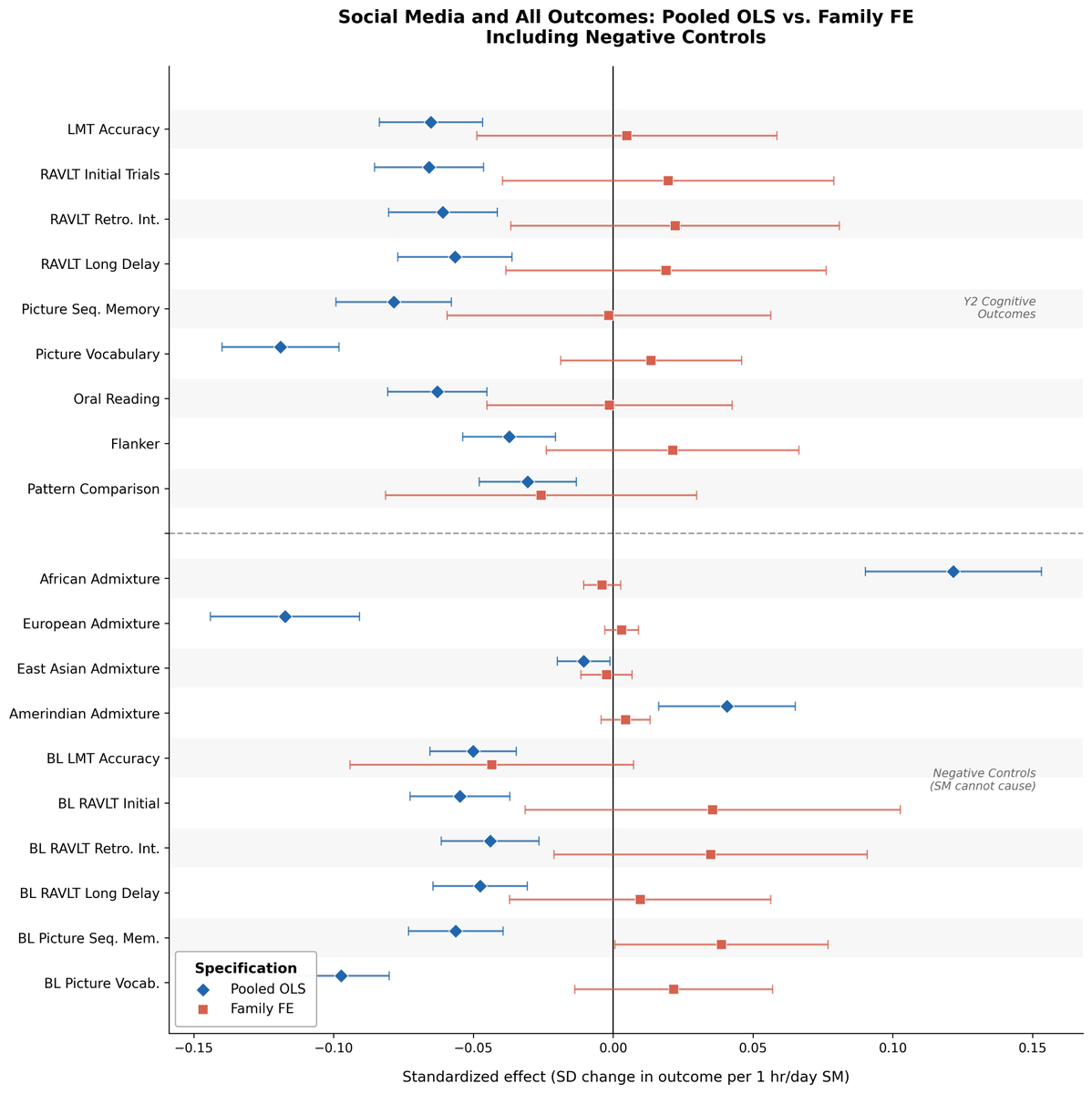
Is social media making the kids dumb? This study seems to say so
But I had the ability to reanalyze these results and I found otherwise🧵
Using these authors' methods, I found that you could also say social media use makes people more African and causes test scores in the past:
"20% of the studies presented causal claims that were not supported by their designs, opening the risk of their results being misinterpreted and their effect sizes being exaggerated [..] exacerbated by a lack of method transparency and construct validity" https://t.co/Sy6XUuQZDp
New Research: The intervention effect of internet-based cognitive behavioral therapy on anxiety, depression, and stress in college students: a systematic review and meta-analysis based on randomized controlled trials https://t.co/YqcrJK6ky1 #FrontiersIn#Psychology
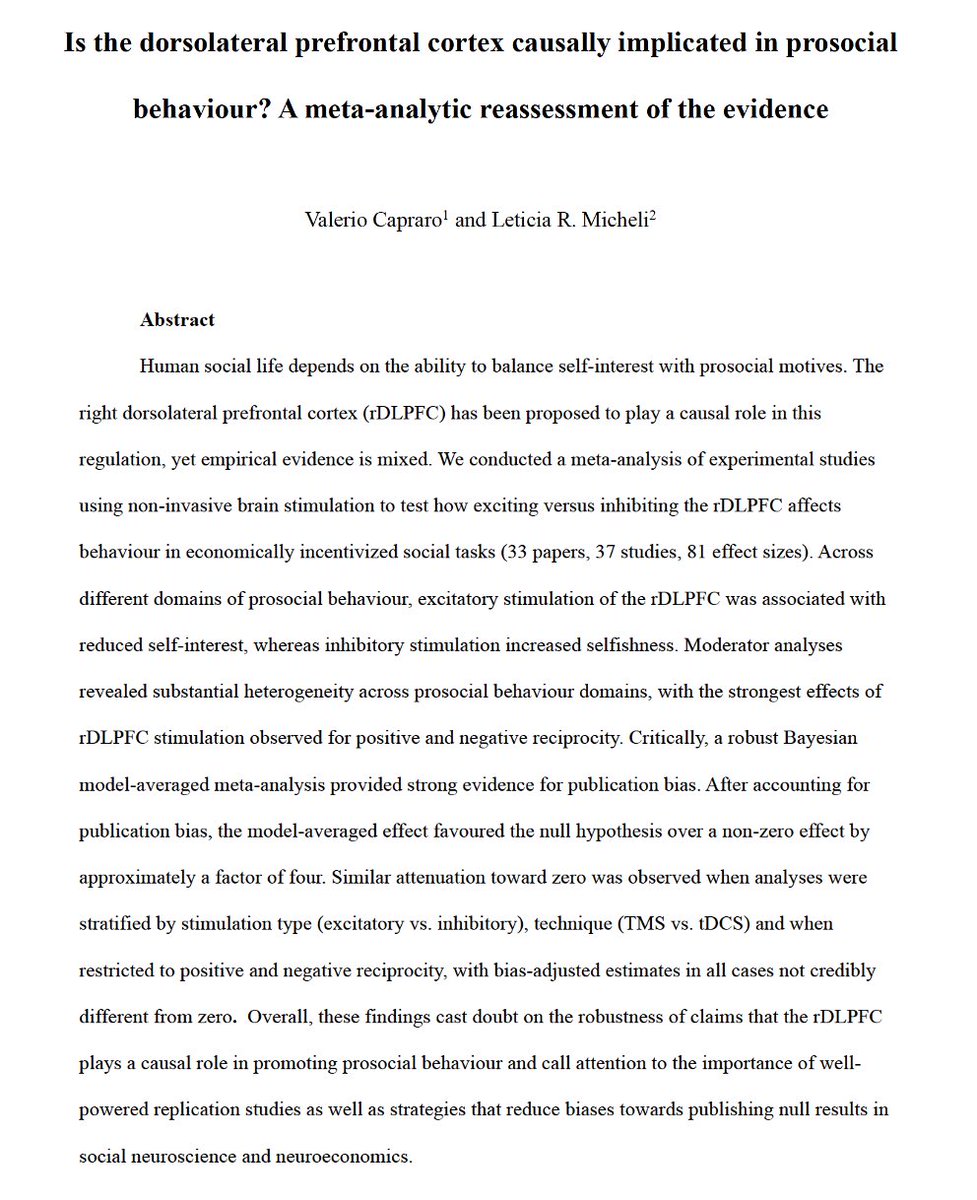
This new preprint might make some noise.
One of the central assumptions in social neuroscience is that the right dorsolateral prefrontal cortex is involved in prosocial decision making.
Neurostimulation studies using TMS and tDCS are often cited as providing the strongest causal evidence for this claim.
In this new paper, we meta-analyzed two decades of studies that stimulated the rDLPFC while participants made economically incentivized decisions involving costly prosocial behavior.
At first glance, the results look exactly as expected:
Exciting the rDLPFC leads to more prosocial behavior,
Inhibiting the rDLPFC leads to less prosocial behavior.
We also find something new in the literature and potentially interesting: stimulating the rDLPFC has a particularly strong effect on positive and negative reciprocity.
However, when we start controlling for publication bias a disaster happens.
Not even one estimation remains credibly different from zero:
Overall effect? Not credibly different from zero
Excitatory stimulation? Not credibly different from zero
Inhibitory stimulation? Not credibly different from zero
Prosocial domain-specific effects? Not credibly different from zero or dramatically underpowered.
TMS studies? Not credibly different from zero
tDCS studies? Not credibly different from zero
A total disaster.
Overall, these findings raise questions about the robustness of one of the most widely cited claims in social neuroscience and neuroeconomics, and highlight the need for well-powered replication studies and stronger incentives to publish null results.
*
preprint in the first reply
joint work with Leticia Micheli








![SteveStuWill's tweet photo. The Kids-These-Days Effect
Every generation thinks the younger generation is going to the dogs - a tendency that traces back to at least 624 BCE. A fascinating study explores where this perception comes from, and finds two main culprits.
[Link below.] https://t.co/G9ifyFPfb6](https://pbs.twimg.com/media/HEcrk43bMAAuVJE.jpg)