I haven't used this platform much recently, but can't resist sharing that I successfully defended my PhD thesis earlier this week.
I am now looking forward to start a new job at Aarhus University after the summer.
Many thanks to my advisors, Lars Ljungqvist and David Domeij, and also everyone else who supported me and/or provided me with comments and feedback over the years.
@ek_oberg The 2023 EER paper by de Graeve and Mazzolini (https://t.co/R5cFiZJtW2) constructs market values of public debt for a range of OECD countries, including Sweden, covering the period 1995-2020, and their database is free to download from the journal website.
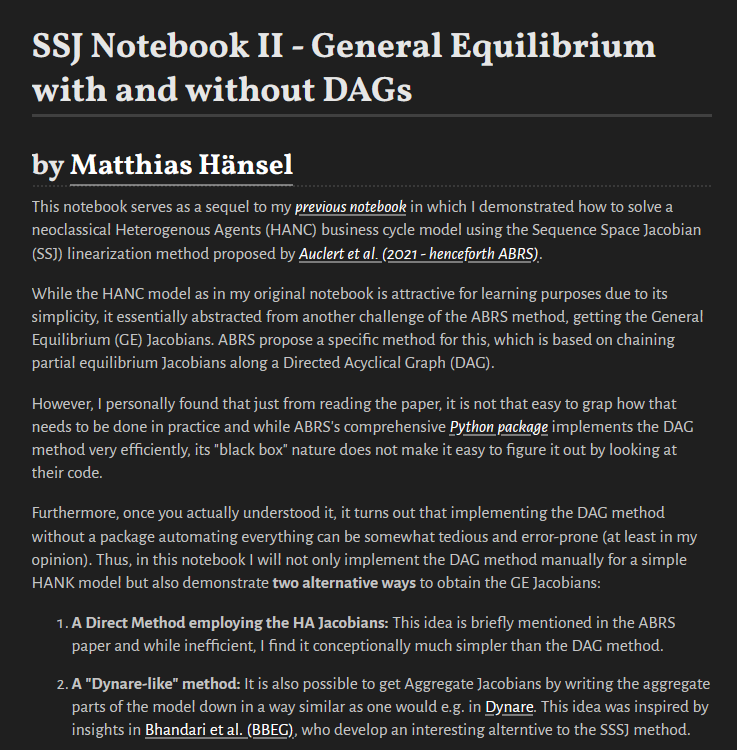
In particular, I show how to use an alternative approach that has a bit more of a "Dynare flavour".
Of course, everything is again coded from scratch in Julia.
As many people seemed to have appreciated my previous SSJ notebook, I wrote a sequel.
You want to use Sequence Space Jacobians to analyze HANK models but don't warm up to representing models using DAGs? I discuss some alternatives.
Link: https://t.co/17J8Agjn4o
The paper "HANK faces Unemployment" by by A . Consolo (ECB, @egostino ) and me is now available as ECB Working Paper.
See below for link and short thread. 👇
@gp_mihalache@pzoch5 I see. For the former case, perhaps ideas from this recent work are interesting: https://t.co/onM5oUg6Jo. It seems to build on SSJ and aims to improve the computation of perfect foresight dynamics after big (and potentially permanent) shocks.
Thus, spending a bit of time to provide a seemingly useful public resource helped me to attend a cool conference.
I am sharing this to encourage others to do the same.
Below a link to said notebook that I posted a while ago:
https://t.co/HSQyH0mUoI
Back home after a few intensive days at the Vigo Workshop on Dynamic Macroeconomics.
Not only did I learn a lot about macroeconomics, but also that putting some work into providing public goods can benefit you: 1/n
In particular, one of the program committee members told me that while there were concerns on how my work would fit the program (no other monetary/HANK papers), he appreciated my SSJ notebook (see below) and thus pushed more for me to be included. 2/3
@TimKriegerFR Man könnte auch in jedem Lebensjahrzent (ab 10, bis 70?) zu Dienstzeit verpflichten, wobei Wehr-/Reservedienst, Elternzeit sowie manche Ehrenämter angerechnet werden. Nutzen für BW, gender equality (Papa nimmt elternzeit), "gesellsch. Zusammenhalt" und scheint gerechter.
@ToreEllingsen1 One could imagine a natural experiment where some couples are unexpectedly or randomly subject to spatial separation, e.g. due to a draft lottery? And compare outcomes for people whose partner got sent away to others initially cohabiting?
@gp_mihalache@t_holden If it is just on equilibrium outcomes, I am ok with direct nom. rate -> inflation link. After all, inflation rate is the only effect changing nom. rates would have in a flex price model.
@gp_mihalache@t_holden Indeed. But P changing requires p's changing. Anyway, I think perceived differences here because I (and perhaps schnabel?) was initially thinking of a "transmission chain", i.e. which agent reacts first to what and so on. Models ofc don't take a stance, only on eq outcome.