I’LL SAY IT STRAIGHT: THIS IS THE BEST VIDEO ON THE INTERNET FOR FINDING STOCKS WHERE INSTITUTIONS ARE ALREADY BUYING.
IF YOU FIND A BETTER ONE, SEND IT TO ME.
A follower asked me recently whether I prefer buying breakouts or pullbacks, and I think my answer would've been completely different a few years ago.
Nowadays, my answer is pretty simple = whichever one the market is rewarding me for.
But there's a lot more to that answer than it sounds, and I think understanding the difference could save newer traders an unbelievable amount of money. More importantly, there's something I've learned about the relationship between breakouts & pullbacks that completely changed how I approach my entries.
This is a longer-winded writeup, but let me explain.
When we're in a choppy environment like we've experienced recently, I'm generally much more interested in buying weakness in strength rather than chasing stocks through obvious breakout pivots. You can have the most textbook setup imaginable, buy through your pivot, watch the stock move +5% in your favor, and then spend the rest of the afternoon wondering how the heck it moved back at b/e and/or took a loss.
Do that enough times and those little paper cuts start adding up. What's frustrating is that your stock selection might've been perfectly fine. You were just using an entry tactic that the environment wasn't rewarding.
That's an important distinction I've had to learn over the years. A good stock, a good setup, and a good entry aren't necessarily the same thing.
So when breakouts stop following through, I naturally start paying more attention to leaders that have already proven themselves with a Stage 1 → Stage 2 breakout and are now pulling back toward their rising 9/21EMAs or major weekly pivots. I'm still looking for the exact same characteristics... RS against the market + its peers, constructive price action (linearity), and evidence that institutions are willing to defend these areas.
But I want to make something clear because I see this misunderstood ALL the time.
A stock touching its 9EMA is not a reason for me to buy it.
I want to see how it gets there. Is volume contracting as price pulls back? Are sellers struggling to push it lower? Is it holding up better than the rest of its group? And most importantly, when price reaches that area of interest, are buyers actually showing up?
I've watched plenty of stocks bleed into their moving averages, sit near LOD for an hour, and then slice straight through support. There's a pretty big difference between a stock reaching an area where buyers "might" show up and actually seeing evidence that they're willing to defend it.
That's where my lower timeframes come into play.
Let's say I've been stalking a leader that's pulling back toward its rising daily 9EMA. Instead of trying to catch the exact bottom, I'll watch how price behaves around that level during the session. Maybe we get an aggressive flush off the open, a reclaim of VWAP, and then the first higher low begins developing on the 15/30 minute chart.
Now I've got something to work with.
If price starts reclaiming that intraday pivot, I can potentially enter with my risk against LOD or whatever technical level invalidates the setup. I'm not guessing where the bottom is anymore, because I'm letting buyers show their hand before I commit my capital.
And here's the part I wish someone had explained to me years ago.
I'm technically buying a pullback on the daily chart and a breakout on the intraday chart at the EXACT same time.
Think about that for a second...
The daily chart is showing weakness within an established uptrend, while the 15/30 minute chart is beginning to show strength as buyers reclaim control. Same stock, same opportunity, 2 completely different perspectives depending on the timeframe.
Price is fractal, and once I started understanding that relationship, I stopped obsessing over whether I was a "breakout trader" or a "pullback trader."
I'm just trying to position myself in strong stocks at areas where I can be wrong quickly and small.
Now, flip the environment.
When we're in a healthy trending market, breadth is expanding, my scans are filling up with leaders, and breakouts are actually following through, I'm MUCH more comfortable buying through major pivots.
But why?
Because I've learned that some of the strongest stocks in the market are incredibly rude. They'll spend 4-8 weeks building a big base, volume dries up, price tightens underneath a major weekly pivot, and then the stock breaks out and never gives you the pullback you were patiently waiting for.
I've missed my fair share of incredible opportunities because I was so determined to get the perfect entry that I forgot what I was actually trying to accomplish.
The goal isn't to buy the lowest possible price. The goal is to find an asymmetric opportunity where the potential upside meaningfully outweighs what I'm risking.
If a stock has spent weeks absorbing supply and is finally expanding out of a major Stage 1 base into a potential Stage 2 uptrend, I'm not going to automatically pass on it because it didn't pull back to the 9EMA first.
Sometimes paying a little more for confirmation is perfectly reasonable, assuming I can still define my risk appropriately.
That's the entire idea behind compression → expansion that I talk about so frequently. I'm looking for tension building underneath major pivots, volatility contracting, volume drying up, and eventually buyers overwhelming the available supply.
But there's another piece of this that I think matters even more than the entry itself, and it's something I wish I'd taken seriously during my first few years trading.
My own equity curve has a HUGE influence on how aggressively I'm willing to trade either setup.
I could wake up tomorrow and find 5 breakouts on my scans, but if my last several trades have been paper cuts, my positions aren't building cushion, and leaders keep failing to hold their gains, why would I suddenly start throwing meaningful capital at the market?
That's something I used to struggle with. I'd convince myself that the next setup was going to be the one that finally worked, even though the market had been telling me for days that my edge wasn't being rewarded.
Nowadays, I'm much more comfortable starting small and letting the market prove itself.
Maybe I take a pilot position in a leader pulling back into its 9EMA. If it starts working, I build some cushion. Another setup appears and that one starts working too. Suddenly I've got multiple positions behaving the way I want them to, and my equity curve is beginning to confirm what I'm seeing on the charts.
That's when I start thinking about progressively increasing exposure.
I've gone from mostly cash to heavily invested within a matter of days before, not because I woke up and decided the market was going higher, but because my trades kept working and I had actual profits to lean against.
The market earned my exposure. I didn't give it away because I felt bullish.
And the opposite is equally important. If I'm taking consecutive losses and nothing is following through, I have no problem reducing exposure and sitting on my hands until something changes.
I think this is where a lot of traders get frustrated. They'll find a strategy that works for a few months, experience a difficult stretch, and immediately assume they need to reinvent their entire system.
Sometimes that's true, but majority of the time, the problem isn't your strategy at all. You're simply trying to force an entry tactic in an environment that isn't rewarding it.
Here's something I'd encourage you to do if you've been struggling with this recently.
Go back through your last 20-30 trades and separate your breakout entries from your pullback entries. Then look at what the market was doing when you took them. Were leaders holding their moving averages? Were breakouts sticking? Were you buying through resistance in a choppy environment, or buying against support in names showing RS? And were your positions actually building cushion, or were you constantly watching green trades turn red?
You might start recognizing patterns in your own behavior that have absolutely nothing to do with your ability to identify a good stock.
I've learned an unbelievable amount about myself by doing this over the years.
And if you miss a breakout in a true leader, please don't convince yourself that you have to own it at any price. I've made that mistake more times than I'd like to admit. A stock can be up +10% from your original pivot and still be a fantastic company, but that doesn't mean it's offering a fantastic entry anymore.
If it's truly a leader, there's a good chance it'll eventually give you another opportunity. Maybe that's an inside day, a tight flag, a pullback into the rising 9/21EMAs, an EMA crossback, or another multi-day base where you can define your risk again.
I'd rather miss the first 10% of a much larger move than spend the next three weeks digging myself out of unnecessary losses because I couldn't stand watching something run without me.
So when somebody asks whether I prefer breakouts or pullbacks, I genuinely don't think there's a universal answer.
In a healthy trending market, I'm happy to buy strength as stocks expand out of major bases. In a choppy environment, I'd much rather look for weakness in established leaders and wait for buyers to prove themselves on the lower timeframes.
And regardless of which entry I take, my thought process is essentially the same. I want a leading stock in a leading group, a meaningful area of interest on the weekly/daily chart, a tight lower-timeframe execution, and a logical place to be wrong.
If my positions start working, I'll press.
If they don't, I'll back off.
I've spent the better part of 6+ years trying to become a better trader, and it's pretty funny how much of that improvement has come from simplifying things I used to make way too complicated.
I'm not trying to perfect the entry, my goal is trying to get better at recognizing when the environment, the stock, and my own equity curve are all giving me permission to take risk.
That's really what it comes down to for me.
Everything else is just an entry tactic.
My 2 cents.
DELETING YOUR BROWSING HISTORY DOESN'T DELETE YOUR BROWSING HISTORY.
GOOGLE KEEPS ITS OWN COPY, TIED TO YOUR ACCOUNT, ON A PAGE MOST PEOPLE HAVE NEVER OPENED.
HERE'S HOW TO WIPE ALL OF IT:
Want to know how to avoid major drawdowns and improve your returns in the stock market?
Understanding Stan Weinstein's Stage Analysis is a great place to start. Every stock moves through 4 stages!
One of the most important lessons I've learned from Stan Weinstein's Stage Analysis is understanding where a stock stands in its market cycle and when to buy, hold, reduce exposure, or stay away.
The framework primarily uses the 30-week moving average (roughly equivalent to the 150-day SMA), price action, volume, and relative strength.
Stage 1: Basing / Accumulation
What does it look like?
- Usually forms after a prolonged Stage 4 downtrend
- Stock stops making consistent lower lows and starts trading sideways
- 30-week moving average begins to flatten
- Price moves above and below the flattening moving average
- Selling pressure decreases, and volume often dries up
What does it mean?
- The stock is trying to establish a bottom, but buyers haven't taken full control yet. This is where I start building my watchlist and looking for improving technicals, higher lows, and signs of accumulation.
- Remember, a stock falling 50-70% doesn't automatically make it a Stage 1 base. It needs time to stabilize and build a proper structure.
Stage 2: Advancing/Uptrend
What does it look like?
- Stock breaks out above its Stage 1 base
- Breakout ideally happens on expanding volume
- 30-week moving average starts sloping upward
- Higher highs and higher lows
- Relative strength improves against the broader market
What does it mean?
- Buyers are taking control, and institutional accumulation may be supporting the uptrend.
- This is my favorite stage to own growth stocks! I generally look for Stage 1 → Stage 2 breakouts and constructive pullbacks to rising moving averages.
- The goal isn't to buy at the absolute bottom but to participate when the stock starts showing evidence of a sustainable uptrend.
Stage 3 vs. Stage 4 - This is where a lot of us make mistakes!
Stage 3: Topping / Distribution
What does it look like?
- Usually forms after a prolonged Stage 2 advance
- Momentum slows, and price starts moving sideways
- 30-week moving average begins flattening
- Price repeatedly crosses above and below the moving average
- Breakouts start failing, and selling volume may increase
- Major support levels are still holding
What does it mean?
- The previous uptrend is losing momentum, and the stock may be going through distribution.
- Stage 3 doesn't automatically mean a crash is coming. Some stocks consolidate and resume their uptrends.
- For me, this is where I become cautious, tighten risk management, consider trimming positions, and avoid aggressively adding exposure.
Stage 4: Declining / Downtrend
What does it look like?
- Stock breaks below major support or its Stage 3 range
- 30-week moving average starts sloping downward
- Price trades below the declining moving average
- Lower highs and lower lows
- Short-term rallies often fail near declining moving averages
What does it mean?
- Sellers are in control, and the stock is in a downtrend.
- One of the biggest lessons I've learned is that technicals often reveal weakness before fundamentals do.
- A company can continue reporting strong earnings while its stock is entering Stage 4 because the market is already pricing in future expectations.
The biggest difference between Stage 3 and Stage 4:
Stage 3 = Sideways price action, flattening moving averages, potential distribution.
Stage 4 = Support breakdown, declining moving averages, established downtrend.
Another important thing to understand is that Stage 1 and Stage 3 can look very similar!
Both involve sideways price action and flattening moving averages. The difference is what happened before:
- Sideways consolidation after a prolonged decline could be Stage 1.
- Sideways consolidation after a major advance could be Stage 3.
My approach is simple:
Stage 1 - Build your watchlist and prepare.
Stage 2 - Look for opportunities to participate.
Stage 3 - Protect your gains and manage risk.
Stage 4 - Protect your capital and avoid weak downtrends.
Stage Analysis isn't perfect, but it's one of the most valuable frameworks I've learned in my investing and trading journey.
I use technicals to understand WHEN to participate and fundamentals to understand WHAT I'm buying.
Understanding these four stages can make a tremendous difference in how you navigate market cycles!
21 short pieces of advice for becoming more selective 👇
1. Look for reasons to reject a trade before looking for reasons to take it.
2. A valid setup is not automatically a good setup. I want exceptional opportunities, not technically acceptable ones.
3. Raise your standards when the market gets weaker. Don't compensate for fewer opportunities by accepting worse ones.
4. Focus on genuine market leaders. A beautiful chart in an average stock is still an average opportunity.
5. Demand a strong prior move. I want proof that the stock has already demonstrated leadership.
6. Avoid stocks with too much overhead resistance. The cleanest opportunities usually have room to move.
7. Prefer tight, controlled price action. Wide, erratic bars often tell me the stock isn't ready.
8. Don't buy a setup just because you've been waiting for days. Time spent waiting doesn't make the next opportunity better.
9. Reduce your watchlist. When everything is interesting, nothing gets your full attention.
10. Compare setups against each other. The question isn't whether Stock A looks good. It's whether it deserves capital more than B, C and D.
11. Stop chasing. A great stock at a poor entry can still become a poor trade.
12. Don't lower your standards after missing a big winner. Missing one opportunity doesn't make the next mediocre setup better.
13. Become more selective after several losses. The market may be telling you that your normal standards aren't high enough for current conditions.
14. Separate boredom from opportunity. Wanting to trade is never a reason to trade.
15. Don't confuse research with obligation. Spending hours studying a stock doesn't mean you have to buy it.
16. Pay attention to how breakouts are behaving across the market. Repeated failures are information.
17. Judge the whole trade: market, stock, setup, entry and risk. One strong element cannot compensate for several weak ones.
18. Keep track of the trades you regret taking—not just the trades you regret missing.
19. Study your biggest winners. They show you what deserves your capital far better than generic setup definitions.
20. Accept that high selectivity can mean doing nothing for days or weeks. That's not a flaw in the process.
21. Make rejection part of your edge. I don't need to find more stocks to trade. I need to get better at saying no.
Selectivity isn't about finding fewer opportunities. It's about demanding more from every opportunity.
After 20+ years in the market, my trading has become simpler—not more complicated.
I don't need dozens of setups, indicators, or strategies.
I need rules I trust enough to follow when money and emotions are involved.
Here are 20 of mine:
1. Cut losses quickly. I never average down.
2. Give strong winners room. I sell based on rules, not fear.
3. Position size matters as much as stock selection.
4. I trade with the market environment, not against it.
5. A valid setup isn't enough. I want exceptional setups.
6. If the upside doesn't justify the risk, I pass.
7. Liquidity matters. I want to be able to exit when I'm wrong.
8. I use the EMA 8/21 to help manage strong trends.
9. I journal my trades and regularly study them.
10. I make decisions from price action, not predictions.
11. I don't trade because I'm bored.
12. I don't gamble through earnings without a sufficient cushion.
13. I add to positions that prove me right, not positions that prove me wrong.
14. Volume confirms whether a move has real demand behind it.
15. The larger my profit cushion becomes, the more room I can give a leader.
16. I don't need to predict what happens next. I need to respond correctly.
17. Before I enter, I know my entry, risk, and exit plan.
18. I stick with one system long enough to understand it deeply.
19. I would rather take 2 exceptional trades than 10 average ones.
20. When there is nothing to do, I do nothing.
Most of these rules are simple.
Following them consistently when you're losing, frustrated, excited, or afraid of missing out is the difficult part.
That's where trading experience is built.
📌This is the Summary of my Entire Swing Trading System👇
✅ Market Environment
🔵 Should be favorable for Swing Trading.
🔵 Green Zone (Ideally Young Fresh New Uptrend or Intermediate Uptrend)
✅Setups:
🔵Stage 2 Stock
🔵Big base Breakout + Strong Institutional Leg + Shallow Pullback + High Quality Tight Pivot
🔵Strong Buying Force + Shallow Pullback +High Quality Tight Pivot Near Recent Highs or 21 EMA.
🔵 Young IPO'S + Huge Liquidity.
✅Scanning:
🔵Scan for leading stock in Strongest Sector/theme.
🔵 25% Within 52 Week High
🔵 Young IPO
✅Entry:
🔵 Tight Pivot Breakout Entry
🔵 Gap up Opening
🔵 Breakaway Gap
🔵 Shakeout
✅Exit: -
🔵Stop loss at Pivot Low or Standard Stop Loss : 4%
🔵Trim into strength and move stop to even
🔵Use moving average to trail
✅Indicators:
🔵10/21Exponential moving averages
🔵Volume
My entire system comes down to these 6 things.
For Finviz/TradingView-style screeners approximate the universe like this:
Price > $5
Avg volume > 1M (targets $5M+ ADV)
Perf Month >25% or Quarter >50% or Half >100% (top RS leaders)
High volatility (proxy for ADR 4%+)
Then manually chart for tight consolidations after 30%+ prior moves with rising 10/20 MA.
EPs: Premarket gap >10% + volume >3x on quiet stocks.
Parabolic shorts: Extreme vertical runs then weakness.
Full consolidation filters need chart review or custom scripts.
END-OF-WEEK REMINDER:
Here are 8 things I recommend doing this weekend to become a better trader next week:
1. Review every trade you made. Focus on execution, not just P&L.
2. Identify your biggest mistake and write down how you'll prevent it next week.
3. Study your best trade. What made it work, and can you repeat it?
4. Review the general market, breadth, and leading sectors.
5. Study the strongest stocks. Look for accumulation, tight bases, and relative strength.
6. Clean up your watchlist. Remove broken charts and mediocre setups.
7. Prepare your best setups. Define entries, stops, position sizes, and invalidation levels.
8. Disconnect from the market. Exercise, spend time with your family, and recharge mentally.
My goal every weekend is simple: Enter Monday with a clear mind, a focused watchlist, and a plan.
Don't just prepare to trade next week. Prepare to make better decisions.
You have to learn how to buy relative strength names on weakness...
Every leading stock eventually pulls back
I like to use the 8 & 21 EMAs as areas where strong momentum names can find support during those pullbacks
BUT...
The mistake most traders make is blindly buying the second price touches an EMA
An EMA is NOT an automatic buy signal
It’s an area where you should start paying attention to how price reacts
Instead of guessing that the moving average will hold, wait for confirmation that buyers are actually stepping back in
Two of my favorite confirmations:
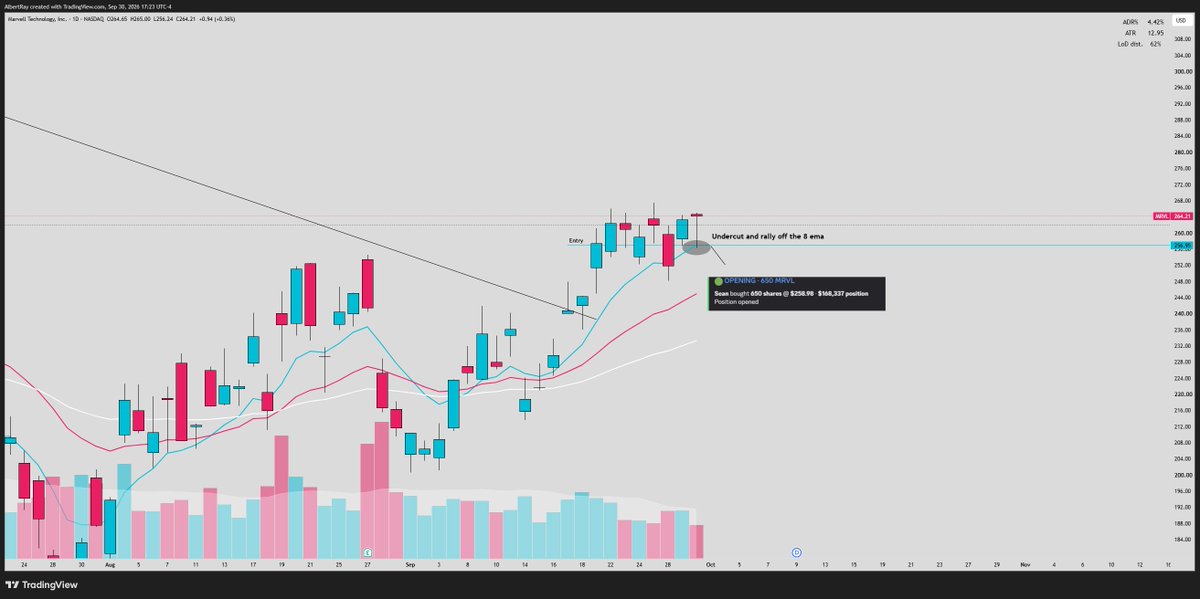
1. UNDERCUT & RALLY
Instead of buying directly at the EMA, let price undercut the previous days low
If price trades below the previous days low/range low, flushes out weak hands, and then quickly reclaims the level, that reclaim can tell you much more than the initial touch.
You’re letting the market prove that buyers are willing to defend the area rather than assuming they will
The undercut can shake out traders who bought the EMA blindly, trigger stops below the level, and create a much cleaner reclaim
This is how I bought $MRVL today
I waited for:
-Break under previous days low
-Tap 8 EMA
-Reclaim previous days low
-Buy on the reclaim
Stop loss goes to the low of day
I was able to catch a massive reversal with a few % risk, without having to GUESS the bottom.
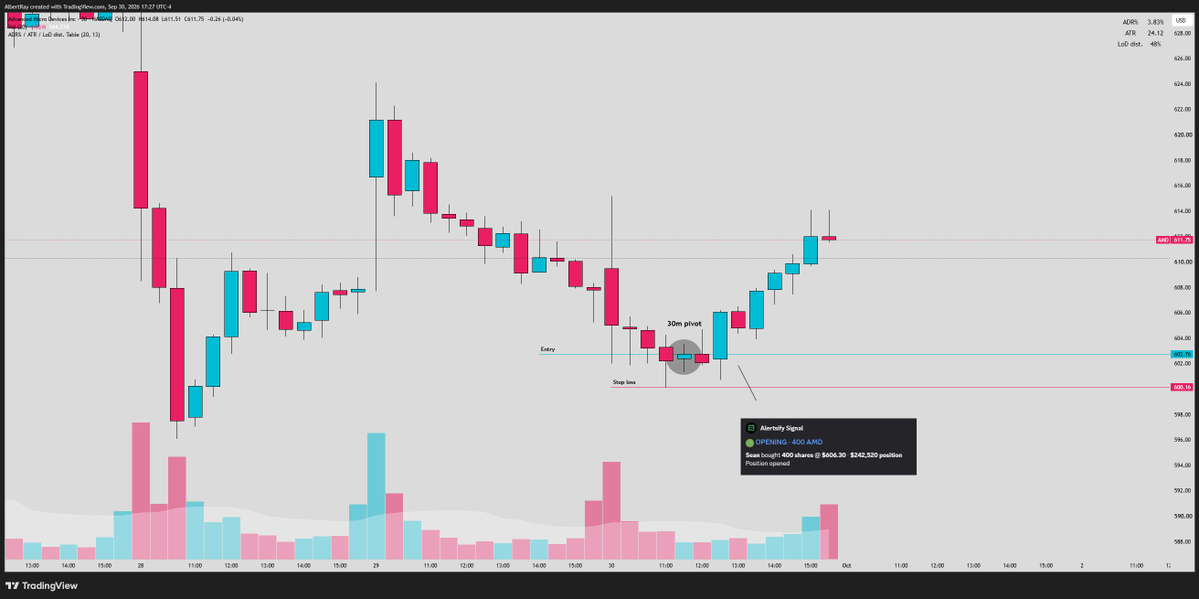
2. 30 MINUTE PIVOT
Another way I look for confirmation is by dropping down to the 30-minute chart and letting price establish a pivot
Instead of trying to catch the exact bottom at the daily EMA, let the stock bounce first...
Once buyers step in, you'll see the first 30m green candle form off the 8 ema
Now you have a defined 30 minute pivot to watch
If price can break back above that pivot, you have evidence that momentum is beginning to shift back toward the buyers.
Yes, your entry may be slightly higher than someone who blindly bought the EMA...
But you're trading with confirmation instead of prediction.
That's the trade-off I'm willing to make.
This is how I bought $AMD today right off the 8 EMA...
Remember:
The moving average itself isn't the signal
It's the REACTION around the moving average that matters
A weak stock can touch the 21 EMA and slice straight through it
A leading stock can pull into the same EMA, shake traders out, establish a pivot, and then reclaim momentum...
That's why the process starts with RELATIVE STRENGTH
Find the stocks that have already proven themselves
Wait for weakness into a key moving average
Then
Use an undercut & rally or a 30-minute pivot to let price confirm that buyers are stepping back in
You don't always have to chase strength
Sometimes the best opportunity is waiting for strength to temporarily go on sale.
Netflix has 260 million subscribers. Netflix is betting that 250 million of them never open the settings menu.
One guy did. He worked Netflix customer support for 3 years. Handled 15,000 complaints. He told me something that should change the way you watch tonight:
"Every single complaint I got for 3 years was caused by the same 10 settings. Not bugs. Not content. Settings."
"'Why is my picture blurry?' Because Netflix set your streaming quality to Auto — which doesn't mean best quality. It means lowest quality Netflix can get away with before you notice."
"'Why are my recommendations terrible?' Because 3 people are watching on your profile and the algorithm thinks you're one person who loves true crime, kids cartoons, and Korean dramas at the same time."
"'Why does every movie look like a soap opera?' Because a motion smoothing setting you've never seen is turned on — making a $200 million film look like it was shot on a phone."
"'Why do I scroll for 45 minutes and give up?' Because autoplay previews are feeding the algorithm false data every single time you pause on a thumbnail. Netflix thinks you're interested. You were just reading the description."
"I spent 3 years answering the same 10 complaints. Every single time the fix was the same: 'Let me walk you through your settings.' Every single time the customer said: 'Why didn't Netflix tell me this?'"
"Because Netflix makes more money when you scroll. Not when you find something."
Here are 10 Netflix settings that are ruining your experience right now — and exactly how to fix each one in under 5 minutes:
🧵