The MIT AI Risk Initiative which aims to provide credible, timely, and decision-relevant answers to questions related to AI risks and mitigations and practice.
📢 New paper: Prioritization of Risks from Artificial Intelligence: A Delphi Study of 272 International Experts
AI creates many risks, from discrimination, privacy loss, and fraud to more emerging concerns such as overreliance, dangerous capabilities being misused in weapons or cyberattacks, and AI systems pursuing unintended goals.
But which risks are most severe? Who is most vulnerable? And who is most responsible for addressing them?
To answer these questions, we conducted a three-round expert consultation with 272 AI experts.
💡 Four insights from our findings:
1️⃣ If things continue as they are over the next 5 years, experts assigned ≥10% probability of catastrophic outcomes (e.g., >1 million deaths or >$100 billion in losses) to 18 of 24 risks. Top concerns: cyberattacks and weapons, dangerous AI capabilities, competitive dynamics, power centralization, and disinformation and influence at scale.
2️⃣ Even assuming pragmatic mitigations, 5 risks remained above the 10% catastrophic threshold: dangerous AI capabilities, cyberattacks and weapons, environmental harm, inequality, and power centralization.
3️⃣ Vulnerability is broadly distributed, but responsibility is concentrated. Experts assigned the highest vulnerability to AI users and the general public, while assigning primary responsibility for mitigation to frontier AI developers, governments, regulators, and standards bodies.
4️⃣ Information, finance, and national security were rated the sectors most vulnerable to AI risks.
🔗How can you engage? See our (fancy) new webpage for our interactive summaries of the findings and preprint, and please share with anyone working on AI risk, governance, or policy.
https://t.co/qPsLHIuJGh
This research is part of the MIT AI Risk Initiative (@MITAIRisk), which aims to help society understand, prioritize, and manage risks from AI. The initiative includes the MIT AI Risk Repository, a living database of more than 1,700 AI risks, the AI Incident Tracker, a collaboration with the Responsible AI Collaborative, which connects risks to over 1,400 incidents, and the MIT AI Governance Map, which analyzes risk coverage across more than 1,000 laws, standards, policies, and other governance documents curated by the Center for Security and Emerging Technology (CSET).
#AI #AIrisk #AISafety #AIGovernance #ResponsibleAI #RiskManagement
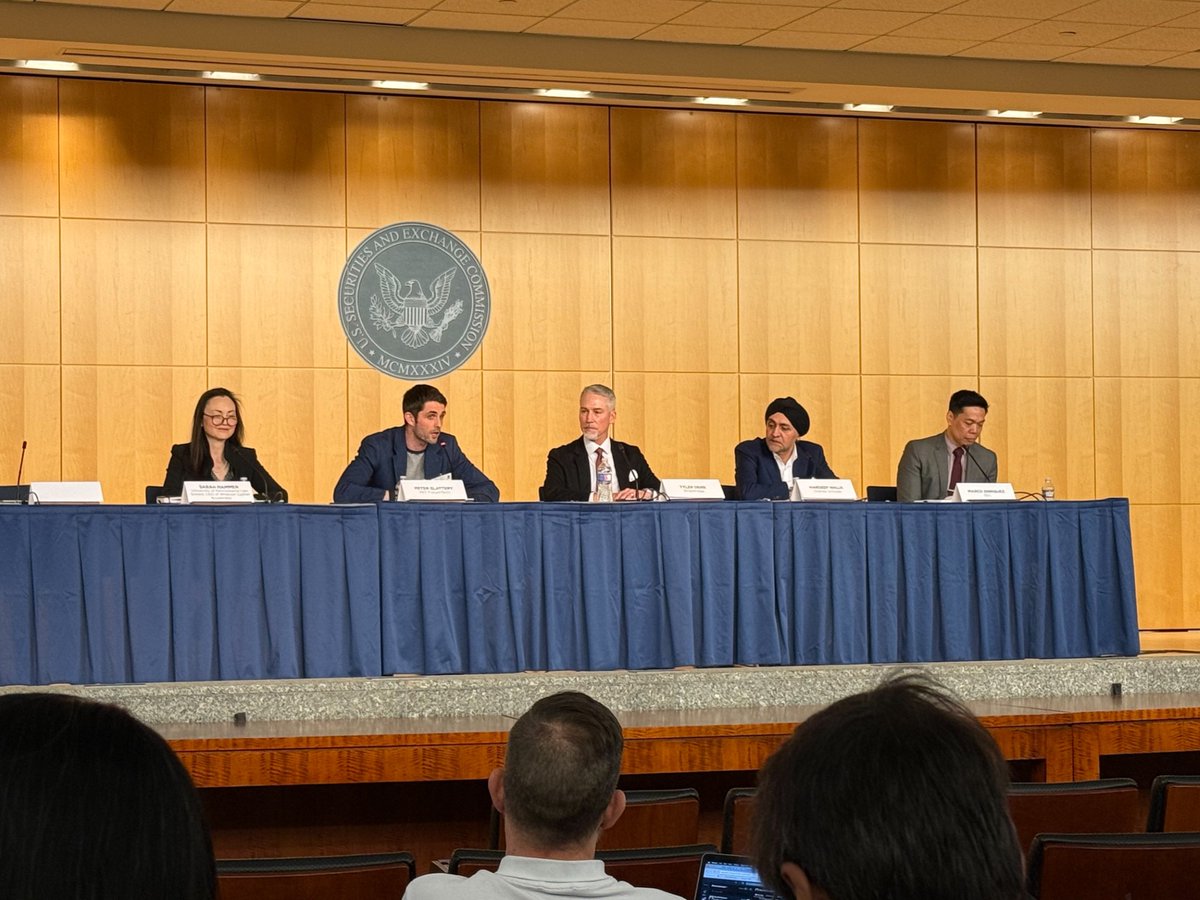
Peter Slattery (@PeterSlattery1) recently spoke about his work on the MIT AI Risk Repository (@MITAIRisk) on a panel about the future of AI at the U.S. Securities and Exchange Commission (@SECGov) in Washington, DC.
See agenda here: https://t.co/sevm8LCecq
📢 New paper: Our write-up of the AI Risk Repository was recently accepted to Patterns at Cell Press.
In 2024, we released the first version of the MIT AI Risk Repository, which synthesized over 700 risks from 44 frameworks into two taxonomies.
We have just published an update on our database, which now synthesizes and categorizes over 1,725 AI risks from 74 frameworks.
Since its release, our work has had a huge amount of impact, with more than 240,000 visits, >180 citations, >3000 inbound links from other websites, and support from Commonwealth Bank, the Society of Actuaries, and other collaborators.
📚Work in progress
Since the release of the database, we have started to use our taxonomies in several related projects to make 'AI risk response gaps' more legible.
1️⃣ We have started to map AI incidents (in collaboration with the AI Incident Database) and ii) AI governance documents (in collaboration with the Center for Security and Emerging Technology (CSET).
2️⃣ We've identified and extracted over 2,000 mitigations for specific risks and created a corresponding AI risk mitigation taxonomy, which we hope to release in the upcoming months (I will link the preliminary version in the comments).
3️⃣ We have surveyed 272 experts to identify which risks they were most concerned about and which sectors or actors they thought were most vulnerable and responsible for addressing these risks.
4️⃣ We have surveyed thousands of public documents from large market cap organizations to identify which risks and mitigations they mention. This allows users to see coverage across sectors and actors at the document and excerpt level.
We have a lot of other exciting (follow-up) work in the pipeline, but I'll save that for a future update.
🔗 How can you engage?
Follow the MIT AI Risk Initiative, visit our website, explore the repository, read our preprint, offer feedback, or suggest missing resources or risks (see links in comments).
🙏 Please help us spread the word by sharing this with anyone relevant. We particularly appreciate connections with potential funders and financial supporters. We are significantly funding-constrained at the moment.
Thanks to everyone involved: Alexander Saeri, Jess Graham, Emily Grundy, Michael Noetel, Risto Uuk, Soroush J. Pour, James Dao🔸,Stephen Casper and Neil Thompson.
https://t.co/35UL6XAH8E
Great to see the MIT AI incident tracker, led by Simon Mylius, featured in @TIME: https://t.co/el80ADL0oM
The AI Incident Tracker maps incidents in the AI Incident Database according to the MIT AI Risk Repository’s causal and domain taxonomies, and assigns each incident a harm-severity score.
Using an LLM, it processes raw incident reports, providing a scalable methodology that can be applied cost-effectively across much larger datasets as numbers of reported incidents grow.
In the dashboard you can explore trends such as:
- distribution of incident classifications by year
- distribution of incident sub-domains by year
- incidents with high direct harm severity scores by year
- incidents causing severe harm in more than one harm category
- distribution of harm severity scores by year
Our last update added new evaluation fields for each incident, including:
- 5 categories of NatSec impact: Physical Security & Critical Infrastructure / Information Warfare & Intelligence Security / Sovereignty & Government Functions / Economic & Technological Security / Societal Stability & Human Rights
- A Fishbone/Ishikawa diagram that presents a number of potential causes for each incident
- The primary goal of the AI system involved
Visit our website to explore the data.
Congratulations also to Daniel Atherton and the AI Incident Database (@IncidentsDB) for the coverage. We are lucky to be able to build on their critical work.
Thanks to Harry Booth for the write-up (@HarryBooth59643)
We recently released our April 2025 update which added 9 new frameworks, ~600 new risks, and one new subdomain (multi-agent risks) to our database.
Read here: https://t.co/0Wn1Wz9KM7
MIT AI Risk Repository was selected for 2025 Paris Peace Forum AI Action Summit! Our database of 1000+ AI risks from 56 frameworks was chosen among 770 global projects. Come and see our booth on February 10 👉 https://t.co/rWkMYsxA8q. Visit https://t.co/BSL0NoFWjj #AIActionSummit