Just one week to go!
MIT FutureTech's 5th Annual Conference: Predicting AI’s Future is this Oct. 22–23!
Explore AI's future in computing, economics & beyond.
Invite-only registration: [email protected]
https://t.co/YR2842qu8E
#MITFutureTech #PredictingAIsFuture #ArtificialIntelligence #FutureOfAI #MIT
In just a year, AI has gone from winning gold at the IMO to claiming a million-dollar Millennium Problem. But the remarkable headlines carry a selection bias: we hear about the problems models crack, not the ones they quietly fail on.
To get a fairer picture, we at MIT FutureTech built the Wikipedia Unsolved Problems Tracker (beta), which follows all 457 problems on Wikipedia’s list of unsolved problems in mathematics as of January 2024.
Early results show AI involved in 57% of resolutions since 2024, with those resolutions leaning toward counterexamples. Still, less than 7% of the list has been resolved, and most of those results are claims that haven’t been verified yet.
As the data comes in, our tracker should help show whether human insight in mathematics is headed for the waste bin alongside the abacus, or whether mathematics still has a few tricks up its sleeve. You can read the piece on our blog(https://t.co/2NfSFpwfOj) or interact with the data on the tracker(https://t.co/wSuNU1TyDj).
#MITFutureTech
What will the future of AI look like?
Join us Oct. 22–23 for the MIT FutureTech Annual Conference: Predicting AI’s Future, exploring what’s ahead for AI across computing, economics, risks & benefits.
Registration is by invitation only. Contact [email protected] to request an invitation.
https://t.co/YR2842qu8E
#MITFutureTech #AI
New paper with Kazimier Smith and @ProfNeilT at @MITFutureTech and @mit_ide: "Birth, Life, and Death of AI Models." We track the lifecycle of open-weight AI models using a weekly panel of the ~108k most-downloaded models on @huggingface (>53B downloads) https://t.co/GGxsmws4cO
Thank you to co-authors Matthias Martens, Adam Kuzee (@adamkuzee), Brittany Harris, Harry Lyu, Wensu Li (@li_wensu), Jonathan Rosenfeld, Meiri Anto, Martin Fleming (@Fleming_Martin), Neil Thompson (@ProfNeilT), as well as Substack collaborators Zachary Brown, Alexander Fogelson, Sebastian Sartor (@SartorSebastian), and Lucy Yan!
Does automation look more like a crashing wave hitting some workers and not others, or a broadly rising tide?
Our latest Substack post from @adamkuzee explains the concepts and data behind a recent MIT FutureTech paper on the shape of AI progress: https://t.co/2eiqYtqMiW
@MITSloan@MIT_CSAIL@ProfNeilT
#AI #Automation #FutureOfAI #FutureOfWork #AIResearch #MITFutureTech
📢 New paper: Prioritization of Risks from Artificial Intelligence: A Delphi Study of 272 International Experts
AI creates many risks, from discrimination, privacy loss, and fraud to more emerging concerns such as overreliance, dangerous capabilities being misused in weapons or cyberattacks, and AI systems pursuing unintended goals.
But which risks are most severe? Who is most vulnerable? And who is most responsible for addressing them?
To answer these questions, we conducted a three-round expert consultation with 272 AI experts.
💡 Four insights from our findings:
1️⃣ If things continue as they are over the next 5 years, experts assigned ≥10% probability of catastrophic outcomes (e.g., >1 million deaths or >$100 billion in losses) to 18 of 24 risks. Top concerns: cyberattacks and weapons, dangerous AI capabilities, competitive dynamics, power centralization, and disinformation and influence at scale.
2️⃣ Even assuming pragmatic mitigations, 5 risks remained above the 10% catastrophic threshold: dangerous AI capabilities, cyberattacks and weapons, environmental harm, inequality, and power centralization.
3️⃣ Vulnerability is broadly distributed, but responsibility is concentrated. Experts assigned the highest vulnerability to AI users and the general public, while assigning primary responsibility for mitigation to frontier AI developers, governments, regulators, and standards bodies.
4️⃣ Information, finance, and national security were rated the sectors most vulnerable to AI risks.
🔗How can you engage? See our (fancy) new webpage for our interactive summaries of the findings and preprint, and please share with anyone working on AI risk, governance, or policy.
https://t.co/qPsLHIuJGh
This research is part of the MIT AI Risk Initiative (@MITAIRisk), which aims to help society understand, prioritize, and manage risks from AI. The initiative includes the MIT AI Risk Repository, a living database of more than 1,700 AI risks, the AI Incident Tracker, a collaboration with the Responsible AI Collaborative, which connects risks to over 1,400 incidents, and the MIT AI Governance Map, which analyzes risk coverage across more than 1,000 laws, standards, policies, and other governance documents curated by the Center for Security and Emerging Technology (CSET).
#AI #AIrisk #AISafety #AIGovernance #ResponsibleAI #RiskManagement
@ylecun this should help - anyone can see for themselves how automation will effect occupations in our new tool: https://t.co/NpfC4Lp0Ck. Based on expertise paper by @davidautor and @ProfNeilT
tl;dr: in some jobs, automation eliminates expert tasks, reduces wages, and permits entry of less expert workers. In others, it eliminates inexpert tasks, boosts wages, and raises barriers to entry #AI #Automation #FutureOfWork #LaborEconomics
Dario is wrong.
He knows absolutely nothing about the effects of technological revolutions on the labor market.
Don't listen to him, Sam, Yoshua, Geoff, or me on this topic.
Listen to economists who have spent their career studying this, like @Ph_Aghion , @erikbryn , @DAcemogluMIT , @amcafee , @davidautor
How can we ensure AI's economic benefits are widely shared?
At the AI for the Economy Forum, @Google and @MITFutureTech are convening policymakers & experts to discuss the partnerships needed to support workers in the AI transition. Learn more: https://t.co/ax1aBBWkp3
Crashing Waves vs. Rising Tides: Preliminary Findings on AI Automation from Thousands of Worker Evaluations of Labor Market Tasks
abs: https://t.co/zkWaCSpuwv
Can academic science keep up with the AI frontier?
Our substack tracks the meteoric rise of AI foundation models in science and the constraints on future breakthroughs: https://t.co/lB1N0mllo7
#AI#Science#AIResearch#FutureOfScience
Can Academic Science Keep Up with the AI Frontier? Our newest substack tracks the meteoric rise of AI foundation models in science and the constraints on future breakthroughs. Read here: https://t.co/lB1N0mllo7
#AIResearch#AIinScience#FoundationModels
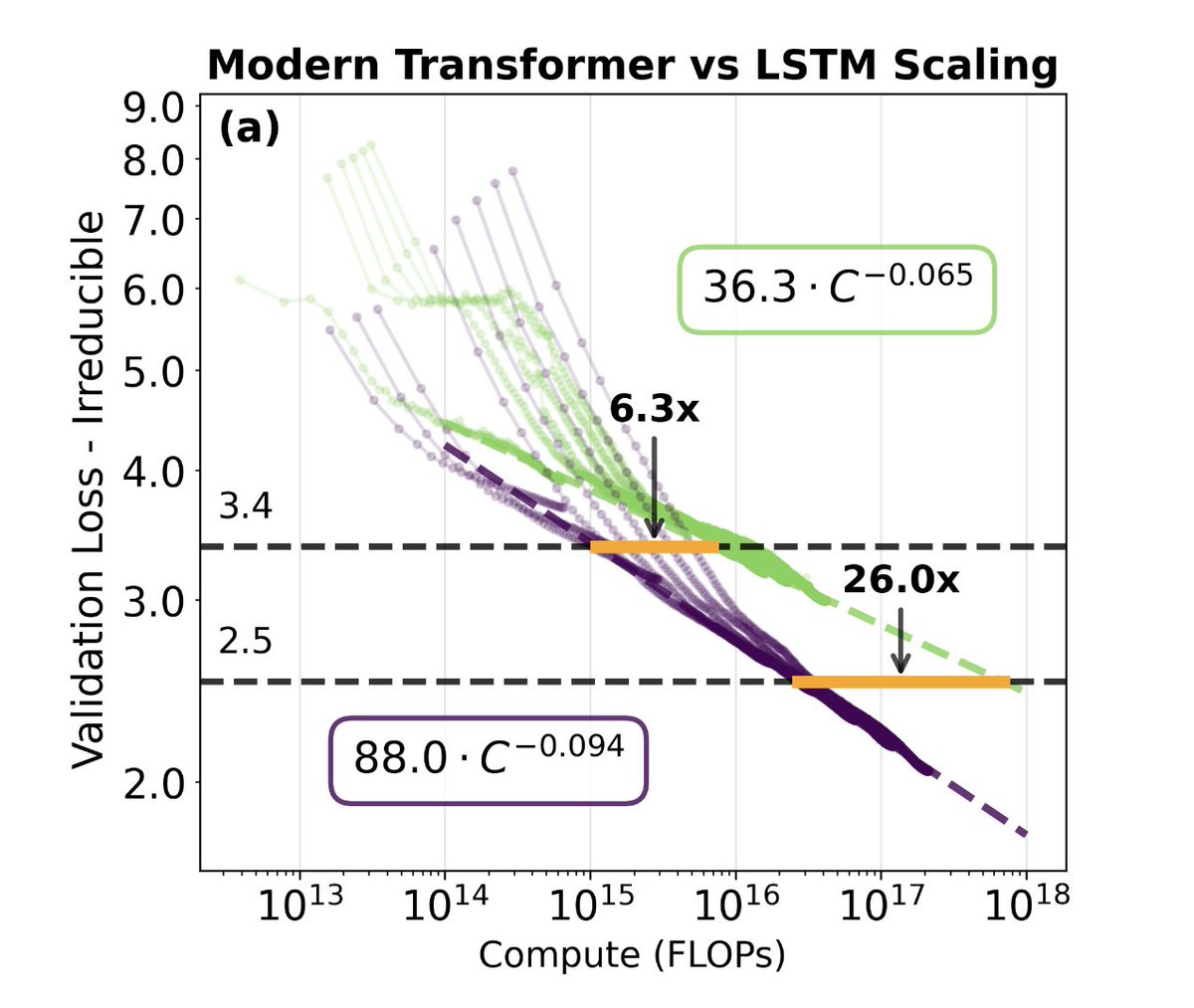
For example, @MITFutureTech found that shifting from LSTMs (green) to Modern Transformers (purple) has an efficiency gain that depends on the compute scale:
- At 1e15 FLOP, the gain is 6.3×
- At 3e16 FLOP, the gain is 26×
Naively extrapolating to 1e23 FLOP, the gain is 20,000×!
Great to see the MIT AI incident tracker, led by Simon Mylius, featured in @TIME: https://t.co/el80ADL0oM
The AI Incident Tracker maps incidents in the AI Incident Database according to the MIT AI Risk Repository’s causal and domain taxonomies, and assigns each incident a harm-severity score.
Using an LLM, it processes raw incident reports, providing a scalable methodology that can be applied cost-effectively across much larger datasets as numbers of reported incidents grow.
In the dashboard you can explore trends such as:
- distribution of incident classifications by year
- distribution of incident sub-domains by year
- incidents with high direct harm severity scores by year
- incidents causing severe harm in more than one harm category
- distribution of harm severity scores by year
Our last update added new evaluation fields for each incident, including:
- 5 categories of NatSec impact: Physical Security & Critical Infrastructure / Information Warfare & Intelligence Security / Sovereignty & Government Functions / Economic & Technological Security / Societal Stability & Human Rights
- A Fishbone/Ishikawa diagram that presents a number of potential causes for each incident
- The primary goal of the AI system involved
Visit our website to explore the data.
Congratulations also to Daniel Atherton and the AI Incident Database (@IncidentsDB) for the coverage. We are lucky to be able to build on their critical work.
Thanks to Harry Booth for the write-up (@HarryBooth59643)
The world’s top AI researchers are paid millions for their expertise—but how much do individual breakthroughs really drive AI progress, compared to simply building bigger datacenters?
Our new paper, On the Origins of Algorithmic Progress in AI, suggests the literature overestimates algorithms and underestimates compute.
Deep dive via our substack:
https://t.co/2EiiM4Pzxy
#AIResearch #ComputeScaling #AlgorithmicProgress