1/ How do we see 3D shape — for grasping, reaching, navigating — when the world is constantly in motion? We started with one piece of this puzzle—how the brain recovers surface geometry from dynamic input. New preprint, a joint effort from Josh Tenenbaum’s and Jim DiCarlo’s labs at MIT. (1/6)
https://t.co/1In72kZdTf
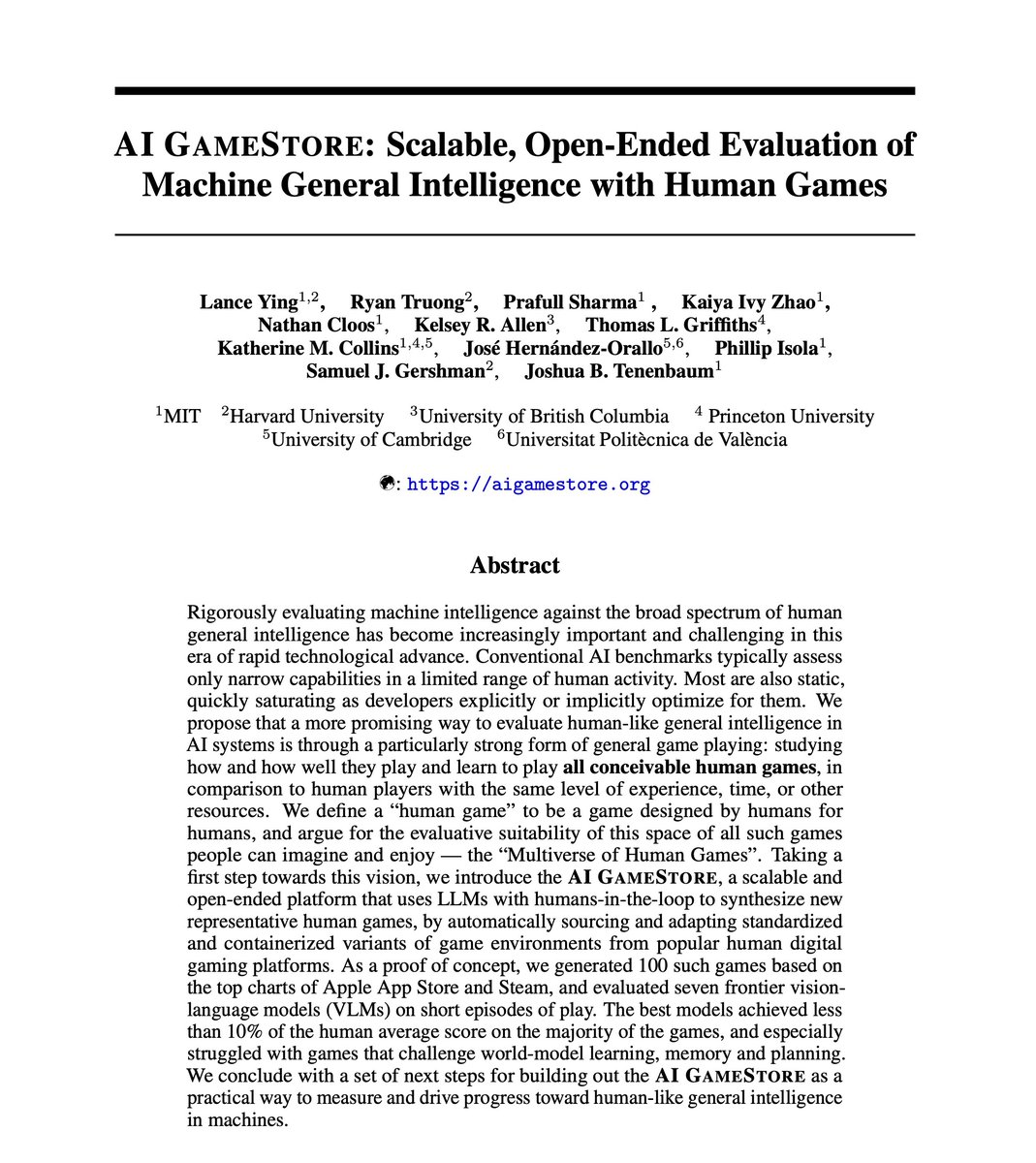
Today we present a new framework for measuring human-like general intelligence in machines (what some people call AGI).
Conventional AI benchmarks today assess only narrow capabilities in a limited range of human activities.
We propose that a more promising way to evaluate human-like general intelligence in AI systems is through a particularly strong form of general game playing: studying how and how well they play and learn to play all conceivable human games — what we call the ``Multiverse of Human Games''.
Taking a first step towards this vision, we introduce the AI GameStore, a scalable and open-ended platform that uses LLMs with humans-in-the-loop to automatically construct standardized and containerized variants of popular human games on digital gaming platforms.
As a proof of concept, we generated 100 such games based on the top charts of Apple App Store and Steam, and evaluated seven frontier vision-language models (VLMs) on short episodes of play. The best models achieved less than 10% of the human average score on the majority of the games.
Check out our website to play the games, see how agents play, and build agents to solve them!
Huge congratulations to @LanceYing42 and @xuanalogue on their new EMNLP paper, and invitation to present their work later this week! We’re thrilled to see this exciting work recognized. 👏 #EMNLP2025#NLP
https://t.co/LPZBt7rS3A
How do people flexibly integrate visual & textual information to draw mental inferences about agents we've never met?
In a new paper led by @LanceYing42, we introduce a cognitive model that achieves this by synthesizing rational agent models on-the-fly--presented at EMNLP 2025!
How do people flexibly integrate visual & textual information to draw mental inferences about agents we've never met?
In a new paper led by @LanceYing42, we introduce a cognitive model that achieves this by synthesizing rational agent models on-the-fly--presented at EMNLP 2025!
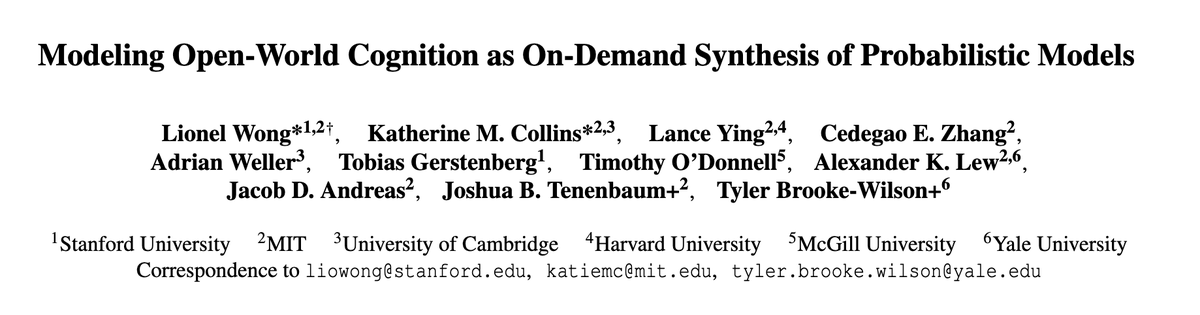
How do people reason so flexibly about new problems, bringing to bear globally-relevant knowledge while staying locally-consistent? Can we engineer a system that can synthesize bespoke world models (expressed as probabilistic programs) on-the-fly?
How do people reason while still staying coherent – as if they have an internal ‘world model’ for situations they’ve never encountered? A new paper on open-world cognition (preview at the world models workshop at #ICML2025!)
Tomorrow, Oct. 8, @fchollet@mikeknoop are bringing ARC Prize live to @MIT in Boston!
Thanks to Prof. Josh Tenenbaum, @mitbrainandcog, @MITCoCoSci, and AI@MIT for making this event possible.
MIT students & staff - register now to get in!
https://t.co/PO5cv4IS0H
Hi friends — I'm delighted to announce a new summer workshop on the emerging interface between cognitive science 🧠 and computer graphics 🫖!
We're calling it: COGGRAPH! https://t.co/XGbMQWW7By
June – July 2024, free & open to the public
(all career stages, all disciplines)
🧶
I'm deeply honored to receive one of this year's @cogsci_soc Glushko Dissertation Prizes.
While I'm still in a state of disbelief about the award, what I can say in no uncertain terms, is that developing these ideas with @rebecca_saxe has been immensely formative and rewarding.
We show that Ada *dramatically outperforms* other approaches for using LLMs in planning (including a Voyager-like model!) on two interactive planning benchmarks — Mini Minecraft and ALFRED. We’re excited to try scaling this to harder robotics domains! [4/5]
Then, we interactively use these abstractions to build concrete plans, in the process learning *which actions are actually useful for solving problems*, and *how to implement them in the environment*. [3/5]
We use LLMs as *priors* over high-level, symbolic action abstractions that might be useful for collections of related tasks like cooking or game-playing. [2/5]
People don't take a one-size-fits-all approach to planning: we change how we abstract the world to fit our goals.
Our approach, Ada, integrates LLMs + formal planning to learn libraries of composable skills adapted to individual planning domains: https://t.co/gbDZqnnw83
🧵 [1/5]
[publication] "Perception of 3D shape integrates intuitive physics and analysis-by-synthesis"
Research from @MITCoCoSci studying intuitive physics to explain how shape can be inferred from the deformations it causes to other objects, as in cloth draping.
https://t.co/wSZJJeeVZL
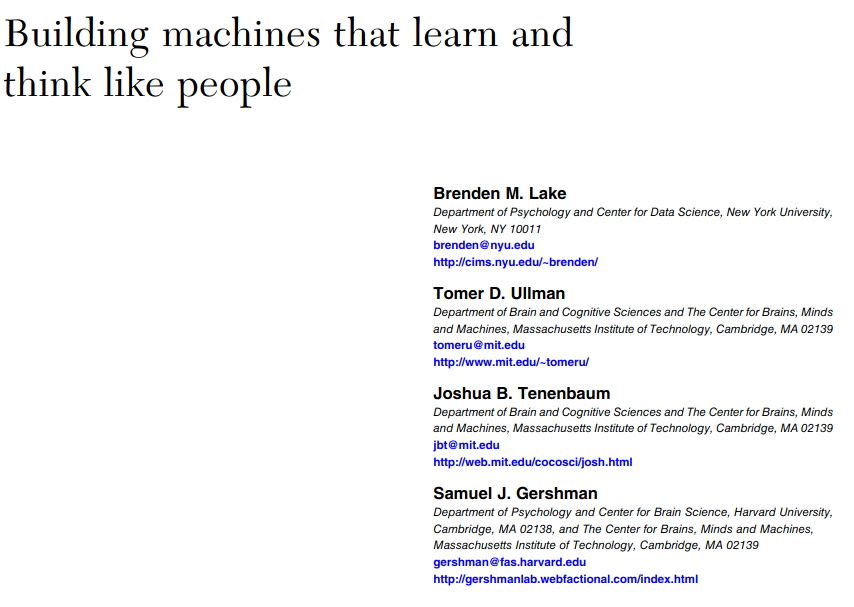
In a seminal paper by @LakeBrenden@TomerUllman@MITCoCoSci and @gershbrain put forward core domains of intelligence that are easy for people to reason about but difficult for machines. These include intuitive physics, causal reasoning, and intuitive psychology, among others.
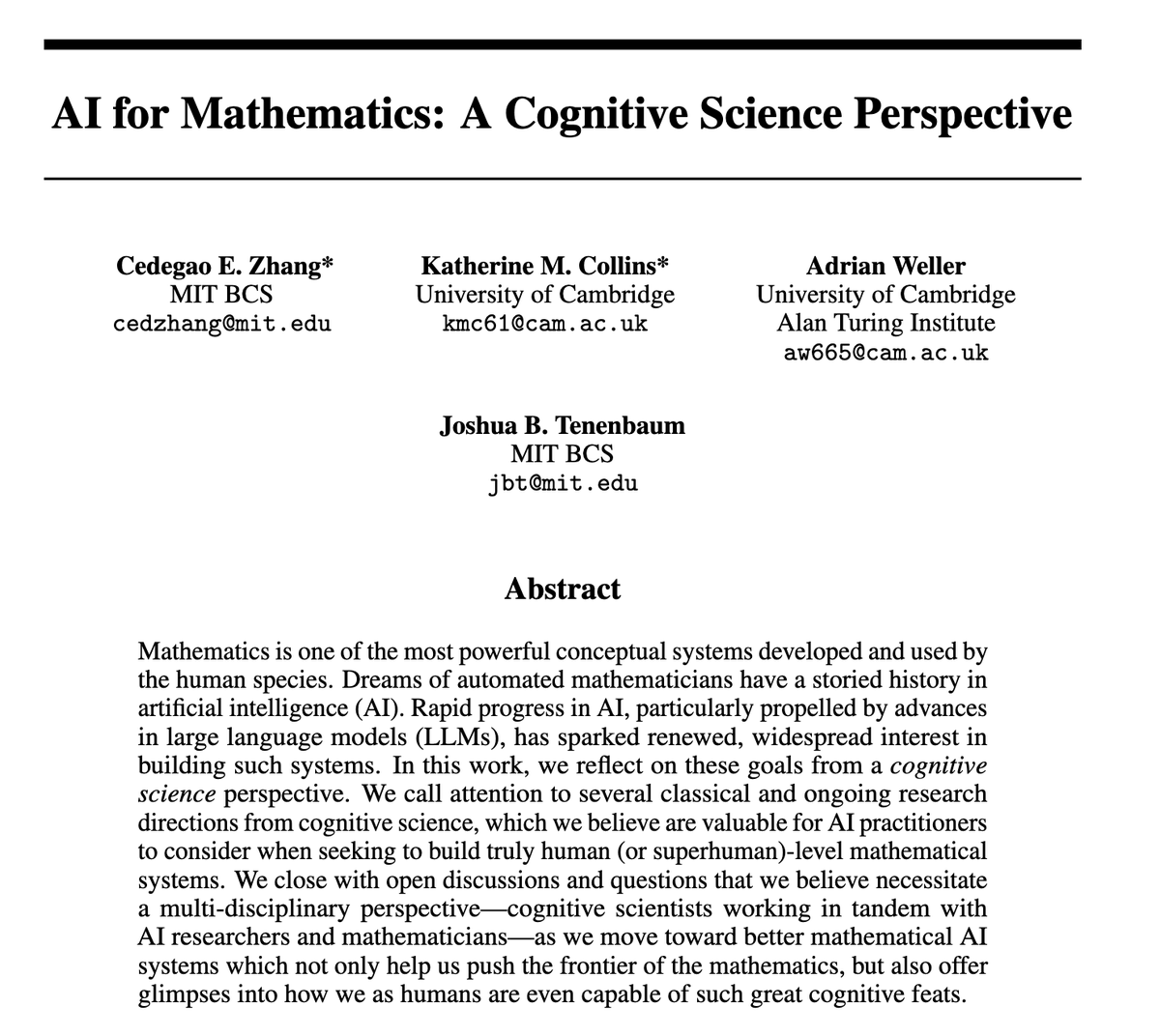
There have been tremendous advances at the nexus of AI + mathematics. But it’s worth reflecting what our goals are for automated mathematicians. In our brief position piece for the #MathAI workshop @NeurIPSConf, we argue now is a great time to look to CogSci for reflection! 1/
Once upon a time, a mighty sphinx, the Area Chair of Thebes, terrorized all who dared to cross the mountain path into the city. Travelers would be asked the riddle: “How is a photon like a rational agent?” Failure to answer resulted in an immediate desk reject. #NeurIPS2023


![MITCoCoSci's tweet photo. People don't take a one-size-fits-all approach to planning: we change how we abstract the world to fit our goals.
Our approach, Ada, integrates LLMs + formal planning to learn libraries of composable skills adapted to individual planning domains: https://t.co/gbDZqnnw83
🧵 [1/5] https://t.co/9uJiT4b5Xe](https://pbs.twimg.com/media/GB5uRnFbEAAYpOl.png)





![MITCoCoSci's tweet photo. Then, we interactively use these abstractions to build concrete plans, in the process learning *which actions are actually useful for solving problems*, and *how to implement them in the environment*. [3/5] https://t.co/q2t23bJgvZ](https://pbs.twimg.com/media/GB5ujHYbEAEIBju.jpg)
![MITCoCoSci's tweet photo. We use LLMs as *priors* over high-level, symbolic action abstractions that might be useful for collections of related tasks like cooking or game-playing. [2/5] https://t.co/5DAmvCeBx3](https://pbs.twimg.com/media/GB5ueyQbEAIfWWQ.jpg)
![MITCoCoSci's tweet photo. People don't take a one-size-fits-all approach to planning: we change how we abstract the world to fit our goals.
Our approach, Ada, integrates LLMs + formal planning to learn libraries of composable skills adapted to individual planning domains: https://t.co/gbDZqnnw83
🧵 [1/5] https://t.co/9uJiT4b5Xe](https://pbs.twimg.com/media/GB5uTNDbEAItqYG.jpg)
![MIT_CBMM's tweet photo. [publication] "Perception of 3D shape integrates intuitive physics and analysis-by-synthesis"
Research from @MITCoCoSci studying intuitive physics to explain how shape can be inferred from the deformations it causes to other objects, as in cloth draping.
https://t.co/wSZJJeeVZL https://t.co/allkiy7Sui](https://pbs.twimg.com/media/F_9EhLpbMAAIdFP.png)