The ISN is a team — MIT, the Army, and industry – working together to discover and field technologies that advance Soldier protection and survivability.
#Mesodyne is making great strides in developing small, portable power sources to address needs of the @USArmy & other @DeptofDefense orgs. The @MIT_ISN is pleased and proud to have played a critical role in the foundational research behind these advances. @ArmyResearchLab @DoDCTO
Congratulations to Tomás Palacios, the Clarence J. LeBel Professor of Electrical Engineering at @MIT, on being named director of the MIT Institute for Soldier Nanotechnologies! @MIT_ISN https://t.co/TlTbub6NuX
Sponsored by #DoD@USArmy, the Institute for Soldier #Nanotechnologies explores the use of #nanotechnology to enable unprecedented advances in soldier protection, survivability, and mission capabilities, and is an Univ-Affiliated Research Ctr (UARC). https://t.co/KleVNNw4fo
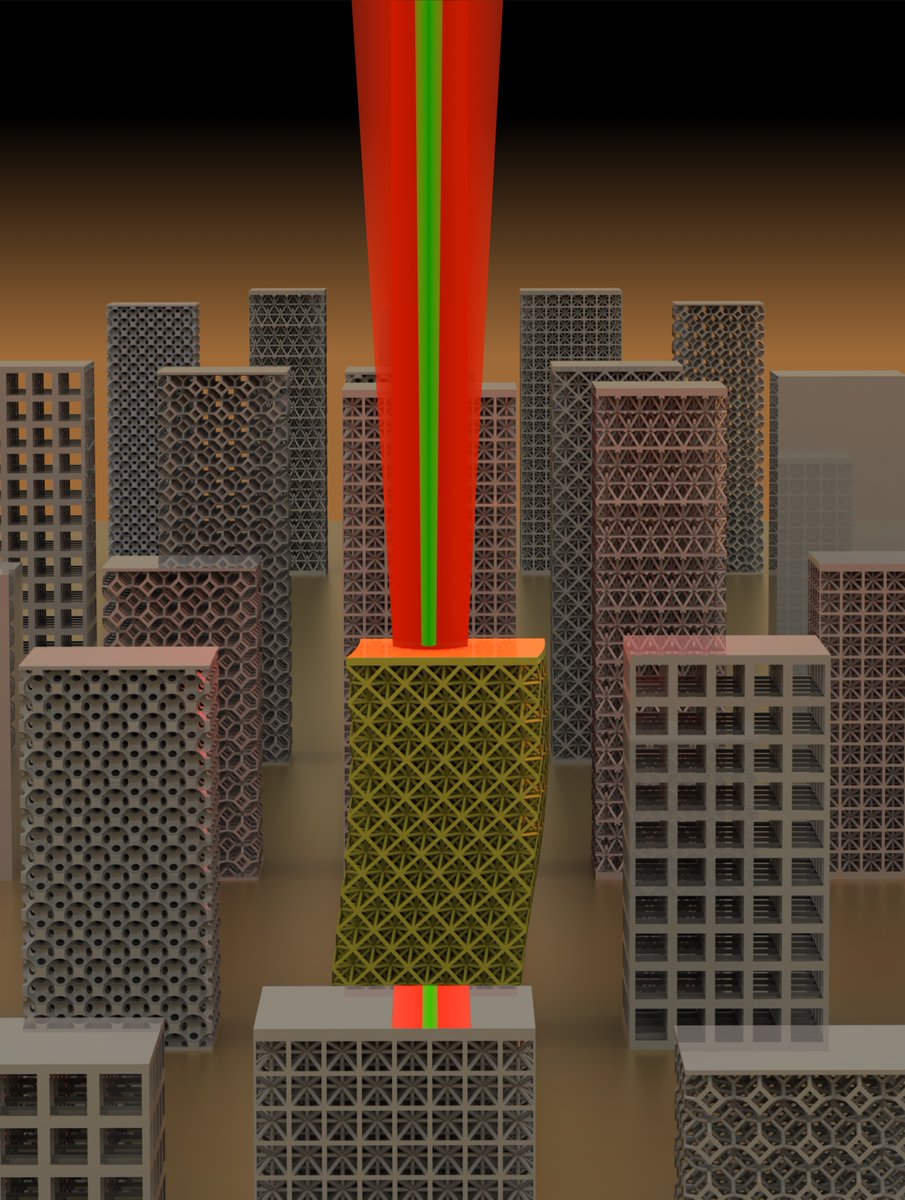
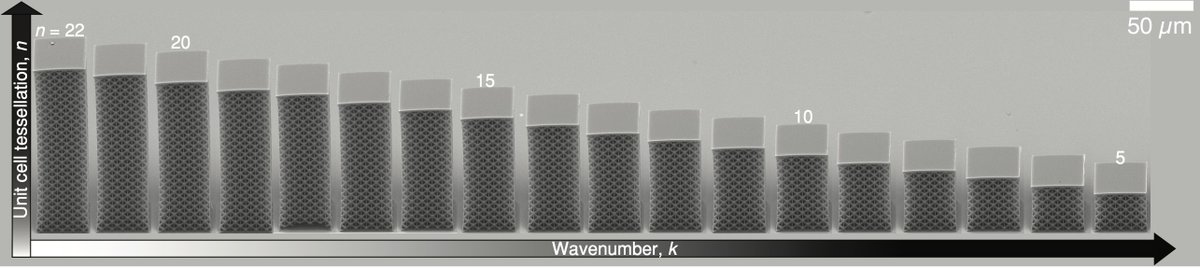
Excited to share our efforts on placement of inertia within 3D metamaterials towards tunable elastodynamic properties at the microscale.
❓Could a single-material 3D architecture attain widely tunable dynamic properties without altering static behaviors?
https://t.co/LSRMOMVWTx
Engineers from @MIT (including @MIT_ISN) and @ArmyResearchLab have developed a new way to quickly test an array of #metamaterial architectures and their resilience to #supersonic impacts.
https://t.co/QjtDgZK8LR (Work funded by @DeptofDefense)
Great new paper in @Nature from @MIT & @MITMechE's @CarlosMPortela. Important research results that, through innovative characterization techniques developed, could impact a broad spectrum of S&T to come.
@DoDCTO @armyfutures @usarmy_devcom @ArmyResearchLab-funded @NNInanonews
Last but not least, huge congrats to team members @CasimirLight , @SomuDhulipala, @rachelmsun, and J. Lem for turning this framework into reality, along with collaborators T.Pezeril and W.DeLima. Exciting path ahead in dynamics & ultrasound w/ metamaterials!
Leveraging the richness of responses, we demonstrate this framework as a route to quantify ‘invisible’ defects in microscopic components/materials. Two common defect types at these scales result in quantifiable defect densities in each.
Through wave propagation in the MHz regime, we construct partial dispersion relations that enable characterization of acoustic metamaterials, also identifying anisotropic attenuation of these waves.
Using laser pump/probe schemes, we extract the full (dynamic) effective elastic tensor of metamaterials, allowing a fully experimental representation of elastic surfaces as well as quantifying dynamic stiffening.
Can vibrational ‘fingerprints’ lead to high-throughput characterization of metamaterials?
In our work, out in @Nature today, we present a non-contact framework to rapidly characterize microscale metamaterials in the dynamic regime!
🔗: https://t.co/l8HTUKFace
@MITMechE@MIT
Excited to share our recent collaborative work on fatigue-resistant hydrogel fibers. They can deliver light in complex in vivo environments for optogenetics-assisted pain inhibition@xinyue1liu��� @AnikeevaLab @ProfZhaoMIT https://t.co/a1WAEhLi3o
The @SiyuanRao lab developed flexible and fatigue-resistant optical fibers made from hydrogel that allow optogenetic manipulations in the periphery in freely behaving mice.
@xinyue1liu@AnikeevaLab@ProfZhaoMIT
https://t.co/yduDHAHhcb
* Soft fatigue-resistant hydrogel optical fibers that reliably function in living animals for months.
* Fatigue-resistant reliable connections with other devices.
* Easy and reproducible protocol.
* The paper can be downloaded here.
https://t.co/8uCOI5S0QJ