When do machine learning models actually outperform standard polygenic scores? 🤔
In our new preprint, we benchmark how non-additive genetic effects (i.e, dominance deviations) shape polygenic prediction across simulated and UK Biobank traits.
👉 https://t.co/FMbNEkIQpw
🧵 1/6
Our new preprint on "The genetic landscape of heterogeneity in human functional brain connectivity" is available on medRxiv. Check it out! @MJ_Schipper, Christiaan de Leeuw, @cato_romero, @khelwegen, @DPosthu, Jeanne Savage and Martijn van den Heuvel.
https://t.co/ZcuZNKcmpY
FLAMES is freely available from GitHub: https://t.co/4T0fNnrsyH
Enhanced PDF available here: https://t.co/7Wa7ORhj3u
This is likely my last tweet, interested in more? Follow me on https://t.co/PuZPK91xfe
Incredibly proud to see our latest work out in Nature Genetics: https://t.co/Sjyo9KOGBJ
Here we share our FLAMES framework, which predicts the effector genes in GWAS loci with state-of-the-art precision🔥
Special thanks to @DPosthu
Full thread describing findings below!
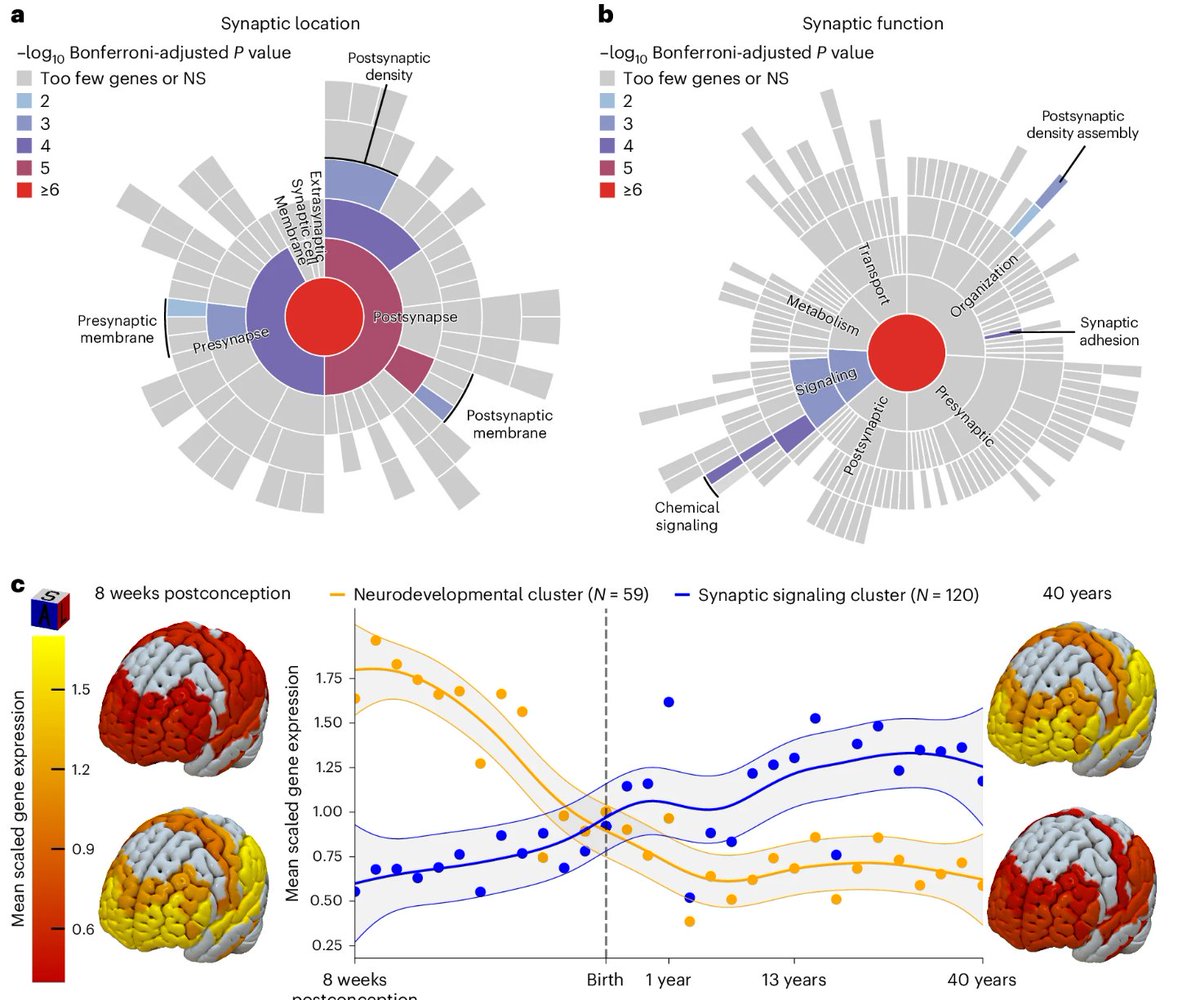
We use FLAMES to prioritize 180 schizophrenia risk genes. We find that these genes are highly enriched in synaptic functions.
Clustering these genes based on relative expression throughout the lifetime shows that ~one third of these genes are expressed strongest prenatally.
- T30: @MJ_Schipper "FLAMES: Accurate Causal Gene Prioritization in Psychiatric Gwas Loci " ECIP-Poster Finalist - FLAMES is the latest tool for our lab and was just accepted for publication!
The 7th event is scheduled for November 7th! We're excited to welcome @ILibedinsky , PhD candidate from @VUamsterdam , who will be presenting their work on quantifying brain connectivity signatures by means of polyconnectomic scoring! https://t.co/u688adBQ5k
Tools that predict the causal genes in GWAS loci are too complex! Many use XGBoost models with >45 features (i.e. L2G, Ei).
CALDERA achieves better performance despite using LASSO regression and only 12 features. This makes it much easier to understand why a gene was chosen.
And the winner is ... Bernardo Maciel who last week won the Poster Prize at the Dutch Neuroscience Meeting. Congratulations and well deserved!! @VUamsterdam
@adamauton Very cool work! Thoughts about why the performance is equal to other methods in Weeks set? That set is data driven so would that be the best indication of performance? The OT set is expert curated for example so, likely lots of literature present. Would that bias the benchmark?
Could not be more delighted to present our work investigating how over 220,000 complex and molecular trait-associated genetic variants affect transcriptional regulation using massively parallel reporter assays!
https://t.co/1eoN4OxAvd
See below for a 🧵. 1/n
@dougthespeed@SashaGusevPosts Is there any hypothesis as to why this is the case? Could it be that spare genotyping will result in more distal tagging associations, whereas denser genotyping will actually find 'causal' SNPs with the appropriate annotation?
Super proud to see our human neurodevelopmental atlas of chromatin accessibility out in nature! Thank you to @slinnarsson@MJ_Schipper@DPosthu and @ReagorCaleb, as well as the KI hospital and Cambridge University for a very joyful collaboration. https://t.co/S2Co6Wcthr
1/16 Our new preprint is out, in which we developed an approach to transform Polygenic (Risk) Scores (PGSs) to disorder probabilities (i.e. the absolute lifetime disorder risk). Here is a brief overview.
https://t.co/e1GWqYZBTj
Very happy to announce that the preprint for FLAMES, our novel tool to predict the effector gene of complex trait loci is live:
https://t.co/rT3KcEQkMA (1/5)
Applying FLAMES on the fine-mapping of the latest PGC3 schizophrenia GWAS we prioritize 187 genes in different loci. We show that these genes separate into a pre-natal cluster enriched in neurodevelopmental processes and a post-natal cluster enriched in synaptic signalling. (5/5)