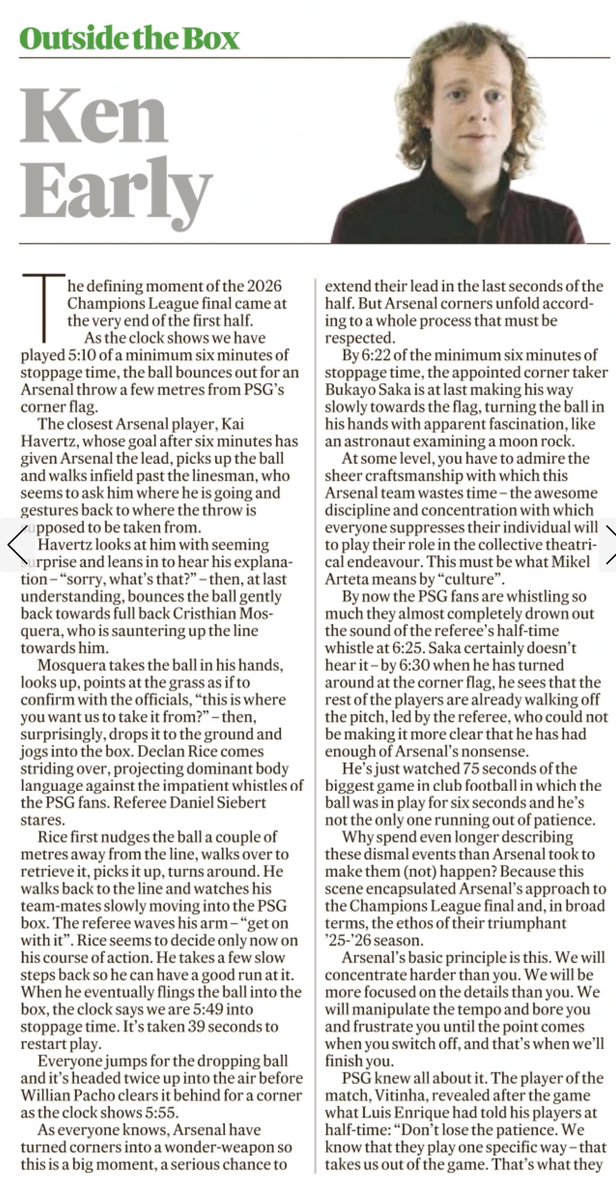
I love the angle taken by @kenearlys on the Champions League final.
He’s absolutely right to dedicate so much time to how Arsenal waste time 🗑️
The drinking water and human life lines 🤣
I hate Arsenal, irrationally, as I explained at weekend. But my argument over VAR with them and West Ham was largely goal was given, and about 20 Arsenal fouls in box were ignored at same time. And that's me being irrational.
In Scotland, I get desperation for Hearts to win. In on it. But that Motherwell handball against Celtic is not only clearest you'll see, but also involved another foul in same action, as in elbowing a guy in head.
The reaction is mental.
What do people want VAR to do here 😂😂😂
I obviously dislike the claret and blue the most but there is something ridiculous about Arsenal, their supporters, Arteta et al and so it's amusing to see the wheels coming off
Such a random post but if anyone seeing Gorillaz tonight in Manchester, night 1, finds and picks up a Paddington bear teddy keyring from the bottom left of the floor, I’ll literally pay you to give him back
He means more to me than words can describe.
@TheSpecialRon Well said as always Ronald, expect nothing else from someone of your schooling.
As you allude to, our record of "improving" under a new manager is, mixed.... only support a change if it's a clear rational upgrade, not an emotional punt.
@GuillemBalague great post and some thoughtful answers. A limited sample size to agree, and only online - but looking at #bcfc twitter - constantly fulminating, demanding the sacking of a bright young coach, learning on the job and demonstrably getting better having delivered 100+ pts last yr
Seeing the video of Robert Sanchez telling the Chelsea fans to relax as it was only half time, made me want to talk about something that has been on my mind for a while: why football stadiums are becoming more impatient, more toxic and polarised.
The pandemic changed our routines and it accelerated a transformation that was already happening in society: overnight, our lives moved onto screens. We watched sport through devices, we debated online, we consumed information in fragments and, importantly for this point, we lived inside a constant stream of opinions.
And with that, something else grew stronger: extremisation.
We have become less able to accept what doesn’t match our own perception. The world has turned into a place where difference is a threat and disagreement feels personal.
Even when those opinions are built on incomplete information, we treat them as unquestionable truths. The most important voice is no longer the most informed one, but the loudest one, the strongest in the moment.
And football, as always, reflects society.
In stadiums now, we increasingly see impatience that would have been unthinkable years ago. Fans protesting a team even before half-time. Whistling after one mistake, even teams that are top of the table. Demanding changes immediately, as if football were a video game and not a complex sport shaped by confidence, form (both appearing in waves during a campaign), injuries, personalities, the limits of a squad or the finances.
We forget that coaches work every day with these players. That they know the realities behind the scenes. That progress is not always instant. But patience has become rare, because the modern world trains us to expect immediate solutions.
What’s worse is that creating a toxic atmosphere no longer feels like a problem for many supporters. The priority becomes: “I want what I want, and I want it now.” Even if it damages the team. Even if it poisons the environment. Even if it turns the stadium into a place of tension instead of support. I cannot think of anything worse than your own fans chanting, “you are going to be sacked in the morning.”
This phenomenon is particularly noticeable in England right now, where protests and frustration inside grounds are becoming more common. Perhaps it is less frequent in Spain, where there is still — sometimes — a different relationship with suffering, with time, with process, with football clubs and the role of fans. At Real Madrid, the whistling to the team lasted a game and it was a protest against the sacking of Xabi Alonso, or a message to the players. The following game, they had moved on. I feel that is legitimate. But the trend is spreading.
The truth is hardly any club lives in happiness anymore. And I feel it is not because football has changed dramatically, but surely because society has.
The modern fan experience is shaped by constant noise, constant judgement, constant outrage. And football, which used to be an escape, has become another space where people project frustration and impatience.
It’s not really about the manager. Or the player. Or even the result. What we are hearing is basically about the world we have become. Although I do feel there is another way.
I know none of this is new. But how about if we thought we might not be right. Someone else might be. Or changing an opinion. Or listening a bit more. Or considering we might not know everything. And respect our differences.
Hey @grok , who was the most famous person (with the most followers) who has visited my profile? They don't have to be mutual. Don't tag them, just say who it was.
Here is a fascinating explanation of why everything went to hell in America after 2012: Americans used to spread out, live with likeminded people, but smartphones/social-media put us all into one big room, to get mad at each other:
from @Noahpinion
https://t.co/vlp4dpRyEj
@sha1875 1,000,000 pc this.
At my school couple lads went to watch Villa, same Blues, couple Albion. All other non- participating "fans" were Villa - for exactly those reasons, and used to shout loudest about their "achievements" and denigrate rivals etc