ML Prague 2026 is only two weeks away, and we’re down to the last tickets available.
This year, ML Prague 2026 welcomes a special addition to the program: three speakers from Taiwan, joining us through our strategic partnership with CzechInvest.
Taiwan plays a key role in the future of AI, semiconductors, edge computing, and real-world deployment. We’re proud to bring that perspective to Prague.
▪ Yi-Ting Chen will present how AI systems can be built around human needs through a practical case study in assistive feeding, combining perception, decision-making, and multi-agent interaction.
▪ Ethan Tu will show how real-time ML systems are deployed at national scale to detect coordinated behavior and strengthen democratic resilience against cognitive warfare.
▪ Albert Liu will explain why the next wave of AI must move beyond centralized cloud systems and run directly at the edge through next-generation NPUs.
If you’ve been hesitating, now is the time to register.
👉 https://t.co/yjKZ15WJbU
#mlprague #mlprague2026 #ai #machinelearning #llm #mlops #aiengineering #techconference #prague
#MLPrague takes place in one month, and only a few spots remain in these hands-on workshops ⏳
These are not high-level talks. These are practical sessions focused on what actually breaks (and works) when you move ML systems into production:
- From Zero to Task-Master -
Most teams are still prompting models and hoping for the best. That approach fails when you need consistency, domain knowledge, or control.
This workshop walks through how to adapt an LLM to your use case end-to-end: data preparation, fine-tuning, evaluation, and deployment.
- Probabilities Over Prompts -
“Please don’t hallucinate” is not a strategy. If you’re using LLMs in production, you need to understand uncertainty. This session focuses on log probabilities, calibration, and testing so you can detect unreliable outputs before they cause issues.
- Graph-Based Anomaly Detection -
Many real-world problems are not in tables, but in relationships. Fraud, attacks, system failures... patterns that only emerge when you look at connections. This workshop covers how to model systems as graphs and detect anomalies, from classical methods to graph neural networks.
👉 Register now: https://t.co/yjKZ15WJbU
#mlprague2026 #ai #machinelearning #llm #mlops #aiengineering#techconference #prague
As AI systems are adopted across applications, many teams still treat them as just another software component. That creates a blind spot.
AI does not only extend existing security risks, it introduces new ones driven by how these systems are designed, operated, and trusted, often rooted in assumptions about system boundaries, trust, and model behavior.
Many of these risks don’t fit into traditional cybersecurity models.
The talk of Aleksandra Kowalczuk at #MLPrague2026 connects classical vulnerabilities with new AI-specific risks, drawing on frameworks such as the OWASP Top 10 for LLM Applications and the OWASP Machine Learning Security Top 10, and translates them into practical decisions for system design and operations.
👉 Last tickets available at https://t.co/yjKZ15WJbU
#mlprague #ai #machinelearning #cybersecurity #aisecurity #owasp #llm #mlops #aiengineering#techconference #prague
Many ML systems perform well in theory, but face real challenges once deployed in production.
▪️ Models degrade after deployment.
▪️ Recommendation systems lose relevance.
▪️ Infrastructure costs increase at scale.
In these talks, engineers from Meta, Bloomreach, and Rankacy share how they deal with these issues in practice.
👉 Less than 10 standard tickets available at https://t.co/yjKZ15WJbU
#mlprague #mlprague2026 #MachineLearning #MLOps #MLSystems
#AIinProduction #MLPrague #AI #DataScience #ml
We just opened the Call for Poster Proposals.
If you’re working on an interesting ML project, system, experiment, or dataset, a poster is a great way to share your work and start technical conversations with the community.
Why present a poster?
• Get your work in front of ML engineers and researchers
• Receive feedback from people working on similar problems
• Demonstrate your expertise in a specific ML domain
What’s more:
🎟️ Poster presenters receive a 30% conference ticket discount
📅 Submission deadline: March 22
👉 Submission form: https://t.co/yjKZ15WJbU
#mlprague #mlprague2026 #machinelearning #ai #conference #machinelearningconference #aiconferences #aiconferences2026 #mlconference #workshops #prague
Everyone is shipping AI systems fast.
Only a few ask themselves a key question: what new security risks are we introducing?
At this year's #MLPrague, Aleksandra Kowalczuk (Accenture) will dive into one of the most overlooked realities of production AI:
🎯 Risks of Implementing AI/ML Systems: From Classic Vulnerabilities to New Attack Vectors
As AI moves from experiments to real-world systems, security assumptions that worked for traditional software start to break.
In this session, you’ll discover:
▪️ Why AI systems create entirely new attack surfaces.
▪️ How classic application vulnerabilities evolve in ML environments.
▪️ What OWASP Top 10 for LLM Applications and ML Security reveal about real risks.
▪️ Why trust boundaries, architecture decisions, and human assumptions are often the weakest link.
This is not a theoretical ethics talk. It’s a practical look at what can go wrong when AI meets production.
👉 If you build, deploy, or operate ML systems: this session will likely change how you think about security.
➡️ Learn more about this year’s program at https://t.co/yjKZ15Xh1s
#mlprague #mlprague2026 #machinelearning #ai #conference#machinelearningconference #aiconferences #aiconferences2026#mlconference #workshops #prague #aisecurity #mlsecurity#cybersecurity #llmsecurity
���� How can machine learning accelerate scientific discovery?
At Machine Learning Prague 2026, Ariane Mora (AITHYRA, ex Caltech) will present an engineering driven approach to enzyme discovery that combines machine learning, large scale data processing, and experimental validation.
Her modular framework integrates 20+ open source tools to map chemical reactions into protein sequence space and retrieve candidate enzymes from massive databases. The predictions are then validated experimentally, including enzymes capable of degrading synthetic pollutants far from the training data.
Why this talk matters for ML engineers:
• Designing modular ML pipelines across multiple tools and datasets.
• Working with complex representations and structured data spaces.
• Understanding generalization beyond the training distribution.
• Connecting ML outputs with real world validation.
👉 A strong example of machine learning moving from models to measurable scientific impact.
➡️ Learn more about this year's program at https://t.co/yjKZ15WJbU
#mlprague #mlprague2026 #machinelearning #ai #conference#machinelearningconference #aiconferences #aiconferences2026#mlconference #workshops #prague
🔥 Last sales of this year! Save up to €81 on your ML Prague 2026 ticket using code spring15 at checkout.
Don't miss this year's program👇
▪️ Why Good Models Fail After Deployment
▪️ Real Time Digital Avatars
▪️ Building SOTA Text and Multimodal Embedding Models
▪️ Enzyme Discovery Using Machine Learning
▪️ And much more:
👉 Register at https://t.co/yjKZ15WJbU
#mlprague #mlprague2026 #machinelearning #ai #conference#machinelearningconference #aiconferences #aiconferences2026#mlconference #workshops #prague
⚠️ The problem
Hyper-realistic avatars are slow.
Real-time avatars lack visual quality.
🧠 The solution
New approaches break this trade-off by separating motion from appearance, enabling avatars that are both hyper-realistic and real-time.
🎯 What you’ll learn
✔️ How to build realistic avatars without latency
✔️ The key technical choices behind these breakthroughs
✔️ Why this matters for gaming, live streaming, and virtual events
➡️ Learn more about this year's program at https://t.co/yjKZ15WJbU
#mlprague #mlprague2026 #machinelearning #ai #conference#machinelearningconference #aiconferences #aiconferences2026#mlconference #workshops #prague
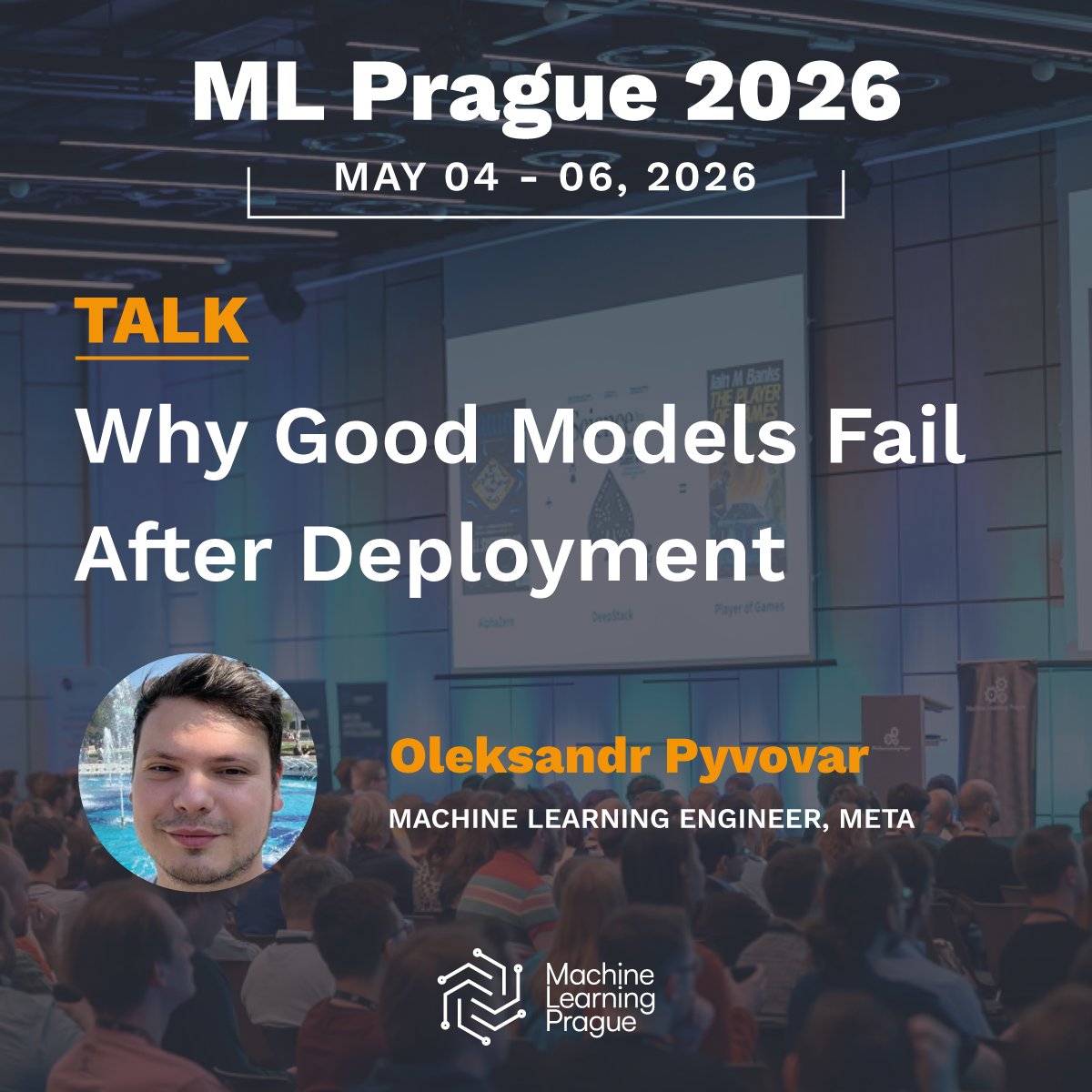
🚨 Why good ML models fail after deployment
In this talk, Oleksandr Pyvovar (Meta, ex-Intel) explores a paradox many ML practitioners know well: models that perform great offline often fail (or even cause harm) once deployed.
Rather than focusing on architectures, the session examines the environments models operate in, highlighting issues like distribution shift, feedback loops, metric misalignment, delayed effects, and biased data collection.
The talk emphasizes system-level thinking, mental models, and practical strategies, applicable across ranking, search, forecasting, and decision-making systems.
👉 If you’ve ever said “but it worked great offline”, this talk is for you.
➡️ Learn more about this year's program at https://t.co/yjKZ15WJbU
#mlprague #mlprague2026 #machinelearning #ai #conference #machinelearningconference #aiconferences #aiconferences2026 #mlconference#workshops #prague
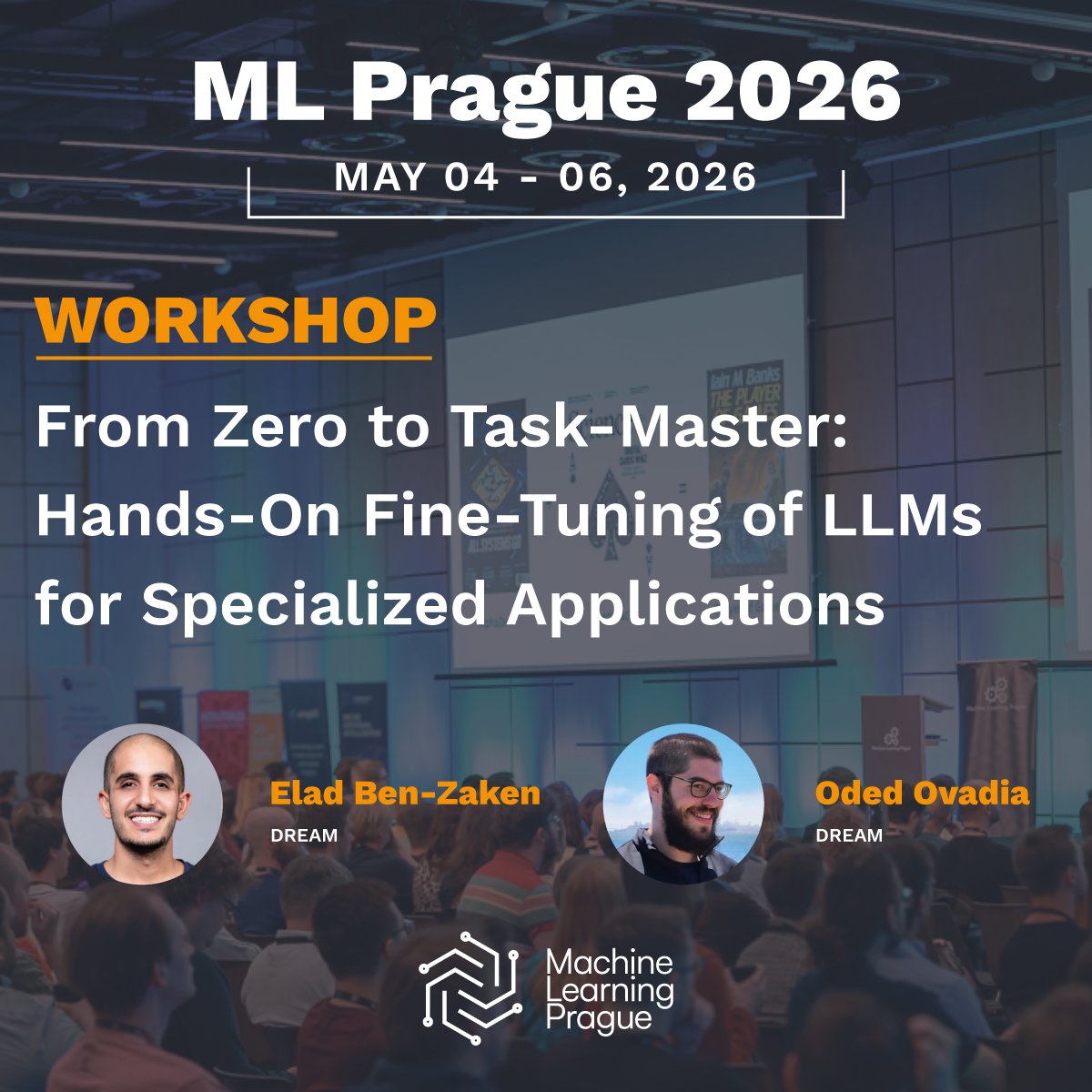
Large Language Models (LLMs) like Claude and Grok are changing how we use AI in business. For advanced practitioners, making them work well for real-world, domain-specific tasks needs more than just prompt engineering. You need to fine-tune them, adapt them specifically, and use efficient training methods.
In this hands-on workshop at #MLPrague, led by Elad Ben-Zaken and Oded Ovadia, you’ll go step by step:
▪️ Dataset preparation
▪️ Fine-tuning a pre-trained model
▪️ Evaluating results
▪️ Deploying the adapted model
Everything is done in code, and you’ll be ready to use these techniques in your projects right away.
👉 Register at https://t.co/yjKZ15WJbU
🎟️ 1 workshop ticket gives you two sessions: one in the morning and one in the afternoon.
#mlprague2026 #ai #MachineLearning #aiconferences#aiconferences2026 #mlconference #aiworkshops #prague
Interest in small and domain-specific language models is rising fast, but turning that interest into a reliable training pipeline is where things usually get messy.
⚠️ In practice, teams often run into distributed setups that are hard to replicate, underused GPUs, scaling that doesn’t behave as expected, and cloud spend that grows faster than the model.
In this hands-on workshop at ML Prague 2026, you’ll train a small language model end-to-end with Amazon SageMaker HyperPod, and learn how to:
▪️ set up a reproducible, cloud-native distributed training workflow
▪️ choose resources and scale in a way that makes sense in real deployments
▪️ boost efficiency with LoRA (Low-Rank Adaptation), quantisation, and mixed-precision training
You’ll walk away with a concrete training blueprint you can reuse, not a generic “one solution fits all” recipe.
👉 Register at https://t.co/yjKZ15WJbU
🎟️ 1 workshop ticket gives you access to 2 workshops, one in the morning and one in the afternoon.
#mlprague #mlprague2026 #ai #machinelearning #aiconferences #aiconferences2026 #mlconference#aiworkshops #prague
Our Call for Talks is now open! We're inviting 25-minute talk proposals on innovative theoretical or practical topics for our advanced audience of ML/AI engineers and researchers.
- Present your work to a technical audience.
- Gain free access to the full conference.
- Join our exclusive speakers' dinner.
- Deadline: January 11, 2026
- Find the form on our website: https://t.co/yjKZ15WJbU
#MLPrague #mlprague2026 #conference #workshops #machinelearning #AI #deeplearning #conference2026 #machinelearningconferences #AIConferences
📣 50 Early Bird Tickets Just Released – Don’t Miss Out and save up to 100€ on your tickets! 📣
What’s waiting for you this year at Machine Learning Prague?
▪ 10 brand-new, hands-on workshops are now open.
▪ Join two workshops with a single ticket.
▪ Meet our first renowned speakers.
▪ Save up to €100 when you grab a combo ticket.
👉 Register now at https://t.co/RfvZnL5PDg
#MLPrague #MLprague2026 #Workshops #MachineLearning #AI #DeepLearning #Conference #Conference2026 #MachineLearningConferences #AIConferences
Call for Workshop Proposals is Open!
We’re seeking presenters/instructors to lead 3-hour, hands-on workshops for an advanced technical audience.
Why apply?
- Speak at ML Prague 2026 to gain visibility among attendees and grow your professional network.
- Free full-conference pass for all workshop facilitators.
- Find the ‘Call for Workshops’ registration form at https://t.co/yjKZ15WJbU
#mlprague #mlprague2026 #machinelearning #AI #workshops #callforworkshops #CallForPapers #conference#conference2026 #prague
The #mlprague team extends a heartfelt thank you to everyone who helped make Machine Learning Prague 2025 such a special edition — celebrating our 10th anniversary together! 🎉
It’s been an incredible three days, and we've loved sharing them with you ❤️
For those traveling home, we wish you a safe journey. We look forward to seeing you all again next year! 🙂
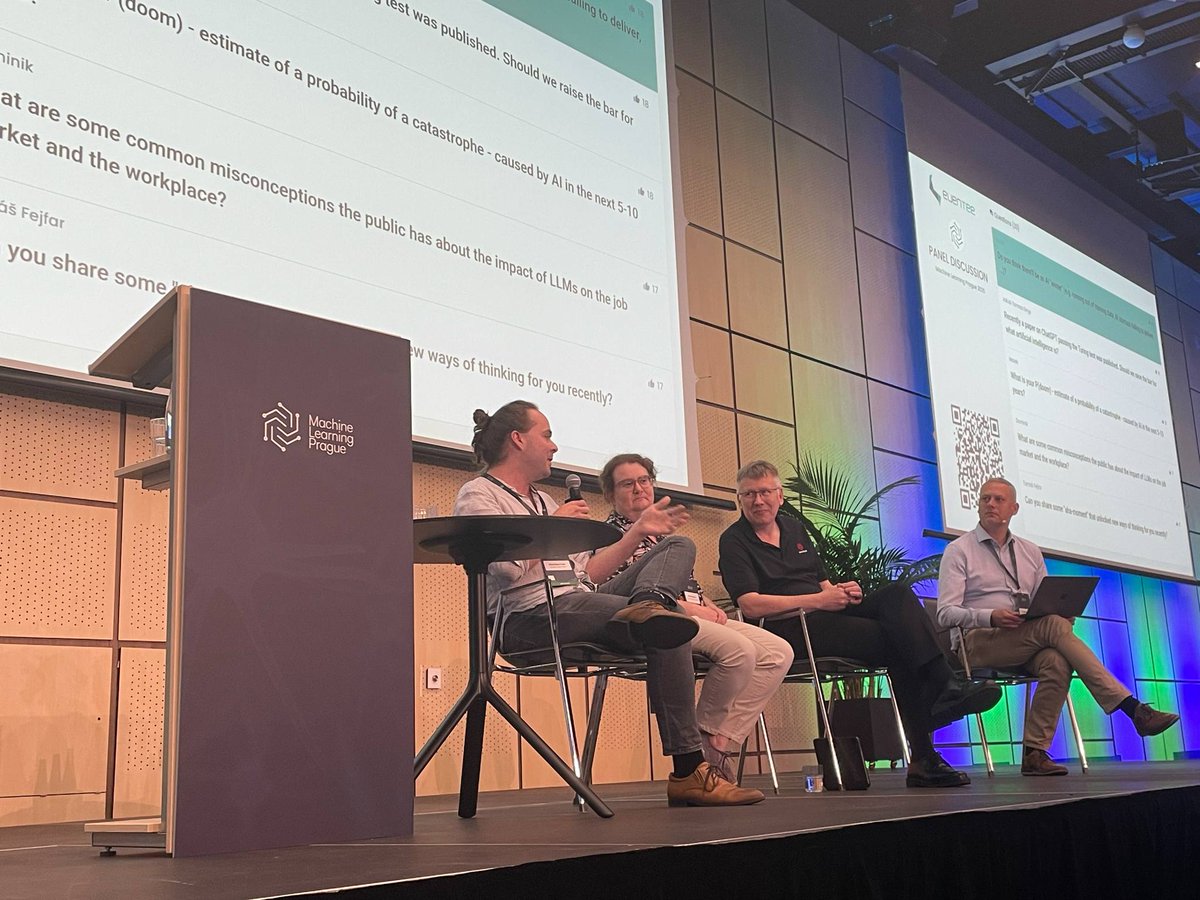
Closing out the first decade of ML Prague conference with a compelling panel discussion featuring:
▪️ Stanislav Fort, Google DeepMind
▪️ Iryna Gurevych, Technical University of Darmstadt
▪️ Jon McLoone, Wolfram Research
▪��� And moderated by Jiří Materna (Scientific program & Co-Founder, ML Prague)
#mlprague #mlprague2025 #mlconference #aiconference #machinelearning #AI #conference #prague #10years
⭐ Today at #mlprague - Afternoon talks
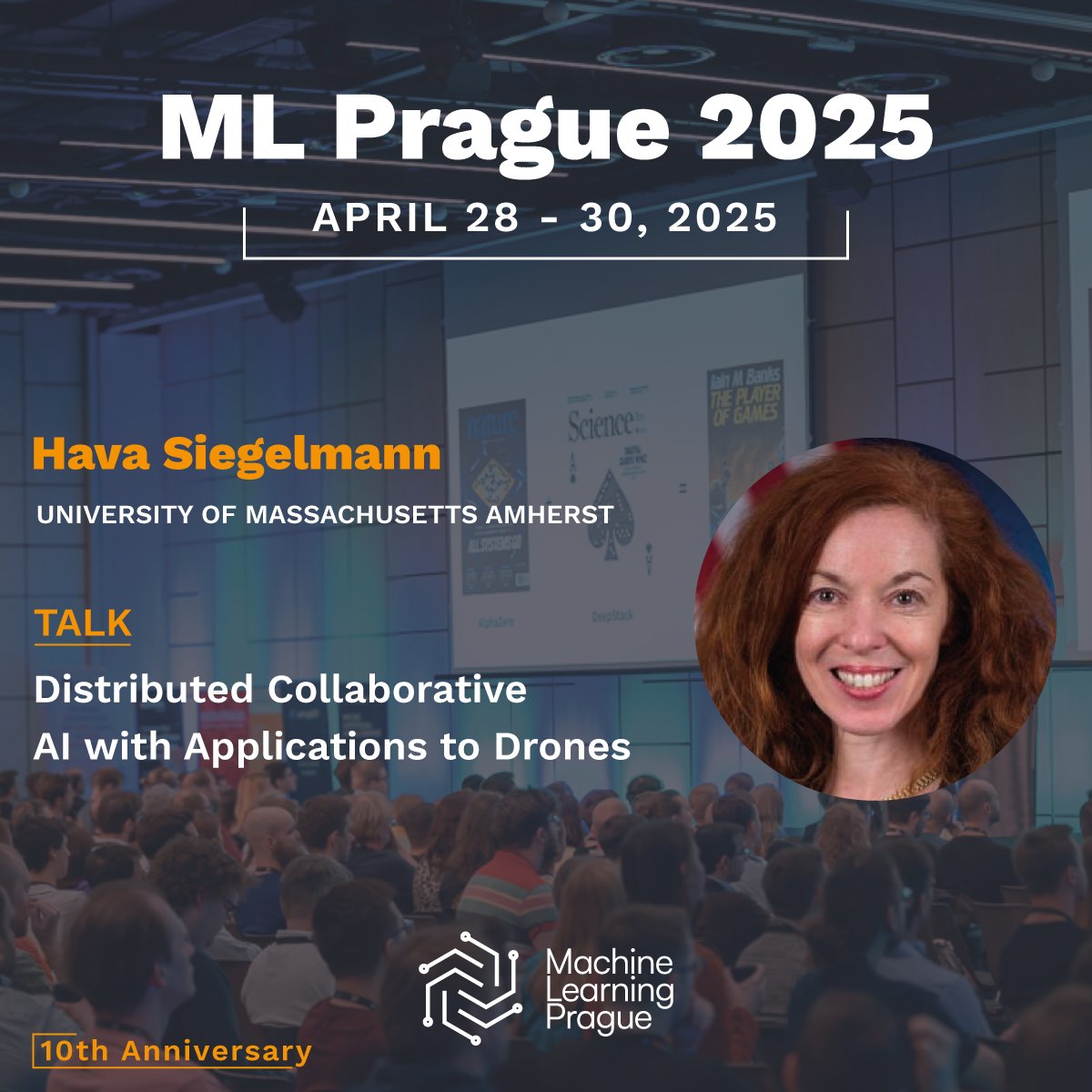
▪️ Distributed Collaborative AI with Applications to Drones
Hava Siegelmann has addressed the challenges limiting drone autonomy, such as computational constraints, energy limits, and communication overload. She has presented sequence AI algorithms that improve compute and energy efficiency, enable rapid adaptation to dynamic environments, and allow the use of cheaper hardware. She has also introduced a new cooperative AI paradigm where drones act as lifelong learners, updating and peer-teaching each other without overwhelming communication needs — moving toward safer and truly autonomous systems.
▪️ How to feed your LLMs with data from the web
Jan Čurn @apify has explained how to efficiently collect and prepare web data for feeding Large Language Models (LLMs) and RAG applications. He has addressed challenges like blocking, dynamic content rendering, and data quality, and has shown how to build robust web data extraction pipelines and clean HTML to avoid the "garbage in, garbage out" problem — backed by real-world application examples.
▪️ Fitting LLMs into a single GPU: Making neural networks smaller
Vladimir Macko has tackled the challenge of fitting large neural networks into a single GPU by making models smaller and more efficient. He has presented state-of-the-art techniques in pruning and quantization, and has shared key insights from both academic research and industry projects. He has shown practical strategies for algorithm selection, toolchain optimization, and model evaluation to help machine learning practitioners shrink models without sacrificing performance.
#mlprague #mlprague2025 #mlconference #aiconference #machinelearning #AI #conference #prague #10years
⭐ Today at #mlprague - Afternoon talks
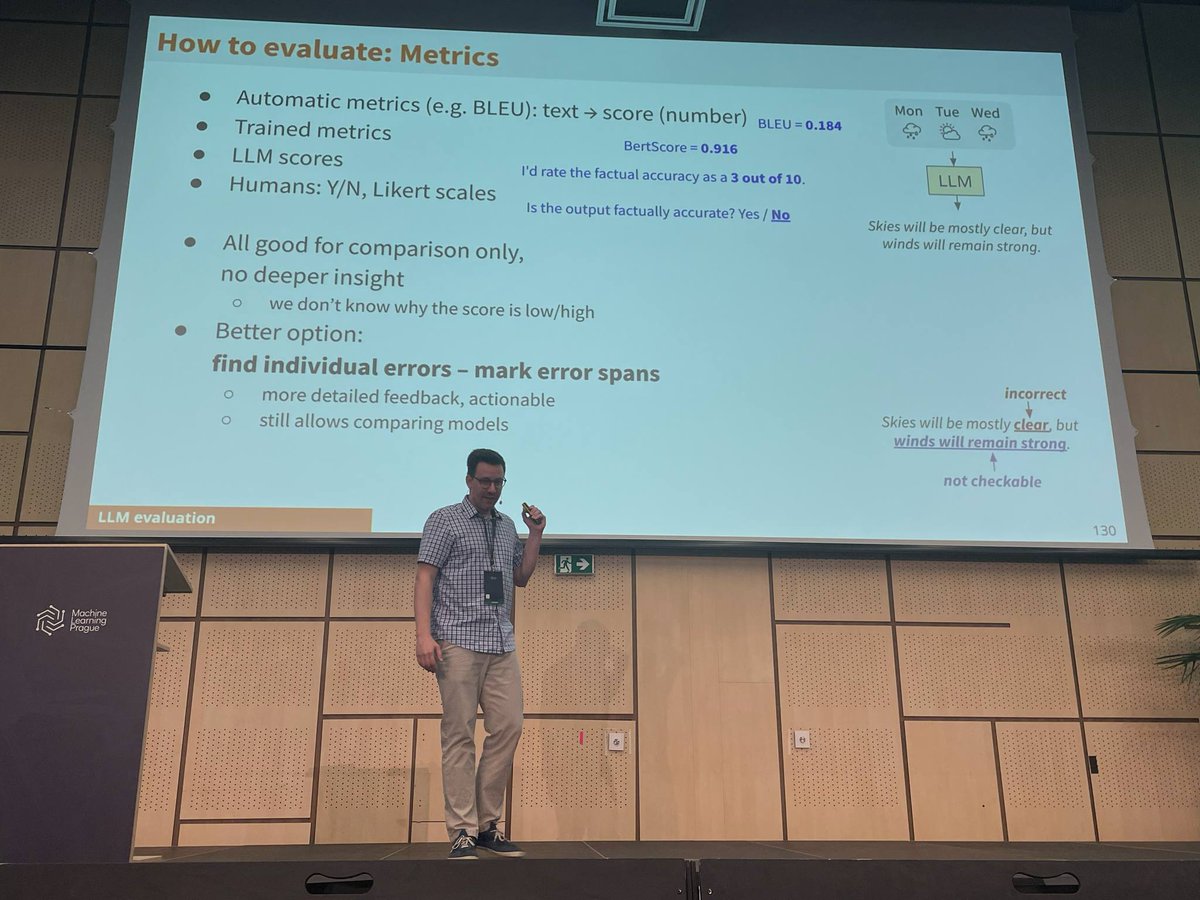
▪️ Evaluating LLM outputs with humans and LLMs
Ondrej Dusek has tackled how to effectively evaluate LLM outputs on text generation tasks. He has introduced an efficient human annotation framework and schema, and presented a new metric based on an ensemble of open-source LLMs that explains each annotated error. He showed how both methods achieve high correlation with human judgments and avoid data leakage by using fresh, unseen benchmarks.
▪️ Advances and Challenges in Topic Modeling of Text Documents
Martin Neznal explored advances and challenges in topic modeling for text documents. He presented methods for improving clustering quality through better preprocessing, comparing different clustering techniques, and showed strategies to detect new clusters over time. He also addressed how to validate topic quality using both traditional metrics and LLM-based evaluation, and emphasizing the role of human feedback to refine and improve real-world topic modeling systems.
▪️ Towards Real-World Fact-Checking with Large Language Models
Iryna Gurevych addressed the challenge of real-world fact-checking with large language models. She presented strategies to dismantle misleading narratives that misuse scientific publications and demonstrating how multimodal LLMs can detect misinformation based on visual content. She was also showing how to generate strong alternative explanations that counter false claims, addressing not just why a claim is false, but why it appeared credible in the first place.
#mlprague #mlprague2025 #mlconference #aiconference #machinelearning #AI #conference #prague #10years
⭐ Today at #mlprague - Morning talks
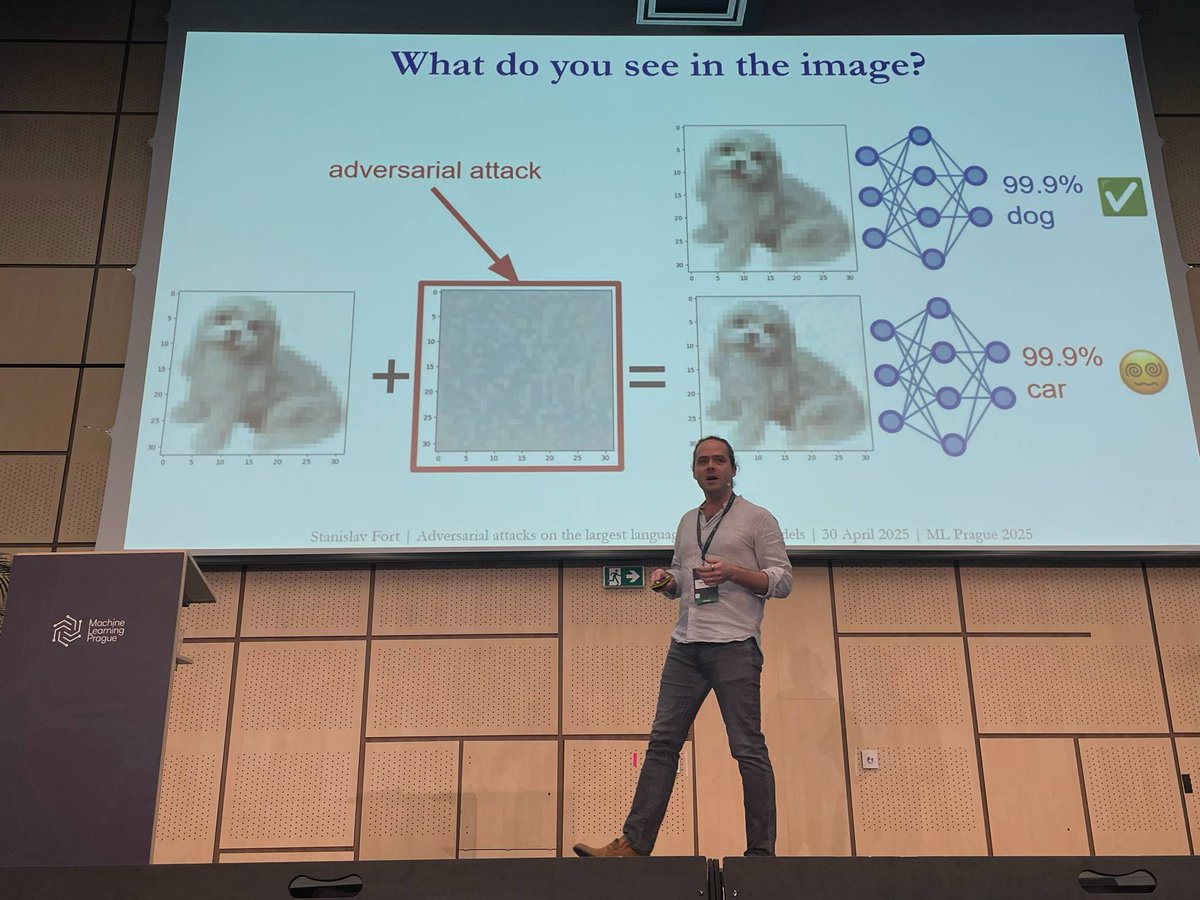
▪️ Adversarial attacks on the largest language and vision models
Deep neural networks — from computer vision models to massive language models — remain highly vulnerable to adversarial attacks, and there is still limited theoretical understanding and few reliable defenses against these threats.
Stanislav Fort (Google DeepMind) explored the robustness of modern deep learning models, demonstrated practical examples of transferable attacks on large closed-source vision-language models, and drew connections between adversarial vulnerabilities and broader challenges in general AI alignment.
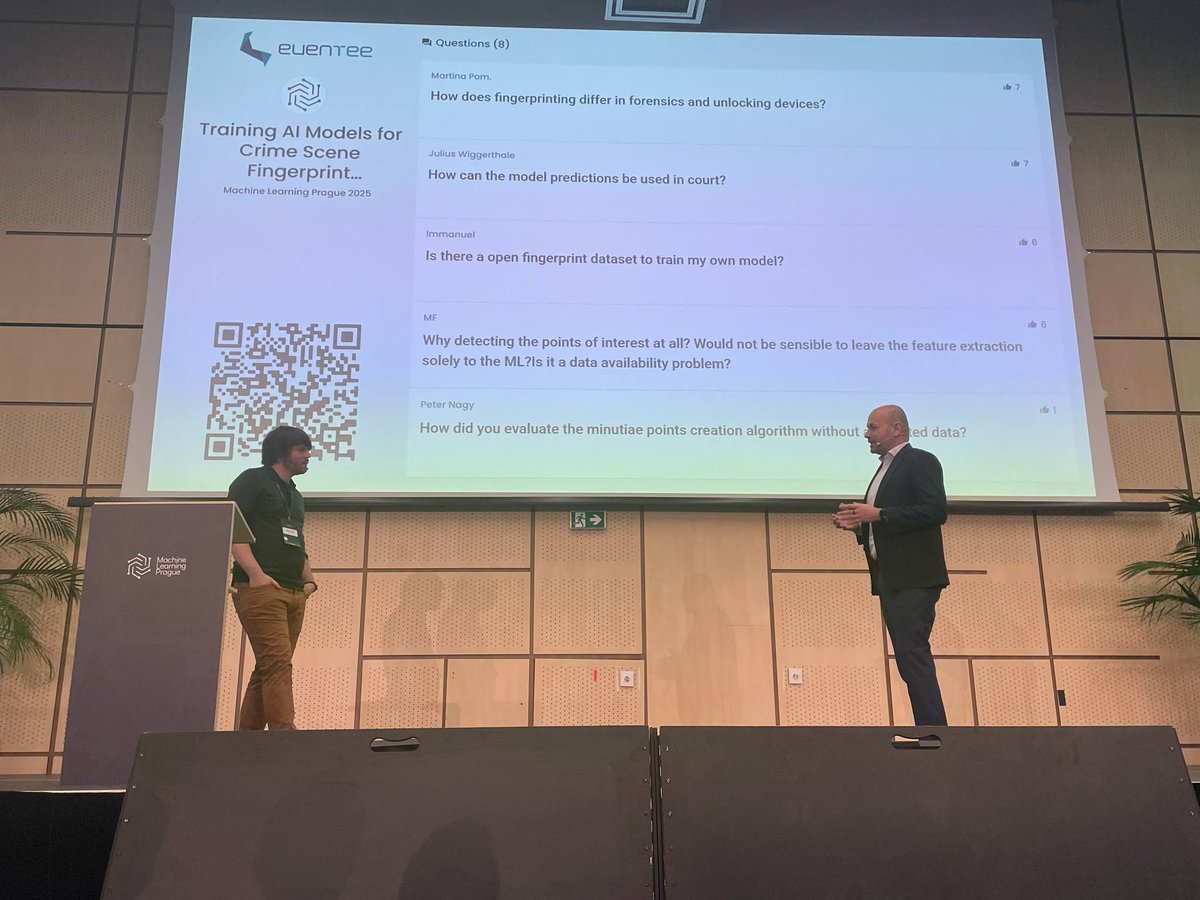
▪️ Training AI Models for Crime Scene Fingerprint Recognition
Jakub Sochor (Innovatrics) addressed the challenge of training AI models for crime scene fingerprint recognition without ground truth annotations. By introducing innovative methods using synthetically generated fingerprint data, he is showing how AI advancements boost the accuracy and efficiency of latent fingerprint analysis in forensic investigations.
▪️ Understanding the neural networks through rule extraction
Tomáš Pevný (Czech Technical University) is uncovering how neural networks store and process information by extracting decision rules from trained models. He is explaining why understanding these rules is difficult without knowing the data distribution, offering insights into both the robustness of neural networks and the ease of creating adversarial examples. He is also showing how decision rules compose during inference.
#mlprague #mlprague2025 #mlconference #aiconference #machinelearning #AI #conference #prague #10years