For 2022 I know you resolved to have better food system conversations. I am here for you
Here are 7 widely held food ideas that are wrong. Let’s put a stake through their little hearts.
(You prolly won’t agree with them all.)
There’s a truth, and some ideas, at the end.
🧵
@FritsvdSchans@Krijn_J_Poppe Als je nog geinteresseerd bent: ERL is op dit moment bezig onze manuscript te formatteren, en de endversie komt binnenkort online inclusief appendix. Daar is dan een tabel met gross profit en N surplus per type bedrijf (aantal koeien en intensiteit).
@FritsvdSchans@Krijn_J_Poppe Dit is idd altijd afhankelijk van je criteria en perspectief. Voor onze studie hebben we alleen boeren met hetzelfde aantal hectare, koeien, arbeids capaciteit en vermogen gebenchmarked en naar de productivity gap binnen deze groepen gekeken.
@Zhelemi Thanks! We were able to derive all the information from farm accountancy data building on calculations of N surplus of previous studies. We tried to isolate the effect of farm mangement by accounting for all structural differences across farms.
Our paper just got published in Environmental Research Letters. We show that helping Dutch dairy farmers to improve farm management can vastly reduce nitrogen pollution as well as increase farm profit, yielding both environmental and economic gains. (1/2)
My latest research with @nicholasejh and Robin Nabi: New study shows memes about COVID-19 lessen stress https://t.co/k1k0BBjPoH via @usatoday by @darylaustinUT
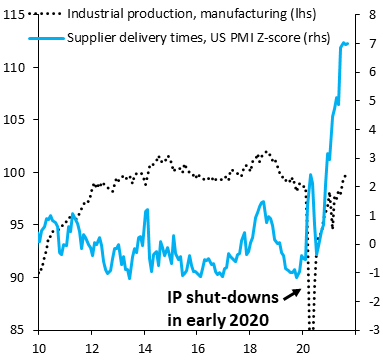
The language around "supply shocks" is a bit mangled. When COVID-19 first hit in 2020, we had a genuine supply shock. US industrial production fell (black) and delivery times lengthened (blue). That's not the story now, since industrial production is up. This is a DEMAND shock...