“In a country devoid of polls, and where other approaches don’t seem to work, the relationship between candidate numbers and election outcomes is something,” say @terencewoodnz and @MLaveil.
Blog: https://t.co/LAMWxw8R34
#PNGpolitics#PNGelections#Pacific
“The closure of the regional processing centre saw the end of the economic boom in Manus,” says @MLaveil. “While it is unclear how the Manus administration utilised the revenue boost it received, it is unlikely this windfall was saved or invested.”
https://t.co/aOqj4NbMft
As PNG marks 50 years of independence, the PNG Canberra Students Association are holding the PNG 50 for 50 Symposium at @ANUCrawford on 11 September.
Program: https://t.co/DHvNf4QsNG
Register to attend in-person (limited spaces) or online: https://t.co/eDY5FWS6AA
"New wards and LLGs have required new rolls, new ballot papers and the coordination of more individual elections, making the job of the PNG Electoral Commission, which is conducting this election, more difficult and creating delays," says @MLaveil.
https://t.co/u2m0KKAlYb
"This [research] suggests that the national government responds more adequately to the needs of urban local level governments, which is problematic given 90% of Papua New Guinea’s LLGs are rural," says @MLaveil. #PNG#governance
https://t.co/5nLL6pEmI9
Here's another recent critique of close elections RDDs.
It's unclear whether there is actually good evidence against potentially fatal precise manipulation around the cutoff in these designs.
The McCrary (2008) DCdensity and Cattaneo, Jansson, & Ma (2018; 2020) rddensity approaches are widely used as tests for precise manipulation.
But virtually everyone interprets statistically insignificant results of these as evidence of no manipulation.
@FitzgeraldJack_ has a new working paper that argues that we should actually be using equivalence testing on this test, similar to Hartman's (2021) argument about using equivalence testing in tests of covariate balance.
Fitzgerald develops a 3-step procedure which tests for evidence that precise manipulation is practically equal to zero.
He shows that precise manipulation at the cutoff is potentially a serious problem.
In his sample of recent RDD research (which is made up of 75% close election RDDs), he finds that >44% of studies can’t be significantly bounded even beneath a 50% upward jump (or equivalently, a 33.3% downward jump).
This is a problem!
This week, on the Intel, we asked "50 years of independence in PNG: What do we need to think about for the future of the Australia-PNG Partnership?"
👉 ANU's @natashaturia
👉ANU's @MLaveil
👉@LowyInstitute's @ONobetau
Explore the responses: https://t.co/ZFMjCta8Hh
Sign up to get the Intel straight to your inbox 👉 https://t.co/sPiDhl1AJt
@stephendziedzic@marianfaa@marianfaa wished you consulted with a local economist or banking expert on the need for increased competition in the banking sector. Would've made for a more balanced take.
Really enjoyed briefing some of the PNG media today on PNG's budget documents and fiscal policy, in a session organised by @ABC media development initiative and @MLaveil!
My @LowyInstitute colleagues have analysed the global implications of Trump 2.0. As I write in the intro, same man but very different world to the one in which he was last in power, with hot wars in Europe and Middle East. Hoping @WarintheFuture is right!
https://t.co/XK3IPDVsvE
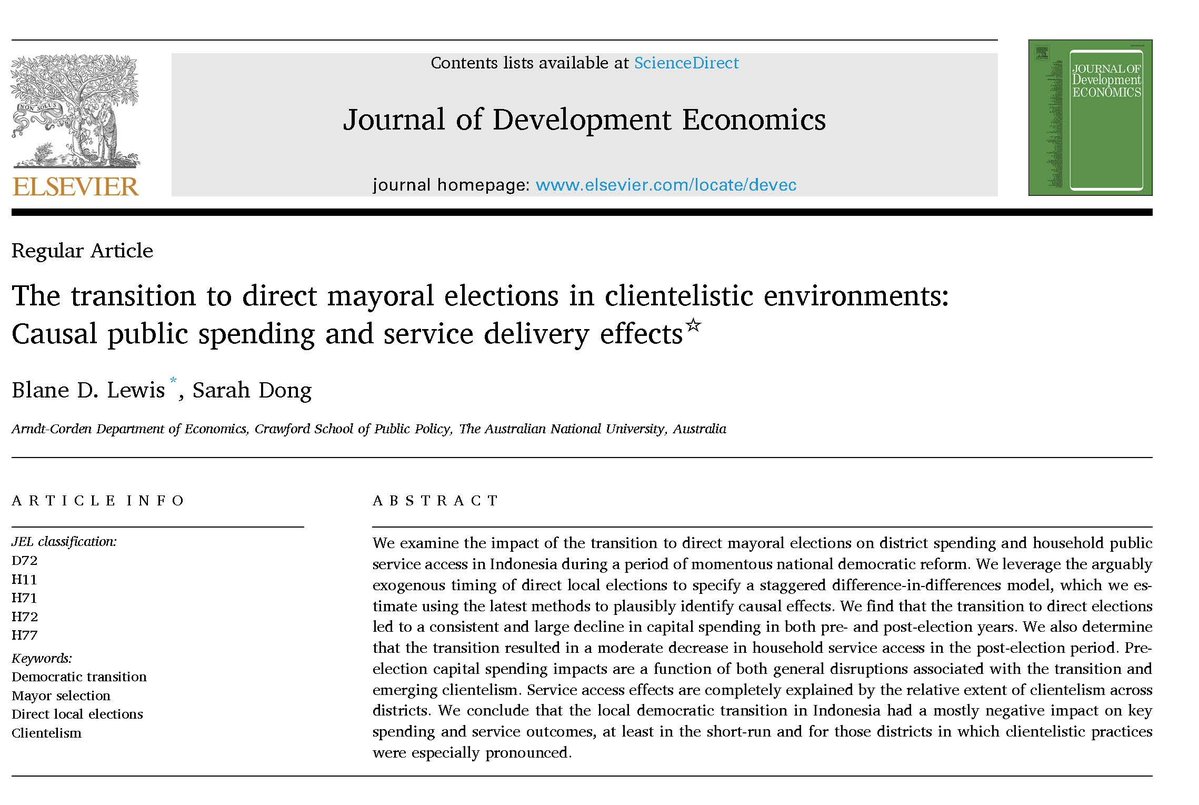
Interested in political economy of local elections? We find that Indonesia's local democratic transition had a mostly negative impact on key public spending and service outcomes, especially in districts where clientelistic practices were pronounced.
https://t.co/ZDISaM8q1Q
Australia spends over $600 mil in aid to PNG annually - but one PNG minister has warned of wastage, duplication and funds being “withheld in Canberra”.
https://t.co/fikVFyUtY8