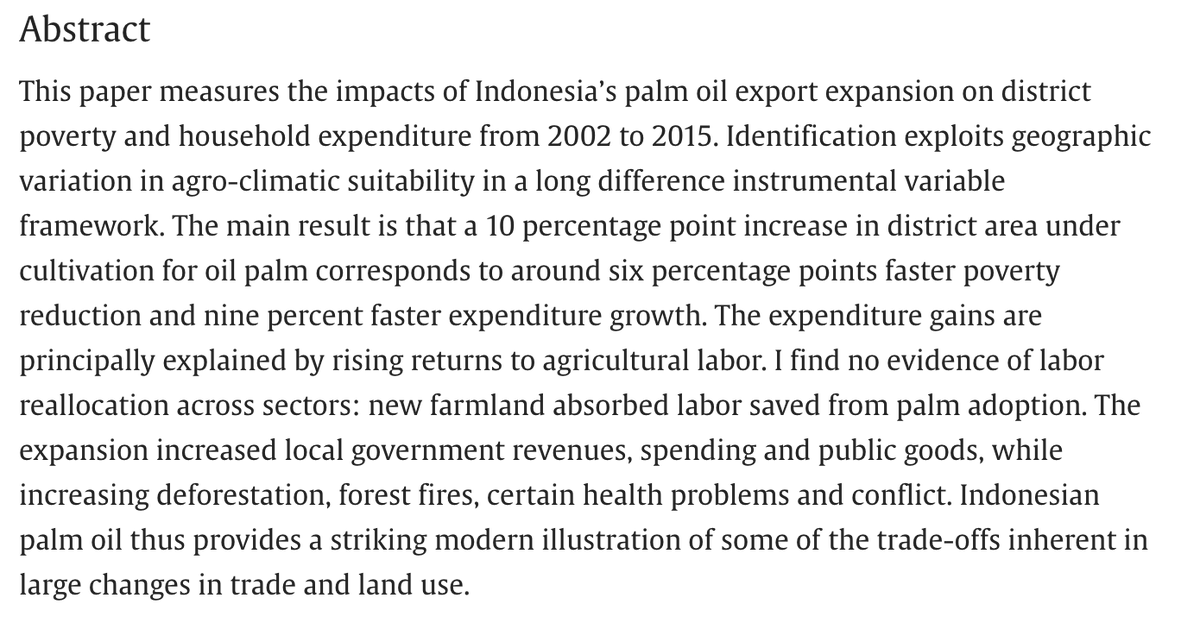
Some "overdue" news: my first paper on palm oil, started over a decade ago, was accepted for Christmas and is in print open access at the @JIntlEcon today. It's quite different from earlier versions, and the (excellent) review process improved it a lot.
https://t.co/lfuu6kwdMj
I'm so sad about this. When I started learning how to do social science in 2014, I learned so much from reading Raul's blog and following his Twitter. He represented the best of social science education and led as an example to pay it forward. I hope his family finds peace.
https://t.co/xLLbaZglv6 All of that work is still here. Rereading some of it now, I'm struck by just how kind and generous it is. I hope his example lives on.
UChicago President on AI:
“The University has a duty of care to ensure that the education offered to you is responsive to these technological developments by teaching you how to think with machines, how to think without them, and how to think about them.”
Sounds right to me.
Thanks @AlterIgoe for having me on @Devex's new Theory of Change podcast.
We talked about how we pick problems at @coeff_giving, why Strep A stands out as a unique opportunity, and the challenge of making big bets across long time horizons: https://t.co/eKmYxtX0gD
Between 1985--2023, MIT's faculty grew 9%. Administrative staff grew 189%. 📈 Why? In new @PNASNews paper, we use dynamical system model to show administrative bloat can emerge without empire-building--just from well-intentioned problem-solving gone awry https://t.co/MZgGkxilZ2
Today I am posting Lecture 2 of my course on Geoeconomics at Oxford. It covers the history of the field and its open areas of research:
https://t.co/FPX74i0iEb
Since I am fond of the history of thought, I spent perhaps too many slides on it. But I have been reading about geoeconomics and grand strategy since high school. My love affair with the field began when I read Paul Kennedy’s The Rise and Fall of the Great Powers: Economic Change and Military Conflict from 1500 to 2000 in my junior year, and later, a book by two Spanish admirals that summarized the ideas of Alfred Mahan and Halford Mackinder. So I felt I could indulge myself.
I also treat the German-language tradition in detail, since it is less familiar to English-speaking readers. Carl Schmitt, for instance, has gained prominence lately, whatever one thinks of him.
One thing the slides leave out: in class, I spent a good deal of time outlining ideas for new papers. This is a growing field, and young researchers have ample scope to make substantial contributions. But those ideas, really suggestions, are harder to put on slides.
Enough with the bleak local politics for a minute. Very excited to share that pre-proofs are out for our JDE article, “Local and Spillover Effects of Trade on Structural Transformation: Evidence from Brazil,” with @JosecoronadoAr and @GuilhermeKlei11. Thread below. 1/9
Forthcoming in the AER: "Taxing Top Wealth: Migration Responses and their Aggregate Economic Implications" by Katrine Jakobsen, Henrik Kleven, Jonas Kolsrud, Camille Landais, and Mathilde Munoz. https://t.co/d9yoTeOwlI
This is not a mystery: because of grade inflation, many students don’t do the reading because they’re not incentivized to do the reading.
Students are just as smart and ambitious as they always have been, they’re just put in an environment where working hard isn’t explicitly rewarded. We are not cooked if faculty can reverse course (as many are already doing). Assign the readings, design the course to reward hard work and learning, and you’ll be amazed at the results.
@jt_kerwin My engagements with him had always been positive and he was a shining example of how quant and qual disciplines can be more than the sum of their parts when they try to understand, engage respectfully, and leverage each others strengths
This is so sad. I still use his example image when I teach PhD students how to read academic papers. I didn’t know Pacheco-Vega personally but he will live on in this small way.
New working paper on AI and Job displacement!
I use high-frequency, timely Australian administrative data to ask whether AI is already disrupting work.
The answer, at least up to October 2025, is:
No!
Thread.
There has been quite a bit of recent discussion on the @deankarlan & co. new paper revisiting the seminal poverty traps paper. In today's blog I summarize why taking the single asset threshold model of poverty traps too literally doesn't make sense in most cases 1/2
note that even if you take the initial result literally, the stable high equilibrium is not much higher than the low one, note the 2 issues Dean & co point out on log transforms and geography, and argue the main trap is more people don't migrate
https://t.co/SiXJenfZ3j