@ratschbum It means Harbour will pay a chunk of its 2026 Norwegian tax bill during 2027, because Norway collects in instalments across two years.
So 2027 free cash flow dips and net debt stays higher, and it looks like the business deteriorated.
$HBR.L Spent the last few days/weeks in Harbour Energy's filings.
The company's own presentation says its 2027 leverage is "impacted by the tax lag effect."
Nobody seems to have worked out what that sentence is actually admitting.
Writing it up. Out this week ( maybe next 😅).
New Deep Dive : $PDEX screens at 14x earnings. It isn't cheap. And I'm still long. Here's why.
Strip the one-time Monogram gains and you're paying low-20s for a micro-cap that's 79% one customer. On paper, a pass.
Except two things the screen doesn't show:
1. That one customer just signed minimum purchase volumes through 2027. The base is contracted.
2. Pro-Dex holds an exclusive, near-100%-margin royalty on a Zimmer Biomet robotic-knee system launching in 2027. A robotic-surgery annuity.
Management expects it to become customer #2.
If it scales, my base case is ~$100. If it doesn't, you paid a fair price for a contracted compounder.
You pay for the core and get the robot for free.
Long $PDEX. Not financial advice.
Deep dive in the comments ↓
Met with $PDEX management this morning at Planet MicroCap in Las Vegas.
One interesting takeaway: from my understanding, Prodex will not be manufacturing the disposables for the Zimmer/Monogram robotic platform. Instead, they negotiated a fee on every procedure performed using the system.
Management described it as essentially “free money”, participation in the economics of each procedure without the manufacturing burden.
#PlanetMicroCap
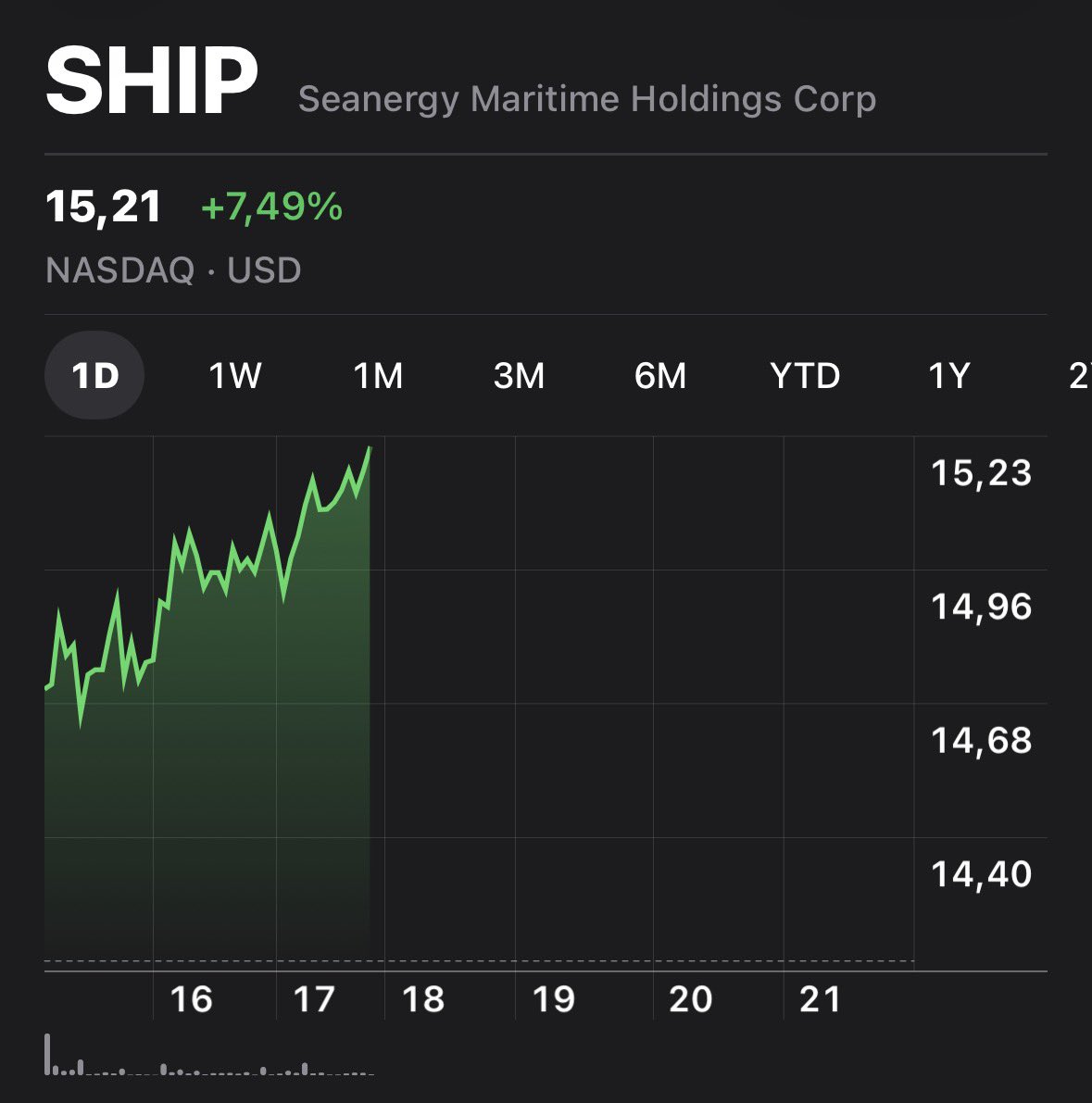
Just dropped a new deep dive on $SHIP
• Pure-play Capesize exposure
• Trading at a 36% discount to NAV
• Structural tonne-mile demand growth from Guinea + Simandou
• Orderbook effectively locked until 2029/30
• Aging global fleet + CII constraints reducing effective supply
• Potentially record El Niño into Q4’26/Q1’27
The key point:
Demand is growing on the longest dry bulk routes in the world while supply cannot respond fast enough.
That’s the setup.
Seanergy owns 20 Capesize/Newcastlemax vessels today and has 6 modern scrubber-fitted eco newbuilds arriving directly into what could become an extremely tight market in 2027-2028.
Meanwhile:
• Q1’26 was one of the strongest seasonal Q1s in years
• Spot rates remain elevated
• The company trades at ~$14 vs ~$21.8 NAV
• Dividend yield ~5.7%
Risks are real:
• Aging fleet
• Freight rate mean reversion
• 2027 financing execution
• Concentrated governance
But at current pricing, I think the risk/reward is compelling.
Full deep dive below with:
- detailed fleet analysis
- Guinea & Simandou thesis
- Capesize supply dynamics
- El Niño wildcard
- valuation work
- 2026/2027 cash flow modelling
- risk section
Link in first comment.
Just dropped a new deep dive on $SHIP
• Pure-play Capesize exposure
• Trading at a 36% discount to NAV
• Structural tonne-mile demand growth from Guinea + Simandou
• Orderbook effectively locked until 2029/30
• Aging global fleet + CII constraints reducing effective supply
• Potentially record El Niño into Q4’26/Q1’27
The key point:
Demand is growing on the longest dry bulk routes in the world while supply cannot respond fast enough.
That’s the setup.
Seanergy owns 20 Capesize/Newcastlemax vessels today and has 6 modern scrubber-fitted eco newbuilds arriving directly into what could become an extremely tight market in 2027-2028.
Meanwhile:
• Q1’26 was one of the strongest seasonal Q1s in years
• Spot rates remain elevated
• The company trades at ~$14 vs ~$21.8 NAV
• Dividend yield ~5.7%
Risks are real:
• Aging fleet
• Freight rate mean reversion
• 2027 financing execution
• Concentrated governance
But at current pricing, I think the risk/reward is compelling.
Full deep dive below with:
- detailed fleet analysis
- Guinea & Simandou thesis
- Capesize supply dynamics
- El Niño wildcard
- valuation work
- 2026/2027 cash flow modelling
- risk section
Link in first comment.
Just dropped a new deep dive on $SHIP
• Pure-play Capesize exposure
• Trading at a 36% discount to NAV
• Structural tonne-mile demand growth from Guinea + Simandou
• Orderbook effectively locked until 2029/30
• Aging global fleet + CII constraints reducing effective supply
• Potentially record El Niño into Q4’26/Q1’27
The key point:
Demand is growing on the longest dry bulk routes in the world while supply cannot respond fast enough.
That’s the setup.
Seanergy owns 20 Capesize/Newcastlemax vessels today and has 6 modern scrubber-fitted eco newbuilds arriving directly into what could become an extremely tight market in 2027-2028.
Meanwhile:
• Q1’26 was one of the strongest seasonal Q1s in years
• Spot rates remain elevated
• The company trades at ~$14 vs ~$21.8 NAV
• Dividend yield ~5.7%
Risks are real:
• Aging fleet
• Freight rate mean reversion
• 2027 financing execution
• Concentrated governance
But at current pricing, I think the risk/reward is compelling.
Full deep dive below with:
- detailed fleet analysis
- Guinea & Simandou thesis
- Capesize supply dynamics
- El Niño wildcard
- valuation work
- 2026/2027 cash flow modelling
- risk section
Link in first comment.
Just dropped a new deep dive on $SHIP
• Pure-play Capesize exposure
• Trading at a 36% discount to NAV
• Structural tonne-mile demand growth from Guinea + Simandou
• Orderbook effectively locked until 2029/30
• Aging global fleet + CII constraints reducing effective supply
• Potentially record El Niño into Q4’26/Q1’27
The key point:
Demand is growing on the longest dry bulk routes in the world while supply cannot respond fast enough.
That’s the setup.
Seanergy owns 20 Capesize/Newcastlemax vessels today and has 6 modern scrubber-fitted eco newbuilds arriving directly into what could become an extremely tight market in 2027-2028.
Meanwhile:
• Q1’26 was one of the strongest seasonal Q1s in years
• Spot rates remain elevated
• The company trades at ~$14 vs ~$21.8 NAV
• Dividend yield ~5.7%
Risks are real:
• Aging fleet
• Freight rate mean reversion
• 2027 financing execution
• Concentrated governance
But at current pricing, I think the risk/reward is compelling.
Full deep dive below with:
- detailed fleet analysis
- Guinea & Simandou thesis
- Capesize supply dynamics
- El Niño wildcard
- valuation work
- 2026/2027 cash flow modelling
- risk section
Link in first comment.
$IMPP
Update from the Q1 2026 earnings call: Harry stated that management's current NAV estimate stands at $14 per share on the current share count.
That said, it's worth doing the fully diluted math :
— Basic shares (Q1 2026 weighted avg): 45.3M
— Management NAV @ $14/share: ~$634M
— Class F + Class G warrants: 19.05M additional shares if fully exercised
— Cash proceeds to company from exercise: ~$120M (19.05M × $6.30)
Fully diluted NAV: $634M + $120M = $754M
Fully diluted shares: 45.3M + 19.05M = 64.35M
Fully diluted NAV/share: ~$11.72
At the current share price, that still implies a meaningful discount to NAV even after accounting for full warrant dilution.